Free Daily Podcast Summary
Many Minds: Daily Summaries Delivered
by Kensy Cooperrider – Diverse Intelligences Summer Institute
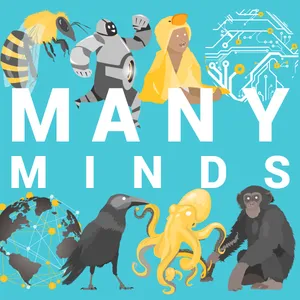
Our world is brimming with beings—human, animal, and artificial. We explore how they think, sense, feel, and learn. Conversations and more.
Latest Episodes
The most recent episodes — sign up to get AI-powered summaries of each one.
- 1 weeks ago1h 34m
Coming of age in Ngogo
It's a familiar story in many ways. A child is born, and for years afterward is adored and indulged and anchored to home and family. But then the child grows up and starts crossing that long threshold into adulthood. The transition proves—to say the least—a bit turbulent. Now when I say this story is familiar, I don't just mean familiar to us as human beings. After all, a similar story has long played out among our closest cousins, the chimpanzees. My guest today is Dr. Rachna Reddy. Rachna co-directs the longstanding Ngogo Chimpanzee Project in Uganda and is an incoming Assistant Professor of Psychology at the University of California, Berkeley. For more than a decade now, she has been closely observing the chimpanzees at Ngogo—and especially the adolescents. Here Rachna and I talk about why adolescence—in all its intensity—is such a scientifically fascinating life-stage. We sketch the Ngogo research site, home to the largest group of chimpanzees ever studied. We unpack the different stages of chimpanzee life history. We zoom in on chimpanzee adolescence using a variety of different lenses—we talk about greetings, dominance hierarchies, grooming, social rejection, mentorship, deference, patrolling, female dispersal, and more. We discuss the so-called civil war that has taken root at Ngogo. And, finally, we talk about Rachna's in-progress novel (if that's the right word), which tells the story of one chimpanzee's coming of age in immersive detail. I think you'll enjoy this one folks. Chimpanzees offer us a kind of parallel universe, a funhouse mirror version of human life—one that is deeply relatable in some ways, and totally alien to us in others. And the parallels and non-parallels are arguably all the more striking in adolescence. But before we get to it, one humble ask: As the new season of Many Minds ramps up, this would be a great time to support the show. You could do this by rating us, writing a review on Apple Podcasts or a comment on Spotify, or by doing the old-fashioned thing of just recommending us to a friend or colleague. Your support is—as always—much appreciated. Alright friends, without further ado. Here's my conversation with Dr. Rachna Reddy. Enjoy! Notes 4:00 – Damien and several other chimpanzees discussed in this episode feature in the Netflix documentary series Chimp Empire. 8:00 – See here for a study by Dr. Reddy and a colleague on caregiving behavior in recently orphaned chimpanzee siblings. 13:00 – See here for a comprehensive recent article by Dr. Reddy and colleagues about puberty and adolescence in chimpanzees. 16:00 – The Ngogo fission—and subsequent "civil war"—is treated in detail in Chimp Empire and was the subject of a recent, widely discussed research paper (which includes Dr. Reddy as an author). 26:00 – "Tanner stages" are a widely used scale for measuring different phases of puberty in humans. 29:00 – For more discussion of life history stages and how these differ across species, see our earlier episodes here and here. For a recent report that Ngogo females experience menopause, see here. 36:00 – For some of Dr. Reddy's work on dominance hierarchies in adolescent male chimps, see here. 39:00 – For a detailed discussion of the chimpanze
- 3 weeks ago1h 32m
The natural history of linguistic diversity
Thousands of languages are used around the world today, and this linguistic diversity is a precious part of our human heritage. But it's also more than that. Linguistic diversity provides clues—a vast crazy quilt of clues—about how language works, about how history has unfolded, about the dynamics of culture, and about the nature of the human mind. My guest today is Dr. Damián Blasi. Damián is an ICREA Research Professor based at the Center for Brain & Cognition at the Pompeu Fabra University in Barcelona. Over the last decade or so, Damián's emerged as one of the most innovative researchers in the study of language and linguistic diversity. He's been widely recognized for this work, and most recently was awarded the 2026 FABSS Early Career Impact Award from the Cognitive Science Society. In this conversation, Damián and talk about why scientists should care about linguistic diversity. We do a bit of linguistic diversity 101—how many languages there are, how we can enumerate them, how they vary from another. We discuss a recent paper in which Damian and his colleagues reconstructed the explosive rise and precipitous fall of human linguistic diversity over the last 12,000 years. We talk about the factors that drive language change. And we discuss how cognitive science relies too much on English and English speakers—and how this may be holding the field back. Along the way, Damián and I touch on the Tower of Babel, a golden age of linguistic diversity, the human bite configuration, scientific aesthetics, whether children shape language, polygenetic theories of language evolution, the pace of language change, schooling, linguistic inequality and behemoth languages, and why Damián thinks that possibility space of human language might be bigger and wilder than we currently imagine. This is a special episode of the Many Minds podcast. As I mentioned, Damián is this year's winner of an award from the Cognitive Science Society, in recognition of his outstanding early-year contributions to the field. He recently gave a keynote at the society's annual conference in Rio de Janeiro, and we've partnered with the Cognitive Science Society to feature this conversation about his work. I'll also mention that this wasn't my first time chatting with Damián—he's an alumnus of the Diverse Intelligences Summer Institute (DISI), the sponsor & incubator of this podcast. We met there a couple years ago, and so it was all the more fun to reconnect with him here. Alright friends, without further ado, on to my conversation with Dr. Damián Blasi. Enjoy! Notes 10:00 – The UNESCO page on multilingualism and linguistic diversity. 17:00 – The Ethnologue database. 20:00 – For examples of Dr. Blasi's work on "behemoth languages" and on how languages are not represented equally in terms of technological and development investment, see here and here. 26:00 - For the paper in which Dr. Blasi and colleagues introduced Grambank, see here. For the database itself, see here. 29:00 – For Dr. Blasi's earlier work on sound-meaning associations across languages, see here. 33:00 – For discussion of Darwin's views on monogenesis vs polygenesis and race, see our recent episode. 36:00 – For mo
- Aug 17, 20261h 33m
From the archive: Electric ecology
Hi friends! We're still taking a bit of a summer pause. We'll be back at the end of August—in the meanwhile, enjoy this listener favorite from our archives! ----- [originally aired September 19, 2024] There's a bit of a buzz out there, right now, but maybe you haven't noticed. It's in the water, it's in the air. It's electricity—and it's all around us, all the time, including in some places you might not have expected to find it. We humans, after all, are not super tuned in to this layer of reality. But many other creatures are—and scientists are starting to take note. My guest today is Dr. Sam England. Sam is a sensory ecologist at the Natural History Museum in Berlin, and one of a handful of scientists uncovering some shocking things about the role of electricity in the natural world. Here, Sam and I have a wide-ranging conversation about electroreception—which is the perception of electrical stimuli—and electric ecology—which is the study of the ecological roles of electricity. We talk about how an interest in electroreception first got started, and why it's recently resurged. We discuss aquatic electroreception versus aerial electroreception, active electroreception versus passive electroreception. We talk about how electroreception is actually kind of easy to evolve. Along the way, we consider electrolocation and, its analog in sound, echolocation. We touch on dolphins, sharks, echidnas, ticks, caterpillars, bees, and spiders. We zoom in on electrostatic pollination, and what is inarguably the coolest sounding anatomical structure known to biology: the ampullae of Lorenzini. I think you'll enjoy this one, friends. As Sam describes here, electroreception is one of those "alien senses"—it really challenges the imagination. And electric ecology is one of those frontiers in our understanding of the natural world. So without further ado, here's my chat with Dr. Sam England. Enjoy! A transcript of this episode is available here. Notes and links 3:00 – For many of the topics discussed in this episode, see this comprehensive recent review of electroreception and electric ecology by Dr. England and a colleague. 7:30 – A paper reviewing the (contested) phenomenon of electromagnetic hypersensitivity in humans. 9:30 – An encyclopedia article on electroreception in monotremes. 13:00 – An early study of electrolocation in "weakly electric" fish. 17:00 – A popular article about the discovery of electroreception in sharks. 20:30 – A 2013 study showing that bumblebees detect the electric fields around flowers. 23:30 – A recent review of electroreception and its evolution in fish. 25:00 – A study demonstrating electroreception in the Guiana dolphin. 34:00 – A recent <a href= "https://www.cell.com/current-biology/fulltext/S0960-9822(23)00772-8?_hsmi=263616874&_hsenc=p2ANqtz--faOOOSB
- Jul 31, 20261h 28m
From the archive: Varieties of childhood
Hi friends! We're taking a bit of a summer pause. We'll be back soon—in the meanwhile, enjoy this listener favorite from our archives! ----- [originally aired July 10, 2025] Childhood is a special time, a strange time. Children are adored and catered to—they're given their own menus and bedrooms. They're considered delicate and precious, and so we cushion them from every imaginable risk. Kids are encouraged to play, of course—but very often it's under the watchful eye of anxious adults. This, anyway, is how childhood looks in much of the United States today. But is this the way childhood looks everywhere? Is this the way human childhoods have always been? My guests today are Dr. Dorsa Amir and Dr. Sheina Lew-Levy. Dorsa is an Assistant Professor of Psychology & Neuroscience at Duke University, where she runs the Mind and Culture Lab. Sheina is an Associate Professor of Psychology at Durham University in the UK, where she co-directs the Forager Child Studies research group. Both Sheina and Dorsa have spent much of their careers thinking about how childhoods differ across cultures—and why. In this conversation, I talk with Dorsa and Sheina about their fieldwork with indigenous groups in Ecuador and the Congo, respectively. We discuss the different ways that childhood differs in these places—for instance, in terms of parents' attitudes toward risk, in terms of the social structures and activities in which kids are embedded, and in terms of the freedom that children are granted. We discuss developmental psychology's "WEIRD problem." We talk about the quasi-autonomous cultures that children create among themselves—sometimes called "peer cultures"—and discuss how these kid-driven cultures end up shaping and benefit the larger community. Along the way, we touch on adult supremacy, adverse childhood experiences, walking the forest and climbing papaya trees, parenting norms, ding dong ditch and "nananabooboo", the pioneering work of the folklorists Iona and Peter Opie, teaching, toys, and the enduring question of what childhood is for. Alright friends, lots to think about here. On to my conversation with Sheina Lew-Levy and Dorsa Amir. Enjoy! A transcript of this episode is available here. Notes and links 9:30 – For an overview of work on how culture shapes motor development, see here. 11:00 – The paper by Dr. Lew-Levy's and a colleague about "walking the forest." 16:00 – Dr. Amir's TedX talk, 'How the Industrial Revolution Changed Childhood.' 17:30 – For some of Dr. Amir's work on risk across cultures, see here. 35:00 – For a recent paper by Dr. Lew-Levy and colleagues about the evolution of childhood, see here. 39:00 – The popular article by Ann Gibbons, 'The Birth of Childhood.' 41:00 – For the idea of the "patriarch hypothesis," see here. 42:00 – For more on the "WEIRD problem" in developmental psychology, see here. 48:00 – A paper by Dr. Lew-Levy and colleagues about toys in hunter-gatherer groups. For more on the material culture of childhood, see our earlier episode with Michelle Langley. 52:00 – A <a href= "https://www.sciencedirect.com/science/arti
- Jul 17, 20261h 40m
From the archive: Philosophers on psychedelics
Hi friends! We're taking a bit of a summer pause. We will be back soon—in the meanwhile, enjoy this listener favorite from our archives! ----- [originally aired May 14, 2025] Some call it the "psychedelic renaissance." In the last decade or so, interest in psychedelic drugs has surged—and not just among Silicon Valley types and psychiatrists and neuroscientists. It's also surged among a stereotypically soberer crowd: academic philosophers. The reasons are clear. With their varied and sometimes transformative effects, psychedelics raise ethical questions, epistemological questions, metaphysical questions, questions about the nature of experience and the nature of the mind. My guest today is Dr. Chris Letheby. Chris is a philosopher of cognitive science at the University of Western Australia and the author of the 2021 book, Philosophy of Psychedelics. Here, Chris and I talk about the so-called classic psychedelics—LSD, psilocybin, ayahuasca, and others—and how interest in them has gone through three distinct waves. We discuss the effects that these substances seem to have, in particular their capacity to treat certain psychiatric conditions and their tendency to induce "mystical-like" experiences. We consider the idea that psychedelics might serve as agents of moral enhancement. And we dig into the psychological and neural mechanisms by which psychedelics seem to have their diverse—and often salutary—effects. Along the way, we talk about ontological shock, comforting delusions, brain plasticity, unselfing, microdosing, placebo effects and adverse effects, physicalism and idealism, the REBUS model, environmental virtues, plant consciousness, meditation, and much more. Maybe this is obvious but this episode is not just for the seasoned psychonauts out there. Whatever your personal experience with these substances, they offer a distinctive window into the mind—a new way of grappling with big questions. Perhaps this much is also obvious but we're not encouraging or endorsing the use of psychedelics here—just offering a little fuel for your intellectual fires! Alright friends, on to my conversation w/ Dr. Chris Letheby. Enjoy! A transcript of this episode is available here. Notes and links 4:00 – For a brief historical overview of research into psychedelics, see this paper. 8:30 – For work by an early trailblazer in the philosophy of psychedelics, see Thomas Metzinger's Being No One. 12:30 – For our earlier episode on the psychology and philosophy of visual illusions, see here. 18:00 – For a history of the concept of "set and setting," see here. 19:00 – A 2024 review of "adverse events" in classic psychedelics. 26:00 – A blog post on the history of the term "psychedelic." 27:00 – A recent review and meta-analysis of the use of psychedelic therapy for depressive symptoms. 31:00 – On mystical experience see Walter Stace's classic work, Mysticism and Philosophy. On the measurement of mystical-type experiences, see, e.g., Walter Pahnke's paper here. 36:00 – On the idea of "psychoplastogens," see <a href= "https://
- Jul 3, 20261h 19m
The origins of Darwin's ideas
No discipline, no sphere of intellectual life, has been untouched by the work of Charles Darwin. He died in 1882 but his ideas are very much alive; they're now central to how we understand the natural world, the human mind, non-human minds, plants, biogeography, morality and emotion, culture, language, and more. But where did his ideas come from? How did they grow out of his travels, his social circle, his hobbies, his particular cast of mind? My guest today is Dr. Janet Browne. Janet is Professor Emerita at Harvard University in the department of the History of Science. She is perhaps best known for her widely acclaimed two-volume biography of Charles Darwin. And she has now published an updated and abridged single-volume version. Here, Janet and I talk about Darwin's life and ideas. We pick up the story during his travels on the Beagle, a five-year voyage that laid the foundation for the rest of his career. We talk about what he was reading, what he was seeing, and how these experiences helped form his most influential work, On the Origin of Species. We discuss Darwin's style as a thinker, as a naturalist, as a writer, and as an experimentalist. We touch on his relationships with contemporaries like Charles Lyell and Alfred Russel Wallace. And we consider his long—and often overlooked—engagements with pigeons, barnacles, plants, and worms. I greatly enjoyed Janet's two-volume biography of Darwin, and I enjoyed this new single-volume edition just as much. So if this episode sparks your interest, I heartily recommend that you check these books out. Alright friends, on to my conversation with Dr. Janet Browne. Enjoy Notes 3:30 – Darwin's autobiography is available here. All of Darwin's letters are readable (and searchable) at the Darwin Correspondence Project. 11:00 – Darwin's account of his five-year stint on the HMS Beagle can be found in his Voyage of the Beagle. 17:00 – Charles Lyell's Principles of Geology (Vol. 1). 27:00 – For a recently published history of Lamarck and his ideas, see here. 31:00 – For more on Darwin's interest in pigeons and pigeon breeding, see here. 34:00 – For more on Darwin's barnacle studies, see here. 40:00 – For a brief account of the relationship between Wallace and Darwin, see Dr. Browne's article here. 44:00 – Alfred Russel Wallace's Malay Archipelago is here. Wallace's own essay on natural selection, sent to Darwin before the publication of On the Origin of Species, is here. The proceedings in which Darwin's and Wallace's
- Jun 20, 20261h 20m
The sparkling deep
It's tempting to see bioluminescence as an oddity, one of those rare eccentricities of life on earth. And, on land, maybe that's true. But our planet is mostly water, and out in the open ocean bioluminescence is utterly commonplace. Creatures of all shapes and sorts sparkle and glow, glitter and pulse. But what are these displays for? Why did they evolve? How did light become the currency of the deep? My guest today is Dr. Sönke Johnsen. Sönke is a Distinguished Professor of Biology at Duke University, where he and his research group study the visual ecology of the ocean. He's the author of a number of books: most recently Into the Great Wide Ocean, about life in the pelagic realm, and The Radiant Sea, a photographic tour of bioluminescence and color, written in collaboration with Dr. Steven Haddock. Here, Sönke and I talk about the open ocean: the most common habitat on our plant, yet one that many people will never experience. We consider the curious distribution of bioluminescence— rare on land, exceptionally prevalent in the ocean, and all but absent in freshwater. We talk about how bioluminescence seems to have evolved—many, many times over in fact. We survey the functions of making light in the deep—from counter-illumination to courtship to revenge. Finally, we consider what Sönke takes to be the biggest remaining puzzle about bioluminescence at sea. Alright friends, if you're enjoying Many Minds, we ask (humbly) if you would think about rating us, reviewing us, leaving us a comment, boosting us on social media, or perhaps haranguing your friends—relentlessly—until they give us a listen. Without further ado, onto my conversation with Dr. Sönke Johnsen. Enjoy! Notes 3:30 – The scientific report by Dr. Johnsen and colleagues describing the bioluminescent octopus, Stauroteuthis syrtensis. 12:00 – A popular article on the bristlemouth. The article reports a scientist's estimate of "as many as a dozen [bristlemouths] per square meter of ocean." 15:00 – A recent discussion of the "burglar alarm hypothesis." 18:00 – The website for the Johnsen Lab at Duke University. 24:00 – A chart and discussion of the depth zones of the ocean. 29:30 – A study by Séverine Martin and Steven Haddock quantifying the prevalence of bioluminescence at different depths. A popular write-up of the same study. 33:00 – A popular article on vertical migration in the ocean, also called "diel vertical migration." A recent scientific study of the phenomenon. 39:00 – A recent article on the evolution of bioluminescence. <span class
- Jun 5, 20261h 32m
Is Man the Hunter just a myth?
There's a story about of our past that you know well. It goes like this: At some point earlier in human evolution, we started to hunt. Men in particular—perhaps channeling some deep-seated aggressive impulses—began to seek out big game. This new food source, this bonanza of calories, was what allowed our brains to expand. It changed our bodies and our societies and sent our species off on a whole new track. In short, Man the Hunter made us human. This story—told in different versions, with different points of emphasis—has circulated for decades. It's been debunked and revived, rejected and reimagined. What is the history behind the Man the Hunter idea? How does it square with our current understandings of evolution? Is it, in fact, pure fiction? My guest today is Dr. Vivek Venkataraman. Vivek is an evolutionary anthropologist at the University of Calgary, and an editor-in-chief of the journal Hunter Gatherer Research. He and his collaborators recently published an article on the different layers and meanings of the Man the Hunter idea. Here, Vivek and I lay out those meanings. We talk about how the phrase refers, first, to that popular myth about our evolution, but also to a landmark scientific conference in the 1960s, and to a major finding of research on contemporary hunter-gatherer groups—namely, that men generally do do most of the hunting. We do a little crash-course on the field of hunter-gatherer research, including the kinds of questions it asks and frameworks it uses. We dig into some of the key ingredients of the Man the Hunter myth: the idea that we have aggressive tendencies, the idea that only men hunt, and the idea that hunting played a transformative role in our evolution. We walk through three recent, high-profile studies challenging Man the Hunter ideas in various ways. And we talk about the ever-present danger of projecting our current norms and ideals back in time. Along the way, Vivek and I touch on 2001: A Space Odyssey; reasons why contemporary hunter-gatherers may differ from the hunter-gatherers of long ago; giant sloths; extractive foraging; the case of the Agta, a society in which women do engage in big-game hunting; the forest people and the fierce people; risk and cooperation in sexual divisions of labor; persistence hunting and endurance activities; caregiving and cognition; and honey. Alright friends, I think you'll enjoy this one. On to my conversation with Dr. Vivek Venkataraman. Notes 3:30 – The article by Dr. Venkataraman and colleagues, 'The Meaning and Dividends of Man the Hunter.' Commentaries on the article can be read here. A recent popular essay by Dr. Venkataraman on the same ideas. 5:00 – Raymond Dart's "killer ape" was originally laid out in a 1953 article 'The Predatory Transition from Ape to Man' (unavailable online) and then developed in Robert Ardrey's book, African Genesis. 8:30 – The "dawn of man" scene from 2001: A Space Odyssey. 16:00 – The 1966 conference titled 'Man the Hunter' resulted in a 1968 volume of the same name. 27:00 – A philosophical discussion of the use of the "ethnographic analogy" in reconstructions of the past. The <a href= "https://www.cambridge.org/core/journals/american
Get Many Minds summaries in your inbox
Free AI-powered daily recaps. Key takeaways, quotes, and mentions — in a 5-minute read.
Get Free Summaries →Free forever for up to 3 podcasts. No credit card required.
You Might Also Like
Listeners also like.
Inquiring Minds
Explores the intersection of science and society through critical thinking and in-depth analysis.

COMPLEXITY
Santa Fe Institute
Inner Cosmos with David Eagleman
Neuroscientist David Eagleman examines how the brain interprets reality through science, stories, and interviews.
All in the Mind
Explores the science of psychology, neuroscience, and mental health through expert insights and research.
Sean Carroll's Mindscape: Science, Society, Philosophy, Culture, Arts, and Ideas
Conversations with leading thinkers exploring fundamental ideas in science, philosophy, culture, and the arts.
The Telepathy Tapes
Non-speaking autistic individuals and others share extraordinary experiences of telepathy, consciousness, and unexplained mental abilities.
Stuff To Blow Your Mind
Explores the strange edges of science, consciousness, and reality through neuroscience, cosmology, evolution, and emerging technology.
Deeply Human
Explores the psychology behind human behavior, emotions, and relationships to better understand what drives our thoughts and actions.
The World, the Universe and Us
Explores big scientific questions about life, consciousness, climate, and the cosmos with expert scientists and New Scientist journalists.

Hidden Brain
Explores human behavior and the unconscious patterns that shape our decisions, relationships, and society through science and storytelling.

Deepak Chopra’s Infinite Potential
Deepak Chopra explores consciousness, identity, and human potential through conversations with thought leaders and experts.
Brains On! Science podcast for kids
Kids co-host with Molly Bloom to explore science questions, mystery sounds, and fun facts in a weekly podcast.
Customized Recaps
AI-powered recaps with compact key takeaways, quotes, and insights.
Straight to Your Inbox
Get key takeaways from Many Minds in a 5-minute read.
Save Hours Every Week
Stay current on your favorite podcasts without falling behind.
Frequently Asked Questions
What is Podzilla's Many Minds daily summary?
It's a free AI-powered email that summarizes new episodes of Many Minds as soon as they're published. You get the key takeaways, notable quotes, and links & mentions — all in a quick read.
How does the Many Minds podcast summary work?
When a new episode drops, our AI transcribes and analyzes it, then generates a personalized summary tailored to your interests and profession. It's delivered to your inbox every morning.
Is this an official Many Minds product?
No. Podzilla is an independent service that summarizes publicly available podcast content. We're not affiliated with or endorsed by Kensy Cooperrider – Diverse Intelligences Summer Institute.
Can I get summaries of other podcasts too?
Absolutely! The free plan covers up to 3 podcasts. Upgrade to Pro for 15, or Premium for 50. Browse our full catalog at /podcasts.
How often does Many Minds release new episodes?
Many Minds publishes biweekly. Our AI generates a summary within hours of each new episode.
What topics does Many Minds cover?
Many Minds covers topics including Science, Education. Our AI identifies the specific themes in each episode and highlights what matters most to you.
Start getting Many Minds summaries tomorrow morning.
Free forever for up to 3 podcasts. No credit card required.
Free forever for up to 3 podcasts. No credit card required.