Free Daily Podcast Summary
Major Gazer: Daily Summaries Delivered
by Grep News | Kali Kross
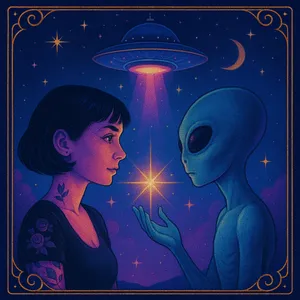
Major Gazer is the space & science show that takes the cosmos and the unexplained seriously. Host Kali Kross explores hard astronomy, physics, and the strangest material the universe has on offer. Episodes range across black holes and quantum mechanics, what Voyager is still telling us from interstellar space, the Wow Signal, and the Tic Tac videos. What do they actually contain, and what's still missing? Each episode walks through what we know, what's been claimed beyond the evidence, and what's genuinely still open. No clickbait. No conspiracy energy. No mysticism. Just specific facts, named sources, named missions, and the actual weirdness of the real universe.
Latest Episodes
The most recent episodes — sign up to get AI-powered summaries of each one.
- Jun 6, 202610 min
Fast radio bursts repeat on a 16-day cycle from space
There’s a weird telescope in British Columbia called CHIME with zero moving parts—it doesn’t even point anywhere, it just sits there while Earth rotates and scans the whole sky. It was built to study dark energy, but it accidentally became an FRB machine, logging 500+ fast radio bursts: millisecond flashes from billions of light-years away, including FRB 20180916B that hits on a real 16-day cycle (4 days on, 12 off). The leading clue isn’t aliens—it’s a magnetar in our own galaxy (SGR 1935+2154) that fired an FRB-like burst, while the 16-day pattern is still an active fight between natural models like a binary orbit or a precessing jet.
- May 30, 202610 min
Jupiter removes about a million asteroids from Earth's path
Jupiter being Earth’s “guardian” is only half the story — the same gravity that carved the Kirkwood gaps can also shove asteroids into Earth-crossing orbits. Yes, it literally shredded Comet Shoemaker‑Levy 9 on camera in 1994 and likely helped drain the asteroid belt (Dawn data backs the long-term sculpting), but Jonathan Horner’s peer‑reviewed models say a smaller or differently placed Jupiter could mean fewer impacts on Earth. Between Grand Tack vs Nice model chaos and the messy Late Heavy Bombardment debate, Jupiter might be shield, threat, or both — and scientists still don’t agree which.
- May 23, 202611 min
The grandfather paradox isn't actually a paradox at all
The grandfather paradox isn’t proof time travel is impossible — it’s proof that backward time travel plus unconstrained free will breaks logic. General relativity actually allows closed timelike curves (Gödel’s rotating-universe solution, plus Kip Thorne’s traversable wormhole work), and physicists have two clean “outs”: Novikov self-consistency (your past actions were always part of history, like Thorne’s wormhole billiard-ball math) or Deutsch’s many-worlds branching (Avengers: Endgame vibes, not Back to the Future). Hawking’s Chronology Protection Conjecture is basically the skeptical counterpunch: maybe nature blocks time machines in practice, but nobody can prove it without quantum gravity.
- May 21, 202611 min
NASA's playbook: what happens in the first 72 hours
Humanity’s closest thing to a first-contact plan is a few-page, non-binding SETI Post-Detection Protocol: verify the signal, tell the IAA/IAU and the UN Secretary-General, and don’t reply without “international consultation.” Problem: it’s basically a gentlemen’s agreement (Jill Tarter’s words), UNOOSA has no first-contact mandate, there’s no timeline, and nobody’s actually named as having authority to speak for Earth. Meanwhile the protocol mostly covers radio signals — not weird physical stuff like Oumuamua, which was spotted after it passed the Sun and sparked peer-reviewed debate (including Avi Loeb arguing an artificial origin couldn’t be ruled out). In 2026 terms, a private lab, company, or even a grad student could find something first and go public or transmit a message with zero legal barrier.
- May 9, 202611 min
AARO reviewed 750 UAP cases and found no extraterrestrial technology
The guy who literally ran the Pentagon’s UFO office (AARO), physicist/intel vet Sean Kirkpatrick, says the big “aliens being interviewed” document doesn’t exist anywhere — not classified, not hidden, not pending. Meanwhile the new UAP/UFO file dump is being hyped like instant disclosure, but it’s mostly a “start the review process” directive plus AARO’s 2024 finding: 750+ sightings logged, some still unresolved, and zero evidence of extraterrestrial tech or beings.
- May 2, 202610 min
Proxima B A Nearby World Awaiting Discovery
Meet Proxima b: a 1.3-Earth-mass rock just 4.2 light-years away, whipping around a red dwarf every 11 days—likely eternal day on one side, night on the other. Astronomers spotted it in Proxima Centauri’s wobble (radial velocity), led by Guillem Anglada-Escudé—not by a direct image. It’s in the habitable zone but blasted by ~250x Earth’s X-rays; Breakthrough Starshot wants 0.2c chip-size laser sails to fly by and beam back pictures in about 24 years.
- Apr 25, 202614 min
Observation Shapes Quantum Outcomes In The Double Slit
One electron, two slits: the double-slit experiment builds a wave-like interference pattern—until you add a which-path detector and the stripes vanish. Reality acts shy. This piece tours superposition, the observer effect, delayed-choice twists, decoherence (why your cat isn’t smeared), and how entanglement powers quantum computers and quantum encryption. It even pokes the big one—does consciousness collapse the wave function, or is information the real bedrock of reality?
- Apr 19, 202611 min
Breakthrough Listen Scanning The Sky For Alien Technosignatures
Alien radio waves could be passing through you right now — and a $100M SETI push is scanning 1M stars and 100 galaxies for technosignatures. Think 500‑ft Green Bank so sensitive it could hear a cell phone on Mars, petabytes of cosmic static, a 72‑second Wow Signal, and the brutal lag: a message from 500 light‑years means 1,000 years per back‑and‑forth.
Get Major Gazer summaries in your inbox
Free AI-powered daily recaps. Key takeaways, quotes, and mentions — in a 5-minute read.
Get Free Summaries →Free forever for up to 3 podcasts. No credit card required.
You Might Also Like
Listeners also like.

Cosmos in a Pod
Explores space, science, philosophy, and technology to reveal the wonders of the universe and humanity's place within it.
SpaceTime with Stuart Gary
Weekly explorations of astronomy, space, and science news with insights from a veteran science journalist and industry experts.
Planetary Radio: Space Exploration, Astronomy and Science
Explores space exploration, astronomy, and science through conversations with experts and advocates shaping humanity's journey beyond Earth.

Dear People of Earth Science and Physics- The UFO Podcast - Disclosure - Aliens - UAP
Explores UFO and UAP phenomena through scientific analysis, physics, and expert discussions on credible sightings and cosmic mysteries.

Galactic Horrors
Dark science fiction tales set in isolated space environments, exploring technological failure, secrecy, and human vulnerability.

Ask a Spaceman!
An astrophysicist answers listener questions about space, time, and the universe.

PBS Space Time
An astrophysicist explains cosmic phenomena like black holes and galaxy evolution through accessible, science-driven discussions.
Bedtime Astronomy
A calming exploration of cosmic wonders, sharing stories about stars, planets, and celestial phenomena to inspire curiosity before sleep.

The Grimerica Show
Casual conversations with fringe thinkers on spirituality, alternative history, and UFOs.

🎙️ Science News Daily | Peer Review'd
Daily science news covering space, biology, physics, and technology breakthroughs.
The Micah Hanks Program
Examines scientific mysteries and fringe topics like UFOs, ancient history, AI, and cryptozoology through critical discussion and guest interviews.

That UFO Podcast
Covers global UFO, UAP, and related phenomena through news updates and interviews with experts and witnesses.
About Major Gazer
Major Gazer is the space & science show that takes the cosmos and the unexplained seriously. Host Kali Kross explores hard astronomy, physics, and the strangest material the universe has on offer. Episodes range across black holes and quantum mechanics, what Voyager is still telling us from interstellar space, the Wow Signal, and the Tic Tac videos. What do they actually contain, and what's still missing? Each episode walks through what we know, what's been claimed beyond the evidence, and what's genuinely still open. No clickbait. No conspiracy energy. No mysticism. Just specific facts, named sources, named missions, and the actual weirdness of the real universe.
Customized Recaps
AI-powered recaps with compact key takeaways, quotes, and insights.
Straight to Your Inbox
Get key takeaways from Major Gazer in a 5-minute read.
Save Hours Every Week
Stay current on your favorite podcasts without falling behind.
Frequently Asked Questions
What is Podzilla's Major Gazer daily summary?
It's a free AI-powered email that summarizes new episodes of Major Gazer as soon as they're published. You get the key takeaways, notable quotes, and links & mentions — all in a quick read.
How does the Major Gazer podcast summary work?
When a new episode drops, our AI transcribes and analyzes it, then generates a personalized summary tailored to your interests and profession. It's delivered to your inbox every morning.
Is this an official Major Gazer product?
No. Podzilla is an independent service that summarizes publicly available podcast content. We're not affiliated with or endorsed by Grep News | Kali Kross.
Can I get summaries of other podcasts too?
Absolutely! The free plan covers up to 3 podcasts. Upgrade to Pro for 15, or Premium for 50. Browse our full catalog at /podcasts.
How often does Major Gazer release new episodes?
Major Gazer publishes weekly. Our AI generates a summary within hours of each new episode.
What topics does Major Gazer cover?
Major Gazer covers topics including Science, Astronomy, Natural Sciences. Our AI identifies the specific themes in each episode and highlights what matters most to you.
Start getting Major Gazer summaries tomorrow morning.
Free forever for up to 3 podcasts. No credit card required.
Free forever for up to 3 podcasts. No credit card required.