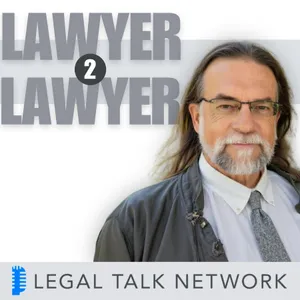
Free Daily Podcast Summary
Lawyer 2 Lawyer: Daily Summaries Delivered
by Attorney J. Craig Williams and Legal Talk Network
Get key takeaways, quotes, and insights from Lawyer 2 Lawyer in a 5-minute read. Delivered straight to your inbox.
Latest Episodes
The most recent episodes — sign up to get AI-powered summaries of each one.
- Jul 23, 202133 min
The Legal Issues Surrounding Homelessness
In cities across our nation, homelessness is an ongoing problem. According to the 2020 Annual Homeless Assessment Report (AHAR) to Congress, completed by the US Department of Housing and Urban Development prior to COVID, roughly 580,000 people were experiencing homelessness in the United States on a single night in 2020. This represented the fourth consecutive year in which homelessness increased nationwide. The severity of this problem has led to high profile conflicts on how to address the crisis. In April of this year, US federal judge David O. Carter issued a 110 page order necessitating the city and county of Los Angeles to find shelter for all unhoused residents of Skid Row, as well as requiring an audit of any spending related to the homeless. Alleging that Judge Carter's ruling is a violation of the separation of powers, the city and county appealed the matter to the 9th Circuit, who heard arguments this month. So, how do we combat homelessness? And is enough being done by city officials? On Lawyer 2 Lawyer, host Craig Williams is joined by professor Gary Blasi, from UCLA School of Law and Breanne Schuster, staff attorney with the American Civil Liberties Union of Washington, as they discuss the legal issues surrounding homelessness, separation of powers, current legislation, and what is being done to combat this nationwide problem.
- Jul 9, 202130 min
Rights of Nature & the Law
The Declaration of Independence famously states "that all men…are endowed by their Creator with certain unalienable Rights". But do those or similar unalienable rights extend beyond people? According to groups like the Global Alliance for the Rights of Nature, our ecosystem - the trees, oceans, animals and mountains - are entitled to rights of their own. So was the Declaration of Independence too limited in its language? Does nature have its own "self-evident" rights? On Lawyer 2 Lawyer, host Craig Williams is joined by Lindsey Schromen-Wawrin, an attorney at Shearwater Law PLLC, to discuss what rights we have to access nature, whether there is a requirement for the government to preserve nature for us, and if we have any legal rights to force the preservation of other species.
- Jun 25, 202131 min
SCOTUS & Religious Freedom
The Supreme Court has seen a number of religious freedom cases so far in 2021. In a 5-4 ruling in Tandon v. Newsom, the high court struck down COVID-related restrictions on group religious activities in private homes. Also, in Fulton v. Philadelphia, a case involving a Catholic group that objects to placing foster children with same-sex couples, SCOTUS ruled that the city of Philadelphia violated the First Amendment when it froze the contract of the Catholic Foster Care Agency. So, did the addition of Justice Amy Coney Barrett impact these religious freedom cases? Do these decisions set any sort of precedent for future cases? On Lawyer 2 Lawyer, host Craig Williams is joined by Professor Jim Oleske from Lewis & Clark Law School, to discuss SCOTUS & religious freedom, focusing on the shadow docket, the rulings stemming from COVID restrictions, and the impact these rulings will have on future cases centered around religion.
- Jun 18, 202123 min
Ransomware Attacks & Cybersecurity
We have all seen a wave of ransomware attacks in the news as of late. For those who are unfamiliar, ransomware is a type of malware that threatens to publish, destroy, or block access to the victim's personal data unless a ransom is paid. The ransom is usually paid to these attackers through cryptocurrencies like Bitcoin, impairing the ability to trace the transaction back to the perpetrator. Targets of all sizes, such as the Colonial Pipeline, McDonalds, the University of California, all the way down to dental practices, have fallen prey to these attacks. No one is immune. So could you be next? And what can we do to prevent these attacks from happening to us? On Lawyer 2 Lawyer, host Craig Williams is joined by Thomas J. Holt, director and professor in the School of Criminal Justice at Michigan State University.
- Jun 4, 202126 min
States Regulating Protests
According to The Hill, Republican lawmakers in 34 states have introduced more than 80 anti-protest bills thus far in the 2021 legislative session. In Florida, Governor Ron Desantis recently signed an 'anti-riot' bill into law that states, in part, that a driver may avoid liability "for injury or death caused if fleeing for safety from a mob." And Oklahoma Governor Kevin Stitt signed a similar bill into law as well, requiring that the driver "unintentionally harm[s] protesters in fleeing said protests". So is this legislation constitutional? Does it infringe on an individual's First Amendment's right to peacefully protest? Or is this a necessary deterrent to combat violence at protests? On Lawyer 2 Lawyer, host Craig Williams is joined by attorney Jeff Lewis, from Jeff Lewis Law, to discuss states regulating protests through legislation, how such laws intersect with the First Amendment, and the impact on those who protest.
- May 21, 202134 min
Packing the Court
Court packing is defined as "the act or practice of packing a court and especially the United States Supreme Court by increasing the number of judges or justices in an attempt to change the ideological makeup of the court." Last month, Congressional Democrats introduced legislation to expand the Supreme Court from nine to 13 justices, and President Biden announced the formation of a commission to study the court's structure, including the number of justices and their length of service. Of course, this has led to yet another controversy along party lines. On Lawyer 2 Lawyer, host Craig Williams is joined by Tonja Jacobi, professor of law at Northwestern Pritzker School of Law, to discuss packing the Supreme Court, the politicization of the High Court, potential reform, and next steps.
- Apr 30, 202131 min
Journalists, Protests, Law Enforcement, and Freedom of the Press
Social justice issues have been at the forefront of protests across our nation. In order to report on these protests, journalists have been on the front lines of the action. Yet, due to a lack of public trust, journalists are often targeted by law enforcement or counter protesters. American broadcast journalist Walter Kronkite, famously said, "Freedom of the press is not just important to democracy, it is democracy."So what are the rights of journalists during protests? What about public citizens? On Lawyer 2 Lawyer, host Craig Williams is joined by Shannon Jankowski, the E.W. Scripps Legal Fellow at Reporters Committee for Freedom of the Press, and David Bralow, Legal Director for the Press Freedom Defense Fund & Senior Vice President, Law, for the First Look Institute, Inc., as they discuss incidents of mistreatment of journalists by law enforcement during recent protests. Together, we explore freedom of the press generally and in the context of protests; and talk briefly about the legalities surrounding the filming and photographing of the police by citizens. Shannon Jankowski is the E.W. Scripps Legal Fellow at Reporters Committee for Freedom of the Press. David Bralow is Legal Director for the Press Freedom Defense Fund and Senior Vice President, Law, for the First Look Institute, Inc.
- Apr 16, 202135 min
Cyberwarfare, U.S./Russia Relations, and Ukraine
In a Daily Beast article published on April 13, 2021, Julia Davis writes that, "the head of the Kremlin-funded RT and Sputnik news agencies believes Russia will invade Ukraine, sparking a conflict with the U.S. that will force entire cities into blackouts." Also, according to a White House produced readout of a recent call between Presidents Biden and Putin, the leaders discussed a potential upcoming summit as well as Russia's military buildup and the ongoing tensions centering around Ukraine. Tensions between the United States and Russia are nothing new, but have recently intensified as a result of findings of Russian interference in US elections, the high profile SolarWinds cyberattack, and the Biden administrations implementation of a new round of sanctions. With no indications of relief on the horizon, what should we expect in the future? Will a cyber attack against the U.S be next? Should we be on high alert? Are we already? Or could we see a resolution of some sort between the two leaders? On Lawyer 2 Lawyer, host Craig Williams is joined by Claire Finkelstein, professor of law and philosophy from University of Pennsylvania Carey Law School/Penn Law and General Charles J. Dunlap Jr., former deputy judge advocate general of the United States Air Force, and professor from Duke Law. They discuss national security, potential threat of cyber warfare, U.S./Russia relations before and after interference in our elections, UN involvement, international law, and what kind of cyber protections are needed. Mentioned in this Episode: Daily Beast Article: Top Kremlin Mouthpiece Warns of 'Inevitable' War With U.S. Over Another Ukraine Land Grab Readout of President Joseph R. Biden, Jr. Call with President Vladimir Putin of Russia Lawfire blog
Get Lawyer 2 Lawyer summaries in your inbox
Free AI-powered daily recaps. Key takeaways, quotes, and mentions — in a 5-minute read.
Get Free Summaries →Free forever for up to 3 podcasts. No credit card required.
You Might Also Like
Listeners also like.
Legal Talk Network - Law News and Legal Topics
Legal Talk Network
Above the Law - Thinking Like a Lawyer
Legal Talk Network
Lawyerist Podcast
Lawyerist.com
Law, disrupted
Law, disrupted
Law Talk With Epstein, Yoo & Cooke
The Civitas Institute at the University of Texas at Austin
The Legal Eagle
Jason Jackson
The Law Entrepreneur
My Legal Academy
The Lawman's Lounge
William Umansky
The Lawfluent Podcast
Isabella Elena Carrozzi
Law Practice Today
The Law Practice Division
Stanford Legal
Stanford Law School
Bloomberg Law
Bloomberg
About Lawyer 2 Lawyer
Lawyer 2 Lawyer is an award-winning podcast covering relevant, contemporary news from a legal perspective. Host J. Craig Williams invites industry professionals to examine current events and recent rulings in discussions that raise contemplative questions for those involved in the legal industry. Launched in 2005, Lawyer 2 Lawyer is one of the longest-running podcasts on the Internet.
Customized Recaps
AI-powered recaps with compact key takeaways, quotes, and insights.
Straight to Your Inbox
Get key takeaways from Lawyer 2 Lawyer in a 5-minute read.
Save Hours Every Week
Stay current on your favorite podcasts without falling behind.
Frequently Asked Questions
What is Podzilla's Lawyer 2 Lawyer daily summary?
It's a free AI-powered email that summarizes new episodes of Lawyer 2 Lawyer as soon as they're published. You get the key takeaways, notable quotes, and links & mentions — all in a quick read.
How does the Lawyer 2 Lawyer podcast summary work?
When a new episode drops, our AI transcribes and analyzes it, then generates a personalized summary tailored to your interests and profession. It's delivered to your inbox every morning.
Is this an official Lawyer 2 Lawyer product?
No. Podzilla is an independent service that summarizes publicly available podcast content. We're not affiliated with or endorsed by Attorney J. Craig Williams and Legal Talk Network.
Can I get summaries of other podcasts too?
Absolutely! The free plan covers up to 3 podcasts. Upgrade to Pro for 15, or Premium for 50. Browse our full catalog at /podcasts.
What topics does Lawyer 2 Lawyer cover?
Lawyer 2 Lawyer covers topics including News, Education, Government, Politics. Our AI identifies the specific themes in each episode and highlights what matters most to you.
Start getting Lawyer 2 Lawyer summaries tomorrow morning.
Free forever for up to 3 podcasts. No credit card required.
Free forever for up to 3 podcasts. No credit card required.