Free Daily Podcast Summary
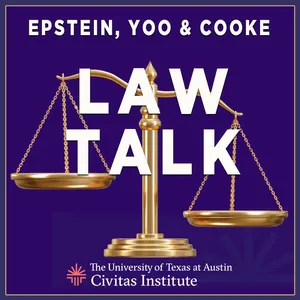
Law Talk With Epstein, Yoo & Cooke: Daily Summaries Delivered
by The Civitas Institute at the University of Texas at Austin
A lively (and often funny) look at legislation and constitutional jurisprudence by preeminent law professors Richard Epstein and John Yoo. The show is hosted by Charles C. W. Cooke.
Latest Episodes
The most recent episodes — sign up to get AI-powered summaries of each one.
- Aug 19, 20261h 13m
10 Commandments, a Ballroom, and Meta Get Their Day in Court
Charles C. W. Cooke, John Yoo, and Richard Epstein debate whether Meta can really be held responsible for the harms of social media, whether Texas can put the Ten Commandments in public-school classrooms, and whether the enormous defamation judgments against Donald Trump can survive Supreme Court scrutiny. They conduct a intense debate over Trump’s White House ballroom, including questions of standing, congressional authority, private funding, and just how far a president can go in remaking the executive mansion. Across all four disputes, the conversation keeps returning to the same fault lines: runaway damages, judicial power, constitutional limits, and whether courts are applying the law—or inventing it.
- Aug 9, 20261h 5m
Trump’s Ballroom, Fauci’s Fifth & the Pardon Power
This week, the Law Talk crew tackles Trump’s White House ballroom fight, the latest battle over birthright citizenship, Anthony Fauci’s decision to plead the Fifth, and the controversial pardons issued by Joe Biden. They debate the limits of executive power, the authority of the courts and Congress, and whether America’s expansive presidential pardon power has finally gone too far.
- Jul 25, 20261h 0m
Bibi, Beer, and Mount Rushmore
Can a U.S. mayor enforce an International Criminal Court warrant? Has President Trump found a new legal path to tariffs after earlier setbacks? And can the government really seize a $95,000 airplane over a six-pack of beer? Richard Epstein, John Yoo, and Charles C. W. Cooke unpack these legal controversies before closing with a spirited debate over which Supreme Court justices deserve a place on the judicial Mount Rushmore.
- Jul 2, 202659 min
The Supreme Court’s Grand Finale: Birthright Citizenship, Women’s Sports, and Campaign Finance
Charles C. W. Cooke, John Yoo, and Richard Epstein break down three major Supreme Court decisions from the end of the term: Trump v. Barbara, the birthright citizenship case that left the status quo intact while sparking a debate over originalism, birth tourism, and Wong Kim Ark; West Virginia v. BPJ, the transgender-athletes case addressing Title IX, equal protection, women’s sports, and federalism; and National Republican Senatorial Committee v. FEC, the campaign-finance ruling that further limits restrictions on coordinated party spending and raises big questions about money, speech, corruption, and the future strength of political parties.
- Jun 29, 202652 min
SCOTUS Decision Day, Part 1: Geofencing, Mail Ballots, and the Administrative State
In part one of our Supreme Court decisions coverage, Charles C. W. Cooke, Richard Epstein, and John Yoo break down the decisions handed down today, beginning with the Court’s treatment of presidential removal power in Trump v. Slaughter and Trump v. Cook (no relation) —the first apparently overruling Humphrey’s Executor for ordinary agencies, the second preserving a major carveout for the Federal Reserve. They also debate Chatrie v. United States, a Fourth Amendment case involving law enforcement’s use of geofencing warrants and cellphone location data, and close with Watson v. Republican National Committee, in which Justice Amy Coney Barrett held that states may count mail-in ballots received after Election Day unless Congress clearly says otherwise. Along the way, the hosts argue over the administrative state, judicial independence, election integrity, and whether the Roberts Court is as predictable—or as partisan—as its critics claim. Part two will be on Thursday, with a decision expected on (cue dramatic music)...birthright citizenship!
- May 27, 202659 min
Into the Gerrymandering and Slush Fund Legal Thunder Dome
The Supreme Court drops a bombshell voting-rights ruling, Richard Epstein declares the republic is heading for the rocks, John Yoo says everybody needs to calm down because politicians have always behaved terribly, and Charlie Cooke tries to referee the whole thing before the podcast devolves into anarchy. Along the way: racial gerrymandering, constitutional originalism, the mysterious “Republican Form of Government Clause,” whether Trump can legally settle a lawsuit with… himself, and why both parties suddenly love slush funds when they’re the ones holding the hose. It’s a cheerful little conversation about whether America’s political system is fundamentally broken — and whose fault it is.
- Apr 22, 202654 min
Birthright, Free Speech, and War: Law Talk Live at UT Austin
In this episode of Law Talk Live—recorded at the University of Texas at Austin and hosted by the Civitas Institute—Charles C. W. Cooke, John Yoo, and Richard Epstein debate some of the most contentious constitutional questions of the moment. The panel examines the future of birthright citizenship in light of recent Supreme Court arguments, the tension between free speech and professional regulation in a major First Amendment case, and the legal and moral framework governing modern warfare, including what counts as a war crime. Blending sharp disagreement, historical insight, and a dose of humor, the conversation explores how precedent, originalism, and real-world pressures collide when the Constitution is pushed to its limits.
- Mar 20, 20261h 0m
Who's More Libertarian? Iran, Guns, and the Limits of Law
John Yoo, Richard Epstein, and Charles C.W. Cooke dive into the legal firestorm surrounding U.S. actions in Iran—debating “imminence,” anticipatory self-defense, and whether international law has any real teeth. Then, they tackle a major 2nd Amendment case testing whether drug use can justify a permanent gun ban—and whether courts or legislatures should draw that line. Finally, a heated clash over parental rights, the Constitution, and California’s school policies raises a deeper question: where do these rights actually come from?
Get Law Talk With Epstein, Yoo & Cooke summaries in your inbox
Free AI-powered daily recaps. Key takeaways, quotes, and mentions — in a 5-minute read.
Get Free Summaries →Free forever for up to 3 podcasts. No credit card required.
You Might Also Like
Listeners also like.
Above the Law - Thinking Like a Lawyer
Three legal experts analyze everyday topics through a legal lens, exploring how law shapes common experiences and cultural phenomena.
Stanford Legal
Experts analyze pressing legal issues, landmark cases, and constitutional questions shaping American democracy and society.

The Lawfare Podcast
Discussions with experts on national security, law, and policy covering foreign policy, intelligence, cybersecurity, and governance.
Law and Chaos
Legal journalists analyze pivotal courtroom cases and their impact on American democracy.
The Lawfare Podcast: Patreon Edition
Experts and policymakers discuss national security, law, and policy issues including foreign policy, intelligence, and cybersecurity.
The Counsel
A former prosecutor analyzes high-profile legal cases and the intersection of law, politics, and current events.
Talking Feds
Legal and political analysis from former government officials, journalists, and experts discussing current issues in law and policy.

Brief Recess: A Legal Podcast with Michael Foote & Mélissa Malebranche
Two lawyers dissect viral legal stories, answer listener questions, and explain how to use the law for social change.
Bloomberg Law
Legal analysis from prominent attorneys and scholars on current cases and news-shaping issues, hosted by June Grasso.

EconTalk
Long-form conversations on economics, philosophy, history, and human behavior with experts from diverse fields.

Amicus With Dahlia Lithwick | Law, justice, and the courts
A weekly exploration of the U.S. Supreme Court, its justices, and the legal issues shaping American law and society.
Civics 101
Explains how U.S. government institutions and constitutional rights function in everyday life.
About Law Talk With Epstein, Yoo & Cooke
A lively (and often funny) look at legislation and constitutional jurisprudence by preeminent law professors Richard Epstein and John Yoo. The show is hosted by Charles C. W. Cooke.
Customized Recaps
AI-powered recaps with compact key takeaways, quotes, and insights.
Straight to Your Inbox
Get key takeaways from Law Talk With Epstein, Yoo & Cooke in a 5-minute read.
Save Hours Every Week
Stay current on your favorite podcasts without falling behind.
Frequently Asked Questions
What is Podzilla's Law Talk With Epstein, Yoo & Cooke daily summary?
It's a free AI-powered email that summarizes new episodes of Law Talk With Epstein, Yoo & Cooke as soon as they're published. You get the key takeaways, notable quotes, and links & mentions — all in a quick read.
How does the Law Talk With Epstein, Yoo & Cooke podcast summary work?
When a new episode drops, our AI transcribes and analyzes it, then generates a personalized summary tailored to your interests and profession. It's delivered to your inbox every morning.
Is this an official Law Talk With Epstein, Yoo & Cooke product?
No. Podzilla is an independent service that summarizes publicly available podcast content. We're not affiliated with or endorsed by The Civitas Institute at the University of Texas at Austin.
Can I get summaries of other podcasts too?
Absolutely! The free plan covers up to 3 podcasts. Upgrade to Pro for 15, or Premium for 50. Browse our full catalog at /podcasts.
How often does Law Talk With Epstein, Yoo & Cooke release new episodes?
Law Talk With Epstein, Yoo & Cooke publishes monthly. Our AI generates a summary within hours of each new episode.
What topics does Law Talk With Epstein, Yoo & Cooke cover?
Law Talk With Epstein, Yoo & Cooke covers topics including News, History, Government, Politics. Our AI identifies the specific themes in each episode and highlights what matters most to you.
Start getting Law Talk With Epstein, Yoo & Cooke summaries tomorrow morning.
Free forever for up to 3 podcasts. No credit card required.
Free forever for up to 3 podcasts. No credit card required.