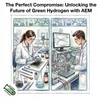
The Perfect Compromise: Unlocking the Future of Green Hydrogen with AEM
In this episode of Innovate and React, I met with Miriam Hesse and Bastian Kaufmann, researchers at the Hydrogen and Fuel Cell Center (ZBT) to discuss the rising potential of Anion Exchange Membrane (AEM) water electrolysis. We explore how AEM serves as the perfect compromise between traditional alkaline systems and proton exchange membrane (PEM) electrolysis, offering high efficiency without the reliance on expensive precious metals like platinum and iridium. Miriam and Bastian share their journey into hydrogen research and how ZBT acts as a crucial bridge between fundamental chemistry and applied industrial engineering across the entire hydrogen value chain. The conversation dives deep into the specific challenges and innovations within AEM technology, from navigating the historical bottlenecks of polymer membrane stability to the intricate process of fabricating homogeneous catalyst layers directly onto porous transport layers (PTLs). We discuss the promising use of nickel-based catalysts to optimize the oxygen and hydrogen evolution reactions. Furthermore, we examine the complexities of scaling this technology for industry, emphasizing the need for long-term degradation data, accelerated stress tests, and advanced analytical methods like electrochemical impedance spectroscopy (EIS) and the distribution of relaxation times (DRT) to pinpoint exactly where performance losses occur in real-world systems.
Podzilla Summary coming soon
Sign up to get notified when the full AI-powered summary is ready.
Free forever for up to 3 podcasts. No credit card required.
Listen to This Episode
More from Innovate and React
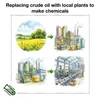
Replacing crude oil with local plants to make chemicals
Replacing chemical plants with methanol-eating bacteria
Defying Markovnikov: A New Spin on the Wacker Oxidation
Stopping PFAS at the Source: Innovating Industrial Wastewater Treatment
Get summaries like this every morning.
Free AI-powered recaps of Innovate and React and your other favorite podcasts, delivered to your inbox.
Free forever for up to 3 podcasts. No credit card required.