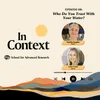
From informal settlements in Bolivia and Arizona to recycled water in Singapore, this conversation reveals why solving water insecurity takes more than technology—and how our ideas about what’s safe, fair, and worthy of trust shape the systems we build.In this episode:Modular, adapted, decentralized (MAD) water systems and piped water skepticismSingapore’s “Four Taps” and New Water recycled systemsWater insecurity, emotional distress, and mental healthCultural meanings of water: trust in science vs. trust in natureAnthropology, optimism, and reimagining water futures in the AnthropoceneKey Takeaways: Water solutions that work must align with people’s actual political, economic, and cultural realities, not just technical ideals.Emotional distress around water often stems less from physical scarcity than from unequal systems of access, exchange, and the social meanings attached to them.Different societies place their faith in different things: some in the purity of “nature,” others in the reliability of science, and these trust patterns shape how new water technologies are received.Anthropological perspectives help “denaturalize” our assumptions about what counts as normal or inevitable in water systems, opening up space for more ethical and locally grounded alternatives.Even amid climate change and inequality, small-scale experiments in water sharing, infrastructure, and community reciprocity point toward futures that can still be meaningful, dignified, and hopeful.“Anthropology asks us to pay the same amount of attention to understanding our own assumptions. Right? What do we take for granted as natural about a water situation, and how can we, with the benefit of listening to others in the world, denaturalize it a little bit?” - Martha Kaplan“I'm interested in is how humans build meaning and social systems and exchanges under situations of extreme duress.” - Amber WutichAbout Martha Kaplan: Martha Kaplan has been a professor of Anthropology at Vassar College since 1990. A cultural and political anthropologist, she earned her PhD from the University of Chicago and has conducted research in Fiji, India, the United States, and Singapore. Her work explores colonial and postcolonial societies, globalization, and the cultural politics of water, and she has authored several influential books and articles on these topics. Supported by organizations including Fulbright and the National Science Foundation, Kaplan teaches courses in anthropology, postcolonial studies, globalization, and environmental culture.About Amber Wutich: Amber Wutich is a Regents Professor, President's Professor, and Director of the Center for Global Health at Arizona State University. A MacArthur Fellow and member of the U.S. National Academy of Sciences, she is a leading expert on water insecurity whose research examines how communities adapt to water scarcity. Wutich has authored more than 200 publications and nine books, leads major collaborative water equity initiatives, and has secured over $80 million in research funding.Connect with Martha Kaplan: Profile: https://www.vassar.edu/faculty/makaplan&n
Podzilla Summary coming soon
Sign up to get notified when the full AI-powered summary is ready.
Free forever for up to 3 podcasts. No credit card required.
Listen to This Episode
More from In Context with School for Advanced Research
The Grid: The Invisible System Running Your Life. You never think about it—until it fails
What If the Border Story Starts With Water?
Believing In Bits
Social Movements and Ethics in Philosophy
Get summaries like this every morning.
Free AI-powered recaps of In Context with School for Advanced Research and your other favorite podcasts, delivered to your inbox.
Free forever for up to 3 podcasts. No credit card required.