Free Daily Podcast Summary
Geopolitics Decanted with Dmitri Alperovitch: Daily Summaries Delivered
by Silverado Policy Accelerator
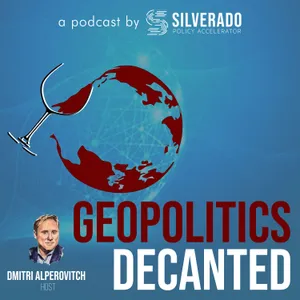
Geopolitics Decanted is a podcast featuring geopolitical analysis and in-depth expert interviews on topics ranging from War in Ukraine, Great Power Competition with China, changing nature of warfare, sanctions and export controls, semiconductors and cybersecurity. This is a podcast for people who care about the details and are seeking a comprehensive understanding of global issues, not just the sound bytes. It is hosted by Dmitri Alperovitch, Chairman of Silverado Policy Accelerator, a Washington DC-based non-profit with a mission to promote prosperity and global competitiveness for America and its allies by accelerating bipartisan strategic, economic and technological policy solutions.
Latest Episodes
The most recent episodes — sign up to get AI-powered summaries of each one.
- 3 weeks ago47 min
The Miracle Is Over: Inside China's Slow-Motion Economic Decay
China's boom ran on the largest credit expansion ever recorded — roughly a third of global GDP in eight years. Rhodium Group's Logan Wright, who spent fourteen years tracking the financial plumbing from Beijing and Hong Kong, argues that engine has been shutting down since 2018 and the economy behind the headline numbers is growing at 1.5–2%, not 5%. China peaked at 18.5% of global GDP in 2021 and has been sliding ever since. The US has quietly outgrown it every year since. Wright and host Dmitri Alperovitch talk through why PPP flatters an economy suffering from deflation, why $52 trillion of RMB penned behind capital controls makes outflows inevitable, and why the widely-cited pivot from property to EVs, batteries and AI doesn't survive contact with the data. Rhodium tracks industrial land sales and local-government revenue bonds: strategic industries went from 2% to 6% of issuance while the share of loans priced at or below the prime rate climbed to 59%. The story of China's credit of the last decade: not reallocation to productive industries but forbearance. What emerges is a picture with no Lehman moment and no bank runs. Just deflation, a 9.5%-of-GDP deficit buying less each year, export competitiveness that comes from weak domestic demand rather than strength, and a decade that looks uncomfortably like Japan's. 00:00 Introduction 01:16 China's economic decline 03:25 How the US has outgrown China for five years 06:11 Why China's PPP lead doesn't matter 12:41 Beijing's fear of capital outflows 16:39 What could trigger a financial crisis 17:14 Credit is flowing to the least productive sectors 19:31 Throwing good money after bad 26:59 China's dependence on Europe 34:19 Can China boost domestic demand? 38:58 The Chinese economy in 2035
- Jun 28, 202652 min
How Russia Could Beat NATO, War of Attrition over Taiwan, and How Ukraine Turned the Tide
Franz-Stefan Gady just played the Russian Chief of General Staff in a German war game — and won. He joins Dmitri Alperovitch to explain how he manufactured a NATO crisis in the summer of 2026, why the U.S. is built for the wrong war over Taiwan, and how Ukraine quietly turned its fortunes around heading into 2026. In this episode: How Russia could beat NATO without firing on it. Inside the Bundeswehr war game where Gady cut off the Baltics with a "humanitarian corridor" into Lithuania, an information-warfare campaign that split European politics, and nuclear saber-rattling aimed at Berlin — and his unsettling conclusion that Russia may not need a ground invasion at all. A war of attrition over Taiwan. Why sinking China's invasion fleet — the celebrated "hellscape" — is the easy part, and what happens on "day after" once U.S. precision munitions run dry and Xi refuses to go home. Alperovitch and Gady debate whether denial alone wins anything, and how a conflict neither side can decisively win punishes whoever has the weaker defense-industrial base. How Ukraine turned the tide. Stabilized manpower, a cleaner chain of command, a real edge in unmanned warfare (helped by Starlink finally going dark for Russian units), and a new mid and long-range strike advantage — set against the relentless Donbas grind and the debate over whether drones have killed maneuver warfare or just split the sky in two. 00:00 Introduction 00:58 How Russia Could Defeat NATO: A War Game 07:42 Potential Russian Air Campaign Against Europe 09:48 Result of the Russia-NATO War Game 13:13 German Brigade in Lithuania: Obstacle for Russia? 15:34 Can Russia Achieve Strategic Surprise? 17:10 How to Defend the Baltics 24:04 NATO's Deficiencies in Ballistic Missiles 27:28 US-China Conflict: Could It Turn Into a War of Attrition? 29:35 Maritime vs. Land Warfare: The Taiwan Dilemma 35:10 What Happens After the PLA Fleet is Sunk? 40:48 Ukrainian Military Successes in 2026 48:15 Are Conditions Right for the Return of Maneuver Warfare? 49:36 Splitting the Air Space: High and Low Altitude Air Superiority
- Mar 23, 202643 min
How to Reopen the Strait of Hormuz
Three weeks into the US-Israel war with Iran, the Strait of Hormuz remains closed — and reopening it may be far harder and slower than many may realize. Dmitri Alperovitch talks to RADM Mark Montgomery (Ret.), who has transited the strait 25+ times and lays out what it will actually take, why Kharg Island is a distraction, and the possible uncomfortable timeline for return to normalcy. 00:00 Introduction 01:09 Threat Environment in the Strait of Hormuz 03:37 Military Strategies for Reopening the Strait 05:19 Cruise Missile Threat 11:43 Tackling the Mine Problem 19:57 Convoy Operations in the Persian Gulf 26:43 Kharg Island 31:41 How long to return of normal traffic in the Gulf? 36:14 The Endgame 42:20 The Houthi problem
- Nov 15, 202541 min
What Happens if the Supreme Court Kills Trump’s Tariffs?
Dmitri Alperovitch and Silverado trade experts Sarah Stewart and John Corrigan examine the implications of the upcoming Supreme Court ruling on Trump's reciprocal and fentanyl tariffs. They explore the stakes of this constitutional challenge, including whether the government might have to refund the substantial tariff revenues already collected and how the administration could respond should the Court rule against them. 00:00 Introduction 02:16 Types of Tariffs Currently in Place 12:13 Supreme Court Timeline and the Issue of Refunds 14:33 Alternative Tariff Options 22:14 A New Weapon for the Trump Administration: Section 338 Tariffs 31:14 Back to the Future With an Old Tool: Section 421 Tariffs 38:14 Why Countries Shouldn't Rush to Celebrate Potential End of IAEPA Tariffs
- Oct 31, 202523 min
Why The China Trade Truce Is Unlikely to Last
Dmitri Alperovitch talks with Sarah Stewart, CEO at Silverado and former senior US trade negotiator, about the Trump-Xi meeting in South Korea. They discuss the details of the agreement reached and why it is a temporary trade truce at best. 00:00 Introduction 01:13 US Objectives for the Trump-Xi Meeting 08:43 The Rare Earths Truce 11:29 A Temporary Truce, Not a Deal 12:31 China's Historical Record of Delivering on Their Commitments 16:11 Why This Truce Is Unlikely to Last a Year 17:39 Deals With the Rest of the World 18:45 Strategic Implications of the Malaysia Trade Deal 20:27 No Concessions on AI Chips Export
- Oct 22, 202543 min
Keeping Russian Economy Afloat: Kremlin's Economic High Wire Act
Is Russia close to an economic collapse? Dmitri Alperovitch sits down with Chris Weafer, an expert on the Russian economy, to assess how long the Kremlin can keep this high wire act going. 00:00 Introduction 01:17 Current State of the Russian Economy 10:02 Budget Challenges and Military Spending 19:29 Impact of Oil Prices and Sanctions 30:10 Economic Headwinds 32:20 Impact of Ukrainian Strikes on Refineries
- Aug 5, 202548 min
Why Drones Can’t Replace Traditional Firepower
Dmitri Alperovitch talks to air power expert Justin Bronk about why it's a bad idea for Western militaries to follow Ukraine's lead and overly invest in production of small drones like FPVs and other loitering munitions. They also dive into best counter-drone strategies, as well as the implications of Ukraine's Operation SpiderWeb and Israel's forward deployed drones neutralizing Iranian air defenses during Operations Rising Lion for strategies to protect aircraft and air-defenses against such threats. 00:00 Introduction 00:28 Why NATO Should Not Follow Ukraine Into Overreliance on Drones 09:22 Small FPVs vs Other Drone Types 15:42 Best Strategy for Effective Anti Drone Defense 26:06 Would Ukraine Be Better Off Spending Money on Conventional Systems? 28:01 Orchestration of Combined Arms Warfare 29:11 Does Ukraine Need More FPVs or Artillery? 31:33 Can America Afford to Invest in Both Small Drones and Conventional Systems? 34:06 Options for Neutralizing Air Defenses 36:53 The State of Russian Air Defenses 38:53 How to Protect Air Forces Against Operation SpiderWeb-style drone tactics 44:35 Assessing the Efficacy of Ukrainian F-16s NATO Should Not Replace Traditional Firepower with ‘Drones’: https://www.rusi.org/explore-our-research/publications/rusi-defence-systems/nato-should-not-replace-traditional-firepower-drones
- Jul 2, 202546 min
Why America's Nuclear Deterrence Strategy Needs to Change
Dmitri Alperovitch talks with Vipin Narang, a former Acting Assistant Secretary of Defense for Space Policy, a portfolio which includes U.S nuclear weapons employment strategy, about why we are now entering the New Nuclear Age and the urgent changes that the United States has to make to its nuclear deterrence posture and strategy. They also debate the utility of counterforce vs countervalue nuclear targeting approaches and how believable the U.S. extended nuclear deterrence is to allies. 00:00 Introduction 00:57 Israel-Iran War 11:47 CAT5 Hurricane of Nuclear Threats 13:50 Is China Preparing to Fight a Nuclear War? 18:04 Debating Counterforce vs. Countervalue Nuclear Targeting Strategies 24:32 Is Nuclear Extended Deterrence Believable to Allies? 40:02 Is Pakistan Building ICBMs to Target the United States? 42:44 Does America Need Mobile ICBM Launchers? How to Survive the New Nuclear Age by Vipin Narang and Pranay Vaddi: https://www.foreignaffairs.com/united-states/how-survive-new-nuclear-age-narang-vaddi
Get Geopolitics Decanted with Dmitri Alperovitch summaries in your inbox
Free AI-powered daily recaps. Key takeaways, quotes, and mentions — in a 5-minute read.
Get Free Summaries →Free forever for up to 3 podcasts. No credit card required.
You Might Also Like
Listeners also like.

School of War
Discussions with military leaders, policymakers, and historians on the strategy, history, and consequences of war.
NatSec Matters
Former national security officials interview top leaders on critical security challenges and U.S. policy responses.

Fareed Zakaria GPS
Analyzes global political issues and international affairs through interviews and expert discussions.

One Decision
Former intelligence leaders and journalists examine high-stakes decisions that shaped global events.
Pekingology
A deep dive into Chinese politics, the Communist Party’s operations, and the global implications of China’s domestic and foreign policies.
Global Security Briefing
Experts analyze global security challenges and international defense policies, with a focus on the UK, Indo-Pacific, and Gulf regions.
The Truth of the Matter
Breaks down complex global policy issues through informed, balanced discussions without spin or sensationalism.

The Team House
Deep-dive conversations on national security with special operations veterans, intelligence professionals, and frontline reporters.

The Rest Is Politics: US
Insightful analysis of U.S. politics and policy from a former White House official and a veteran BBC correspondent.

DINESH Podcast
Dinesh D'Souza hosts conversations on politics, history, philosophy, and literature.
Ukrainecast
A BBC podcast investigating the war in Ukraine through on-the-ground stories, expert analysis, and high-level interviews.

All-In with Chamath, Jason, Sacks & Friedberg
Four tech investors discuss technology, markets, politics, and poker with candid, in-depth analysis.
About Geopolitics Decanted with Dmitri Alperovitch
Geopolitics Decanted is a podcast featuring geopolitical analysis and in-depth expert interviews on topics ranging from War in Ukraine, Great Power Competition with China, changing nature of warfare, sanctions and export controls, semiconductors and cybersecurity. This is a podcast for people who care about the details and are seeking a comprehensive understanding of global issues, not just the sound bytes. It is hosted by Dmitri Alperovitch, Chairman of Silverado Policy Accelerator, a Washington DC-based non-profit with a mission to promote prosperity and global competitiveness for America and its allies by accelerating bipartisan strategic, economic and technological policy solutions.
Customized Recaps
AI-powered recaps with compact key takeaways, quotes, and insights.
Straight to Your Inbox
Get key takeaways from Geopolitics Decanted with Dmitri Alperovitch in a 5-minute read.
Save Hours Every Week
Stay current on your favorite podcasts without falling behind.
Frequently Asked Questions
What is Podzilla's Geopolitics Decanted with Dmitri Alperovitch daily summary?
It's a free AI-powered email that summarizes new episodes of Geopolitics Decanted with Dmitri Alperovitch as soon as they're published. You get the key takeaways, notable quotes, and links & mentions — all in a quick read.
How does the Geopolitics Decanted with Dmitri Alperovitch podcast summary work?
When a new episode drops, our AI transcribes and analyzes it, then generates a personalized summary tailored to your interests and profession. It's delivered to your inbox every morning.
Is this an official Geopolitics Decanted with Dmitri Alperovitch product?
No. Podzilla is an independent service that summarizes publicly available podcast content. We're not affiliated with or endorsed by Silverado Policy Accelerator.
Can I get summaries of other podcasts too?
Absolutely! The free plan covers up to 3 podcasts. Upgrade to Pro for 15, or Premium for 50. Browse our full catalog at /podcasts.
How often does Geopolitics Decanted with Dmitri Alperovitch release new episodes?
Geopolitics Decanted with Dmitri Alperovitch publishes occasional. Our AI generates a summary within hours of each new episode.
What topics does Geopolitics Decanted with Dmitri Alperovitch cover?
Geopolitics Decanted with Dmitri Alperovitch covers topics including News, Commentary. Our AI identifies the specific themes in each episode and highlights what matters most to you.
Start getting Geopolitics Decanted with Dmitri Alperovitch summaries tomorrow morning.
Free forever for up to 3 podcasts. No credit card required.
Free forever for up to 3 podcasts. No credit card required.