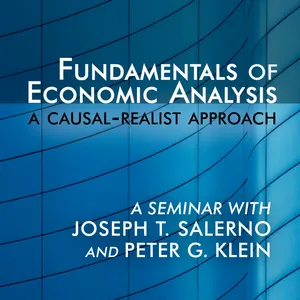
Free Daily Podcast Summary
Fundamentals of Economic Analysis: A Causal-Realist Approach: Daily Summaries Delivered
by Joseph T. Salerno
Get key takeaways, quotes, and insights from Fundamentals of Economic Analysis: A Causal-Realist Approach in a 5-minute read. Delivered straight to your inbox.
Latest Episodes
The most recent episodes — sign up to get AI-powered summaries of each one.
- Jun 16, 2007
10. Banking and the Business Cycle
We have today a hybrid of two forms of banking — loan banking (non-inflationary) and deposit banking (inflationary if not 100% reserve holdings). The cause of booms is the credit expansion by central banks that is not backed by pools of private savings. The longer the inflation-driven boom continues, the worse the inevitable clearing bust must be. Austrian policy is to leave everything alone to permit all the adjustments needed. Keynesian policy is to keep inflating. Theirs is a crisis of interventionism. The tenth and final lecture from Fundamentals of Economic Analysis: A Causal-Realist Approach. Download the MP4 video.
- Jun 15, 2007
8. Competition and Monopoly
Competition can mean rivalry or freedom. All firms must serve the preferences of consumers in order to exist. Monopoly has historically been an artificial privilege granted by the state. Monopolies do not last for long in free markets unless maintained by government interventions. Antitrust policies were generally not demanded by consumers, but created by jealous competitors. Antitrust laws are insensible and wasteful. The eighth in a series of ten lectures, from Fundamentals of Economic Analysis: A Causal-Realist Approach. Download the MP4 video.
- Jun 15, 2007
9. Money and Prices
In the history of money, bartering was awkward because wants were not divisible. Direct exchange depended upon a double coincidence of wants. Demand for a medium of exchange grew until a general medium of exchange emerged, like gold and silver. A medium of exchange should display these characteristics: must be generally acceptable, widely demanded for non-monetary uses, easily portable, homogeneous, highly divisible and highly durable. Although it is beneficial to have more of any other commodity, it is not true of money. A greater supply of money merely dilutes the purchasing power of each money unit. The consequences of inflation include a rise in prices, a fall in purchasing power, and a stealth tax on citizens. The ninth in a series of ten lectures, from Fundamentals of Economic Analysis: A Causal-Realist Approach. Download the MP4 video.
- Jun 14, 2007
6. Profit, Loss, and the Entrepreneur
Causal-realist analysis allows imaginary constructs like the ERE — Evenly Rotating Economy — in order to isolate certain factors like interest. There would be no profit or loss in the ERE, because those can only exist under conditions of uncertainty. Klein explains profit as a category, not a line item. The entrepreneur’s function is to experiment with combinations of factors of production to find those that produce the greatest economic value. The sixth in a series of ten lectures, from Fundamentals of Economic Analysis: A Causal-Realist Approach. Download the MP4 video.
- Jun 14, 2007
7. Capital, Interest, and the Structure of Production
Time preference says that individuals prefer satisfaction now to later, present to future. This explains the loan market. In the structure of production, the capitalist pays wages now, despite the fact that he himself does not get paid until the final stage when the product actually comes to market. Consumption, saving, investment and spending occur in every production stage – across time. The interest rate is the rate of price spread. It is what the capitalist earns for time preference. The seventh in a series of ten lectures, from Fundamentals of Economic Analysis: A Causal-Realist Approach. Download the MP4 video.
- Jun 13, 2007
4. Price Controls: Case Studies
As with all government intervention, price controls do not achieve what their originators think they will. Trying to maintain a supply of milk by putting a price control on it will cause shortages, which are the very situations the price manipulators said they wanted to avoid. Rent control seems great to the snug renter, but it will assure that no new building or renovations will be undertaken by entrepreneurs. Shortages follow. Agricultural subsidies, quotas and price support loans function as regressive taxes upon the poor. Sugar cane price controls are among long-standing interventions in the market. The fourth in a series of ten lectures, from Fundamentals of Economic Analysis: A Causal-Realist Approach. Download the MP4 video.
- Jun 13, 2007
5. Pricing of the Factors of Production and the Labor Market
Factors of Production are economic goods: scarce means used to achieve an individual’s ends. They are land, labor and capital. Each is examined. Incomes are earned by factor owners as production takes place. There is no separated production and distribution. Consumer goods and producer goods are subjectively determined by how they are used. Factor pricing is by the Austrian theory of imputation. To Austrians, all costs are opportunity costs. The fifth in a series of ten lectures, from Fundamentals of Economic Analysis: A Causal-Realist Approach. Download the MP4 video.
- Jun 12, 2007
2. Exchange and Demand
All action is really exchange. What the actor prefers less is exchanged for something he prefers more, including gift giving. It is a fallacy to say that the goods exchanged have equal value. Salerno also covers elastic and inelastic demand. The second in a series of ten lectures, from Fundamentals of Economic Analysis: A Causal-Realist Approach. Download the MP4 video.
Get Fundamentals of Economic Analysis: A Causal-Realist Approach summaries in your inbox
Free AI-powered daily recaps. Key takeaways, quotes, and mentions — in a 5-minute read.
Get Free Summaries →Free forever for up to 3 podcasts. No credit card required.
You Might Also Like
Listeners also like.
Introduction to Austrian Economic Analysis
Joseph T. Salerno
Austrian School of Economics: Revisionist History and Contemporary Theory
Joseph T. Salerno
Austrian Economics: An Introductory Course
Murray N. Rothbard
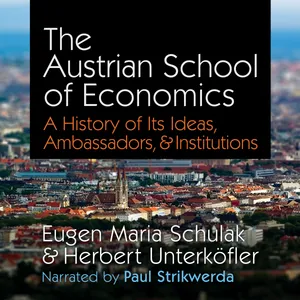
The Austrian School of Economics: A History of Its Ideas, Ambassadors, and Institutions
Eugen-Maria Schulak
The Austrian School of Economics: An Introduction

Mises University 2017
Mises Institute
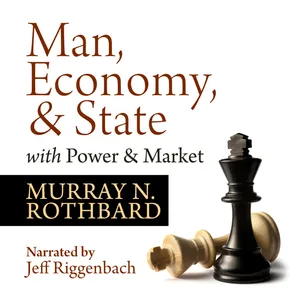
Man, Economy, and State, with Power and Market
Murray N. Rothbard
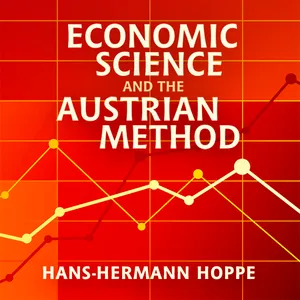
Economic Science and the Austrian Method
Hans-Hermann Hoppe

Ask an Austrian
LP Mises Caucus
Economics 101

Mises Audio Books Podcast
Mises.org
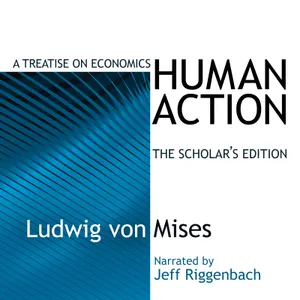
Human Action: A Treatise on Economics
Ludwig von Mises
About Fundamentals of Economic Analysis: A Causal-Realist Approach
Joseph T. Salerno and Peter G. Klein are two of the most productive micro-economists in the Austrian School today. This seminar provides an introduction to Austrian Economics. Presented at the Mises Institute, 11-15 June 2007.
Customized Recaps
AI-powered recaps with compact key takeaways, quotes, and insights.
Straight to Your Inbox
Get key takeaways from Fundamentals of Economic Analysis: A Causal-Realist Approach in a 5-minute read.
Save Hours Every Week
Stay current on your favorite podcasts without falling behind.
Frequently Asked Questions
What is Podzilla's Fundamentals of Economic Analysis: A Causal-Realist Approach daily summary?
It's a free AI-powered email that summarizes new episodes of Fundamentals of Economic Analysis: A Causal-Realist Approach as soon as they're published. You get the key takeaways, notable quotes, and links & mentions — all in a quick read.
How does the Fundamentals of Economic Analysis: A Causal-Realist Approach podcast summary work?
When a new episode drops, our AI transcribes and analyzes it, then generates a personalized summary tailored to your interests and profession. It's delivered to your inbox every morning.
Is this an official Fundamentals of Economic Analysis: A Causal-Realist Approach product?
No. Podzilla is an independent service that summarizes publicly available podcast content. We're not affiliated with or endorsed by Joseph T. Salerno.
Can I get summaries of other podcasts too?
Absolutely! The free plan covers up to 3 podcasts. Upgrade to Pro for 15, or Premium for 50. Browse our full catalog at /podcasts.
How often does Fundamentals of Economic Analysis: A Causal-Realist Approach release new episodes?
Fundamentals of Economic Analysis: A Causal-Realist Approach publishes daily. Our AI generates a summary within hours of each new episode.
What topics does Fundamentals of Economic Analysis: A Causal-Realist Approach cover?
Fundamentals of Economic Analysis: A Causal-Realist Approach covers topics including Education, Courses. Our AI identifies the specific themes in each episode and highlights what matters most to you.
Start getting Fundamentals of Economic Analysis: A Causal-Realist Approach summaries tomorrow morning.
Free forever for up to 3 podcasts. No credit card required.
Free forever for up to 3 podcasts. No credit card required.