Free Daily Podcast Summary
Austrian School of Economics: Revisionist History and Contemporary Theory: Daily Summaries Delivered
by Joseph T. Salerno
Get key takeaways, quotes, and insights from Austrian School of Economics: Revisionist History and Contemporary Theory in a 5-minute read. Delivered straight to your inbox.
Latest Episodes
The most recent episodes — sign up to get AI-powered summaries of each one.
- Dec 15, 2018
Forerunners of the Austrian School: The French Liberal School
The French Liberal School had been dominant through four generations because they were privately funded, but when the government intervened in the French universities the Liberal School lost its hold. Richard Cantillon, Etienne Bonnot de Condillac, A.R.J. Turgot, Jean-Baptiste Say, Frederic Bastiat, and Michel Chevalier were responsible for economic concepts such as opportunity cost, the entrepreneur as risk-bearer, monetary theory, cause and effect methodology, utility, economic liberalism, and Say’s Law. Both in Great Britain and the United States during 1870-1890, the French Liberal School was hated and denigrated. The American Economic Association was started in 1880. There was no room for the liberals. The History of Economic Doctrine, which appeared in 1947, claimed the French Liberal School, which they now called the Optimist School, had abandoned the task of scientific investigation. Lecture 1 of 10 from Joseph T. Salerno's Revisionist History and Contemporary Theory.
- Jun 11, 2005
10. The Gold Standard in Theory and Myth
The mythology of gold really grew up with Keynes and the quantity theory. Here are six of those myths: the gold standard is unable to accommodate the needs of an growing economy; the quantity of money is arbitrarily determined; the gold standard is a government price fixing scheme; the gold standard subjects a country to alternating inflation and deflation; the gold standard requires high costs devoted to resources; and the gold standard results in high interest rates.Basic supply and demand analysis in most cases will show us that these are myths. Having refuted all six myths, Salerno turns to a few gold standard proposals.Supply siders want a gold standard, but they want plenty of money, a fixed price of gold, and a target reserve amount of gold. This monetarist concept does not allow gold to be a real medium of exchange.Hazlitt, Hulsmann, Senholz, and Tmberlake supported a non-monetarist approach called a parallel private gold standard. Don’t get rid of the fiat, just freeze the Fed action and the monetary base. Then convert reserve accounts into Fed notes. Give a proportional amount of Fed-held gold to each citizen. Abolish legal tender laws and make gold contracts in gold enforceable.Salerno and Rothbard object to this plan, unless a link between dollars and gold is established as a way to go back to gold.Mises’ plan went further than the currency school. The currency school forgot that checking account money was also part of the money supply. Mises wanted the freedom to buy and sell gold, and allow after three months conversions of dollars back into gold through conversion agencies. The Fed could not interfere. The dollar is defined legally as a weight of gold.Rothbard’s plan was to get rid of the Fed and reprice the gold. Take the total amount of currency and divide into that the total ounces of gold owned by the Treasury to get a price per ounce. Then call in all fed notes and turn them in at that rate. There would be a one-off inflation and it would still be a fractional reserve system. Another plan yields no inflation and 100% backing.Lecture 10 of 10 from Joseph Salerno's Revisionist History and Contemporary Theory.
- Jun 10, 2005
7. The Political Economy of the Chicago School: Libertarian or Jacobin?
The founder of the Chicago School, Frank Knight, was an avowed egalitarian. Rousseau was his influence. Jacobins believed in mass democracy and politics as the only way to implement their ideas. They hated aristocrats and religious leaders. Knight believed in progressive taxation. He wanted neocon social democracy.Milton Friedman was part of the Chicago school. His Capitalism & Freedom contains much of his thought. He was more pro-freedom than Knight. But, he introduces the concept of externalities and approves of the welfare state. Education (public-private schools with vouchers), poverty (charity will not suffice, thus massive welfare systems needed) and the monetary system (monetarism) were his focus.Lecture 7 of 10 from Joseph Salerno's Revisionist History and Contemporary Theory.
- Jun 10, 2005
8. The Debate on the Socialist Calculation Debate
The debate still continues. It is all about Mises’ initial article and then book on Socialism in 1922. He demonstrated the necessity of the price system and showed how subjective values were transformed into objective prices which could be used as meaningful cardinal numbers in economic calculation.One big cartel that owns everything would be just like socialism, because there would be no price signals. Mises calls this the intellectual division of labor. With no market you never have profits or losses. You have no information. The distinctive mark of socialism is the oneness. Capitalism is an entrepreneurial system, not a static system like those just playing market.Lecture 8 of 10 from Joseph Salerno's Revisionist History and Contemporary Theory.
- Jun 10, 2005
9. Money and Gold in the 1920s and 1930s: Defending the Rothbardian Position
Friedman’s book, Monetary History of the United States, tried to show the depression was caused by a deflation of the money supply by the Fed. Rothbard’s America’s Great Depression was published the next year in 1963. Rothbard argued that the Fed was actively inflating the money supply.Salerno defends Rothbard’s position (against Timberlake) on the definition of inflation, a marginal 100% reserve rule, physical description of the money supply, Treasury policy, and Fed policy.Lecture 9 of 10 from Joseph Salerno's Revisionist History and Contemporary Theory.
- Jun 9, 2005
6. Keynes and the 'New Economics' of Fascism
Monetary inflation is the key way to bring about economic fascism. Fascism was a spending, borrowing government, militarism, imperialism, and a planned economy. Keynes’ followers came to power in the 60s with the Kennedy administration. Nixon went on to impose wage and price controls.Lecture 6 of 10 from Joseph Salerno's Revisionist History and Contemporary Theory.
- Jun 8, 2005
4. The Theory of Monopoly Price: From Menger to Rothbard
Prior to Mises there had been nothing written on the theory of monopoly price. Mises felt there could be some limited times of monopoly on the free market, e.g. diamond mines, but Rothbard felt that there could not be monopolies. Both theories developed out of Menger’s original thoughts.Lecture 4 of 10 from Joseph Salerno's Revisionist History and Contemporary Theory.
- Jun 8, 2005
5. Modern Monetary Theory: The Austrian Contribution
Monetary theory is where Austrians diverge the most from mainstream. Mises built a new taxonomy of money. He said money included any checking account deposits. The marginal utility of gold on the last day of barter was determined by the uses of gold. People then demanded gold as money because there was preexisting value. A paper dollar must have such a connection to money. Government cannot create money. Money is not neutral. The natural trend of prices in a market economy is falling.Lecture 5 of 10 from Joseph Salerno's Revisionist History and Contemporary Theory.
Get Austrian School of Economics: Revisionist History and Contemporary Theory summaries in your inbox
Free AI-powered daily recaps. Key takeaways, quotes, and mentions — in a 5-minute read.
Get Free Summaries →Free forever for up to 3 podcasts. No credit card required.
You Might Also Like
Listeners also like.
The Austrian School of Economics: A History of Its Ideas, Ambassadors, and Institutions
Eugen-Maria Schulak
The Austrian School of Economics: An Introduction
Introduction to Austrian Economic Analysis
Joseph T. Salerno
Fundamentals of Economic Analysis: A Causal-Realist Approach
Joseph T. Salerno
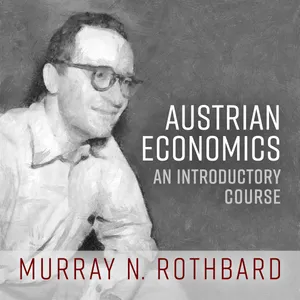
Austrian Economics: An Introductory Course
Murray N. Rothbard
Economics 101

Mises University 2017
Mises Institute

Mises Audio Books Podcast
Mises.org
Economic Science and the Austrian Method
Hans-Hermann Hoppe
Man, Economy, and State, with Power and Market
Murray N. Rothbard
Mises Audio Books Podcast Reverse Order
Mises.org
Ask an Austrian
LP Mises Caucus
About Austrian School of Economics: Revisionist History and Contemporary Theory
Joseph T. Salerno presents a series of ten formal lectures on topics related to the history and theory of the Austrian School of Economics.Download the complete audio of this event (ZIP) here.
Customized Recaps
AI-powered recaps with compact key takeaways, quotes, and insights.
Straight to Your Inbox
Get key takeaways from Austrian School of Economics: Revisionist History and Contemporary Theory in a 5-minute read.
Save Hours Every Week
Stay current on your favorite podcasts without falling behind.
Frequently Asked Questions
What is Podzilla's Austrian School of Economics: Revisionist History and Contemporary Theory daily summary?
It's a free AI-powered email that summarizes new episodes of Austrian School of Economics: Revisionist History and Contemporary Theory as soon as they're published. You get the key takeaways, notable quotes, and links & mentions — all in a quick read.
How does the Austrian School of Economics: Revisionist History and Contemporary Theory podcast summary work?
When a new episode drops, our AI transcribes and analyzes it, then generates a personalized summary tailored to your interests and profession. It's delivered to your inbox every morning.
Is this an official Austrian School of Economics: Revisionist History and Contemporary Theory product?
No. Podzilla is an independent service that summarizes publicly available podcast content. We're not affiliated with or endorsed by Joseph T. Salerno.
Can I get summaries of other podcasts too?
Absolutely! The free plan covers up to 3 podcasts. Upgrade to Pro for 15, or Premium for 50. Browse our full catalog at /podcasts.
How often does Austrian School of Economics: Revisionist History and Contemporary Theory release new episodes?
Austrian School of Economics: Revisionist History and Contemporary Theory publishes daily. Our AI generates a summary within hours of each new episode.
What topics does Austrian School of Economics: Revisionist History and Contemporary Theory cover?
Our AI identifies the specific themes in each episode and highlights what matters most to you.
Start getting Austrian School of Economics: Revisionist History and Contemporary Theory summaries tomorrow morning.
Free forever for up to 3 podcasts. No credit card required.
Free forever for up to 3 podcasts. No credit card required.