Free Daily Podcast Summary
Functional Relations: Daily Summaries Delivered
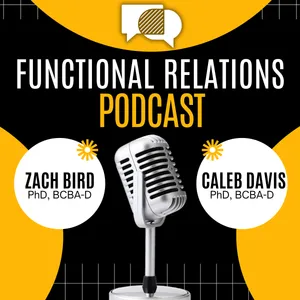
by Zachary Bird, PhD, BCBA-D and Caleb Davis, PhD, BCBA-D
An ABA podcast where Dr. Zachary Bird and Dr. Caleb Davis set aside time to have engaging conversation with experts in the field of behavior analysis to explore topics like ethics of functional analysis, effective supervision practices, translating research to practice, and others. BACB, IBAO, and QABA CEUs are available for listeners. To purchase, visit www.functionalrelationspodcast.com To deliver social praise or aversive stimulation, you can email us at functionalrelationspodcast@gmail.com
Latest Episodes
The most recent episodes — sign up to get AI-powered summaries of each one.
- 2 weeks ago1h 3m
#46 - Pavlovian Conditioning in the Classroom? w/ Dr. Rick Colombo
In this episode, Zach and Caleb discuss a recent publication on Pavlovian Conditioning in classroom w/ Dr. Rick Colombo. 1 General CEU (BACB, IBAO, and/or QABA) is available for this episode. You can purchase it at https://www.functionalrelationspodcast.com Become a member to get access to our entire library of CEs and access exclusive video podcasts and behind the scenes content for $79/yr. https://www.functionalrelationspodcast.com/subscription/membership Things to check out from the episode: Dr. Domjan Youtube video: The Psychology of the Smart Phone References: Colombo, R. A., Mahmoudi, S., Wright, W. B., Huang, Y. H., & Madden, G. J. (2026). Appetitive Pavlovian conditioning in two inclusive kindergarten classrooms. Journal of the Experimental Analysis of Behavior, 125(3), e70107. Lewon, M., & Domjan, M. (2026). Toward a Modern View of Pavlovian Conditioning in Applied Behavior Analysis. Perspectives on Behavior Science, 49(2), 267-295. Madden, G. J., Mahmoudi, S., & Brown, K. R. (2023). Pavlovian learning and conditioned reinforcement. Journal of Applied Behavior Analysis, 56(3), 498–519. https://doi.org/10.1002/jaba.1004
- Aug 1, 20261h 19m
#45 - Spreading the Science: Radical Behaviorism for All w/ Dr. Matt Normand
In this episode, Zach and Caleb discuss a recent paper on radical behaviorism and the dissemination of those ideas with Dr. Matt Normand. 1.5 General CEU (BACB, IBAO, and/or QABA) is available for this episode. You can purchase them at https://www.functionalrelationspodcast.com Become a member to get access to our entire library of CEs and access exclusive behind the scenes content for $79/yr. https://www.functionalrelationspodcast.com/subscription/membership Dr. Matt Normand Substack References: Johnston, J. M. (2014). Radical behaviorism for ABA practitioners. Sloan Publishing. Johnston, J. M., & Ahearn, W. H. (2026). The status of radical behaviorism. Perspectives on Behavior Science, 1-16. Moore, J. (2008). Conceptual foundations of radical behaviorism. Schlinger, H. D., & Normand, M. P. (2026). Radical Behaviorism: A Primer for the Profession and the Person. Perspectives on Behavior Science, 1-19.
- Jul 1, 20261h 22m
#44 - Leveling Up the Respondent-Operant Distinction w/ Dr. Michael Domjan
In this episode, Zach and Caleb discuss the distinction between operant and respondent behavior with Dr. Michael Domjan. 1.5 General CEU (BACB, IBAO, and/or QABA) is available for this episode. You can purchase them at https://www.functionalrelationspodcast.com Become a member to get access to our entire library of CEs and access exclusive behind the scenes content for $79/yr. https://www.functionalrelationspodcast.com/subscription/membership Things to check out from the episode: Dr. Domjan's Youtube channel: Introduction to Learning and Behavior: Key Concepts Dr. Domjan's textbooks discussed during the episode: The Essentials of Conditioning and Learning, Fifth Edition Amazon.com: The Principles of Learning and Behavior: 9781285088563: Domjan, Michael P.: Books References: Brown, P. L., & Jenkins, H. M. (1968). AUTO‐SHAPING OF THE PIGEON'S KEY‐PECK 1. Journal of the experimental analysis of behavior, 11(1), 1-8. Domjan, M. (2016). Elicited versus emitted behavior: Time to abandon the distinction. Journal of the Experimental Analysis of Behavior, 105(2), 231-245. Skinner, B. F. (1965). Science and human behavior (No. 92904). Simon and Schuster. Skinner, B. F. (2019). The behavior of organisms: An experimental analysis. BF Skinner Foundation.
- Jun 1, 20261h 19m
#43 - Analyzing Complex Teacher-Student Interactions w/ Dr. Corey Stocco and Molly Dwyer
In this episode, Zach and Caleb discuss analyzing teacher-student interactions with Dr. Corey Stocco (BCBA-D) and Molly Dwyer (BCBA). 1.5 General CEU (BACB, IBAO, and/or QABA) is available for this episode. You can purchase it at https://www.functionalrelationspodcast.com Become a member to get access to our entire library of CEs and access exclusive behind the scenes content for $79/yr. https://www.functionalrelationspodcast.com/subscription/membership Things to check out from the episode: Learn more about the Nurtured Heart Approach Nurtured Heart Institute | Nurtured Heart Approach training References: Athens, E. S., & Vollmer, T. R. (2010). An investigation of differential reinforcement of alternative behavior without extinction. Journal of Applied Behavior Analysis, 43(4), 569-589. Patterson, G. R. (2002). The early development of coercive family process. In J. B. Reid, G. R. Patterson, & J. Snyder (Eds.), Antisocial behavior in children and adolescents: A developmental analysis and model for intervention (pp. 25–44). Washington, DC: American Psychological Association. Sidman, M. (1989). Coercion and its fallout. Boston: Authors cooperative. Stocco, C. S., & Thompson, R. H. (2015). Contingency analysis of caregiver behavior: Implications for parent training and future directions. Journal of applied behavior analysis, 48(2), 417-435. Vollmer, T. R., Peters, K. P., Kronfli, F. R., Lloveras, L. A., & Ibañez, V. F. (2020). On the definition of differential reinforcement of alternative behavior. Journal of Applied Behavior Analysis, 53(3), 1299-1303.
- May 1, 20261h 9m
#42 - The Status of Radical Behaviorism w/ Dr. Bill Ahearn
In this episode, Zach and Caleb discuss a recent publication on the status of radical behaviorism with Dr. Bill Ahearn. 1 General CEU (BACB, IBAO, and/or QABA) is available for this episode. You can purchase it at https://www.functionalrelationspodcast.com Become a member to get access to our entire library of CEs and access exclusive behind the scenes content for $79/yr. https://www.functionalrelationspodcast.com/subscription/membership References: Johnston, J. M., & Ahearn, W. H. (2026). The status of radical behaviorism. Perspectives on Behavior Science, 1-16. Skinner, B. F. (1984). Selection by consequences. Behavioral and brain sciences, 7(4), 477-481.
- Apr 1, 202640 min
#41 - Student Episode: 7 Dimensions of ABA
In this episode, Zach and Caleb have a discussion to help students understand the 7 dimensions of applied behavior analysis from the 1968 article "Some Current Dimensions of Applied Behavior Analysis" by Baer, Wolf, & Risley. This covers A.5. of the BCBA Test Content Outline (6th ed). No CEs are available for this episode. Become a member to get access to our entire library of CEs and access exclusive behind the scenes content for $79/yr. https://www.functionalrelationspodcast.com/subscription/membership References: Cooper, J. O., Heron, T. E., & Heward, W. L. (2020). Applied behavior analysis (3rd ed.). Upper Saddle River, NJ: Pearson. Baer, D. M., Wolf, M. M., & Risley, T. R. (1968). Some current dimensions of applied behavior analysis. Journal of applied behavior analysis, 1(1), 91–97. https://doi.org/10.1901/jaba.1968.1-91
- Mar 1, 20261h 8m
#40 - Rethinking How We Teach Tacts w/ Dr. Judah Axe
In this episode, Zach and Caleb discuss rethinking how we approach teaching tacts w/ Dr. Judah Axe. 0.5 Ethic/0.5 General CEU (BACB, IBAO, and/or QABA) is available for this episode. You can purchase it at https://www.functionalrelationspodcast.com Become a member to get access to our entire library of CEs and access exclusive behind the scenes content for $79/yr. https://www.functionalrelationspodcast.com/subscription/membership Things to check out from the episode: Making meaningful book Essentials for living References: Axe, J. B., & Laprime, A. P. (2017). The effects of contingent pairing on establishing praise as a reinforcer with children with autism. Journal of Developmental and Physical Disabilities, 29(2), 325-340. Bahry, S., Gerhardt, P. F., Weiss, M. J., Leaf, J. B., Putnam, R. F., & Bondy, A. (2023). The ethics of actually helping people: Targeting skill acquisition goals that promote meaningful outcomes for individuals with autism spectrum disorder. Behavior Analysis in Practice, 16(3), 672-695. Barosky, C. (2023). Antecedent variables influencing tacting with children with autism [Unpublished doctoral dissertation]. Simmons University. Clements, C. C., Zoltowski, A. R., Yankowitz, L. D., Yerys, B. E., Schultz, R. T., & Herrington, J. D. (2018). Evaluation of the social motivation hypothesis of autism: a systematic review and meta-analysis. JAMA psychiatry, 75(8), 797-808. Dozier, C. L., Iwata, B. A., Thomason‐Sassi, J., Worsdell, A. S., & Wilson, D. M. (2012). A comparison of two pairing procedures to establish praise as a reinforcer. Journal of applied behavior analysis, 45(4), 721-735. Dube, W. V., MacDonald, R. P., Mansfield, R. C., Holcomb, W. L., & Ahearn, W. H. (2004). Toward a behavioral analysis of joint attention. The Behavior Analyst, 27(2), 197-207. Dudley, L. L., Axe, J. B., Allen, R. F., & Sweeney‐Kerwin, E. J. (2019). Establishing praise as a conditioned reinforcer: Pairing with one versus multiple reinforcers. Behavioral Interventions, 34(4), 534-552. Lovaas, O. I. (1987). Behavioral treatment and normal educational and intellectual functioning in young autistic children. Journal of consulting and clinical psychology, 55(1), 3. Cengher, M., & Fienup, D. M. (2020). Presession attention affects the acquisition of tacts and intraverbals. Journal of Applied Behavior Analysis, 53(3), 1742-1767. Moher, C. A., Gould, D. D., Hegg, E., & Mahoney, A. M. (2008). Non‐generalized and generalized conditioned reinforcers: Establishment and validation. Behavioral Interventions: Theory & Practice in Residential & Community‐Based Clinical Programs, 23(1), 13-38. Skinner, B. F. (1957). Verbal behavior. New York: Appleton-Century-Crofts. Sundberg, M. L. (2008). VB-MAPP Verbal Behavior Milestones Assessment and Placement Program: a language and social skills assessment program for children with autism or other developmental disabilities: guide. Mark Sundberg. <br /
- Feb 1, 20261h 8m
#39 - The Science of Positive Culture Building w/ Dr. Bruce Tinor
In this episode, Zach and Caleb discuss practices that support building positive cultures within educational settings with Dr. Bruce Tinor. 1 Supervision CEU (BACB, IBAO, and/or QABA) is available for this episode. You can purchase it at https://www.functionalrelationspodcast.com Become a member to get access to our entire library of CEs and access exclusive behind the scenes content for $79/yr. https://www.functionalrelationspodcast.com/subscription/membership Things to check out from the episode: Book on four hats of leadership: Positional Authority Ain't Leadership: Behavioral Science for Navigating Bull$hit, Optimizing Performance, and Avoiding A$$ Clownery: Gavoni, Dr. Paul: 9798989798100: Amazon.com: Books References: Skinner, B. F. (1984). Selection by consequences. Behavioral and brain sciences, 7(4), 477-481.
About Functional Relations
An ABA podcast where Dr. Zachary Bird and Dr. Caleb Davis set aside time to have engaging conversation with experts in the field of behavior analysis to explore topics like ethics of functional analysis, effective supervision practices, translating research to practice, and others. BACB, IBAO, and QABA CEUs are available for listeners. To purchase, visit www.functionalrelationspodcast.com To deliver social praise or aversive stimulation, you can email us at functionalrelationspodcast@gmail.com
Customized Recaps
AI-powered recaps with compact key takeaways, quotes, and insights.
Straight to Your Inbox
Get key takeaways from Functional Relations in a 5-minute read.
Save Hours Every Week
Stay current on your favorite podcasts without falling behind.
Frequently Asked Questions
What is Podzilla's Functional Relations daily summary?
It's a free AI-powered email that summarizes new episodes of Functional Relations as soon as they're published. You get the key takeaways, notable quotes, and links & mentions — all in a quick read.
How does the Functional Relations podcast summary work?
When a new episode drops, our AI transcribes and analyzes it, then generates a personalized summary tailored to your interests and profession. It's delivered to your inbox every morning.
Is this an official Functional Relations product?
No. Podzilla is an independent service that summarizes publicly available podcast content. We're not affiliated with or endorsed by Zachary Bird, PhD, BCBA-D and Caleb Davis, PhD, BCBA-D.
Can I get summaries of other podcasts too?
Absolutely! The free plan covers up to 3 podcasts. Upgrade to Pro for 15, or Premium for 50. Browse our full catalog at /podcasts.
How often does Functional Relations release new episodes?
Functional Relations publishes monthly. Our AI generates a summary within hours of each new episode.
What topics does Functional Relations cover?
Functional Relations covers topics including Science, Education, Social Sciences. Our AI identifies the specific themes in each episode and highlights what matters most to you.
Start getting Functional Relations summaries tomorrow morning.
Free forever for up to 3 podcasts. No credit card required.
Free forever for up to 3 podcasts. No credit card required.