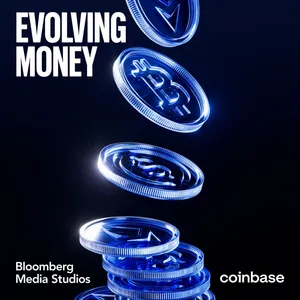
Free Daily Podcast Summary
Evolving Money: Daily Summaries Delivered
by Coinbase, Bloomberg Media Studios
Get key takeaways, quotes, and insights from Evolving Money in a 5-minute read. Delivered straight to your inbox.
Latest Episodes
The most recent episodes — sign up to get AI-powered summaries of each one.
- 1 weeks ago24 min
Stablecoins in Practice and Policy
Stablecoins are crypto currencies designed to maintain a stable value because they’re pegged to a fiat currency, such as the U.S. dollar. The result is a highly liquid currency with a fixed value. Stablecoins are transacted on crypto rails as opposed to legacy banking systems, meaning there is less friction, delay, and cost. Last year, they were used in more than $30 trillion worth of transactions. Checkout.com is putting stablecoins into practice. They are adopting their services so that customers can pay with, and merchants can receive payments in, stablecoins. Meanwhile, Coinbase is working with multiple levels of government to make sure that both legislation and regulations are in place to allow companies to invest in upgrading their systems with confidence. Our guests for this episode are: Meron Colbeci, the Chief Product Officer for Checkout.com. He is responsible for giving merchants and consumers more ways to use stablecoins. Faryar Shirzad, the Chief Policy Officer for Coinbase. He leads the company’s global government relations, regulatory strategy, and public policy efforts, shaping how crypto is legislated and regulated worldwide. For more about this series visit us at:https://sponsored.bloomberg.com/media/coinbase/evolving-money
- Mar 23, 202619 min
Diversifying with Digital Assets
If you want to build a diversified portfolio, you need to assemble assets that respond to different return drivers. Digital assets can play a central role. For starters, cryptocurrencies like bitcoin behave differently than traditional equities or commodities, giving portfolios exposure to unique sources of risk and return. And within the crypto universe, you can find coins, protocols, and equities that all behave differently under different market conditions. By investing in a wide range of digital assets you can potentially both mitigate risk and improve returns. Our guests for this episode are: Omid Malekan - an author and an adjunct assistant professor at Columbia Business School where he teaches college students about crypto and blockchain. Cosmo Jiang - General Partner and Portfolio Manager with Pantera Capital, one of the earliest and most established investment firms focused exclusively on blockchain and digital assets. For more about this series visit us at:https://sponsored.bloomberg.com/media/coinbase/evolving-money
- Feb 11, 202616 min
Blue Chip Meets Blockchain
Crypto has become increasingly integrated into the financial system, from the use of stablecoins for payments, to the trading of tokenized equities on blockchains, to the adoption of crypto holdings by corporate treasuries. We explore how PNC Bank, one of the first movers in this space, has been expanding access to crypto and the challenges it has had to overcome.Our guest for this episode is: Amanda Agati is the Chief Investment Officer for PNC Asset Management – a firm with over $215 billion in total assets under management. For more about this series visit us at:https://sponsored.bloomberg.com/media/coinbase/evolving-money
- Feb 5, 202621 min
The Tokenization Tipping Point
In less than three years, the amount of tokenized real-world assets has grown eightfold, to more than $30 billion across equities, fixed income, private assets, real estate and more. And that’s just the start of the tokenization revolution, experts predict, because of four main drivers: Increased liquidity for illiquid assets, broader investor access, operational efficiency, and global distribution and interoperability.Our guests for this episode are:Ric Edelman, who launched Digital Assets Council of Financial Professionals, the first education platform helping financial advisers responsibly navigate crypto, blockchain, and tokenized assets.Scott Lucas, Head of Markets Digital Assets for J.P. Morgan, who was instrumental in brokering a $50 million commercial paper issuance on a public blockchain. For more about this series visit us at:https://sponsored.bloomberg.com/media/coinbase/evolving-money
- Feb 18, 202519 min
The Regulation Revolution
Financial innovation often outpaces regulators’ ability to keep up. This was the case in the 1700s, when the Irish satirist Jonathan Swift decided to give away no-interest, peer-to-peer loans which immediately bore fruit, spawned imitators, and provided liquidity to parts of Ireland where there had been none. Despite these benefits, it took more than a hundred years for Parliament to formalize the network that had sprung up. A similar phenomenon has happened recently in the U.S., where crypto’s rise caught regulators unprepared. But now, as a pro-crypto President and Congress reshape Washington, the industry is hopeful that it can finally achieve what it needs for sustainable flourishing: regulatory clarity.We’ll explore Swift’s innovation before turning our attention to the regulatory and legal issues that have plagued the current crypto space, learning why America has had a uniquely difficult path to regulatory clarity, what’s changing now that there’s a new administration, and the many opportunities — for investors, businesses, and consumers — that regulatory clarity will unlock. For more about this series visit us at:https://sponsored.bloomberg.com/media/coinbase/evolving-money
- Jan 23, 202518 min
Building Bridges with Bitcoin
Oftentimes, even a revolutionary technological advancement is only the beginning of something bigger. Such was the case in the early 2000s, when the Royal Bank of Scotland released a mobile-banking app that precipitated not only the age of mobile banking, but a proliferation of other apps designed to give people easier access to and control over their money. The same phenomenon has happened since the Bitcoin whitepaper appeared: Beginning with a single game-changer, Bitcoin, the crypto space has blossomed with all manner of innovations: Not just other currencies like Ether, but entirely new ways of building, managing, and investing wealth.We’ll learn about the creation of the very first mobile banking app. Then, along with BlackRock’s Samara Cohen, we’ll dive into the world of new opportunities that crypto has opened up, from ETH and the Ethereum network, to smart contracts, tokenization, and the recent wave of crypto ETPs that have brought even more investors into the crypto space. For more about this series visit us at:https://sponsored.bloomberg.com/media/coinbase/evolving-money
- Jan 9, 202516 min
A Faster, Cheaper Way to Pay
For generations, credit cards have set the speed limit for digital payments made by consumers and businesses around the world. From metal “charge plates” used to run up a tab at a department store; to the Diner’s Club card, which created a groundbreaking, cross-business credit network for everyday purchases; to the rise of digital payments connecting all corners of the world… nothing has felt more frictionless than paying with credit.Until now. Because stablecoins (cryptocurrencies that are pegged to a fiat currency) are making digital payments faster and cheaper than they’ve ever been. And they’re changing what’s possible at every scale of our payments ecosystem — from an international corporation making B2B payments, to a small business selling artisanal tree pots, to a parent sending remittances to family members across borders.We’ll learn how the rise of the credit card changed consumer expectations of what it means to pay for goods and services. Then we’ll dive into the concrete uses of stablecoins that could signal a new revolution in the speed and ease of payments and open up new tools for growth and stability across the world. For more about this series visit us at:https://sponsored.bloomberg.com/media/coinbase/evolving-money
- Dec 17, 202418 min
Rebuilding the Creator Economy
For centuries, creators have given up a big share of their earnings for a chance to reach audiences. In 18th century England, authors’ desires to break free of censorship and exercise the power of the written word led to the growth of modern copyright law, a key pillar of the creator economy. But to this day, publishers and distributors of content have enormous power over how creators make money and grow with their audiences.What if that didn’t have to be the case? What if, by “going onchain” through blockchain-based apps and platforms, creators could gain complete ownership over their content and create new revenue models, where they (not publishers or platforms) could set the terms?We’ll examine what it means to create, consume, and connect onchain — and find out how this next evolution of the online world could rebuild the creator economy as we know it. For more about this series visit us at:https://sponsored.bloomberg.com/media/coinbase/evolving-money
Get Evolving Money summaries in your inbox
Free AI-powered daily recaps. Key takeaways, quotes, and mentions — in a 5-minute read.
Get Free Summaries →Free forever for up to 3 podcasts. No credit card required.
You Might Also Like
Listeners also like.
Money Reimagined
CoinDesk
Bloomberg Crypto
Bloomberg and iHeartPodcasts
Unchained
Unchained

Bitcoin, Fiat & Rock'n'Roll
Alexander Bechtel, Michael Blaschke, Jonas Gross, Manuel Klein

Cryptoconomy
Cryptoconomy
Medium of Exchange
Jason Keil

Coinbase Markets Podcast
Coinbase
Masters in Business
Bloomberg
Coinbase: Around The Block
Coinbase
Masters in Business
Bloomberg
Digital Money Advisor
Steve Sanduski
Customized Recaps
AI-powered recaps with compact key takeaways, quotes, and insights.
Straight to Your Inbox
Get key takeaways from Evolving Money in a 5-minute read.
Save Hours Every Week
Stay current on your favorite podcasts without falling behind.
Frequently Asked Questions
What is Podzilla's Evolving Money daily summary?
It's a free AI-powered email that summarizes new episodes of Evolving Money as soon as they're published. You get the key takeaways, notable quotes, and links & mentions — all in a quick read.
How does the Evolving Money podcast summary work?
When a new episode drops, our AI transcribes and analyzes it, then generates a personalized summary tailored to your interests and profession. It's delivered to your inbox every morning.
Is this an official Evolving Money product?
No. Podzilla is an independent service that summarizes publicly available podcast content. We're not affiliated with or endorsed by Coinbase, Bloomberg Media Studios.
Can I get summaries of other podcasts too?
Absolutely! The free plan covers up to 3 podcasts. Upgrade to Pro for 15, or Premium for 50. Browse our full catalog at /podcasts.
How often does Evolving Money release new episodes?
Evolving Money publishes monthly. Our AI generates a summary within hours of each new episode.
What topics does Evolving Money cover?
Evolving Money covers topics including Business, Investing. Our AI identifies the specific themes in each episode and highlights what matters most to you.
Start getting Evolving Money summaries tomorrow morning.
Free forever for up to 3 podcasts. No credit card required.
Free forever for up to 3 podcasts. No credit card required.