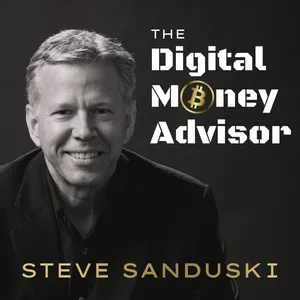
Free Daily Podcast Summary
Digital Money Advisor: Daily Summaries Delivered
by Steve Sanduski
Get key takeaways, quotes, and insights from Digital Money Advisor in a 5-minute read. Delivered straight to your inbox.
Latest Episodes
The most recent episodes — sign up to get AI-powered summaries of each one.
- Feb 14, 20221h 19m
Bitcoin's Impact on War, Geopolitics, and the Treasury System with Matthew Pines
In a Nutshell: Matthew Pines says trying to speculate and reason about the future evolution of geopolitics and state relations in the absence of Bitcoin is extremely difficult. "In fact, it's probably one of the things that stresses all world leaders out and economists and hedge funds. Everyone's trying to predict how the global system is going to evolve so trying to answer the question of how the global system's going to evolve WITH Bitcoin imposes an additional complexity," he said. Yet, this difficulty doesn't stop us from trying or from gaming out different possible scenarios. In today's show, Matthew Pines and I discuss the current state of geopolitics among Russia, Ukraine, China, and the US, and the potential role that Bitcoin, stablecoins, central bank digital currencies, and US treasuries might play in shaping the denouement. And we zoom out as well and discuss whether widespread Bitcoin adoption can act as a deterrent to war in general and why Bitcoin might reduce certain incentives to initiate war but not all of them. Guest: Matthew Pines, Management Consultant, Fellow - National Security, International Policy at the Bitcoin Policy Institute.
- Feb 9, 20221h 25m
Bitcoin, the Climate Crisis, and Financialization with Margot Paez (aka jyn urso)
Margot Paez says the financialization of the US economy is one reason why it's been difficult to take decisive action on climate change. She views Bitcoin "as a very important tool in this whole process because it exists outside of the system. And it's also kind of an attack on the existing financial structures because it takes away a centralized power basically from Wall Street and decentralizes it in a very non-coercive way. And everybody has an opportunity to participate in it and use Bitcoin to their benefit." The challenge for bitcoiners like my guest today, Margo Paez, is how to dispel the FUD and encourage companies and governments to actualize the benefits that Bitcoin offers. We don't need to wait 10 or 20 years to harness Bitcoin's ability to address climate change or wealth inequality. And emphasizing the power of Bitcoin's present might be the surest path towards realizing its potential for a more equitable future. Guest: Margo Paez (aka jyn urso on Twitter), Fellow – Renewable Energy, Environmental Studies, Bitcoin Policy Institute and a PhD candidate in the civil engineering department at Georgia Institute of Technology.
- Jan 27, 20221h 14m
Bitcoin's Connection to Religion, Metaphors, Belief Systems, and Being a Force for Good with Mark Stephany
In a Nutshell: This was a thoughtful, introspective, and heartfelt conversation with Mark Stephany. As a doctor, he's been on the frontlines of the culture war that's flamed up around Covid and vaccines. As the son of a priest and a nun, he's explored and questioned the meaning of religion and the power of myths and metaphors. As a person concerned about the direction of society, he's explored racial and social justice issues. And as a curious person, he's deeply explored Bitcoin and how it can be a force for good. In our conversation, we explore these big issues and discuss connections to Bitcoin. For example, many of the current Twitter wars about whether Bitcoin is -- or should be -- progressive are missing the point. The ultimate promise of Bitcoin isn't a particular political ideology, it's sovereignty for the individual user. A progressive might use that sovereignty to help marginalized communities facing unjust barriers to our current financial system. A conservative might see sovereignty as a means of separating their finances from the control of the state. And people in other countries might define sovereignty as building and transporting wealth outside the reach of oppressive regimes. Bitcoin can actualize beliefs that are important to us and help us gain a better understanding of what's important to others. Guest: Mark Stephany, doctor, entrepreneur, and host of The Progressive Bitcoiner podcast.
- Jan 15, 20221h 23m
The Politics of Bitcoin with Dennis Porter
In a Nutshell: People tend to get triggered when you talk about the politics of Bitcoin. Bitcoin is a technology but it is also a political protest statement in the sense that it is separating money from state and it gives you the option to opt-out. Whether you are left, right, center, up, down, sideways, progressive, libertarian, non-labeled, or Trumpian, almost everyone who coalesces around Bitcoin agrees that monetary policy left in the hands of a few unelected bureaucrats is, and has been shown to be, a relative disaster. But when you go beyond that, look out, it becomes a politics of Bitcoin food fight (at least on Twitter!). Recently, the political power of Bitcoiners has come into focus and one of the people leading the charge is Dennis Porter. Guest: Dennis Porter, host of Smart People Sh*T, a podcast focused on exploring bitcoin as a technology and as a tool to help reshape society for the good. We Discuss: Is Bitcoin inherently political? The social and political philosophies that might have factored into the creation of Bitcoin. What the "milkshake theory" says about a future where the U.S. dollar and Bitcoin coexist. How a renewed focus on states' rights could lead to competition that's healthy for Bitcoin and the broader U.S. economy. Why Dennis believes Bitcoin could turn down the temperature in our political debates and, potentially, help the U.S. steer clear of another civil war. How Bitcoin could create both a check on government overreach and a safeguard for individual rights. The ramifications of getting Bitcoin-friendly politicians elected. What Bitcoin "fixes" related to politics. How Bitcoin can hold politicians accountable to their constituents. The nuance of the Bitcoin single issue voter. What a Republican sweep in 2022 and 2024 could mean.
- Jan 13, 20225h 15m
The Philosopher Kings of Bitcoin with Andrew Bailey, Bradley Rettler, Craig Warmke, and Troy Cross
In a Nutshell: One of the beautiful things about Bitcoin is its interdisciplinary nature. To really "get" Bitcoin, you have to have at least a working knowledge of a wide variety of disciplines. That's one reason why I love talking to academic philosophers who are also Bitcoiners. They have frameworks to help us understand the expansive and interconnected nature of Bitcoin and the kinds of questions we should be asking ourselves about it. Here's Andrew Bailey, Bradley Rettler, and Craig Warmke writing at Coindesk: Philosophy is all-inclusive, the ultimate bundled interdiscipline. Bitcoin pairs well with philosophy because every one of its ingredients falls within the purview of philosophical research. Philosophers draw from whatever evidence is relevant – and evidence relevant to Bitcoin spans psychology, economics, cryptography and more. But neither psychology, nor economics, nor cryptography, nor computer science alone provides a deep understanding of the system as a whole. A bird's eye view of Bitcoin is necessarily a philosophical one. In today's show, I combine four previously released conversations with the leading Bitcoin philosophers into one mega 5-hour show. Necessarily, we cover a broad range of topics that I hope will add to your knowledge and appreciation for this thing we call Bitcoin. Guests in Alphabetical Order: Andrew Bailey, Associate Professor of Philosophy at Yale-NUS college in Singapore Bradley Rettler, Assistant Professor of Philosophy at the University of Wyoming, Craig Warmke, Assistant Professor of Philosophy at Northern Illinois University Troy Cross, Professor of Philosophy and Humanities at Reed College in Oregon.
- Jan 6, 20221h 19m
Making the Progressive Case for Bitcoin with Nicole Dobrow
In a Nutshell: Bitcoin is for everyone including people who align with progressive values. A growing group of progressives see Bitcoin as a tool for furthering social justice and leveling the economic playing field. Nicole passionately shares why people with progressive values should adopt Bitcoin now to ensure they don't get left behind as the world financial system moves toward a Bitcoin standard. Guest: Nicole Dobrow, a prolific Bitcoin writer, social worker, and progressive Bitcoiner who fell down the rabbit hole and now sees Bitcoin as a life raft for people in marginalized communities and the LGBTQ community.
- Dec 28, 20212h 27m
The Expansive Nature of Bitcoin with Troy Cross
In a nutshell: Troy Cross and I discuss philosophical angles related to Bitcoin including what Plato and Aristotle would have thought of Bitcoin, how to influence skeptics of Bitcoin, a new proposal to incentivize green mining, and why Troy does not regret paying 5 bitcoin for a pair of Alpaca socks. Guest: Troy Cross, Professor of Philosophy and Humanities at Reed College and a self-described "Philosopher, Environmentalist, and Bitcoiner."
- Dec 8, 20211h 10m
What Financial Advisors Should Think, Feel, and Do About Bitcoin, Crypto, and DAOs with Steve Larsen and Adam Blumberg
In a Nutshell: The tentative embrace of Bitcoin and other digital assets by advisors and institutions was one of the biggest stories in financial services this year. As more professionals clear the emotional ("It's a scam!") and educational ("I don't get it.") hurdles, now we have to overcome the operational hurdles. The story of 2022 could very well be how a new wave of fintech platforms and forward-thinking leaders solve those challenges and make digital assets an essential tool in helping clients build wealth. Guest: Steve Larsen, CPA, CFP® is a Partner at Columbia Advisory Partners where he manages financial planning and digital asset strategies. He also teaches financial planning and cryptocurrency classes at Gonzaga University and develops continuing education courses for CPAs and CFPs. Adam Blumberg, CFP®, is the co-founder of Interaxis, a company that provides research and education to advisors and companies in the cryptocurrency, digital assets, blockchain, and DeFi space. Steve and Adam are the Co-Founders of Planner DAO, a decentralized autonomous organization owned by financial planners.
Get Digital Money Advisor summaries in your inbox
Free AI-powered daily recaps. Key takeaways, quotes, and mentions — in a 5-minute read.
Get Free Summaries →Free forever for up to 3 podcasts. No credit card required.
You Might Also Like
Listeners also like.
Magic Internet Money
Brad Mills
Bitcoin Advisory Podcast
Stephan
The Bitcoin Frontier
Unchained Capital, Inc

Cryptoconomy
Cryptoconomy
Stratacast
David Seroy
Think Bitcoin Podcast
Logan
Money Reimagined
CoinDesk

State of Bitcoin with Brandon Keys
Green Candle Investments

Bitcoin Rails | Isabel Foxen Duke
Isabel Foxen Duke
The Bitcoin Edge
Paula Iversen

Gday Bitcoin
Sean Clarke
Founding Bitcoin
Kaz Bycko
About Digital Money Advisor
Enlightening conversations about digital money, the macro factors affecting it, and the investment opportunities that result. We're especially fond of Bitcoin!
Customized Recaps
AI-powered recaps with compact key takeaways, quotes, and insights.
Straight to Your Inbox
Get key takeaways from Digital Money Advisor in a 5-minute read.
Save Hours Every Week
Stay current on your favorite podcasts without falling behind.
Frequently Asked Questions
What is Podzilla's Digital Money Advisor daily summary?
It's a free AI-powered email that summarizes new episodes of Digital Money Advisor as soon as they're published. You get the key takeaways, notable quotes, and links & mentions — all in a quick read.
How does the Digital Money Advisor podcast summary work?
When a new episode drops, our AI transcribes and analyzes it, then generates a personalized summary tailored to your interests and profession. It's delivered to your inbox every morning.
Is this an official Digital Money Advisor product?
No. Podzilla is an independent service that summarizes publicly available podcast content. We're not affiliated with or endorsed by Steve Sanduski.
Can I get summaries of other podcasts too?
Absolutely! The free plan covers up to 3 podcasts. Upgrade to Pro for 15, or Premium for 50. Browse our full catalog at /podcasts.
How often does Digital Money Advisor release new episodes?
Digital Money Advisor publishes biweekly. Our AI generates a summary within hours of each new episode.
What topics does Digital Money Advisor cover?
Digital Money Advisor covers topics including Technology, Business, Investing. Our AI identifies the specific themes in each episode and highlights what matters most to you.
Start getting Digital Money Advisor summaries tomorrow morning.
Free forever for up to 3 podcasts. No credit card required.
Free forever for up to 3 podcasts. No credit card required.