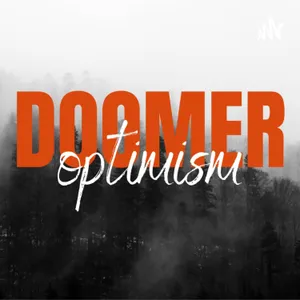
Free Daily Podcast Summary
Doomer Optimism: Daily Summaries Delivered
by Doomer Optimism
Doomer Optimism is a podcast dedicated to discovering regenerative paths forward, highlighting the people working for a better world, and connecting seekers to doers.
Latest Episodes
The most recent episodes — sign up to get AI-powered summaries of each one.
- 3 days ago1h 26m
DO 311 - Mike Healy Manufacturing Community
Every once in a while someone comes into the DO world and it is so clear how well they fit in it’s amazing you hadn’t found them yet! This is true of Mike, Chicagoan, Northsider (boo!), who has a vision for how to make good things in the world and is working to do so. Right now that looks like a manufacturing business he started, but Mike talks through his whole trajectory from fancy universities, working in politics, Chicago river ship boat captain, to trying to revitalize middle side American cities (with the help of Nick Offerman).You can support Mike’s work here: www.wilmot-productions.com
- 2 weeks ago1h 28m
DO 310 - Chapter House with Josh and Hannah Centers
This episode explores how Josh and Hannah Centers built Chapter House, a publishing project designed to restore beautiful, culturally literate children’s books to homeschool families. From Homer and Shakespeare to Beowulf, Greek myth, and Our Island Story, they explain why classic literature still matters for forming attention, imagination, and virtue in a distracted age.They also share the homeschooling experiences that shaped their philosophy, including Hannah’s background as a public school teacher, their journey with a dyslexic child, and why Charlotte Mason’s ideas about habit training and whole-person education continue to guide their work. Josh makes the case that the liberal arts are even more important in the age of AI, while Hannah describes how the right book can open a reluctant reader’s world.If you care about education, great books, or raising kids with depth and resilience, this conversation offers a thoughtful and hopeful vision for what learning can be.
- 3 weeks ago41 min
DO 309 - Bill Kauffman
"But at Least They're Human: Face-to-Face Living -- With Joy and Without Illusions"From the conference: Another Life is Possible co-organized by the Woodcrest Bruderhof community, Doomer Optimism and Savage Collective, July 2026https://doomeroptimism.substack.com/p/do-308-bill-kauffman
- Aug 14, 20261h 7m
DO 308 - Growing Pecans with Lenny Wells
Tom and Jason talk to Lenny Wells - pecan farmer and extension agent - about growing pecans in Georgia, the cultural and ecological factors.Along the way we also discuss:-how he got into pecans -his book on pecans-consulting with a pecan farmer in Spain-his love for Wendell Berry, and -fly-fishing in MontanaEnjoy!
- Aug 3, 20261h 31m
DO 307 - Microcolleges with Jacob Hundt
In this episode Ashley and Jacob discuss the concept of microcolleges, and examples of alternative educational models writ large. Timestamps:00:00 - Intro: Exploring education, community, and sustainability02:27 - How a class on sustainable development shifted a life trajectory04:02 - Higher education as transformative yet bureaucratic: a nuanced view06:20 - The role of micro-colleges as laboratories for alternative education models08:20 - Microcollege principles: human scale, place-based focus, holistic curriculum10:12 - Experiential learning in agriculture and sustainability in Uruguay13:19 - Moving to Uruguay: motivation, land, community, and self-sufficiency16:26 - The influence of environmental sociology and fieldwork on education18:13 - Rizoma and regenerative agriculture: connecting resources across bioregions23:21 - Adapting the Uruguay model to local high schools and legislative advocacy26:13 - The challenges of bureaucratic hurdles in US-based experiential programs27:27 - The origins and evolution of Thoreau College in Wisconsin28:05 - Deep roots in the Driftless region, organic farming, and educational experimentation29:04 - Waldorf pedagogy, family-centered schooling, and youth leadership31:51 - Deep Springs College: history, pillars, and self-governance34:40 - The influence of Nicola Tesla and pioneering education in remote settings36:27 - The unique, small scale, and community-centered design of Deep Springs and inspired schools40:34 - Gender, environment, and community: reflections on co-ed versus single-sex models41:26 - The importance of family and nurturing environments in education communities43:11 - The role of place-based knowledge and historical understanding in cultivating belonging45:27 - The holistic curriculum: arts, nature, and expedition-based experiential learning48:45 - The ethics and profundity of slaughtering animals as a ritual of reverence50:05 - Broadening perspectives: practical engagement over superficial debates54:35 - The significance of embodied work, such as farming and outdoor survival skills55:55 - Building agency through collective effort and sharing tangible skills62:45 - The impact of experiential and community-based learning on resilience65:05 - Ideals of subsidiarity and bioregional identity as anchors for local culture66:39 - The cultural and environmental richness of bioregions like the Driftless70:47 - The importance of place-based storytelling, native histories, and ecological literacy75:34 - The power of local, tangible practices versus abstract ideologies77:26 - The role of shared projects in dissolving superficial divisions85:12 - Cultivating inner resilience and emotional strength through holistic education87:11 - Moving from global scale despair to local scale action and empowerment89:04 - The importance of facing difficulties together and growing through challenge90:46 - The value of community hubs and bioregional identity in creating hope and agency
- Jul 15, 20261h 29m
DO 306 - Building New Athens with Jackson Solway
Movetonewathens.comTIMESTAMPS: 00:00 - Introducing the idea of building a city from scratch to address societal doom02:08 - Jackson’s background in tech and recruitment influencing city planning03:03 - The role of ambition and ecosystem understanding in city development06:20 - How tech industry recruitment reveals societal dysfunction and potential solutions08:39 - The cultural decline: urban decay, regulations, and family disconnection11:48 - The blueprint for New Athens: promises to residents and leveraging local incentives15:07 - Examining societal doom: urban chaos, lawlessness, and cultural disintegration18:19 - Why cities are the optimal size for revival and the role of regulations19:16 - Ideal demographic makeup: balancing virtue, ambition, and risk-taking21:49 - Global and regional efforts for renewal: bioregions, state lines, and culture-based organization26:56 - Practical steps for deregulation and attracting people, businesses, and investors33:01 - The significance of moral bounds, virtue, and community in city planning42:50 - The importance of craft manufacturing, local food, and human-scaled urban design46:47 - Envisioning a human-friendly, tech-lite city culture52:28 - Population growth, family life, and the cultural mimetic effect58:40 - The collapse of woke ideology and the rise of anti-tech, pro-human movements65:00 - AI as a secular religion, the need to maintain human sovereignty and meaningful life71:01 - The role of technology regulation: keeping devices off the body and emphasizing human presence76:33 - The dynamics of institution-building, trust, and leadership challenges83:50 - The archetype of visionary leaders and operational builders for city creation88:17 - How to follow and support the New Athens project
- Jun 16, 20261h 8m
DO 305 - Orthodox Masonry
Patrick Lemmon and Seth HarrisIn this episode, Patrick and Seth discuss the principles of traditional and orthodox building methods, the importance of local materials, and the future of sustainable construction. They explore how craftsmanship, local culture, and thoughtful design can create enduring and meaningful structures.Keywords:building, masonry, traditional construction, local materials, sustainability, architecture, craftsmanship, Vermont, masonry revival, orthodox Chapters00:00 Introduction to the Built Environment and Human Flourishing03:00 Personal Journeys in Craftsmanship and Building Traditions05:58 The Philosophy Behind Orthodox Masonry08:54 The Importance of Teamwork in Craftsmanship11:50 Learning from Nature: Building with Local Materials15:00 Challenging Traditional Building Practices18:02 The Historical Context of Building in Vermont21:04 The Concept of Housewrights and Holistic Building23:57 The Impact of Industrialization on Building Practices27:03 The Relationship Between Building Materials and Environment29:59 The Future of Building: Embracing Local and Sustainable Practices40:02 The Impact of Flooding on Homes41:56 The Evolution of Building Materials43:50 Ventilation and Heating in Masonry Homes50:04 Design Principles in Architecture52:00 The State of the Building Arts Movement01:03:04 Optimism in Building PracticesOrthodox Masonry is a design/build firm specializing in structural masonry and timber frame construction. Creating buildings that are both structurally and aesthetically resilient, we offer an alternative to disposable construction. https://www.orthodoxmasonry.com/about
- May 27, 20261h 5m
DO 304 - Courtyard Urbanism with Alicia Pederson
In this episode, Alicia Pederson, founder of Courtyard Urbanist, takes us on a fascinating journey from ancient Rome to today’s urban development roadblocks. She explains how courtyard-based architecture can address housing shortages, social isolation, and environmental concerns—all while creating vibrant, affordable neighborhoods for middle-class families.Read more about Alicia's work and vision here: https://courtyardurbanist.com/p/welcome-to-courtyard-urbanist
Get Doomer Optimism summaries in your inbox
Free AI-powered daily recaps. Key takeaways, quotes, and mentions — in a 5-minute read.
Get Free Summaries →Free forever for up to 3 podcasts. No credit card required.
You Might Also Like
Listeners also like.

Optimist Economy
Economists discuss U.S. economic challenges and practical solutions to improve outcomes for workers, retirees, and aspiring Americans.

Joe Lonsdale: American Optimist
Conversations with innovators and leaders working on solutions to America’s biggest challenges, emphasizing optimism and progress.
A Bit of Optimism
Conversations with thinkers and doers exploring what drives purpose, growth, and meaning in life.

Makes Sense - with Dr. JC Doornick
Explores everyday mysteries and thought-provoking questions about human behavior and reality.

Health Optimization Medicine Podcast
Experts discuss health optimization, performance, and decision-making with insights from neuroscience, medicine, and consciousness.

Better Offline
Ed Zitron investigates how tech’s powerful players shape society, from crypto scams to venture capital, through interviews and critical analysis.

The Diary Of A CEO with Steven Bartlett
Conversations with CEOs, experts, and leaders exploring personal growth, mindset, and the realities of building successful businesses.
Fuller Expectations
Explores living with purpose, reinvention, and personal growth in midlife and beyond.

Soul Boom
Conversations about creativity, spirituality, and psychology with artists and thinkers exploring the human experience.

The Great Simplification with Nate Hagens
Discussions with experts on energy, ecology, economics, and human behavior to understand the systemic challenges facing civilization.
Commune with Jeff Krasno
Explores practices and ideas for healthy, purposeful living through conversations on wellness, spirituality, and societal well-being.

Happier in Hollywood
Two veteran TV writers share candid insights on surviving and thriving in Hollywood’s competitive entertainment industry.
Customized Recaps
AI-powered recaps with compact key takeaways, quotes, and insights.
Straight to Your Inbox
Get key takeaways from Doomer Optimism in a 5-minute read.
Save Hours Every Week
Stay current on your favorite podcasts without falling behind.
Frequently Asked Questions
What is Podzilla's Doomer Optimism daily summary?
It's a free AI-powered email that summarizes new episodes of Doomer Optimism as soon as they're published. You get the key takeaways, notable quotes, and links & mentions — all in a quick read.
How does the Doomer Optimism podcast summary work?
When a new episode drops, our AI transcribes and analyzes it, then generates a personalized summary tailored to your interests and profession. It's delivered to your inbox every morning.
Is this an official Doomer Optimism product?
No. Podzilla is an independent service that summarizes publicly available podcast content. We're not affiliated with or endorsed by Doomer Optimism.
Can I get summaries of other podcasts too?
Absolutely! The free plan covers up to 3 podcasts. Upgrade to Pro for 15, or Premium for 50. Browse our full catalog at /podcasts.
How often does Doomer Optimism release new episodes?
Doomer Optimism publishes weekly. Our AI generates a summary within hours of each new episode.
What topics does Doomer Optimism cover?
Doomer Optimism covers topics including Education, How To. Our AI identifies the specific themes in each episode and highlights what matters most to you.
Start getting Doomer Optimism summaries tomorrow morning.
Free forever for up to 3 podcasts. No credit card required.
Free forever for up to 3 podcasts. No credit card required.