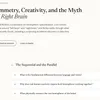
DL Ep. 33: The Left Brain / Right Brain Myth with Dr. Richie Davidson and Dr. Cortland Dahl
Reminder: Join us tonight at 8pm ET for a live Ask Me Anything with Richie and Cort. Send questions in advance by replying to this email or drop a comment.In this episode, Richie and Cort continue their conversation on brain asymmetry by revisiting one of the most popular neuroscience ideas of the 1990s: the divide between the “left brain” and the “right brain.” Was the right hemisphere really the creative side of the brain, and the left hemisphere the logical one? Richie explains where that idea came from, what it got right, and why it was taken too far. Along the way, he explores language, visual-spatial processing, the 200 million neurons connecting the hemispheres, and why real creativity may depend less on one side of the brain than on the coordination between both.Watch on YouTube; Listen on Spotify or Apple Podcasts.If these conversations are useful, please consider subscribing to our YouTube channel.CHECK OUT EPISODE COMPANION FLASHCARDS below!This is the second part of our conversation on hemispheric specialization with Dr. Richard Davidson and Dr. Cortland Dahl. For the first part, see Your Brain Is a Storyteller, where we explore what split-brain research reveals about consciousness and emotion. For more on the popular science misreadings Richie warns about here, see our recent episode on Why dopamine isn't your problem. Dr. Richard Davidson is the William James and Vilas Research Professor of Psychology and Psychiatry at the University of Wisconsin–Madison and founder of the Center for Healthy Minds and the Healthy Minds App. His new book with Dr. Cortland Dahl, Born to Flourish, was published by Simon & Schuster in March 2026.Podcast Chapter List00:00:00 – Intro clip: Creativity requires both hemispheres00:01:30 – Welcome to Dharma Lab00:02:47 – Left brain/right brain ideas in popular culture00:04:00 – Where did these ideas come from?00:05:11 – Language, handedness, and hemisphere differences00:07:36 – The myth of the creative right brain00:08:50 – The 200 million neurons connecting both hemispheres00:10:38 – Split-brain patients and the corpus callosum00:11:57 – What surprised Richie in the early asymmetry research?00:13:10 – The resting brain data they almost threw away00:15:15 – Stable patterns in the resting brain00:16:04 – From “noise” to emotional style00:18:23 – The prefrontal cortex and emotion00:19:58 – Could you choose to use one side of the brain?00:21:52 – A grain of truth, taken too far00:22:55 – Sequential vs. parallel processing00:23:50 – Why real creativity requires both hemispheres00:24:51 – Interhemispheric coordination and creativity00:26:08 – Tibetan mudras and two-handed movement00:27:31 – Visualization, imagination, and creativity00:28:34 – ClosingEarlier Post on Brain Asymmetry (Part 1)Written transcript for those who prefer to readLightly edited for clarity and readability.Intro clip: Creativity requires both hemispheres00:00Richard Davidson:One of the things that’s true about language, and especially about speech, is that it’s sequential. We can’t say six words at the same time. Just can’t do it.Cortland Dahl:I’m pretty sure my son could when he was really young, but in any case, it’s usually true.Richard Davidson:Usually true. But if you have pictures of those six words — let’s say there are six animals and you present a picture — you can see all six at the same time.That difference is what we call sequential versus parallel processing. There are certain kinds of visual-spatial skills that can be done more in parallel, and other kinds of skills and tasks that require more sequential activity.And of course, real human creativity, I think, requires both.Th
Podzilla Summary coming soon
Sign up to get notified when the full AI-powered summary is ready.
Free forever for up to 3 podcasts. No credit card required.
Listen to This Episode
More from Dharma Lab

Does Meditation Really Change Your Brain?
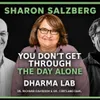
You Don't Get Through The Day Alone - Sharon Salzberg on DL Ep. 36
The Superpowers in Your Brain’s Wiring with Dr. Richard Davidson and Dr. Cortland Dahl (DL #35)
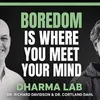
Boredom is Where You Meet Your Mind; DL Ep.34 with Dr. Richie Davidson and Dr. Cortland Dahl
Get summaries like this every morning.
Free AI-powered recaps of Dharma Lab and your other favorite podcasts, delivered to your inbox.
Free forever for up to 3 podcasts. No credit card required.