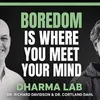
Boredom is Where You Meet Your Mind; DL Ep.34 with Dr. Richie Davidson and Dr. Cortland Dahl
We now live in a world where boredom is almost optional. The moment there is a gap in the day, we can reach for a device and instantly distract ourselves.In this episode of Dharma Lab, Dr. Richard Davidson and Dr. Cortland Dahl explore boredom and restlessness from both a scientific and contemplative perspective. Richie explains why boredom often brings us face to face with the “default mode” of the brain, the self-referential narrative we carry around about who we are. Cort reflects on the physical, restless energy of boredom, and how meditation can turn that discomfort into an object of curiosity. They also offer a simple and powerful tool to bring more awareness into our day: the next time we feel the urge to escape boredom, we can pause, notice the urge, and let that moment become a practice.Watch on YouTube; Listen on Spotify or Apple Podcasts.If these conversations are useful, please consider subscribing to our YouTube channel.Episode Companion Flashcards!In this episode00:00:00 – Have we lost the ability to be bored?00:00:58 – Why boredom matters00:01:21 – “I could not sit still”00:03:34 – Boredom and comfort with our own mind00:04:19 – The default mode network00:05:01 – Why awareness can feel uncomfortable at first00:06:52 – The body’s role in restlessness00:08:36 – Richie’s childhood outlet: the bicycle00:11:12 – Why kids need to move00:12:15 – Meditation as training for boredom00:13:19 – Phones as an escape from discomfort00:14:41 – The everyday practice of not checking your phone00:16:25 – Turning the urge into a cue for awareness00:18:44 – What does boredom actually feel like?00:20:21 – Who is actually bored?00:22:03 – Turning ordinary waiting into practiceWritten transcript for those who prefer to read00:00:00 – Have we lost the ability to be bored?Cortland Dahl:We’re now living in a world where we just have such an easy escape hatch. We carry around these devices, and it’s so easy to distract ourselves that I feel like we’ve almost developed an incapacity to be bored.Richie Davidson:Our response to boredom, our relationship to boredom, has a lot to do with our comfort with our own mind. One of the things about boredom is that we tend to get bored when there’s not stuff for us to do. And when there’s not stuff for us to do, we are confronted inevitably by our own mind.00:00:58 – Why boredom mattersCortland:Hello everyone. Welcome to Dharma Lab. I’m here with my dear friend and colleague, Dr. Richard Davidson, one of the world’s eminent neuroscientists, and I’m Cortland Dahl.Today we’re going to talk about something I think probably everybody experiences, and maybe experiences a lot, which is boredom and restlessness.00:01:21 – “I could not sit still”Cortland:I have such vivid memories of this. If we had a normal distribution of where people fall and how easily bored they are, I’m pretty sure I would have been an outlier. I was so easily bored as a kid. I was one of those kids who just could not sit still.I have vivid memories, especially of summer afternoons, sitting at home and desperately trying to call my friends to see if anybody wanted to hang out. There was nothing on TV. This was back in the days before you could get everything on demand, just boring daytime TV shows.And I remember this feeling of crawling out of my skin. I literally could not sit there. We had no mobile phones. This was long before the iPhone and smartphones. But I would have done anything to have had something like that.Now it’s kind of amazing. After years of meditation, I would say if one thing has changed in my life, it’s my relationship to boredom. I kind of feel like I’m immune to boredom now. There’s a whole long practice history with that.But I thought we could start by talking about boredom because we’re now living in a world where we have such an easy escape hatch. We carry around these devices, and it’s so easy to distract ourselves that I feel like we’ve almost developed an incapacity to be bored, to just sit with that.So maybe we could talk about it from a scientific perspective. We can both share our personal experiences. But let me kick it over to you, Richie, and see
Podzilla Summary coming soon
Sign up to get notified when the full AI-powered summary is ready.
Free forever for up to 3 podcasts. No credit card required.
Listen to This Episode
More from Dharma Lab

Does Meditation Really Change Your Brain?

You Don't Get Through The Day Alone - Sharon Salzberg on DL Ep. 36
The Superpowers in Your Brain’s Wiring with Dr. Richard Davidson and Dr. Cortland Dahl (DL #35)
DL Ep. 33: The Left Brain / Right Brain Myth with Dr. Richie Davidson and Dr. Cortland Dahl
Get summaries like this every morning.
Free AI-powered recaps of Dharma Lab and your other favorite podcasts, delivered to your inbox.
Free forever for up to 3 podcasts. No credit card required.