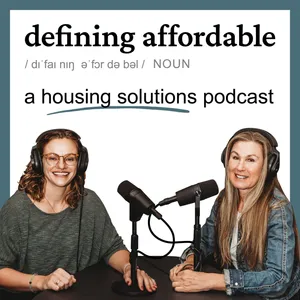
Free Daily Podcast Summary
Defining Affordable: A Housing Solutions Podcast: Daily Summaries Delivered
by Jaime Albarelli and Robin Martinez
Defining Affordable: A Housing Solutions Podcast explores the policies, history, and real-world forces behind the chronic—and increasingly severe—shortage of affordable housing in the United States. Hosted by affordable housing professionals Jaime and Robin, the show breaks down complex housing issues and highlights practical solutions for people working in the housing industry, curious listeners who want to better understand the problem, and those navigating the challenges of finding an affordable place to live.
Latest Episodes
The most recent episodes — sign up to get AI-powered summaries of each one.
- Aug 7, 202643 min
Transit-Oriented Development: What Makes It Work?
Transit-oriented development promises to connect housing, transportation, and opportunity—but simply building homes near a train or bus station isn't enough. Our first guest, Jacob Billitteri, Senior Project Manager at Affirmed Housing, joins us to explore what it actually takes to create successful transit-oriented communities and why thoughtful planning matters as much as the housing itself.Using the Berryessa Transit Center development in San José as a real-world case study, we examine how affordable housing, public transit, zoning, financing, and infrastructure can work together to create more connected communities. We also discuss California's SB 79, the challenges facing transit-oriented development, and why reliable transit and long-term regional planning are essential if these communities are going to succeed.Editor's Note: At the beginning of this episode, we revisit a correction from our previous discussion of institutional investors and the 21st Century ROAD to Housing Act. Additional information and sources are included below.Sources & More ReadingTransit-Oriented DevelopmentUrban Institute. Transit-Oriented Development. https://www.urban.org/tags/transit-oriented-developmentUrban Institute. Transit-Oriented Development Can Help Cities Grow. Which Urban Areas Are Doing Best? https://www.urban.org/urban-wire/transit-oriented-development-can-help-cities-grow-which-urban-areas-are-doing-bestReconnecting America. Case Studies for Transit-Oriented Development. https://www.njtod.org/wp-content/uploads/2023/09/Briefing-Report-Number-3-Case-Studies-for-Transit-Oriented-Development-ReConnecting-America.pdfSB 79California Department of Housing and Community Development. SB 79 Transit-Oriented Development. https://www.hcd.ca.gov/planning-and-research/sb79-todCalifornia YIMBY. SB 79. https://cayimby.org/legislation/sb-79/CalMatters. How California's SB 79 Could Reshape Housing Near Transit. https://calmatters.org/housing/2026/04/sb-79-implementation/Berryessa Transit CenterCity of San José. Berryessa BART Urban Village. https://www.sanjoseca.gov/your-government/departments-offices/planning-building-code-enforcement/planning-division/citywide-planning/urban-villages/berryessa-bartStrategic Growth Council. Nearly 200 Affordable Homes Break Ground at Berryessa Transit Center. https://sgc.ca.gov/newsroom/press-releases/2026/nearly-200-affordable-homes-break-ground-at-berryessa-transit-center-in-san-jose/Live at Berryessa. https://www.liveatberryessa.com/homeStrategic Growth Council. Affordable Housing and Sustainable Communities (AHSC) Program. https://sgc.ca.gov/grant-programs/ahsc/San Diego Transit & HousingSANDAG. 2025 Regional Plan. https://www.sandag.org/regional-plan/2025-regional-planKPBS. Breaking Down SANDAG's $125 Billion Spending Plan. https://www.kpbs.org/news/quality-of-life/2026/02/09/breaking-down-sandags-125-billion-spending-planSANDAG. Draft SB 79 Transit-Oriented Development Map. https://www.sandag.org/projects-and-programs/regional-initiatives/housing/draft-sb-79-transit-oriented-development-mapSan Diego HistorySan Diego History Center. Streetcars C
- Jul 21, 202651 min
Breaking Down the 21st Century ROAD to Housing Act
Congress has passed the bipartisan 21st Century ROAD to Housing Act, one of the most significant federal housing bills in years. But unlike many housing bills, this isn't primarily about spending more money. It's about changing the rules that shape how housing gets built.This episode breaks down what the legislation actually does, including reforms to Community Development Block Grants, environmental reviews, manufactured and modular housing, building codes, homeownership programs, and housing development incentives. It also explores where the bill makes meaningful progress, where it falls short, and why implementation by states and local governments will ultimately determine its impact.Editor's Note: During our discussion of the institutional investor provisions, we referenced a requirement that certain build-to-rent and renovate-to-rent homes must be sold to individual buyers after seven years. After recording, we learned this provision appeared in an earlier version of the legislation but was removed before the final bill became law. We'll discuss this correction at the beginning of our next episode.Sources & Further ReadingAbout the 21st Century ROAD to Housing ActCongress.gov – H.R. 6644: 21st Century Road to Housing Act (Full Bill Text)https://www.congress.gov/bill/119th-congress/house-bill/6644/textBipartisan Policy Center – Inside the Deal: What's in the Final 21st Century Road to Housing Acthttps://bipartisanpolicy.org/issue-brief/inside-the-deal-whats-in-the-final-21st-century-road-to-housing-act/National Low Income Housing Coalition – 21st Century ROAD to Housing Act Explainerhttps://nlihc.org/sites/default/files/21ST_Century_ROAD_Explainer.pdfVPM / NPR – Bipartisan Home Affordability Bill Passes the Househttps://www.vpm.org/npr-news/npr-news/2026-05-20/bipartisan-home-affordability-bill-passes-the-houseNational Council of State Housing Agencies – Changes in Store for Housing Programs After Congress Passes Comprehensive Housing Billhttps://www.ncsha.org/blog/changes-in-store-for-housing-programs-after-congress-passes-comprehensive-housing-bill/JD Supra – ROAD to Housing Act Unlocks New Funding Opportunities and Regulatory Reformshttps://www.jdsupra.com/legalnews/road-to-housing-act-unlocks-new-funding-7351328/LAist – What the Once-in-a-Lifetime Federal Housing Bill Means for Californiahttps://laist.com/news/housing-homelessness/what-the-once-in-a-lifetime-federal-housing-bill-means-for-californiaEnvironmental Review (NEPA) ReformsNixon Peabody – HUD Environmental Review Reforms Under the ROAD to Housing Acthttps://www.nixonpeabody.com/insights/alerts/2026/06/30/hud-environmental-review-reforms-under-road-to-housing-actSingle-Staircase Apartment BuildingsThe Pew Charitable Trusts – Small Single-Stairway Apartment Buildings Have Strong Safety Recordhttps://www.pew.org/en/research-and-analysis/reports/2025/02/small-single-stairway-apartment-buildings-have-strong-safety-recordNFPA Journal – The Single-Exit Stairwell Debatehttps://www.nfpa.org/news-blogs-and-articles/NFPA-Journal/2024/08/06/The-Single-Exit-Stairwell-DebateInstitutional Inve
- Jul 7, 202628 min
What If Stability Was Just The Starting Line?
Affordable housing creates stability. But what should come next?We've spent a lot of time discussing why homeownership has become increasingly difficult to achieve and what that means for wealth inequality in America. But if fewer people are able to build wealth through traditional homeownership, how do we create new opportunities for renters?This episode explores innovative ideas that challenge the traditional path to wealth-building, including reporting rent payments to credit bureaus, renter wealth creation models, community land trusts, and limited-equity housing cooperatives.These approaches don't replace the need for more affordable housing. They build on it by asking a bigger question: once someone has stable housing, how do we help them build financial security, assets, and long-term opportunity?Housing stability matters. But maybe stability isn't the finish line. Maybe it's where opportunity begins.Sources & Continued ReadingRenter Wealth CreationRenter Wealth Creation — Enterprise Community Partners https://www.enterprisecommunity.org/impact-areas/upward-mobility/renter-wealth-creationInvesting Endowment Funds to Create Savings and Assets for Low-Income Families — Annie E. Casey Foundation https://www.aecf.org/blog/investing-endowment-funds-to-create-savings-and-assets-for-low-income-familiesCommunity Land TrustsUnderstanding Community Land Trusts — Shelterforce https://shelterforce.org/2021/07/12/understanding-community-land-trusts/Stewardship Works — Shelterforce https://shelterforce.org/2010/12/24/stewardship_works/Shared Equity — Shelterforce https://shelterforce.org/2018/05/07/shared-equity/Community Land Trusts: The Basics — Lincoln Institute of Land Policy [verify/update PDF link before publishing]How Community Land Trusts Are Powering Co-op Growth in Canada: Lessons for the U.S. — Grounded Solutions Network https://groundedsolutions.org/how-clts-are-powering-co-op-growth-in-canada-lessons-for-the-u-s/Housing Cooperatives & Limited Equity CooperativesWhat Is Cooperative Housing? — Cooperative Housing International https://www.housinginternational.coop/what-is-a-housing-cooperative/Limited Equity Housing Cooperatives: Why They’re a Solution for Our Times — Nonprofit Quarterly https://nonprofitquarterly.org/limited-equity-housing-cooperatives-why-theyre-a-solution-for-our-times/Housing Co-ops — California Center for Cooperative Development https://www.cccd.coop/co-op-info/co-op-types/housing-co-opsCommunity Land Trusts vs. Co-ops: Resources — Bay Area Community Land Trust https://www.bayareaclt.org/clts-vs-co-ops-resourcesLimited Equity Housing Cooperatives — Sustainable San Mateo https://sustainablesanmateo.org/wp-content/uploads/2024/01/Limited-Equity-Housing-Cooperatives_202401.pdfSan Diego ExampleAvanzando San Ysidro Groundbreaking — San Diego Housing Commission https://sdhc.org/news-release/avanzando-groundbreaking/
- Jun 23, 202641 min
The Cost of Going Backward: HUD's New Approach to Homelessness
HUD recently released its 2026 Continuum of Care (CoC) Notice of Funding Opportunity (NOFO), signaling a major shift in federal homelessness policy. In this special episode of Defining Affordable, Jaime and Robin examine the proposed changes, the evidence behind them, and what they could mean for communities across the country.HUD argues that Housing First has failed and proposes a renewed emphasis on transitional housing, recovery-focused programs, and new measures of self-sufficiency. But do the data support that conclusion?Drawing on decades of research, local experience, and examples from communities across the nation, Jaime breaks down the claims made in the NOFO and explores why many housing professionals are concerned that these changes could reverse hard-won progress in reducing homelessness and improving housing stability.The conversation examines the real costs of homelessness, the effectiveness of Housing First and Permanent Supportive Housing, and the potential consequences of moving away from evidence-based approaches that have helped communities achieve measurable results.Resources referenced during the episode, including opportunities for advocacy and further reading, are included below.Sources & Further ReadingHUD's 2026 Continuum of Care NOFOHUD News Release — HUD Announces 2026 Continuum of Care Notice of Funding Opportunity (NOFO)https://www.hud.gov/news/hud-no-26-038HUD — FY 2026 Continuum of Care Competition Stakeholder Memohttps://www.hud.gov/sites/default/files/OCHCO/documents/Stakeholder-Memo.pdfNational Alliance to End Homelessness — FY 2026 Continuum of Care Competition NOFO Analysishttps://endhomelessness.org/wp-content/uploads/2026/06/FY2026-Continuum-of-Care-Competition-NOFO-Analysis.pdfNational Coalition for the Homeless — HUD Policy Updates and Analysishttps://nationalhomeless.org/tag/hud/Shelterforce — Judge Blocks HUD Overhaul of Federal Funding for Homelessness Serviceshttps://shelterforce.org/2026/01/23/judge-blocks-hud-overhaul-federal-funding-for-homelessness-services/Public Rights Project — National Alliance to End Homelessness v. HUD: Fact Sheethttps://www.publicrightsproject.org/naeh-v-hud-fact-sheet/Housing First & Permanent Supportive HousingUrban Institute — Housing First Is Still the Best Approach to Ending Homelessnesshttps://housingmatters.urban.org/articles-features/housing-first-still-best-approach-ending-homelessnessNational Alliance to End Homelessness — Cost Savings from Permanent Supportive Housinghttps://endhomelessness.org/wp-content/uploads/2017/06/Cost-Savings-from-PSH.pdfJamboree Housing Corporation — Permanent Housing Ends Homelessnesshttps://www.jamboreehousing.com/pages/permanent-housing-ends-homelessness-presentationsNational Center for Biotechnology Information — Housing First Is Associated with Reduced Use of Emergency Medical Serviceshttps://pmc.ncbi.nlm.nih.gov/articles/PMC6446444/Homelessness, Health, & Housing StabilityCalifornia Policy Lab — Health Conditions Among Unsheltered Adults in the United Stateshttps://capolicylab.org/wp-content/uploads/2025/11/Health-Conditions-Among-Unsheltered-Adults-in-the-US.pdfVoice of San Diego — Project 25: The Pilot Project Aimed at San Diego's Most Difficult Homeless Cases Showed Promise—Then Died<a href="https://voiceofsandiego.org/2022/10/17/project-25-the-pilot-project-aimed-at-san-diegos-most-difficult-homeless-cases-s
- Jun 16, 202639 min
If the Economy Is Booming, Why Does Everything Feel Harder?
In our last episode, Work vs. Wealth: Why Homeownership Keeps Moving Out of Reach, we explored the widening gap between wealth and work, making homeownership increasingly difficult to attain.In this follow-up conversation, Robin and Jaime zoom out to examine the broader economic forces behind that trend.If inflation is under control, why do groceries, insurance, and housing feel so much more expensive? If the economy is booming, why do so many people feel like they're working harder just to stay in the same place?To understand that disconnect, Robin and Jaime explore the concept of a K-shaped economy—a framework that helps explain why economic growth can feel very different depending on whether your income comes from assets or wages.Along the way, they discuss the difference between asset inflation and real wealth, why economic indicators often feel disconnected from everyday experience, and how policies designed to stimulate the economy can produce very different outcomes depending on which side of the K you're on.This episode provides the economic context behind the housing affordability challenges discussed in our previous episode—and helps explain why so many people feel like the numbers don't match reality.Sources & Further ReadingUnderstanding the K-Shaped EconomyEncyclopædia Britannica: What Is a K-Shaped Economy?https://www.britannica.com/money/k-shaped-economyIncome Inequality & Wealth GapsPew Research Center: Wealth Gaps Within Racial and Ethnic Groupshttps://www.pewresearch.org/2023/12/04/wealth-gaps-within-racial-and-ethnic-groups/Pew Research Center: Economic Inequality Seen as a Major Challenge Around the Worldhttps://www.pewresearch.org/global/2025/01/09/economic-inequality-seen-as-major-challenge-around-the-world/Housing, Homeownership & Housing FinanceUrban Institute: The Future of Homeownership and Housing Financehttps://www.urban.org/sites/default/files/2025-06/The_Future_of_Homeownership_and_Housing_Finance.pdfUrban Institute: How Expanding Housing Supply and Supporting Demand Can Increase Homeownershiphttps://www.urban.org/research/publication/how-expanding-housing-supply-and-supporting-demand-can-increase-homeownership50-Year MortgagesNPR Planet Money: Is a 50-Year Mortgage Really That Much Crazier Than a 30-Year One?https://www.npr.org/sections/planet-money/2025/11/18/g-s1-98040/is-a-50-year-mortgage-really-that-much-crazier-than-a-30-year-oneFeatured Resource: Gary StevensonRobin references the work of former interest rate trader and economic commentator Gary Stevenson throughout this episode.The Economy Is Rigged for Billionaires (Prof G Podcast featuring Gary Stevenson)https://podcasts.apple.com/us/podcast/the-economy-is-rigged-for-billionaires-ft-gary-stevenson/id1498802610?i=1000766587939Gary's Economics (YouTube Channel)https://www.youtube.com/garyseconomicsFeatured Resource: Gabriel ZucmanEconomist Gabriel Zucman is one of the leading researchers on wealth inequality, taxation, and global wealth concentration.Gabriel Zucman's Website & Researchhttps://gabriel-zucman.eu/A Blueprint for a Coordinated Minimum Effective Taxation Standard for Ultra-High-Net-Worth Individualshttps://gabriel-zucman.eu/files/report-g20.pdfNew Zealand: Housing, Austerity & Social PolicyDuring the episode, Robin and Jaime discuss how other countries are grappling with many of the same challenge
- Jun 9, 20261h 2m
Work Vs. Wealth: Why Homeownership Keeps Moving Out of Reach
For decades, homeownership was one of the primary ways Americans built wealth. Today, even people with good jobs and steady incomes are finding it increasingly difficult to buy a home.In this episode, Robin and Jaime explore how we got here. They unpack the housing boom and crash of 2008, the rise of mortgage-backed securities, and the role investors played in reshaping the housing market. Along the way, they examine a surprising reality of the pre-crash era: borrowers could often qualify for mortgages with little to no income verification and no down payment at all.The conversation also challenges a common political talking point—that institutional investors are the primary reason homeownership is out of reach. While investors are certainly part of the story, the deeper issue lies in decades of policy decisions that have widened the gap between wealth and work.As Robin puts it, opportunities created by wealth are growing exponentially, while opportunities created by work are shrinking. What does that mean for the future of homeownership—and is there still a path forward?In Part 1 of this two-part series, we examine how we got here. In Part 2, we'll explore emerging models that could help more people build wealth and access homeownership in a changing economy.Sources & Continued ReadingMortgage-Backed Securities (MBS)Handbook Chapter on Mortgage-Backed Securities (MBS)https://www.fhfa.gov/Media/PublicAffairs/Documents/Handbook_chapter_on_MBS_slides_final.pdfThe 2008 Financial CrisisFederal Reserve History: The Great Recession and Its Aftermathhttps://www.federalreservehistory.org/essays/great-recession-and-its-aftermathHistory.com: What Caused the 2008 Financial Crisis?https://www.history.com/articles/2008-financial-crisis-causesK-Shaped EconomyEncyclopædia Britannica: What Is a K-Shaped Economy?https://www.britannica.com/money/k-shaped-economyFederal Reserve Bank of New York: Explaining the K-Shaped Economy: What's Behind the Divide?https://libertystreeteconomics.newyorkfed.org/2026/05/explaining-the-k-shaped-economy-whats-behind-the-divide/
- May 26, 202643 min
Strong Opinions, Weak Facts: Debunking Homelessness Myths
What if everything you thought you knew about homelessness was wrong? Jaime and Robin tackle some of the most common — and most harmful — myths surrounding homelessness, using data and policy history to separate fact from fear-driven narratives. From the misconception that homelessness is caused by “bad choices” or drug use, to the belief that people “just don’t want help,” this conversation digs into the real drivers of housing insecurity: skyrocketing rents, a housing shortage, and decades of eroding social safety nets. Along the way, they unpack why veterans programs have succeeded, why homelessness is rising among seniors and families, and why compassion backed by evidence matters more than ever. If you’ve ever wondered how people end up unhoused — or why the crisis keeps growing — this episode will challenge assumptions and change the way you see homelessness in America.Sources and Further Reading:American Addiction Centers. “Substance Abuse by City.” American Addiction Centers, 2023, https://americanaddictioncenters.org/blog/substance-abuse-by-cityAddiction Center. “Top 10 States With the Highest Overdose Rates.” AddictionCenter.com, https://www.addictioncenter.com/community/top-10-states-highest-overdose/California Health Care Foundation / CalMatters. “Federal Homelessness Report Delayed Amid National Housing Crisis.” CalMatters, May 2026, https://calmatters.org/housing/homelessness/2026/05/homelessness-report-delayed/Centers for Disease Control and Prevention. “Drug Overdose Deaths by State.” CDC National Center for Health Statistics, https://www.cdc.gov/nchs/state-stats/deaths/drug-overdose.htmlCulhane, Dennis, et al. “California Statewide Study of People Experiencing Homelessness (CASPEH).” National Library of Medicine / NIH, 2023, https://pmc.ncbi.nlm.nih.gov/articles/PMC10574586/National Alliance to End Homelessness. “State of Homelessness: 2024 Edition.” EndHomelessness.org, https://endhomelessness.org/state-of-homelessness/National Alliance to End Homelessness. “Employed and Experiencing Homelessness: What the Numbers Show.” EndHomelessness.org, https://endhomelessness.org/blog/employed-and-experiencing-homelessness-what-the-numbers-show/NBC San Diego. “Nevada Settles ‘Homeless Dumping’ Lawsuit.” NBC San Diego, https://www.nbcsandiego.com/news/local/nevada-settles-homeless-dumping-lawsuit/62120/Pew Charitable Trusts. “How Housing Costs Drive Levels of Homelessness.” Pew Research & Analysis, Aug. 22, 2023, https://www.pew.org/en/research-and-analysis/articles/2023/08/22/how-housing-costs-drive-levels-of-homelessnessLos Angeles Times. “West Virginia vs. Los Angeles: Addiction and Homelessness.” Los Angeles Times, Oct. 5, 2023, https://www.latimes.com/homeless-housing/story/2023-10-05/drug-addiction-homelessness-opioids-west-virginia-vs-los-angelesLos Angeles Times. “Police Moved Homeless People Out of Downtown San Diego.” Los Angeles Times Archives, May 10, 1990, https://www.latimes.com/archives/la-xpm-1990-05-10-me-1536-story.htmlKaiser Family Foundation. “Five Key Facts About People Experiencing Homelessness.” KFF, https://www.kff.org/medicaid/five-key-facts-about-people-experiencing-homelessness/United States Interagency Council on Homelessness. “Data & Trends.” USICH.gov, https://usich.gov/guidance-reports-data/data-trendsU.S. Department of Veterans Affairs. “How We Can End Veteran Homelessne
- May 19, 202642 min
California Governor Candidates on Housing: What They’re Actually Proposing
California’s housing shortage and affordability problems are front and center in the 2026 governor’s race. In this episode of Defining Affordable, Jaime and Robin break down where the top candidates stand on housing affordability, homelessness, zoning reform, accountability, and development policy.From deregulation and transit-oriented development to tenant protections and first-time homeownership, the candidates offer very different solutions to the same crisis. We unpack the policies, discuss what feels realistic, and share our thoughts on what the candidates gets right — and wrong — when it comes to housing.Works CitedCalMatters. “California’s Top Governor Candidates Are Finally Talking About Housing.” CalMatters, May 2026. https://calmatters.org/politics/2026/05/california-governor-housing-2026-yimby/CalMatters. “Where California Governor Candidates Stand on Homelessness.” CalMatters, May 2026. https://calmatters.org/politics/2026/05/ca-governor-candidates-homelessness/CalMatters. “HUD PIT Count 2024.” CalMatters, January 2025. https://calmatters.org/housing/homelessness/2025/01/hud-pit-count-2024/Los Angeles Times. “2026 California Governor Candidate Housing & Homelessness Guide.” Los Angeles Times, May 2026. https://www.latimes.com/california/story/2026-05-01/2026-california-election-governor-candidates-housing-homelessness-voter-guidePolitico. “Buckshot or Moonshot? Democratic Candidates to Replace Newsom Offer Grand Plans for More Housing.” Politico, May 2026. https://www.politico.com/news/2026/05/07/buckshot-or-moonshot-dem-candidates-to-replace-newsom-offer-grand-plans-for-more-housing-00909349RAND Corporation. Building Affordable Housing in California Faster and More Efficiently. RAND, 2025. https://www.rand.org/pubs/research_reports/RRA3743-1.htmlRegional Task Force on Homelessness. “New RTFH Data Shows That in November the Number of People Who Moved Off the Streets and Into Housing Outpaced the Number of People Who Fell Into Homelessness.” RTFHSD.org. https://www.rtfhsd.org/new-rtfh-data-shows-that-in-november-the-number-of-people-who-moved-off-the-streets-and-into-housing-outpaced-the-number-of-people-who-fell-into-homelessness/Candidate WebsitesXavier Becerrahttps://www.xbvolunteer.com/Steve Hiltonhttps://stevehiltonforgovernor.com/Chad Bianco https://www.biancoforgovernor.com/Matt Mahanhttps://www.mahanforcalifornia.com/Katie Porter https://katieporter.com/Tom Steyer https://www.tomsteyer.com/
Get Defining Affordable: A Housing Solutions Podcast summaries in your inbox
Free AI-powered daily recaps. Key takeaways, quotes, and mentions — in a 5-minute read.
Get Free Summaries →Free forever for up to 3 podcasts. No credit card required.
You Might Also Like
Listeners also like.

How to Buy a Home: #1 First Time Homebuyer Podcast
A practical guide for first-time homebuyers covering affordability, mortgages, and proven strategies to navigate the housing market.

HousingWire Daily
A daily look at top mortgage and real estate stories with industry leaders and HousingWire’s editor in chief.

How to Money
Two friends break down personal finance topics like debt payoff and investing in simple, practical terms for everyday listeners.
The Strong Towns Podcast
A weekly conversation exploring how urban design, economics, and community systems can strengthen cities and towns financially and socially.

Optimist Economy
Economists analyze U.S. economic challenges like housing, healthcare, and retirement, pairing data and history with practical solutions.

This Old House Radio Hour
Experts offer practical home improvement advice on renovations, repairs, and maintenance for homeowners and DIYers.

Talking Headways: A Streetsblog Podcast
A weekly podcast exploring sustainable transportation, urban planning, and economic development through expert interviews and analysis.

Assembly Required with Stacey Abrams
Stacey Abrams examines societal challenges and features people working on solutions, showing how listeners can take meaningful action.

The MORE Show
Real estate investing education focused on multifamily properties and passive income through expert interviews and practical guidance.

On The Market
Real estate experts analyze current news and economic trends shaping today’s housing market.

The Owner Meeting
Real estate investors share proven strategies and costly mistakes to help others build wealth and achieve financial freedom.

Frugal Friends Podcast
Practical tips and humor for saving money, cutting expenses, and achieving financial independence through frugal living.
About Defining Affordable: A Housing Solutions Podcast
Defining Affordable: A Housing Solutions Podcast explores the policies, history, and real-world forces behind the chronic—and increasingly severe—shortage of affordable housing in the United States. Hosted by affordable housing professionals Jaime and Robin, the show breaks down complex housing issues and highlights practical solutions for people working in the housing industry, curious listeners who want to better understand the problem, and those navigating the challenges of finding an affordable place to live.
Customized Recaps
AI-powered recaps with compact key takeaways, quotes, and insights.
Straight to Your Inbox
Get key takeaways from Defining Affordable: A Housing Solutions Podcast in a 5-minute read.
Save Hours Every Week
Stay current on your favorite podcasts without falling behind.
Frequently Asked Questions
What is Podzilla's Defining Affordable: A Housing Solutions Podcast daily summary?
It's a free AI-powered email that summarizes new episodes of Defining Affordable: A Housing Solutions Podcast as soon as they're published. You get the key takeaways, notable quotes, and links & mentions — all in a quick read.
How does the Defining Affordable: A Housing Solutions Podcast podcast summary work?
When a new episode drops, our AI transcribes and analyzes it, then generates a personalized summary tailored to your interests and profession. It's delivered to your inbox every morning.
Is this an official Defining Affordable: A Housing Solutions Podcast product?
No. Podzilla is an independent service that summarizes publicly available podcast content. We're not affiliated with or endorsed by Jaime Albarelli and Robin Martinez.
Can I get summaries of other podcasts too?
Absolutely! The free plan covers up to 3 podcasts, any in the catalog. Basic raises that to 15, Pro to 40 and Max to 100. Browse our full catalog at /podcasts.
How often does Defining Affordable: A Housing Solutions Podcast release new episodes?
Defining Affordable: A Housing Solutions Podcast publishes weekly. Our AI generates a summary within hours of each new episode.
What topics does Defining Affordable: A Housing Solutions Podcast cover?
Defining Affordable: A Housing Solutions Podcast covers topics including History, Education, Business, Non-Profit. Our AI identifies the specific themes in each episode and highlights what matters most to you.
Start getting Defining Affordable: A Housing Solutions Podcast summaries tomorrow morning.
Free forever for up to 3 podcasts. No credit card required.
Free forever for up to 3 podcasts. No credit card required.