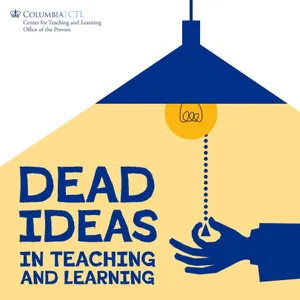
Free Daily Podcast Summary
Dead Ideas in Teaching and Learning: Daily Summaries Delivered
by Columbia University Center for Teaching and Learning
Dead Ideas in Teaching and Learning is a podcast from the Columbia University Center for Teaching and Learning. Our mission is to encourage instructors, students, and leaders in higher education to reflect on what they believe about teaching and learning.
Latest Episodes
The most recent episodes — sign up to get AI-powered summaries of each one.
- 1 weeks ago31 min
The Myth of the One-Size Fits All CTL with Chris Hakala
Chris Hakala, director of the Center for Excellence in Teaching, Learning, and Scholarship (CETLS) at Springfield College, joins us this week to dismantle a persistent myth about centers for teaching and learning. With over 30 years in faculty development, assessment, and the study of student learning, Hakala challenges the dead idea that a CTL’s job is to simply hand faculty a fixed set of best practices about student learning.Instead, Hakala argues that fixed practices don’t always meet faculty where they are or reflect the realities of a given academic discipline. Particularly in the age of AI, the most effective CTLs are grounded in evidence-based pedagogical theory while remaining adaptive and creative in their recommendations on how those theories can be expressed in a given classroom. CTLs can and should recognize that every school, department, and discipline will need a customized approach to student learning.Recommended Readings / References: Cramblet Alvarez, Leslie D., and Christopher M. Hakala. Understanding Educational Developers: Tales from the Center. Routledge, 2024.Schofield, Paul. "Why Pedagogy ‘Experts’ Are Wrong." The Chronicle of Higher Education, 22 Apr. 2026, www.chronicle.com/article/why-pedagogy-experts-are-wrong.Appert, Lucy, host. What Learning Looks Like. NYU Arts & Science Office of Teaching Excellence & Innovation, 2024, sites.google.com/nyu.edu/whatlearninglookslikepodcast/home.
- 3 weeks ago28 min
You Must Remember This: Memorization is Just a Scaffold… as the Semester Goes By with Tommy Lee
Dr. Tommy Lee, a behavioral neuroscientist in Barnard College at Columbia University’s Department of Neuroscience and Behavior, joins Dead Ideas in Teaching and Learning to challenge one of higher ed’s most persistent assumptions: that memorization is a low-level task standing in the way of real learning. Dr. Lee’s research considers how the brain forms episodic memory, including our memories of experiences and spaces.In this episode, we tackle the dead idea that remembering and thinking are opposites. Lee complicates this notion by drawing on his own research into the hippocampus and other studies on working memory, disproving the notion that memorization crowds out critical thinking. Lee argues that as AI agents make it easier to “just look up info,” this dead idea is again becoming pervasive in higher education. We end the episode with practical guidance for instructors looking to build retrieval practice into their coursework. The end result is a classroom that lowers the stakes for students, reduces their anxiety, and makes progress more tangible. Recommended Readings / References: Lee, S. L. T. (Forthcoming 2027). Neuroscience of learning for AI-enhanced teaching. In E. R. Reynolds & B.R. Johnson (Eds.), The Oxford Handbook of Undergraduate Neuroscience Education. Oxford University Press.Krathwohl, D. R. (2002). A Revision of Bloom’s Taxonomy: An Overview. Theory Into Practice, 41(4), 212–218. https://doi.org/10.1207/s15430421tip4104_2Pfeiffer, B. E., & Foster, D. J. (2013). Hippocampal place-cell sequences depict future paths to remembered goals. Nature, 497(7447), Article 7447. https://doi.org/10.1038/nature12112Pan, S. C., & Rickard, T. C. (2018). Transfer of test-enhanced learning: Meta-analytic review and synthesis. Psychological Bulletin, 144(7), 710–756. https://doi.org/10.1037/bul0000151Cowan, N. (2010). The Magical Mystery Four: How Is Working Memory Capacity Limited, and Why? Current Directions in Psychological Science, 19(1), 51–57. https://doi.org/10.1177/0963721409359277Gobet, F., & Simon, H. A. (1996). Recall of rapidly presented random chess positions is a function of skill. Psychonomic Bulletin & Review, 3(2), 159–163. https://doi.org/10.3758/BF03212414Qin, S., Cho, S., Chen, T., Rosenberg-Lee, M., Geary, D. C., & Menon, V. (2014). Hippocampal-neocortical functional reorganization underlies children’s cognitive development. Nature Neuroscience, 17(9), 1263–1269. https://doi.org/10.1038/nn.3788Bastani, H., Bastani, O., Sungu, A., Ge, H., Kabakcı, Ö., & Mariman, R. (2025). Generative AI without guardrails can harm learning: Evidence from high school mathematics. Proceedings of the National Academy of Sciences, 122(26), e2422633122. https://doi.org/10.1073/pnas.2422633122Smith, A. M., Floerke, V. A., & Thomas, A. K. (2016). Retrieval practice protects memory against acute stress. Science, 354(6315), 1046–1048. https://doi.org/10.1126/science.aah5067Haak, D. C., Hille Ris Lambers, J., Pitre, E., & Freeman, S. (2011). Increased Structure and Active Learning Reduce the Achievement Gap in I
- Oct 1, 202642 min
UDL at Scale: Designing Learning at the Institutional Level with Thomas Tobin
Thomas Tobin, one of the foremost voices on Universal Design for Learning (UDL), joins us to preview his forthcoming book, UDL at Scale: Whole-Campus Universal Design for Learning. Where his earlier work made UDL manageable for individual instructors, Tobin's new publication asks what happens when an entire campus — including administrators — advocates for and values universal design. Tobin first joined the Dead Ideas in Teaching and Learning podcast to discuss inclusive teaching in 2022 (listen to "Student Perceptions of Instructor Authority and Inclusive Teaching").In this episode, we tackle the dead idea that learners make impartial, rational decisions about how they learn best. Tobin complicates this notion by sharing a contemporary example: students' increased reliance on AI to bypass the fundamental building blocks of learning. He argues that students will thrive as co-designers of learning only when UDL supports underlie those classroom experiences. UDL is only effective when it is possible, permitted, supported, rewarded, and expected across an educational institution at the faculty, student, and administrative levels.Learn more about our guest’s new publication: Tobin, Thomas J. UDL at Scale: Whole-Campus Universal Design for Learning (Oklahoma University Press, 2026)Other publications mentioned in this discussion: Tobin, Thomas J. Reach Everyone, Teach Everyone: Universal Design for Learning in Higher Education (West Virginia University Press, 2018)Weimer, Maryellen. Learner-Centered Teaching: Five Key Changes to Practice (Wiley, 2013)
- Sep 17, 202638 min
What Five Years of Listening to Students Taught Us About Learning. A Conversation with Chris Gallagher, Kristi Girdharry, and Kevin Smith
For five years, Chris Gallagher, Kristi Girdharry, and Kevin Smith sat down each semester with the same set of twenty Northeastern University students. What began as an analysis of these students’ writing skills evolved into a book on how students often understand the learning process more clearly than faculty recognize. Gallagher, Girdharry, and Smith's new book, Getting Learning Right: The Promise of Higher Education, takes aim at some of the myths that circulate in public discourse about college - that students enroll simply for the credential or that everything can be learned online, for example. In this episode, we focus instead on what the students themselves had to say about their own undergraduate experience. These anecdotes and the insights they provide might just be the inspiration we need to reshape the future of higher education. Learn more about our guests’ new publication, Getting Learning Right: The Promise of Higher Education (MIT Press).Other articles mentioned in this conversation: “Not Just Another AI Statement: Modeling Process and Collaboration in Higher Education” (Inside Higher Ed)
- Mar 26, 202629 min
Bonus Episode: Reimagining Teaching and Learning in the Age of AI. A Conversation with Columbia University Students.
In this special bonus episode, we step away from our typical one-on-one interview format to share excerpts from a student panel that our host Amanda Irvin moderated at the recent "Reimagining Teaching and Learning in the Age of AI" Forum. This event was a joint effort coordinated by the Columbia Center for Teaching and Learning, the Data Science Institute, Columbia Alliance, the School of Engineering, and Teachers College.Four Columbia students, representing a range of disciplines, backgrounds, and relationships with AI, reflect candidly on what it's actually like to be a learner in this moment. They share how AI functions in their academic lives, what they wish faculty understood about their use of it, and what they need from instructors as the landscape continues to shift. The conversation is less a debate about AI and more an exploration about the relational fabric of learning. A full transcript with speaker attributions and bios, as well as a link to the video recording, are available in the show notes.
- Mar 12, 202632 min
AI Is Not Inevitable. A Conversation with Madisson Whitman
In this episode, we sit down with Dr. Madisson Whitman, Director of Undergraduate Studies and Assistant Director of Curriculum Development at Columbia University's Center for Science and Society, and Lecturer in the Department of Anthropology. Drawing on her work in Science and Technology Studies (STS), Whitman challenges one of the most pervasive assumptions of our moment: that AI in higher education is a foregone conclusion.In her recent letter to the editor in the Columbia Spectator, a student-run campus newspaper, Whitman offered a direct rebuttal to the sentiment that "AI is here to stay, so what does that mean for Columbia?" Instead, she invites us to resist the sense of "technological inevitability" that pervades so much of today's academic dialogue and to ask what we might be foreclosing when we don’t question AI’s presence in education.Together, we trace the through-lines between pandemic-era surveillance, "dysfunction creep," and the quiet ways AI is being folded into the learning management systems. We also consider what it looks like to teach with AI rather than through it. Dr. Whitman reminds us that progress is never as linear as it's sold. Educators must keep learning at the center of the conversation, even when urgency and marketing do their best to crowd it out. Other materials referenced in this episode: "AI Is Here to Stay: What Does That Mean for Columbia?" — Columbia Spectator"Letter to the Editor: AI Is Not Inevitable" — Madisson Whitman"A Rant About Technology" — Ursula K. Le Guin
- Feb 26, 202628 min
What Learning Looks Like: A Conversation with Lucy Appert
In this episode, we talk with Dr. Lucy Appert, Senior Director of Teaching Excellence & Innovation at NYU Arts & Science, and host of the new NYU Office of Teaching Excellence and Innovation’s podcast, What Learning Looks Like. As an academic with 25+ years of teaching experience and a deep commitment to student-centered practices, Lucy shared with us her insights on what learning truly means in an age of AI-driven "efficiency."Together, we discuss a key problem in higher education: while educators may accept the messy, developmental nature of learning, students are being marketed an idealized reality where AI-supplemented education is frictionless and instantaneous. The What Learning Looks Like podcast offers a counter-messaging to this misleading EdTech and AI marketing. Instead, true learning involves struggle, synthesis, and personal transformation. Lucy also challenges one of higher education's most persistent “Dead Ideas”: that we cannot change. From pandemic pivots to new faculty communities exploring AI in the classroom, it is clear that higher education is very capable of fluctuation and change. Explore the What Learning Looks Like podcast: https://podcasts.apple.com/us/podcast/what-learning-looks-like/id1839490516 Other materials referenced in this episode: Learning Objectives & Bloom’s Taxonomy
Get Dead Ideas in Teaching and Learning summaries in your inbox
Free AI-powered daily recaps. Key takeaways, quotes, and mentions — in a 5-minute read.
Get Free Summaries →Free forever for up to 3 podcasts. No credit card required.
You Might Also Like
Listeners also like.
Think UDL
Think UDL
School of Practice
Practical, research-backed teaching strategies for educators to implement in their classrooms.

TED Talks Education
Educators and researchers share insights on learning, teaching, and the future of education from TED and TEDx events worldwide.
Your Thoughts Your Reality
A podcast exploring how veterans can overcome psychological challenges like fear and self-doubt through neuroencoding science.
Machine Learning Street Talk (MLST)
Discussions with leading AI researchers and thinkers exploring machine learning, cognitive science, and philosophy of mind without hype.
The Cal Newport Show
Explores strategies for thriving mentally and professionally in a world saturated with digital technology.

TED Talks Daily
Daily audio from TED Talks worldwide, featuring leading thinkers and doers on ideas ranging from artificial intelligence to zoology.

The Grading Podcast
Two educators examine traditional and alternative grading methods to improve student learning outcomes.
3 Takeaways
Features conversations with leading thinkers and experts, distilling each discussion into three actionable insights.
Servant Leadership Institute Podcast
Servant Leadership Institute

Artificial Intelligence Masterclass
Examines the philosophical and ethical dimensions of artificial intelligence and its impact on society, meaning, and the future of work.
New Books in Library Science
New Books Network
About Dead Ideas in Teaching and Learning
Dead Ideas in Teaching and Learning is a podcast from the Columbia University Center for Teaching and Learning. Our mission is to encourage instructors, students, and leaders in higher education to reflect on what they believe about teaching and learning.
Customized Recaps
AI-powered recaps with compact key takeaways, quotes, and insights.
Straight to Your Inbox
Get key takeaways from Dead Ideas in Teaching and Learning in a 5-minute read.
Save Hours Every Week
Stay current on your favorite podcasts without falling behind.
Frequently Asked Questions
What is Podzilla's Dead Ideas in Teaching and Learning daily summary?
It's a free AI-powered email that summarizes new episodes of Dead Ideas in Teaching and Learning as soon as they're published. You get the key takeaways, notable quotes, and links & mentions — all in a quick read.
How does the Dead Ideas in Teaching and Learning podcast summary work?
When a new episode drops, our AI transcribes and analyzes it, then generates a personalized summary tailored to your interests and profession. It's delivered to your inbox every morning.
Is this an official Dead Ideas in Teaching and Learning product?
No. Podzilla is an independent service that summarizes publicly available podcast content. We're not affiliated with or endorsed by Columbia University Center for Teaching and Learning.
Can I get summaries of other podcasts too?
Absolutely! The free plan covers up to 3 podcasts, any in the catalog. Basic raises that to 15, Pro to 40 and Max to 100. Browse our full catalog at /podcasts.
What topics does Dead Ideas in Teaching and Learning cover?
Dead Ideas in Teaching and Learning covers topics including Education, How To, Self-Improvement. Our AI identifies the specific themes in each episode and highlights what matters most to you.
Start getting Dead Ideas in Teaching and Learning summaries tomorrow morning.
Free forever for up to 3 podcasts. No credit card required.
Free forever for up to 3 podcasts. No credit card required.