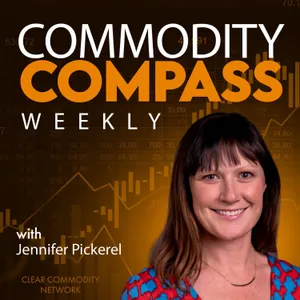
Free Daily Podcast Summary
Commodity Compass Weekly: Daily Summaries Delivered
by Jennifer Pickerel
Welcome to Commodity Compass Weekly with Jennifer Pickerel, your essential source for navigating the fast-moving world of commodities. Every week, we break down the biggest market movers, trends, and macro factors driving price action across energy, metals, agriculture, and beyond. Whether you're trading oil, watching gold, or managing risk in softs and grains, this podcast delivers sharp insights and a forward-looking view to help you stay ahead.Join us every week for a concise and informative update that keeps you connected to the pulse of the global commodity markets.
Latest Episodes
The most recent episodes — sign up to get AI-powered summaries of each one.
- 3 weeks ago15 min
Commodity Compass - 8/28 - Grains Make Volatile Gains as Metals Cool
Kevin Warsh took the stage at Jackson Hole today — and left little doubt the Fed still believes it has work to do on inflation. Gold tumbled more than 3 percent on the day as the odds of a September rate hike climbed back toward a coin flip. And in the ag space, wheat exploded to a three-year high, posting its biggest weekly gain since 2022.
- Aug 21, 202615 min
Commodity Compass - 8/21 - Treasury's Intervention in the Bond Market Sends Gold Soaring
On Wednesday, with the 30-year yield sitting at a 19-year high, Treasury Secretary Scott Bessent announced the government would at least double the size of its long-term debt buybacks from two billion to at least four billion dollars per operation and targeting the 10-to-30-year part of the curve. This happened the same day, Treasury confirmed the national debt had crossed forty trillion dollars for the first time. Yields dropped on the news — and then promptly reversed. Within a day, the 10- and 30-year had erased the entire move and pushed higher than before Bessent spoke, forcing him back in front of the cameras to insist four billion is a floor, not a ceiling, and that yields - quote - "don't reflect the underlying fundamentals." The market's verdict, from a JPMorgan note, was blunt: interventions like this belie the structural challenges and do nothing to address them. Translation — a widening deficit, sticky inflation, and a wave of AI-driven corporate issuance are the real story, and a bigger buyback fixes none of it. For gold, that's about as clean a bull signal as you'll find, and it shows up all over the board.
- Aug 14, 202615 min
Commodity Compass - 8/14 - Gold Finds its Rhythem in Markets Once Again
The market is still working off the summer doldrums — thin, low-conviction trading — and this week's data did little to break the spell. The big commodity story this week was in Washington. On August 7th, the President convened a roundtable of mining executives at the State Department — Rio Tinto, BHP, Freeport, MP Materials among them — and rolled out more than two billion dollars in new critical-mineral deals alongside it. The framing was blunt — cut the dependence on China, and replenish the defense stockpiles drawn down during the Iran conflict. It's the clearest signal yet of just how much public capital is about to hit this space.
- Aug 1, 202616 min
Commodity Compass - 8/1 - Tin Remains a Standout in the Commodity Trade
The Federal Reserve held rates again this week — and it was the press conference, not the decision, that moved markets, driving long-term Treasury yields to their highest since 2007. Halfway around the world, Japan stepped into the currency market to rescue the yen from a forty-year low, and the Bank of Japan held the line hours later. And with crude back above eighty dollars, the Middle East keeps simmering under all of it.
- Jul 24, 202613 min
Commodity Compass - 7/24 - Brent Crude Approaches $100, Gold Finds Relief
The escalation in the Middle East did not pause this week — it expanded. Iran and the United States continue to apply military pressure throughout the Gulf, and the Houthis appear to have opened a second front, with activity threatening Saudi shipping lanes in a separate strait. Oil has now posted back-to-back double-digit weekly gains — fifteen and a half percent last week, ten percent this week — taking WTI from the high sixties to above ninety dollars in just two weeks. Brent is within striking distance of one hundred dollars per barrel.
- Jul 19, 202612 min
Commodity Compass - 7/19 - Brent Crude Has Strong Week to the Upside, Cattle Markets Potentially Show Signs of Topping
Two macro forces defined the week. Iran and the United States escalated military pressure throughout the Gulf. The ceasefire that markets spent six weeks pricing in showed new cracks, and oil reversed its entire recent descent in a single week. And on Wall Street, the AI momentum trade that powered equities higher through the spring finally hit the summer wall. Rotation out of tech accelerated as summer volume thinned the market’s natural buyers. The physical commodity trade and the financial equity trade moved in opposite directions this week — both driven by the same underlying competition for energy and resources.
- Jul 10, 202614 min
Commodity Compass - 7/10 - The Unraveling Ceasefire Boosts Most Commodities this Week
This week delivered a stark reminder that the Hormuz saga is not over. Two days of direct US-Iran clashes mid-week threatened to unravel the ceasefire that markets have been pricing in for the past six weeks. Bloomberg reported Thursday that peace talks are continuing despite the hostilities — a U.S. official confirmed negotiations remain active. Oil steadied by Friday and finished the week higher. But the International Energy Agency added important context to the week's volatility: renewed hostilities, the agency warned, risk undermining efforts to rebuild the depleted global oil inventories that have been draining since the crisis began. Even if a deal eventually gets done, the physical damage to supply buffers is cumulative. Every week without a resolution is a week of inventory destruction the market will eventually have to price back in.
- Jul 2, 202611 min
Commodity Compass - 7/2 - Oil Continues to Fall Ahead of US Holiday Weekend
It's a short week heading into the Fourth of July weekend and the markets treated it accordingly, with lower volume and decisive price moves driven more by a macro narrative than fresh data. The Iran deal remains unsigned. Supreme Leader Khamenei has not publicly committed. But the cumulative weight of optimism across the past six weeks haspushed WTI down nearly thirty percent from its monthly highs, pricing in a resolution the physical market has not yet confirmed. This week's jobs report added a second macro headwind: payrolls came in below expectations, reinforcinga picture of a U.S. economy that is absorbing the energy shock unevenly — gas prices have come down meaningfully, giving consumers some relief, but the broader labor market is softening.
About Commodity Compass Weekly
Welcome to Commodity Compass Weekly with Jennifer Pickerel, your essential source for navigating the fast-moving world of commodities. Every week, we break down the biggest market movers, trends, and macro factors driving price action across energy, metals, agriculture, and beyond. Whether you're trading oil, watching gold, or managing risk in softs and grains, this podcast delivers sharp insights and a forward-looking view to help you stay ahead.Join us every week for a concise and informative update that keeps you connected to the pulse of the global commodity markets.
Customized Recaps
AI-powered recaps with compact key takeaways, quotes, and insights.
Straight to Your Inbox
Get key takeaways from Commodity Compass Weekly in a 5-minute read.
Save Hours Every Week
Stay current on your favorite podcasts without falling behind.
Frequently Asked Questions
What is Podzilla's Commodity Compass Weekly daily summary?
It's a free AI-powered email that summarizes new episodes of Commodity Compass Weekly as soon as they're published. You get the key takeaways, notable quotes, and links & mentions — all in a quick read.
How does the Commodity Compass Weekly podcast summary work?
When a new episode drops, our AI transcribes and analyzes it, then generates a personalized summary tailored to your interests and profession. It's delivered to your inbox every morning.
Is this an official Commodity Compass Weekly product?
No. Podzilla is an independent service that summarizes publicly available podcast content. We're not affiliated with or endorsed by Jennifer Pickerel.
Can I get summaries of other podcasts too?
Absolutely! The free plan covers up to 3 podcasts. Upgrade to Pro for 15, or Premium for 50. Browse our full catalog at /podcasts.
How often does Commodity Compass Weekly release new episodes?
Commodity Compass Weekly publishes weekly. Our AI generates a summary within hours of each new episode.
What topics does Commodity Compass Weekly cover?
Commodity Compass Weekly covers topics including News, Business. Our AI identifies the specific themes in each episode and highlights what matters most to you.
Start getting Commodity Compass Weekly summaries tomorrow morning.
Free forever for up to 3 podcasts. No credit card required.
Free forever for up to 3 podcasts. No credit card required.