Free Daily Podcast Summary
Commerce Untold: Daily Summaries Delivered
by Eitan Koter
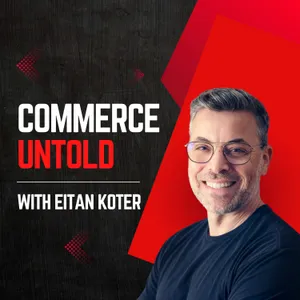
Commerce Untold goes beyond the headlines to uncover the real stories shaping eCommerce and retail today.Hosted by Eitan Koter, the show dives into every layer of modern commerce, from digital innovation and retail media to brand building, marketplaces, social commerce, live shopping, customer experience, and emerging technologies.Each episode features founders, CMOs, retail and e-commerce leaders, and operators sharing what actually drives growth behind the scenes. The wins, the missteps, the strategies, and the untold insights you won’t hear anywhere else.If you care about how products are built, marketed, sold, fulfilled and experienced in today’s rapidly evolving commerce landscape, this podcast is for you.
Latest Episodes
The most recent episodes — sign up to get AI-powered summaries of each one.
- 2 weeks ago37 min
221. Why TikTok Shoppers Still Buy on Amazon with Tom Cochrane
Tom Cochrane is founder of Eleviam, a brand accelerator running more than forty CPG brands across Amazon, Walmart, and TikTok Shop. Before building the agency, he put nearly five million dollars of his own capital into Amazon inventory to prove the model himself.This episode tackles a problem every CPG brand now faces: platforms are getting more expensive, more competitive, and harder to attribute, even as consumer attention keeps fragmenting.Tom and Eitan dig into the halo effect between TikTok Shop and Amazon, why a third of TikTok-driven purchases convert somewhere else entirely, and how Amazon's new AI shopping layer is changing what actually belongs in a listing.Listeners walk away with a clearer view of how to sequence platform investment as a brand matures, and why profitability discipline matters more than chasing growth at any cost.Website: https://expanio.com/Podcast website: https://expanio.com/commerce-untold-podcast/Eitan Koter's LinkedIn: https://www.linkedin.com/in/eitankoter/YouTube: https://www.youtube.com/@CommerceUntoldGuest: Tom Cochrane, Founder, EleviamTom Cochrane's LinkedIn: https://www.linkedin.com/in/thomasgcochrane/Eleviam: https://eleviam.io/Key Takeaways: • Ninety percent of US consumers still validate a purchase on Amazon even when they discovered the product somewhere else. • Thirty-seven percent of TikTok Shop transactions convert off of TikTok, most often on Amazon. • Creator partnerships should be judged on proven GMV track record, not follower count. • Amazon's AI shopping layer now reads full PDP and A+ content, so listings need to answer real buyer objections instead of just stuffing keywords. • Brands should launch omnichannel from day one, but stay narrow with a hero SKU before expanding the catalog. • Agencies scale by building repeatable systems and pod structures before they scale revenue.Chapters:[00:19] Introduction to Tom Cochrane and background[02:35] Running Amazon and TikTok Shop together: the halo effect[05:36] Rising platform costs and the shift toward creator partnerships[08:08] Competition, agentic shopping, and Amazon's AI-driven listings (Cosmos, Rufus)[11:53] Matching platform strategy to a brand's lifecycle stage[19:41] CPG challenges today: LTV, margins, and building a moat[26:11] Inside Eleviam: ICP, delivery, and where e-commerce is headed
- 3 weeks ago41 min
220. How Humor Became a Product Strategy with Oded Friedland
Oded Friedland founded Monkey Business in 1994 after graduating from Bezalel with a degree in industrial design. A former three time European kneeboard surfing champion, he built a company on a simple idea: everyday objects can solve small problems while making people smile.The episode explores how Friedland turned humor into a repeatable design methodology rather than a one time gag, and why finding a good problem matters more than finding a clever solution.The conversation covers the shift from hand drawn blueprints to CAD and AI, the compressed timelines that came with the internet, and the wave of competition now arriving from China's fast growing design industry. Friedland also breaks down how Monkey Business moved from museum and design stores into Amazon and mass retail, and why some of the company's best sellers in physical stores fail online simply because they have no search keyword attached to them.Listeners will walk away with a clearer view of how to build products that appeal to both the brain and the heart, how to predict a product's failure before it launches, and why perceived value, not just price, decides whether a design succeeds commercially.Website: https://expanio.com/Podcast website: https://expanio.com/commerce-untold-podcast/Eitan Koter's LinkedIn: https://www.linkedin.com/in/eitankoter/YouTube: https://www.youtube.com/@CommerceUntoldGuest: Oded Friedland, Founder, Monkey BusinessOded Friedland's LinkedIn: https://www.linkedin.com/in/oded-friedland/Monkey Business: https://www.linkedin.com/company/monkey-business-design/Key Takeaways:Good problems, not clever solutions, are the real bottleneck in product design.A product's commercial success can't be predicted, but its failure often can, if you know what to look for.Search driven marketplaces like Amazon punish products that have no obvious keyword, even if they were retail bestsellers.The strongest products connect on two levels at once, appealing to the brain through function and the heart through desirability.Chinese manufacturing and design competition has shifted from cheap to cheap and increasingly high quality, and it will keep intensifying.Perceived value, not raw price, determines whether a product succeeds, and both price and packaging can be adjusted to protect it.Chapters:[01:16] A three-time European kneeboard surfing champion[02:49] From Freddie Maid to Monkey Business[09:04] Product spotlight: Morris the donkey and the carrot sharpener[12:25] From hand-drawn blueprints to CAD and AI[18:17] The rise of Chinese design competition[20:46] Finding good problems and designing for the brain and heart[27:20] Why you can predict failure but not success[34:32] From museum stores to Amazon, SEO, and knockoffs
- 3 weeks ago36 min
219. How To Fix Retail Shelves with Amit Chachek
Amit Chachek spent two decades building award winning visual effects for brands like Walmart and Coke before founding WeR AR, an augmented reality company built to fix the physical retail shelf.His core argument is simple. Retailers know everything about their backroom inventory and everything about the point of sale, but the space in between, the shelf itself, is a blind spot.Amit walks through how WeR AR uses a standard smartphone camera, no robots or fixed shelf cameras required, to let employees detect, verify, and fix shelf issues in real time. He explains the RGIS partnership, how data ownership is split between the platform and the retailer, and why he still believes smart glasses are three to five years from being useful in the enterprise.Listeners get a grounded look at where AI actually helps on the retail floor right now, and where the hype around wearables and robotics still outpaces reality.Website: https://expanio.com/Podcast website: https://expanio.com/commerce-untold-podcast/Eitan Koter's LinkedIn: https://www.linkedin.com/in/eitankoter/YouTube: https://www.youtube.com/@expanioglobalGuest: Amit Chachek, CEO, WeR ARAmit Chachek's LinkedIn: https://www.linkedin.com/in/amitchachekWeR AR: https://wer.ioKey Takeaways: • The retail shelf hasn't changed in 100 years, and that gap between backroom and POS data is where retailers are blind • A regular smartphone camera can replace shelf scanning robots and fixed cameras, cutting hardware and ROI headaches • Augmented reality on shelf can cut daily shelf management tasks by fifty to eighty percent • Humans empowered by AR outperform robots because robots can detect problems but cannot execute fixes on the shelf • Vision-language models still can't consistently understand spatial environments from video, which is why smart glasses remain years away from real utility • Winning enterprise retail deals takes one internal champion willing to test in real stores for over a year before wider rolloutChapters:[00:16] Introduction: From VFX to Retail Shelves[01:11] Amit's ADHD Story and the Road to Entrepreneurship[04:20] Leaving Media and Entertainment for Augmented Reality[09:40] How AI Reshaped WeR AR's Roadmap[13:43] Pitching Shelf Intelligence to Store Managers[15:23] Smartphones vs. Shelf Scanning Robots[17:20] The RGIS Partnership and Retail Data Ownership[22:19] Smart Glasses, Qualcomm, and Why Phones Still Win
- Aug 21, 202649 min
218. How to Stop Losing Money on Amazon with Andrew Morgans
Andrew Morgans is founder and CEO of Marknology, an Amazon brand accelerator in Kansas City. In fifteen years in e-commerce he has managed over two billion dollars in revenue across 300 brands, launched his own warehouse, and built an AI platform for profitability, PPC, and inventory.This episode explores why most brand owners still do not know their real numbers on Amazon, and why the platform needs to be managed as a P&L, not just a sales channel.Andrew breaks down how storage fees, returns, and blended ad spend across Meta and TikTok quietly eat margin, and shares how shifting from branded search to broader targeting cut one brand's cost per acquisition from forty dollars to eleven. He also discusses building a family run agency and launching his own AI software.Listeners will leave with a sharper framework for finding where their margin is actually going, and why chasing top line revenue without profitability is a losing game.Our podcast is listed in Feedspot's 100 Best E-Commerce Podcasts:https://podcast.feedspot.com/ecommerce_podcasts/Website: https://expanio.com/Podcast website: https://expanio.com/commerce-untold-podcast/Eitan Koter's LinkedIn: https://www.linkedin.com/in/eitankoter/YouTube: https://www.youtube.com/@CommerceUntoldGuest: Andrew Morgans, Founder & CEO, MarknologyAndrew Morgans's LinkedIn: https://www.linkedin.com/in/watchdrewwork/Marknology: https://www.marknology.com/Key Takeaways: • Most brand owners don't actually know their numbers on Amazon, which makes profitable decisions impossible. • Managing Amazon as a P&L instead of a sales channel is the fastest way to protect margin. • Shifting ad targeting from exact-match branded search to broader terms can cut cost per acquisition dramatically, even when ROAS drops. • Vertical integration, agency, warehouse, and personal brands, works best when each piece feeds the others. • Trust with clients is built by under promising and over delivering, not by chasing every channel at once. • Viral moments don't build brands. Consistency and knowing your keyword-level margin do.Chapters:[00:16] Introducing Andrew Morgans and Marknology's Vertical Integration[03:32] Building a Family-Owned Agency From the Ground Up[08:17] Managing Amazon as a P&L, Not a Sales Channel[10:46] Where Profit Leaks: Fees, Attribution, and Hidden Costs[13:41] Case Study: Cutting Cost Per Acquisition by Broadening Targeting[17:00] Focus, Priorities, and Entrepreneurial Balance[21:09] Building an AI Platform for PPC, Inventory, and Profitability[27:43] Expanding Into New Markets and Building Client Trust[41:32] Content, Community, and Closing Thoughts on Testing
- Aug 19, 202632 min
217. How to Turn Data Chaos into Growth with Tim Shea
Tim Shea is the founder and CEO of LatticeWork Insights, where he has spent a decade helping DTC and retail brands untangle data spread across dozens of disconnected platforms. Before that, he built a 25 year career across software engineering, data, and advertising, including years selling data solutions into major media agencies.Most brands have data trapped in Meta, Google, TikTok, Shopify, Amazon, QuickBooks, Salesforce, and Klaviyo, and stitching it together every week eats up expensive leadership time. Tim argues this manual reporting cycle is a hidden cost most founders never account for.The conversation covers when a brand is actually ready to invest in analytics, why LTV and CAC are stories rather than single numbers, and why he tells clients to fund analytics the same way they fund ad spend, expecting a real return. Tim also breaks down where AI genuinely helps data teams and where it creates expensive slop instead.Listeners walk away with a clearer framework for knowing when their reporting problem is actually a decision-making problem, and what it costs to keep ignoring it.Website: https://expanio.com/Podcast website: https://expanio.com/commerce-untold-podcast/Eitan Koter's LinkedIn: https://www.linkedin.com/in/eitankoter/YouTube: https://www.youtube.com/@CommerceUntoldGuest: Tim Shea, Founder and CEO, Latticework InsightsTim Shea's LinkedIn: linkedin.com/in/sheaninesevenMilked Media: https://latticeworkinsights.com/Key Takeaways:Manual reporting across 10-30 disconnected platforms quietly costs brands far more than the software itselfLTV and CAC are not single numbers, they're stories shaped by cohort, channel, and buying behaviorAnalytics should be funded and measured like ad spend, with an expected return above one dollar per dollar spentThe biggest unlock often comes from getting a company to agree on one true north metric, not adding more dashboardsAI is useful in the hands of people who already know how to architect a solution, and dangerous in the hands of people who don'tThe right time to invest in data infrastructure is after product-market fit, not before itChapters: [00:11] Introduction and meeting Tim Shea [00:37] Getting thrown out of a sales pitch and the origin of LatticeWork Insights [03:00] Listening to customer pain over pitching product [04:25] The real cost of data spread across 10-30 platforms [05:03] Manual reporting and the hidden cost to leadership time [08:58] Blending data analytics with intuition [09:32] LatticeWork's process for a new client engagement [13:14] When brands should NOT reach out, and when they should [16:36] Common implementation challenges and getting teams aligned [18:57] Why analytics should be funded like an ad spend [21:44] Where AI actually helps, and where it creates slop [26:40] What brands get wrong when working with agencies [29:49] Tim's ideal customer [31:13] How to find LatticeWork Insights [31:58] Closing thoughts
- Aug 14, 202631 min
216: How Meta Ads Actually Target Now with Krista Karpan
Krista Karpan is the CEO and Co-Founder of Milked Media, a performance marketing agency that has spent nearly a decade helping ecommerce brands scale through paid media, creative strategy, and retention marketing.This episode tackles a shift few marketers have caught up to. Interest based targeting on Meta no longer works, and creative has become the real lever for reaching the right audience.Krista walks through how her agency structures Meta and Google campaigns for new and scaling brands, the metrics that actually indicate a winning ad, and why static images still outperform video in categories like fashion. She also breaks down attribution overlap, marketing efficiency ratio, and the supporting systems, from social proof to email nurture, that determine whether paid traffic ever converts.For founders and marketers relying on ad platforms to carry the business alone, this conversation is a reset on what actually drives profitable growth in 2026.Website: https://expanio.com/Podcast website: https://expanio.com/commerce-untold-podcast/Eitan Koter's LinkedIn: https://www.linkedin.com/in/eitankoter/YouTube: https://www.youtube.com/@CommerceUntoldGuest: Krista Karpan, CEO and Co-Founder, Milked MediaKrista Karpan's LinkedIn: https://www.linkedin.com/in/kristakarpan/Milked Media: https://www.milkedmedia.com/Key Takeaways: • Interest-based targeting on Meta no longer works; creative and messaging now determine who sees your ad • Static images still outperform video in categories like fashion, despite the industry's obsession with video content • A brand's Facebook and Instagram profile functions as a landing page and can cost a sale before a visitor ever reaches the website • Marketing efficiency ratio (spend divided by revenue) cuts through inflated platform-reported attribution better than raw ROAS • New ecommerce brands should structure nearly all campaigns around a sales objective rather than brand awareness until spend scales significantly • Meta ads are one piece of an ecosystem; without organic social, email marketing, and a conversion-ready site, ad spend underperformsChapters:[00:30] The Origin of the Milked Media Name[02:14] A Personal Story: Business Owner and Mom of Four[03:31] Why Interest-Based Targeting Stopped Working[06:18] The Metrics That Signal a Winning Ad[09:39] Static Images vs Video: What Actually Performs[11:02] Meta's Partnership Ads and the UGC Marketplace[12:30] Diagnosing Creative vs Targeting vs Site Issues[15:35] Structuring Campaigns for a New Product Launch[18:06] Why Meta Ads Alone Are Not the Full Solution[21:40] Realistic Conversion Rate Benchmarks for 2026[22:15] Winning Meta's Performance Campaign of the Year[24:48] Solving the Attribution Puzzle Across Platforms[28:05] Milked Media's Ideal Client and Ad Spend Minimums[30:19] Where to Find Krista and Milked Media
- Jul 9, 202634 min
215. Why Knee Braces Haven't Changed in 70 Years ft. Adoram Leshem
Adoram Leshem is the Chief Executive Officer of Nübrace, an orthopedic aids company he founded after years of knee pain from martial arts, hiking, and dirt biking left him searching for a brace that actually worked. When nothing on the market gave him real support, he spent seven years engineering his own solution.The core problem Adoram uncovered is that traditional knee braces are passive. They stabilize and limit movement, but they do nothing to actively support the leg during everyday actions like standing up, sitting down, or climbing stairs.In this conversation, Adoram breaks down the mechanics behind Nübrace's Power Boost Active System, a spring-based design that absorbs body weight on the way down and releases power on the way up. He also explains why the company is targeting the aging knees demographic first, how mobility loss triggers a broader physical and mental decline, and what changed between the first and second generation of the product.Listeners walk away understanding why an entire industry stayed stagnant for decades, and what it actually takes to turn a passive medical device into an active one.Website: https://www.vimmi.netEmail us: info@vimmi.netPodcast website: https://vimmi.net/commerce-untold/Eitan Koter's LinkedIn: https://www.linkedin.com/in/eitankoter/YouTube: https://www.youtube.com/@VimmiVideoCommerce/featuredGuest: Adoram Leshem, Chief Executive Officer, NübraceAdoram Leshem's LinkedIn: https://www.linkedin.com/in/adoram-leshem-a1a83b/Nübrace: https://nubraces.com/Key Takeaways: • Most knee braces only restrict movement. Nübrace's dual spring system actively absorbs body weight on descent and pushes back on ascent. • Reduced mobility creates a downward spiral: less movement means less blood flow, slower healing, and greater dependence. • The orthopedic aids industry hasn't meaningfully innovated in 60 to 70 years, dominated by a handful of traditional European brands. • Nübrace is HSA/FSA eligible and holds a CE Class 1 medical device mark in Europe, with FDA registration in progress. • The brace doubles as a wearable training device, letting users attach resistance bands to strengthen the quad and hamstring at home. • Nübrace's second generation focused on comfort fixes, lighter materials, adjustable strap length, and a flatter spring housing, based directly on first generation customer feedback.Chapters:[00:26] Introduction and welcome[01:05] Adoram's personal story: sports, injuries, and aging knees[02:01] The injury that led to founding Nübrace[03:24] Why launch another knee brace in a saturated market[04:37] The breakthrough: the Power Boost Active System explained[08:28] Who Nübrace is built for: the aging knees demographic[10:03] Mobility, pain, and avoiding unnecessary surgery[13:34] Certification, testing, and HSA/FSA eligibility[17:43] Product demo: fit, sizing, and what's in the box[21:08] Second generation upgrades, US launch strategy, and what's next[30:10] Closing vision: turning passive braces into active devices
- Jul 2, 202631 min
214. AI Won't Fix a Broken Funnel ft. Jeremy Goldman
Jeremy Goldman is VP Editorial & Insights at RETHINK Retail, a community platform supporting retailers, brand leaders, logistics practitioners, and AI specialists. Before joining RETHINK Retail, he founded and sold the Firebrand Group, spent years as an analyst at eMarketer, and has been building e-commerce properties since 2000. He also runs a podcast called Future Proof.This episode examines the gap between AI hype and business reality. Jeremy argues that agentic commerce attracts far more attention than the near-term use cases justify, and that the brands quietly gaining ground are the ones who never stopped running the fundamentals.The conversation covers where AI is delivering real results today, including enhanced product discovery for high-consideration SKUs, and what is actually shifting in search as LLMs reshape how buyers find products. Jeremy and Eitan work through why Google is more relevant than the current discourse suggests, what the rise of TikTok Shop signals about the pace of social commerce adoption, and why community building has become one of the most underrated growth levers available to brands right now.Listeners will leave with a clearer read on where the real ROI in AI sits in 2026, a sharper sense of which fundamentals are worth doubling down on, and a framework for knowing whether their company is commerce-optimized, marketing-optimized, or falling short on both.Website: https://www.vimmi.netEmail us: info@vimmi.netPodcast website: https://vimmi.net/commerce-untold/Eitan Koter's LinkedIn: https://www.linkedin.com/in/eitankoter/YouTube: https://www.youtube.com/@VimmiVideoCommerce/featuredGuest: Jeremy Goldman, VP Editorial & Insights, RETHINK RetailJeremy Goldman's LinkedIn: https://www.linkedin.com/in/jeremygoldmanRETHINK Retail: https://rethink.industries/Key Takeaways:• Agentic commerce is real technology, but the claim that AI will handle all buying decisions within two years is not where the near-term reality lands• AI-driven product discovery is already delivering measurable results for large-catalog, high-consideration SKUs, and that is where brands should focus first• Most companies are either commerce-optimized or marketing-optimized, rarely both, and knowing which one you are determines where the gaps are• Community is the growth lever most brands are underinvesting in: a brand with a genuine community is structurally harder to displace than one relying solely on paid acquisition• When hype cycles hit, the companies that lean back into fundamentals, email, checkout friction, fulfillment speed, and conversion rate, take share from everyone else while they are distractedChapters:[00:12] Introduction and Inside RETHINK Retail[01:37] From E-Commerce Builder to Editorial Leader: Jeremy's Career Thread[05:44] Agentic Commerce: Real Technology, Outsized Claims[07:34] Where AI Is Delivering Real Results in Retail Today[10:28] Google Is Not Out: AI Search and the LLM Landscape[15:27] Commerce vs. Marketing: Knowing What Kind of Company You Are[18:49] Community Building as the Next Growth Unlock for Brands[21:26] TikTok Shop and Why Social Commerce Is Catching On[23:41] Why the Fundamentals Win When Everyone Else Chases Hype[28:36] Omnichannel Strategy: When and How to Add a New Channel[30:33] What Jeremy Is Focused on in the Second Half of 2026
About Commerce Untold
Commerce Untold goes beyond the headlines to uncover the real stories shaping eCommerce and retail today.Hosted by Eitan Koter, the show dives into every layer of modern commerce, from digital innovation and retail media to brand building, marketplaces, social commerce, live shopping, customer experience, and emerging technologies.Each episode features founders, CMOs, retail and e-commerce leaders, and operators sharing what actually drives growth behind the scenes. The wins, the missteps, the strategies, and the untold insights you won’t hear anywhere else.If you care about how products are built, marketed, sold, fulfilled and experienced in today’s rapidly evolving commerce landscape, this podcast is for you.
Customized Recaps
AI-powered recaps with compact key takeaways, quotes, and insights.
Straight to Your Inbox
Get key takeaways from Commerce Untold in a 5-minute read.
Save Hours Every Week
Stay current on your favorite podcasts without falling behind.
Frequently Asked Questions
What is Podzilla's Commerce Untold daily summary?
It's a free AI-powered email that summarizes new episodes of Commerce Untold as soon as they're published. You get the key takeaways, notable quotes, and links & mentions — all in a quick read.
How does the Commerce Untold podcast summary work?
When a new episode drops, our AI transcribes and analyzes it, then generates a personalized summary tailored to your interests and profession. It's delivered to your inbox every morning.
Is this an official Commerce Untold product?
No. Podzilla is an independent service that summarizes publicly available podcast content. We're not affiliated with or endorsed by Eitan Koter.
Can I get summaries of other podcasts too?
Absolutely! The free plan covers up to 3 podcasts. Upgrade to Pro for 15, or Premium for 50. Browse our full catalog at /podcasts.
How often does Commerce Untold release new episodes?
Commerce Untold publishes weekly. Our AI generates a summary within hours of each new episode.
What topics does Commerce Untold cover?
Commerce Untold covers topics including Business, Marketing, Entrepreneurship. Our AI identifies the specific themes in each episode and highlights what matters most to you.
Start getting Commerce Untold summaries tomorrow morning.
Free forever for up to 3 podcasts. No credit card required.
Free forever for up to 3 podcasts. No credit card required.