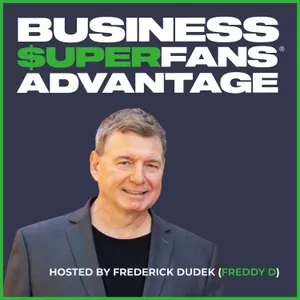
Free Daily Podcast Summary
Business Superfans Advantage: Predictable Growth for Service Entrepreneurs: Daily Summaries Delivered
by Frederick Dudek | Business Prosperity Advisor
*Business Superfans® Advantage* is a weekly business growth podcast for service entrepreneurs who want predictable growth by leveraging their entire business ecosystem as a growth engine—the people, partnerships, and relationships that make their business work—and cultivating superfans who give the business a lasting advantage. Hosted by Frederick Dudek—Business Prosperity Advisor, author of *Creating Business Superfans®*, and founder of Revenue Reactor™—the show provides intelligent business growth guidance to help entrepreneurs build stronger, more profitable businesses without overwhelm, guesswork, or endless trial and error. With decades of experience in SaaS, technology, and business growth, Frederick examines how culture, technology, AI, automation, and better operating systems can improve performance without losing the human touch. Through candid conversations with founders, CEOs, and business experts from around the world, guests share what worked, what failed, and what they wish they had known sooner. The show goes beyond customer acquisition to examine how customers, employees, contractors, suppliers, and partners shape: - Business growth and profitability - Marketing, sales, customer experience, reputation, reviews, referrals, and retention - Leadership, team performance, and accountability - Operations, AI, automation, and scalable systems Each episode turns hard-earned lessons into practical strategies you can apply to recognize what’s shaping your growth, make smarter decisions, turn strong relationships into superfans, and build a business that succeeds with or without you.
Latest Episodes
The most recent episodes — sign up to get AI-powered summaries of each one.
- 2 days ago40 min
How to Get Found in AI Search Without Wasting Your Marketing Budget with Lauren Schafer | Ep. 227
Lauren Schafer, founder and CEO of Lake House Digital, explains how to get found in AI search without wasting your marketing budget. Search has changed more in the past year than in the previous ten, yet many owners still pay for ads and content no one checks. Lauren describes a client spending about $20,000 a month on Google Ads, an estimated $16,000 to $18,000 of it on bot traffic, who now gets real leads for about $5,000. For owners who want marketing they can see working.Full show notes and transcript: FrederickDudek.comHow to Get Found in AI Search Without Wasting Your Marketing Budget with Lauren SchaferWhy This Conversation MattersPeople no longer type “pizza near me.” They ask for exactly what they want, in full sentences, and AI search tools answer with the business that matches most precisely and has been vouched for most recently. Lauren Schafer, founder and CEO of Lake House Digital, explains what that shift means for small businesses, and why marketing you can see and measure is the only kind worth paying for.Direct AnswerYou get found in AI search by building on solid SEO, matching the specific questions customers now ask, and earning fresh signals of trust such as recent reviews and links from people who vouch for you. Lauren Schafer adds that every channel, including paid ads, needs a human checking the numbers.Key TakeawaysAudit your ad targeting before raising your budget. Broad settings with no geographic or industry limits can send most of your spend to traffic that will never buy.Write pages for the full question, not the keyword. Landing pages, titles, and FAQs that mirror how people actually phrase a request are what AI search can match.Keep reviews coming in. A steady flow of recent reviews tells search tools you are still trusted today.Earn links from people who vouch for you. A chamber of commerce listing, a partner’s site, or a podcast appearance all count as third-party credibility.Don’t ignore the smaller platforms. Bing is the default on many work computers, and Yelp reviews still surface in search results.Put a human at both ends of AI work. Start with a clear concept, let the tool speed up the middle, then check the brand, the text, and the hands before anything goes live.Expect an agency to share the dips, not just the wins. A partner who explains a slow July is more useful than one who only reports growth.Key Insights to Share“It has to start human and it has to end human.”— Lauren Schafer“SEO as a foundation is still more important than ever.”— Lauren Schafer“We actually write it in our contracts. Like we have to have access to talk to you.”— Lauren SchaferTimestamps1:07 — From pandemic pivot to Lake House Digital — Why Lauren built an agency around analytics and transparency.4:45 — High-touch by design — Five or six accounts per manager and a live dashboard for every channel.8:56 — Access written into the contract — Why regular conversations keep marketing from becoming siloed.14:58 — Referrals over search — Why about 90% of Lake House’s business comes through introductions.19:17 — A $20,000-a-month Google Ads mess — How tighter targeting cut spend to about $5,000 and brought real leads.23:23 — How AI is changing search — Why SEO is still the foundation and searches keep getting more specific.27:36 — Recent reviews beat old ones — What AI looks for before it recommends a business.30:34 — Don’t count out Bing and Yelp — Plus why one business built 450 local landing pages.33:43 — AI graphics need a human touch — Cut-off text, seven-fingered hands, and AI-content labels.39:35 — LinkedIn’s quiet AI filter — How a few “AI slop” reports can pull a post from feeds.One ActionAsk one hard question about your ad account this week. Open your Google Ads account, or ask whoever runs it, and check three settings: which locations your ads show in, which audiences they target, and how many of last month’s clicks turned into a call, form, or sale. If th
- 2 weeks ago38 min
How to Use AI to Scale Without Losing the Human Trust That Drives Growth with Danny Carpio | Ep. 226
Danny Carpio, co-founder of Veri and author of The Unfirm, explains how to use AI to scale a business without losing the human trust that drives growth. Most owners are told to adopt every new tool, yet still run a playbook that needs a big team, while competitors learn to do the same work with far fewer people. Danny says a company that once needed 5,000 people to scale could now do it with ten or fifteen, and that Veri's first owned model came in 27 times cheaper than a general one. For owners who want AI's leverage without losing their people.Full show notes and transcript: FrederickDudek.comHow to Use AI to Scale Without Losing the Human Trust That Drives Growth with Danny CarpioWhy This Conversation MattersAI is collapsing the cost of doing work. Things that once took a large team, years of training, and outside capital can now be done by a handful of people, and that changes who can compete. Danny Carpio, co-founder of Veri and author of The Unfirm, explains where that new leverage comes from, and why, as everything else gets easier to copy, the trust you earn with people becomes the part of the business no one can replicate.Direct AnswerYou use AI to scale by letting it remove the costs and constraints that used to require a big team, while you invest more, not less, in people. Danny Carpio's view: tools that you own give you leverage, but trust has to be earned. Care for your team and customers, and that care becomes the advantage competitors can't copy.Key TakeawaysRethink what still needs a big team. Work that once took thousands of people may now take a few dozen, so question every assumption about headcount before you hire.Use tools you control for the work that matters most. For anything that makes your business distinctive, prefer a tool trained on your own material over a general one that also serves your competitors.Spend the time AI saves on people. Use the hours you get back for the thank-yous, birthday notes, and check-ins that make people feel seen.Design the work around the people you have. If someone can't work a certain way, change the way, not the person.Believe in people out loud. Giving a struggling team member more responsibility, not less, can turn them into your strongest advocate.Correct in private, recognize in public. Public criticism teaches everyone to keep their heads down and stop contributing ideas.Update how you think, on a schedule. Check what customers, staff, and the market are telling you, and change how you work and price before the old way stops paying.Key Insights to Share“You can't make someone trust you. You have to earn it and you have to actually be trustworthy and care.”— Danny Carpio“If the people you want or need to do something cannot do it, you can't do it that way.”— Danny Carpio“The number one thing you can do is treat your people right.”— Danny CarpioTimestamps0:37 — From law school to operating leverage — How taking over a law firm gave Danny Carpio twenty hours a week back.5:22 — What Veri does — Why content creators need tools they own to scale without being copied.8:15 — The four-minute-mile moment — Why the constraints that held small businesses back are disappearing.14:09 — People still buy from people they trust — How Frederick grew an interpreting business by about a million dollars in a year.15:31 — People as critical infrastructure — Why designing work around real people prevents the failure state.19:30 — Fifteen people doing the work of 5,000 — What operating leverage without bloat means for your competitors.21:18 — How owned AI models work — Why Veri's first model came in 27 times cheaper than a frontier model.30:19 — Building a people-first company — Why earned trust is the validation that matters most.33:19 — Belief creates a Superfan — How one team member took a department from under $100,000 to $225,000.40:07 — Think, then rethink — Danny Carpio's one takeaway for business owners.One ActionTake back one ho
- 4 weeks ago39 min
How to Turn Your Email List Into Paying Clients by Following Up Like a Human with Ely Delaney | Ep. 225
Ely Delaney, founder of Purple Knight Marketing and author of The Follow-Up Code, shows how to turn your email list into paying clients by following up like a human instead of pitching. If your list is big, your open rates are low, and your follow-up sounds like every other sales email, the problem isn't email. Ely describes a client who went from about $35,000 to about $110,000 a month, and from 30 to as many as 100 workshop attendees a week, by changing nothing but how he wrote to his people. For service business owners who would rather build relationships than chase sales.Full show notes and transcript: FrederickDudek.comHow to Turn Your Email List Into Paying Clients by Following Up Like a Human with Ely DelaneyWhy This Conversation MattersMost service business owners already have the list: past clients, old prospects, people they met once at an event. What they don't have is a way to stay in touch that people actually welcome. Ely Delaney, founder of Purple Knight Marketing and author of The Follow-Up Code, explains why value-first follow-up beats the pitch, and how changing nothing but your words can wake up a list that has gone quiet for years.Direct AnswerYou turn an email list into paying clients by following up like a human, not a pitch machine. Ely Delaney's approach: lead with value, write the way you talk, stay in touch consistently, and sell only occasionally. People buy when they're ready, sometimes years later, and consistent, caring follow-up makes you the first person they think of.Key TakeawaysLead with value, and let the sale be an afterthought. Share a book, an idea, or something useful first, so the rare offer gets read instead of sent to voicemail.Write the way you talk. Swap the voice your English teacher taught you for your own stories, style, and quirks; that is what creates an emotional response.Follow up for the long game. Plan for buyers who are ready today, next year, or ten years from now, and keep showing up until they are.Restart a cold list with an apology, not a pitch. Ely's "I'm such a slacker" email simply admits you've been out of touch and asks what's new in their world.Turn a sent email into a conversation. A day or two later, call and ask, "Did you get the thing?" It's a no-threat reason to talk.Thank the people who send you business. Referral partners, vendors, podcast guests, and hosts all keep sending business to people who show appreciation.Know when to send someone elsewhere. If another expert is the better fit, say so; that kind of honesty is what people remember and repeat.Key Insights to Share“Email's not dead, your emails just suck.”— Ely Delaney“We just changed the language. We just changed how we communicated.”— Ely Delaney“Friends make horrible clients, but clients can become amazing friends.”— Ely DelaneyTimestamps0:41 — From chamber networking to follow-up systems — How relationships built Ely Delaney's first business and his follow-up method.4:28 — Four people, one recommendation — How nurtured relationships turn other people into your sales team.7:18 — Lead with value, sell as an afterthought — Why a book recommendation earns more attention than a pitch.14:25 — Relationships run both ways — What hosts, guests, vendors, and referral partners owe each other.18:10 — From 30 seats to 100 — How changing the language took one client from about $35,000 to about $110,000 a month.22:24 — The Follow-Up Code — Why writing like you talk makes people feel you're talking to them.25:22 — Consultative selling plus emotional connection — How a no-pitch talk produced a client of more than four years.30:35 — The ten-year follow-up — Why you never know when someone will be ready to buy.33:22 — "Did you get the thing?" — The zero-threat check-in call that restarts conversations.35:51 — The "I'm such a slacker" email — The re-engagement script behind over $12,000 in sales in one week.One ActionSend Ely Delaney's "I'm such a slacker" e
- Oct 13, 20269 min
How Solo Business Owners Break the Feast-or-Famine Cycle and Build Steady Revenue
Frederick Dudek (Freddy D) shows solo business owners how to break the feast-or-famine cycle and build steady revenue, using lessons from guests Andy Audate, Kristen Nolan, and Kanika Vasudeva. If you hunt for work, deliver it, and then find the pipeline empty again, the answer isn't marketing harder; it's building a business where revenue comes back to you. Andy Audate described a client who went from about $80,000 a year to $60,000 a month over roughly four years once automated follow-up replaced manual selling. For solopreneurs, freelancers, and solo service providers.Full show notes and transcript: FrederickDudek.comHow Solo Business Owners Break the Feast-or-Famine Cycle and Build Steady RevenueWhy This Conversation MattersFor a solo owner, there is no sales team to keep the pipeline full while the work gets done. Frederick Dudek (Freddy D) looks at what owners around the world say they are struggling with most, and for solopreneurs the answer is the revenue roller coaster. He explains why the fix isn't more hunting, and pulls three practical fixes from his conversations with Andy Audate, Kristen Nolan, Kanika Vasudeva, and David Ebner.Direct AnswerSolo business owners break the feast-or-famine cycle by building revenue that comes back to them instead of hunting for new work. Give every client a reason to stay after the job, earn introductions rather than chasing referrals, and let a simple system handle follow-up and invoicing. Steady revenue comes from retention, reputation, and introductions.Key TakeawaysAsk what each client still needs after the job. A maintenance plan, a quarterly review, a retainer, or an annual checkup turns a finished project into revenue that keeps arriving.Close the thank-you gap. A no-agenda "how are you doing?" after the sale keeps you remembered, and being remembered is how the phone rings.Ask for introductions, not referrals. Someone vouching for you directly does the trust-building for you, which matters most when you're the only salesperson.Pass the 15-second test. If people can't explain what you do in one sentence, they can't introduce you.Let a system remember for you. A simple opt-in and a written email sequence keep talking to past clients, vendors, and partners while you're on deadline.Automate invoices and reminders. Collecting money you've already earned shouldn't depend on working up the nerve on a Tuesday afternoon.Keep the human part human. Use technology as a step in the process, not a shortcut: the system carries the message, and you supply the personal touch.Key Insights to Share“The fix isn't more hunting, it's building a business where revenue comes back to you.”“Being remembered is how the phone rings.”“The system carries the message, you still supply the human part.”Timestamps0:00 — 48% of solo owners have gone a month with no income — What owners in 57 countries say they're struggling with most.1:05 — The feast-or-famine trap — Why hunting, delivering, and hunting again keeps the pipeline empty.2:13 — Fix one: stop ending the relationship at the invoice — How Andy Audate's move to an ongoing offer changed his business.3:24 — The thank-you gap — Why a no-agenda check-in keeps you remembered and the phone ringing.3:43 — Fix two: get introduced instead of hunting — The difference between a referral and an introduction, from Kristen Nolan and Kanika Vasudeva.5:01 — Kanika Vasudeva's 15-second test — Whether a stranger can tell what you do fast enough to introduce you.5:11 — Fix three: let a system do the follow-up — Automated sequences, invoicing, and David Ebner's caution about shortcuts.6:21 — Where steady revenue really comes from — Why most solo owners live at reach and how to get the middle working.6:47 — Your one action this week — Map what past clients still need and ask your five happiest clients for an introduction.One ActionList every client you've worked with in the last 12 months. Next to each name, write one thing they still need from you now that the job is done. Then pick your five happiest clients and send each of them a no-
- Oct 9, 202637 min
How to Build a People-First Culture That Drives Referrals and Profit with Sandra Coker
Sandra Coker of Human Power Solutions explains how to build a people-first culture that turns employees and contractors into your reputation, your recruiters, and your best source of referrals. If you see payroll as an expense and wonder why loyal customers, good hires, and referrals are hard to come by, the cause may be how your frontline feels about working for you. Coker says her firm grew into a seven-figure business on 98 percent referrals, and she keeps 50 contract facilitators loyal with birthday brownies, quarterly cards, and a holiday party. For owners and leaders of service firms, trade businesses, and growing teams.Full show notes and transcript: FrederickDudek.comHow to Build a People-First Culture That Drives Referrals and Profit with Sandra CokerWhy This Conversation MattersMost owners can tell you what payroll costs. Far fewer can tell you what the people on that payroll are saying about the company to customers, vendors, and friends. Sandra Coker, founder and CEO of Human Power Solutions and author of People Profit, makes the case to Frederick Dudek (Freddy D) that for service firms, trade businesses, and SMBs, the frontline is the company's reputation, and that leaders who trust, hear, and recognize those people get better customer experiences, easier hiring, and growth that arrives by referral.Direct AnswerA people-first culture drives referrals and profit because the employees and contractors who deal with your customers are your reputation. Trust them with real work, correct mistakes in private, act on their ideas, and recognize the small moments in their lives. People who feel valued serve customers better and recommend your company without being asked.Stop Guessing How to Grow Your Business—Discover What to Focus on Next.Key TakeawaysYour frontline is your reputation. The people who answer the phone, run the service call, or stand at the counter decide what customers think of you, so train and treat them as the professionals they are.Not delegating reads as distrust. Hand over real work, expect a few mistakes, fix them, and add the missing skill. Sandra's rule is that people learn by trying and thrive when trusted.Tone and body language set psychological safety. How you correct one person tells everyone else whether it is safe to speak up, so handle mistakes one-to-one.Ask the people who do the job how to fix it. Take a walk, hold a huddle, and hear it firsthand, because the report that reaches the executive table has already been filtered.Treat contractors like part of the team. Sandra's 50 contract facilitators get birthday brownies, quarterly cards, a shared online community, and a holiday party, and she wants them to pick her work first.Be worthy of the talent you want. A company people love working for recruits through its own staff. A company with a poor reputation pays for every hire.Recommend complementary providers. Sandra sends clients to trusted firms whose services sit beside hers, which makes her one of the client's trusted providers too.Key Insights to Share“They're not the reputation of the company, you are.”— Sandra Coker“People learn by trying and by making mistakes and they thrive when they're trusted.”— Sandra Coker“You've got to be worthy of that talent.”— Sandra CokerGet Practical Insights to Build a Stronger, More Profitable BusinessTimestamps1:11 — From restaurant shifts to Human Power Solutions — Why treating people well became Sandra's operating rule long before she started a company.5:01 — What Sandra told a room of bank tellers that morning — Why the frontline, and not the executive floor, is the company's reputation.6:59 — Why not delegating says "I don't trust you" — How to hand over real work and let people learn from mistakes.7:43 — Correcting in private versus chastising in public — How one public reprimand sends a whole team to update their résumés.10:16 — Let the people doing the job fix the process — Why executives should take a walk and hold a huddle instead of relying on second-hand reports.<
- Sep 17, 202637 min
How to Turn Podcast Guesting Into a $50,000 Client with Kristen Nolan | Ep. 222
Episode 222 Frederick Dudek | Business Prosperity AdvisorKristen Nolan of Interview Valet explains why strategic, well-matched podcast guesting builds more trust and revenue than chasing volume — and why the relationship an appearance produces matters more than the appearance itself.Why This Conversation MattersMost service entrepreneurs treat podcast guesting like a numbers game — get on as many shows as possible and hope something sticks. Kristen Nolan, who strategizes with clients on podcast guesting at Interview Valet, argues the opposite: a handful of well-matched appearances, treated as the start of a real relationship rather than a broadcast opportunity, builds more trust — and more revenue — than volume ever will. This episode is a practical reset for any founder, professional, or trade business owner using visibility as a growth channel.Direct Answer: Podcast guesting builds trust and revenue only when it's strategic, not frequent: match yourself to the right host and audience, lead with the audience's problem instead of your own bio, and treat the relationship as beginning — not ending — when the recording stops, through follow-up, repurposed content, and genuine appreciation.Key TakeawaysStrategy beats volume. Being on every podcast that will have you reads as a "megaphone" — being selectively matched to the right host and audience makes you a "magnet" people want to learn more about.Make it about the audience, not yourself. The guests who convert lead with a problem the listener recognizes and a solution they can use — not a recap of their own career.The relationship starts, not ends, when recording stops. Repurposing the conversation into clips and staying in touch with the host afterward is where most of the return on a podcast appearance actually happens.Small, specific gestures build outsized trust. A handwritten note, a book picked for that person, or a branded gift creates a human touch that generic, mass-producible content can't replicate.Treat a host's show like being invited into their home. Showing up prepared, following through, and sending a genuine thank-you is the bare minimum — and most guests skip it.An introduction beats a referral. "Call my friend Kristen" transfers trust instantly and skips the vetting a cold referral still requires — which is what actually shortens a sales cycle.Service without expectation earns trust in an AI-saturated market. Offering an introduction or a recommendation with no ask attached is exactly the kind of human touch that's becoming rarer — and more valuable — as AI makes everything else easy to mass-produce.Discover What’s Quietly Costing Your Business Revenue—and What to Fix First.Key Insights to ShareWe cannot mass produce that human touch." - "Relationships are the ultimate currency."TimestampsChapters:00:02 - Becoming a Magnet: Targeted, Intentional Messaging05:54 - From Visibility to Revenue — How Interview Valet Strategically Places Guests11:26 - From First Contact to On-Air: Kristen’s Client Onboarding Process21:26 - From Podcast Novice to $50K Client — Onboarding Case Study27:01 - Why Follow-Up Matters in Networking35:29 - Key Takeaways & Action StepsKindly Consider Supporting Our Show: Support Business Superfans® Advantage: Predictable Growth for Service EntrepreneursFreddy D's TakeKristen put language to something I feel every time I host: most guests treat the podcast as the finish line, when it's actually the starting line. I've built a tool that extends a guest's visibility for months past the release date, and I've had only a handful of guests actually use it — because too many still think exposure alone is the win. What stuck with me most is her distinction between a referral and an introduction.A referral still makes me do the work of vetting a stranger; an introduction — "you need to talk to my friend Kristen" — skips that entirely, because the trust has already transferred. That's the whole game for service entrepreneurs and SMBs: the appearance, the follow-up, the small human gesture afterward, all of it exists to earn that kind of introduction. Chase the relationship, not the airtime, and the revenue follows on its own.Stand Out, Stay Remembered, and Strengthen Customer Relationships With Personalized Direct Mail and GiftsOne ActionThis week, pick the last three people
- Sep 8, 20268 min
How to Turn Late-Paying Clients Into Fast-Paying Superfans | Ep. 221
Episode 221 Frederick Dudek | Business Prosperity AdvisorFreddy D breaks down why cash flow leaks are rarely a sales problem — they're a relationship problem playing out with clients, suppliers, and referral partners. He shares three moves any owner can make this week to get paid faster.Why This Conversation MattersCash flow trouble doesn't announce itself as a strategy problem — it shows up as a Sunday night problem, with the same pressure hitting professional and trade service owners from the U.S. to Western Europe. This episode reframes a problem most owners try to solve by selling more, showing instead why the real fix lives in how relationships are managed with the clients, suppliers, and partners who already owe the business money. It's a practical reset for any owner tired of chasing invoices that should have already been paid.Direct Answer: Cash flow leaks rarely come from not earning enough — they come from money already earned sitting outside the bank account too long. The fix isn't more customers or more invoices; it's stronger relationships and automated systems with every stakeholder touching the money, so clients, suppliers, and partners pay and perform on time because the relationship is worth protecting.Key TakeawaysCash flow problems are relationship problems in disguise. Late payments usually trace back to unclear terms or a client relationship that never earned real trust — not a lack of demand for the work.More revenue isn't the fix for a collections leak. If money is already leaking out through slow-paying clients, generating more sales just multiplies the exposure instead of closing the gap.Getting paid on time is a byproduct of being retained and respected, not a separate skill. Clients who see the business as a trusted partner rather than a vendor create far less invoice friction.Cash flow is a whole-stakeholder problem, not just a customer problem. Suppliers, distributors, and referral partners respond to the same relationship investment with better terms and faster priority when it's needed most.An unclear contract and a weak relationship require two different fixes. Honestly diagnosing the top overdue invoices reveals whether the business needs better terms or better trust — mixing up the two wastes effort.Automating invoicing and follow-up removes the emotional avoidance that lets overdue invoices linger. A system that consistently chases payment outperforms an owner who has to remember to.The best time to build the relationship that gets you paid is before you need the money. Trust built in month one is what keeps a client from becoming a month-three collections problem.Discover What’s Quietly Costing Your Business Revenue—and What to Fix First.Key Insights to Share"That's not a business that's failing, that's a business that's healthy on paper and starving in practice." ~ Frederick Dudek (FreddyD)Timestamps0:00 — Cold open: the global cash flow crisis by the numbers — U.S. and Western Europe late-payment stats frame why this leak hits everywhere.1:52 — Welcome to Episode 221: cash flow, the Sunday night problem — Frames why this leak feels different from every other revenue leak.2:20 — Why working capital gets squeezed by how often payments are late, not just how long they take — Reframes the true driver of cash flow pressure.4:23 — Why revenue is the last stage, not the first move — How poor collections quietly undoes everything upstream of it.6:18 — Cash flow is a whole-stakeholder problem — Extends the fix beyond customers to suppliers, distributors, and referral partners.7:32 — Three moves to make this week — Diagnosing overdue invoices, automating follow-up, and building trust before the money is on the line.9:37 — Episode close and the free Revenue Leak Score CTA — Where to check your own business for the leaks this episode describes.Kindly Consider Supporting Our Show: Support Business Superfans® Advantage: Predictable Growth for Service EntrepreneursOne ActionThis week, pull your top five overdue invoices and be honest about each one: was the payment term unclear, or is the relationship weak? Those are two different fixes — a contract problem and a trust problem — so don't treat them the same. Then check whether your invoicing and follow-up sequence is automated; if it still depends on you remembering to chase people, turn it into a system that runs on its own. Finally, with any new client relationship you start this month, invest in the trust
- Sep 3, 202613 min
Stop Killing Sales by Listening for an Opening Instead of Understanding | Ep. 220
Episode 220 Frederick Dudek | Business Prosperity AdvisorA real, unedited LinkedIn conversation shows exactly how a promising partnership talk quietly turned into a lost opportunity. Freddy D breaks down four listening mistakes that kill sales and partnerships long before anyone notices.Why This Conversation MattersEvery service business owner, salesperson, and networker has been on one side of this conversation or the other — the one doing the pitching, or the one who quietly stopped being heard. This episode breaks down a real, unedited example of how a promising partnership conversation turned into a lost opportunity, not because of a bad product or a rude approach, but because of how the conversation was run. It's a practical reset for anyone who wants their next sales, networking, or partnership call to build a relationship instead of just chase a close.Direct Answer: You can kill a sale, or a valuable partnership, without being rude, without a weak product, and without being bad at sales. It happens when you listen for an opening to pitch instead of listening to understand the other person's business, priorities, and what they are deliberately not trying to build right now.Key TakeawaysListen for understanding, not an opening. Waiting for permission to pitch is a different activity than actually diagnosing what the other business needs — and prospects can tell the difference.Context outranks the literal word. A "someday" mention isn't a present-tense decision; repackaging it as one manufactures a choice nobody asked to make.Fit runs in both directions. Your sales process should determine whether you can create value for the customer's business — not bend their business around what you sell.Outcome and method aren't the same thing. "I want more revenue" doesn't always translate to "I need more leads" — check follow-up, retention, referrals, and reputation first.A generated lead isn't proof of a healthy process. The revenue leak can happen entirely after the lead already arrived.Every relationship carries value beyond today's transaction. Protect it even when the immediate deal doesn't close — the next introduction or referral may come from it anyway.Discover What’s Quietly Costing Your Business Revenue—and What to Fix First.Key Insights to Share"Don't listen for an opening. Listen for understanding."Timestamps0:00 — Cold open and show introduction — Previews the core lesson before the story that inspired it.1:59 — Welcome to Episode 220: how to kill a sale without trying — Frames why listening, not rudeness or product quality, decides whether a deal survives.4:20 — Lesson 1: Don't listen for an opening, listen for understanding — The difference between waiting to pitch and actually diagnosing a prospect's business.6:37 — Lessons 2 and 3: context over words, and fit runs both ways — Why a "someday" comment isn't a decision, and why a sales process shouldn't reshape the customer's business.8:58 — Lesson 4: don't confuse the outcome you want with your default method — Why "more leads" isn't always the fix, using the doctor-and-sore-elbow analogy.11:20 — The Business Superfan question to ask before every sales call — Replacing "how do I close this person?" with "how do I strengthen this relationship?"13:40 — Episode close and free Revenue Leak Score CTA — Where to check your own business for the leaks this episode describes.Kindly Consider Supporting Our Show: Support Business Superfans® Advantage: Predictable Growth for Service EntrepreneursOne ActionBefore your next sales call, networking conversation, or partnership discussion, write down one question you will ask purely to understand the other person's business, not to find your opening. Ask it early, actually listen to the answer, and only then decide honestly whether what you offer fits what they need. If you want to see where these same conversations may be quietly costing your own business revenue, take the free Revenue Leak Score at RevenueReactor.AI — it takes about 10 minutes.Stand Out, Stay Remembered, and Strengthen Customer Relationships With Personalized Direct Mail and GiftsFreddy D’s TakeThis episode is Freddy D's Playbook at its most practical — a single hour-long conversation, dissected in real time, that shows exactly where good deals quietly die. What makes it useful is not the story itself; it is the discipline underneath it. Frederick did not walk awa
Get Business Superfans Advantage: Predictable Growth for Service Entrepreneurs summaries in your inbox
Free AI-powered daily recaps. Key takeaways, quotes, and mentions — in a 5-minute read.
Get Free Summaries →Free forever for up to 3 podcasts. No credit card required.
You Might Also Like
Listeners also like.

Right About Now - Legendary Business Advice
Raw business insights from founders and industry leaders, revealing real wins, failures, and actionable strategies without the fluff.
Consulting Success Podcast
Strategies for building a profitable, scalable consulting business, from client acquisition to team management and marketing that works.

Proven Podcast
Charles Schwartz

Young and Profiting (YAP) with Hala Taha: Entrepreneurship and Self-Improvement Podcast
Interviews with top entrepreneurs and experts deliver actionable strategies for business growth, productivity, and personal development.

Success Profiles Radio
Explores diverse aspects of success through interviews with experts in leadership, business, health, relationships, and personal growth.

Wantrepreneur to Entrepreneur | Start and Grow Your Own Business
Teaches aspiring entrepreneurs how to start and grow customer-focused businesses using proven marketing strategies and systems.

Everyone Hates Marketers | No-BS Marketing & Brand Strategy Podcast
A marketing podcast offering practical insights on branding, strategy, and customer research from industry professionals.

The Vault Unlocked
Founders share hard-earned lessons on what actually worked, what failed, and the pivotal decisions behind growing successful companies.

Marketing Made Simple
Strategies for crafting clear marketing messages that connect with customers and grow businesses.

BiggerPockets Business Podcast
Real entrepreneurs share practical advice on starting, growing, and selling businesses, covering hiring, marketing, and raising capital.

The Revenue House
Examines ethical marketing and business growth for purpose-driven companies through expert interviews and real-world strategies.

The Koerner Office - Business Ideas and Deep Dives with Chris Koerner
A serial entrepreneur shares practical business growth tips, side hustle ideas, and deep dives on startups, AI tools, and mobile home park investing.
About Business Superfans Advantage: Predictable Growth for Service Entrepreneurs
*Business Superfans® Advantage* is a weekly business growth podcast for service entrepreneurs who want predictable growth by leveraging their entire business ecosystem as a growth engine—the people, partnerships, and relationships that make their business work—and cultivating superfans who give the business a lasting advantage. Hosted by Frederick Dudek—Business Prosperity Advisor, author of *Creating Business Superfans®*, and founder of Revenue Reactor™—the show provides intelligent business growth guidance to help entrepreneurs build stronger, more profitable businesses without overwhelm, guesswork, or endless trial and error. With decades of experience in SaaS, technology, and business growth, Frederick examines how culture, technology, AI, automation, and better operating systems can improve performance without losing the human touch. Through candid conversations with founders, CEOs, and business experts from around the world, guests share what worked, what failed, and what they wish they had known sooner. The show goes beyond customer acquisition to examine how customers, employees, contractors, suppliers, and partners shape: - Business growth and profitability - Marketing, sales, customer experience, reputation, reviews, referrals, and retention - Leadership, team performance, and accountability - Operations, AI, automation, and scalable systems Each episode turns hard-earned lessons into practical strategies you can apply to recognize what’s shaping your growth, make smarter decisions, turn strong relationships into superfans, and build a business that succeeds with or without you.
Customized Recaps
AI-powered recaps with compact key takeaways, quotes, and insights.
Straight to Your Inbox
Get key takeaways from Business Superfans Advantage: Predictable Growth for Service Entrepreneurs in a 5-minute read.
Save Hours Every Week
Stay current on your favorite podcasts without falling behind.
Frequently Asked Questions
What is Podzilla's Business Superfans Advantage: Predictable Growth for Service Entrepreneurs daily summary?
It's a free AI-powered email that summarizes new episodes of Business Superfans Advantage: Predictable Growth for Service Entrepreneurs as soon as they're published. You get the key takeaways, notable quotes, and links & mentions — all in a quick read.
How does the Business Superfans Advantage: Predictable Growth for Service Entrepreneurs podcast summary work?
When a new episode drops, our AI transcribes and analyzes it, then generates a personalized summary tailored to your interests and profession. It's delivered to your inbox every morning.
Is this an official Business Superfans Advantage: Predictable Growth for Service Entrepreneurs product?
No. Podzilla is an independent service that summarizes publicly available podcast content. We're not affiliated with or endorsed by Frederick Dudek | Business Prosperity Advisor.
Can I get summaries of other podcasts too?
Absolutely! The free plan covers up to 3 podcasts, any in the catalog. Basic raises that to 15, Pro to 40 and Max to 100. Browse our full catalog at /podcasts.
How often does Business Superfans Advantage: Predictable Growth for Service Entrepreneurs release new episodes?
Business Superfans Advantage: Predictable Growth for Service Entrepreneurs publishes biweekly. Our AI generates a summary within hours of each new episode.
What topics does Business Superfans Advantage: Predictable Growth for Service Entrepreneurs cover?
Business Superfans Advantage: Predictable Growth for Service Entrepreneurs covers topics including Business, Management, Entrepreneurship. Our AI identifies the specific themes in each episode and highlights what matters most to you.
Start getting Business Superfans Advantage: Predictable Growth for Service Entrepreneurs summaries tomorrow morning.
Free forever for up to 3 podcasts. No credit card required.
Free forever for up to 3 podcasts. No credit card required.