Free Daily Podcast Summary
Brainforest Café: Daily Summaries Delivered
by McKenna Academy of Natural Philosophy
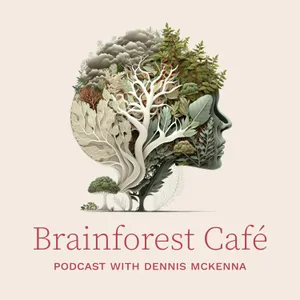
In the Brainforest Café, Dennis McKenna discusses a wide range of topics related to philosophy, plant medicines, psychedelics and consciousness in nature. Guests are invited from diverse fields such as anthropology, neuroscience, and spirituality to explore various aspects of the human experience. Some of the topics that are covered in the Brainforest Café include the history and the role of plant medicines in traditional healing practices and the potential benefits of psychedelic-assisted therapy for mental health. The Brainforest Café also explores the cultural, social, and political implications of psychedelic use. Dennis McKenna shares his own personal experiences with plant medicines, offering insights and reflections on his own journey of self-discovery and transformation. The Brainforest Café is a thought-provoking and engaging exploration of the intersection between science, spirituality, and culture, and offers a valuable perspective on the potential of plant medicines to transform our understanding of ourselves and the natural world.
Latest Episodes
The most recent episodes — sign up to get AI-powered summaries of each one.
- 1 weeks ago1h 15m
Why Ibogaine Triggers a 'Second Childhood' in the Brain - Part 2
Jonathan Dickinson, CEO and co-founder of Ambio Life Sciences and author of Ibogaine and the Bicameral Mind, returns to the Brainforest Café for part two of his conversation with Dr. Dennis McKenna. Where part one followed the personal journey, this one goes into the machinery: what ibogaine is actually doing to the mind and to the cell. - - - Jonathan Dickinson, co-founder and CEO of Ambio Life Sciences and founder of Terragnosis, joins Dr. Dennis McKenna on the Brainforest Café for a conversation about ibogaine, iboga, and the Bwiti tradition of Gabon. A Mexico-licensed psychologist and former executive director of the Global Ibogaine Therapy Alliance, Jonathan helped develop the field's foundational safety guidelines and completed the first Nagoya-compliant export of Tabernanthe iboga root. In part one of a two-part conversation, he traces the path from harm reduction work in Vancouver's Downtown Eastside to initiation in Gabon, and explains why ibogaine refuses to behave like a pharmaceutical. It does not reduce symptoms. It opens a door, and the person has to walk through it. Learn more about your ad choices. Visit megaphone.fm/adchoices
- 1 weeks ago1h 2m
Ibogaine and the Bicameral Mind - Part 1
Jonathan Dickinson, co-founder and CEO of Ambio Life Sciences and founder of Terragnosis, joins Dr. Dennis McKenna on the Brainforest Café for a conversation about ibogaine, iboga, and the Bwiti tradition of Gabon. - - - Jonathan Dickinson, a Mexico-licensed psychologist and former executive director of the Global Ibogaine Therapy Alliance, Jonathan helped develop the field's foundational safety guidelines and completed the first Nagoya-compliant export of Tabernanthe iboga root. In part one of a two-part conversation, he traces the path from harm reduction work in Vancouver's Downtown Eastside to initiation in Gabon, and explains why ibogaine refuses to behave like a pharmaceutical. It does not reduce symptoms. It opens a door, and the person has to walk through it. Learn more about your ad choices. Visit megaphone.fm/adchoices
- 4 weeks ago1h 1m
Inside Colombia’s Top Ayahuasca Retreat
What if the future of ayahuasca isn’t in the hype cycle, but in safety, tradition, and real transformation? In this conversation, Sam Believ and Dennis McKenna explore Colombia’s overlooked ayahuasca lineage, the importance of set and setting, and why plant medicine may hold a key to healing both people and culture. - - - Sam Believ is the founder of LaWayra Ayahuasca Retreat and host of the Ayahuasca Podcast. A former offshore engineer turned modern bridge-builder, Sam is dedicated to making traditional Amazonian medicine accessible, safe, and grounded for the modern world. He build LaWayra - currently the biggest Ayahuasca retreat in Colombia, while raising 3 small kids all in 2 foreign languages and without any business background. At LaWayra he has guided close to 3000 people through their Ayahuasca experience. Learn more about your ad choices. Visit megaphone.fm/adchoices
- Aug 10, 20261h 13m
Ibogaine, Kintsugi & the Secret to True Healing
xx Learn more about your ad choices. Visit megaphone.fm/adchoices
- Jul 27, 20261h 3m
Ayahuasca, Science, and Shamanism
In 2003, Carlos Tanner woke up in his car underwater, having blacked out behind the wheel and driven into a river. Deep in an opiate addiction, he went to the Amazon to save his own life. What he found there became his life's work. In this episode of the Brainforest Café, Dennis McKenna sits down with Carlos, founder of the Ayahuasca Foundation in Iquitos, Peru, for a wide-ranging conversation on healing, tradition, and what happens when a sacred medicine goes global. Carlos recounts his apprenticeship under the late curandero Don Juan Tangoa Paima, who first took him in, and how that path led him to build the Ayahuasca Foundation around one idea: to give the next person the map he never had. He and Dennis also trace a shared history back to their involvement in the documentary The Shaman and the Scientist. At the heart of the conversation is a tension they both clearly feel. Both support plant medicine, yet don’t fully agree on where it should go. Dennis, who first brought the ayahuasca vine to Hawaii in 1976, is openly conflicted about his role in spreading it globally. Carlos presses the question: you can move the plant, but can you move what makes it heal? Learn more about your ad choices. Visit megaphone.fm/adchoices
- Jul 13, 20261h 9m
Can Plants Replace Animals in Drug Testing?
In this episode of the Brainforest Café, Dennis McKenna sits down with medicinal chemist Matt Metcalf to explore a genuinely strange frontier: testing drugs in pea seedlings and the touch-sensitive Mimosa pudica instead of in mice. Along the way they circle the question that started it all, why the opium poppy spends so much energy making opioids at all, and what those molecules might be doing inside a plant that has no nerves. - - - Matthew Metcalf is a neuroscientist with a background in the medicinal chemistry and pharmacology of opioids and cannabinoids as analgesic drugs. He is an assistant professor of Medicinal Chemistry at the Massachusetts College of Pharmacy and Health Sciences University (MCPHS) School of Pharmacy - Worcester. His current research focuses on the development of New Approach Methodologies (NAMs, sometimes called Non-Animal Models) drug tests to limit the use of animals used in drug testing. His current work focuses on the use of living plants as the biological organisms to replace animal models used as drug tests. Outside of his research he is passionate about auroras and timelapse photography. Learn more about your ad choices. Visit megaphone.fm/adchoices
- Jun 29, 20261h 2m
The Pharmacy Was Always the Pantry
Dennis McKenna sits down with his old friend Dr. Cedric Baker, an ethnopharmacologist and medical herbalist who studies the ethnobotany of food across more than thirty countries. Together they take apart one of modern medicine's most stubborn assumptions: that food and medicine are separate things. From Thai kitchens where every dish is therapeutic, to the world's longevity hotspots, to the ethics of who owns a plant, it's a conversation that will leave you looking at your own plate a little differently. - - - Cedric Barrett Baker is an ethnopharmacologist, food ethnopharmacognoist, medicinal food ethnobotanist, integrative oncology medical herbalist, pharmaconutrition research scientist, & medical botany, pharmacognosy and pharmacy historian. He is also a licensed Rph. Learn more about your ad choices. Visit megaphone.fm/adchoices
- Jun 14, 20261h 13m
Can Yeast Save Endangered Psychedelics?
As the psychedelic renaissance surges, wild sources are collapsing under demand—peyote takes decades to grow, safrole extraction is destroying Southeast Asian forests, and Sonoran Desert toads are being overharvested. In his book Bioengineering Enlightenment, Prof. Jeffrey Gerst proposes a radical solution: engineer yeast or fast-growing plants to produce psychedelic compounds sustainably. But at what cost? Dennis McKenna warns this could strip these substances from their cultural and ecological roots, veering into biopiracy. Together, they debate biotech vs. tradition, exploring alternatives like community-led agroforestry, symbiotic rights, and the “Om Fund” to return profits to Indigenous stewards. They also revisit Terence McKenna’s “Stoned Ape” hypothesis, asking whether paleogenomics could experimentally probe the evolution of human consciousness. - - - Jeffrey Gerst, born and raised in New York, is a Professor of Biology with over three decades of academic experience. He began his career at the Mount Sinai School of Medicine and has since held a long-standing position at the Weizmann Institute of Science in Israel, where he serves as the Besen-Brender Chair of Microbiology and Parasitology. His research focuses on how proteins are correctly localized within cells, particularly through the trafficking of messenger RNA (mRNA), a process essential for normal cellular function and disease prevention. Among his key contributions, Gerst’s work has demonstrated that mammalian cells can transfer mRNA between one another, revealing a novel form of intercellular communication. His lab is now exploring this mechanism as a potential gene therapy approach to treat rare genetic disorders such as Tay-Sachs, cystic fibrosis, and Gaucher’s disease by enabling targeted RNA delivery within the body. In addition to his biomedical research, Gerst advocates for the sustainable production of psychedelic compounds using genetic engineering. He is the author of Bioengineering Enlightenment and has presented this work at major scientific conferences. Learn more about your ad choices. Visit megaphone.fm/adchoices
Get Brainforest Café summaries in your inbox
Free AI-powered daily recaps. Key takeaways, quotes, and mentions — in a 5-minute read.
Get Free Summaries →Free forever for up to 3 podcasts. No credit card required.
You Might Also Like
Listeners also like.
Mushroom Revival Podcast
Explores the role of fungi in health, science, technology, and culture.

hidden experience audio
In-depth interviews exploring the personal impact of UFO contact and the broader UFO mystery.

PSYCHOACTIVE
Explores humanity's complex relationship with drugs through conversations with users, experts, and critics.

The Telepathy Tapes
Non-speaking autistic individuals and others share extraordinary experiences of telepathy, consciousness, and unexplained mental abilities.
Inner Cosmos with David Eagleman
Neuroscientist David Eagleman examines how the brain interprets reality through science, stories, and interviews.

Sean Carroll's Mindscape: Science, Society, Philosophy, Culture, Arts, and Ideas
Conversations with leading thinkers exploring fundamental ideas in science, philosophy, culture, and the arts.

Brain Science with Ginger Campbell, MD: Neuroscience for Everyone
Explores neuroscience discoveries and how the brain shapes human identity through interviews and book discussions.

Forum Borealis
In-depth interviews with authors and thinkers on unconventional topics in history, science, philosophy, and politics.
Stuff To Blow Your Mind
Explores the strange edges of science, consciousness, and reality through neuroscience, cosmology, evolution, and emerging technology.

All in the Mind
Explores the science of psychology, neuroscience, and mental health through expert insights and research.

Makes Sense - with Dr. JC Doornick
Explores everyday mysteries and thought-provoking questions about human behavior and reality.
Mayim Bialik's Breakdown
Explores the intersection of science and spirituality through conversations on consciousness, healing, and unexplained phenomena.
About Brainforest Café
In the Brainforest Café, Dennis McKenna discusses a wide range of topics related to philosophy, plant medicines, psychedelics and consciousness in nature. Guests are invited from diverse fields such as anthropology, neuroscience, and spirituality to explore various aspects of the human experience. Some of the topics that are covered in the Brainforest Café include the history and the role of plant medicines in traditional healing practices and the potential benefits of psychedelic-assisted therapy for mental health. The Brainforest Café also explores the cultural, social, and political implications of psychedelic use. Dennis McKenna shares his own personal experiences with plant medicines, offering insights and reflections on his own journey of self-discovery and transformation. The Brainforest Café is a thought-provoking and engaging exploration of the intersection between science, spirituality, and culture, and offers a valuable perspective on the potential of plant medicines to transform our understanding of ourselves and the natural world.
Customized Recaps
AI-powered recaps with compact key takeaways, quotes, and insights.
Straight to Your Inbox
Get key takeaways from Brainforest Café in a 5-minute read.
Save Hours Every Week
Stay current on your favorite podcasts without falling behind.
Frequently Asked Questions
What is Podzilla's Brainforest Café daily summary?
It's a free AI-powered email that summarizes new episodes of Brainforest Café as soon as they're published. You get the key takeaways, notable quotes, and links & mentions — all in a quick read.
How does the Brainforest Café podcast summary work?
When a new episode drops, our AI transcribes and analyzes it, then generates a personalized summary tailored to your interests and profession. It's delivered to your inbox every morning.
Is this an official Brainforest Café product?
No. Podzilla is an independent service that summarizes publicly available podcast content. We're not affiliated with or endorsed by McKenna Academy of Natural Philosophy.
Can I get summaries of other podcasts too?
Absolutely! The free plan covers up to 3 podcasts. Upgrade to Pro for 15, or Premium for 50. Browse our full catalog at /podcasts.
How often does Brainforest Café release new episodes?
Brainforest Café publishes biweekly. Our AI generates a summary within hours of each new episode.
What topics does Brainforest Café cover?
Brainforest Café covers topics including Science, Philosophy, Culture, Society & Culture, Natural Sciences. Our AI identifies the specific themes in each episode and highlights what matters most to you.
Start getting Brainforest Café summaries tomorrow morning.
Free forever for up to 3 podcasts. No credit card required.
Free forever for up to 3 podcasts. No credit card required.