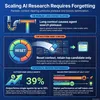
Automated research agents powered by large language models often experience performance plateaus during open-ended discovery tasks as their accumulated history makes their edits overly conservative. To overcome this limitation, researchers introduce a novel strategy called forgetting, which periodically discards previous agent sessions and candidate search histories while retaining only the single best solution found so far. When combined with a collaborative multi-agent team setup that allows asynchronous communication, this reset mechanism clears out unproductive contextual baggage and unblocks fresh exploration. Experimental evaluations across diverse domains—including heuristic programming, algorithm design, kernel optimization, and machine learning training—demonstrate that teams utilizing forgetting consistently outperform single-agent baselines and parallel configurations. Ultimately, the findings emphasize that managing what an automated discovery agent is allowed to remember is just as critical to its overall success as the amount of computational resources provided.
Podzilla Summary coming soon
Sign up to get notified when the full AI-powered summary is ready.
Free forever for up to 3 podcasts. No credit card required.
Listen to This Episode
More from Best AI papers explained

Sparks of Weight-Space Programming: LLMs can natively read & write neural network weights
Quantifying Elicitation of Latent Capabilities in Language Models
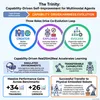
The Trinity: Capability-Driven Recursive Self-Improvement for Multimodal Agents

High-Value Training Data from Noisy, Diverse Sources
Get summaries like this every morning.
Free AI-powered recaps of Best AI papers explained and your other favorite podcasts, delivered to your inbox.
Free forever for up to 3 podcasts. No credit card required.