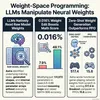
Sparks of Weight-Space Programming: LLMs can natively read & write neural network weights
Frontier large language models demonstrate a surprising capacity for weight-space programming, meaning they can naturally comprehend, evaluate, and modify the raw parameters of neural networks without relying on traditional gradient-based training. Through this paradigm, advanced systems like GPT-6 Astra can analyze a model's numeric weights to accurately determine its intended function, such as identifying a specific game or recognizing the training language from intermediate transformer blocks. Furthermore, these language models can directly edit or construct functional neural network weightsfrom scratch to solve physical control tasks or outperform heavily optimized reinforcement learning agents. When applied to larger language models, such targeted weight corrections can successfully eliminate repetitive reasoning loops and significantly enhance mathematical reasoning capabilities. Ultimately, this approach establishes a direct bridge between natural language instructions and continuous weight spaces, offering new possibilities for mechanistic interpretability and efficient model optimization.
Podzilla Summary coming soon
Sign up to get notified when the full AI-powered summary is ready.
Free forever for up to 3 podcasts. No credit card required.
Listen to This Episode
More from Best AI papers explained

Against All Likelihood
Sample Complexity and Expressiveness of Test-Time Scaling Paradigms

H-Spec: Parallel Speculative Decoding Without a Drafter-Side KV Cache

Mass producing training data with surprising side effects
Get summaries like this every morning.
Free AI-powered recaps of Best AI papers explained and your other favorite podcasts, delivered to your inbox.
Free forever for up to 3 podcasts. No credit card required.