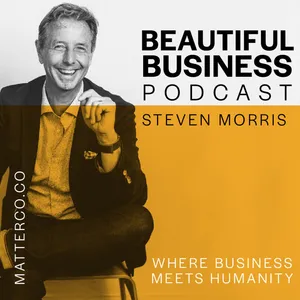
Free Daily Podcast Summary
Beautiful Business: Daily Summaries Delivered
by Steven Morris
Many business owners strategize the purpose and function of their business, but few strive to make it “beautiful.” Each week, listen in as Steven Morris and his guests discuss brand, culture, and business strategies that will create new ways to shape your beautiful business. If you are ready to evolve your business from functional to beautiful, this is the podcast for you.
Latest Episodes
The most recent episodes — sign up to get AI-powered summaries of each one.
- 5 days ago7 min
Fresh Corn?
In today’s episode, I explore what makes something feel trustworthy in a world where polished communication is increasingly easy to produce.The idea begins with two signs that say the same thing: “Fresh Corn.” One is professionally made and built to last. The other is a rough piece of cardboard with hand-painted letters. When people are asked which one they trust more, they choose the cardboard sign.That instinct points to something deeper. We often trust what carries evidence of effort, experience, and human presence. We look for signs that someone was actually there, that the words came from somewhere lived rather than simply generated.As AI and automated tools make polished communication easier to create at scale, those human signals become more valuable. The challenge is deciding what should be made more efficient and what should still carry the cost of attention, judgment, and presence.What we choose to outsource shapes what others learn to trust.Join me as I explore:✅ Why lived experience makes communication feel more believable✅ How polish can change the way we judge credibility✅ Why visible effort and imperfection can strengthen trust✅ What AI and automation are changing about the way we communicate✅ What deserves to remain distinctly humanKey Takeaways:🔑 Trust often attaches to what carries evidence of real experience🔑 Technical polish alone cannot create credibility🔑 Human presence becomes more valuable as communication becomes easier to manufacture🔑 The tools we use shape the signals other people receive🔑 Trust grows when our words, actions, and lived experience feel connectedSubscribe & ShareSubscribe for more reflections on leadership, culture, meaningful work, and the human experiences that shape how we work together. Share this episode with someone thinking carefully about trust, communication, and what we choose to keep human.#Trust #Authenticity #Communication #Leadership #ArtificialIntelligence Steven Morris, CEO of Matter Consulting is an ever-curious life-seeker, brand and culture building expert, advisor, author, and speaker. With over 27 years of entrepreneurial experience, he has served as a trusted advisor to over 3,000 business leaders and evolved more than 250 brands and cultures, including Google, Habitat for Humanity, Samsung, and Disney. His best-selling book, "The Beautiful Business," and his widely read Insights blog are a testament to his consulting expertise in creating unignorable, magnetic, and sustainable companies.His diverse interests, including meditation, fine art painting, surfing, and beekeeping, infuse his work with creativity, soul, and a deep understanding of the human experience.You can find more podcasts and join 30,000+ other brilliant and soulful readers of his weekly INSIGHTS blog at MatterCo.
- 1 weeks ago6 min
The Impeded Stream is the One That Sings
In today’s episode, I reflect on the life and work of Wendell Berry, the poet, farmer, and novelist who spent much of his life tending the same Kentucky land. His writing offers a way of thinking about work that feels particularly relevant to leadership: the things that impede us may also be the things that give our work its shape.Berry wrote about two muses. One gives us the vision. The other reminds us that bringing it into the world will be harder than we imagined. He called this second one the muse of form—the resistance that forces us to adapt, pay attention, and discover another way through.Leadership often asks the same of us.We can easily assume that a healthy team should move without friction. Yet obstacles, difficult questions, competing needs, and human limitations are part of the work itself. Like water encountering a fallen tree, the challenge is learning how to work with what is there rather than simply forcing our way through it.In this episode, I also explore Berry’s idea of thinking downstream. Every decision a leader makes eventually lands with someone else. A reorganization, a new strategy, a shift in priorities, or another demand on a team carries consequences beyond the person making the decision. Leadership requires us to consider not only what a decision achieves, but what condition it leaves others in.That responsibility extends to trust, power, and our capacity for work. Berry described wisdom as “the art of minimums”—knowing when enough has been gathered and when a field needs to lie fallow. Leaders face their own version of that choice: when to keep pushing and when continued extraction will leave too little for the season ahead.At its heart, this episode is about stewardship—reading the obstacles in front of us, understanding who is downstream of our decisions, and recognizing the difference between work that is singing and work that is simply scraping by.Join me as I explore:What Wendell Berry’s relationship with work and the land can teach us about leadershipWhy obstacles can give our work shape rather than simply slow it downWhat the “muse of form” reveals about resistance and constraintWhy healthy teams need boundaries, friction, and difficult questionsHow leadership decisions affect the people downstreamThe relationship between positional power, self-interest, and organizational trustWhat Berry’s “art of minimums” can teach leaders about capacity and restHow to recognize when to push through and when the field needs recoveryKey Takeaways:Obstacles can create the conditions for better thinking, adaptation, and meaningful work.Leadership is less about eliminating resistance and more about learning how to work intelligently with it.Every leadership decision has downstream consequences for other people.Trust grows when people can trace decisions back to a person, a reason, and a responsibility.Good stewardship considers the health of the whole rather than optimizing only for immediate individual gain.Knowing when enough is enough is part of leadership wisdom.Sustainable leadership leaves something worth inheriting for whoever comes next.If this conversation resonated with you, subscribe, leave a review, and share the episode with someone thinking deeply about leadership, stewardship, and the work of caring for what comes next.#Leadership #LeadershipDevelopment #ExecutiveLeadership #OrganizationalCulture #Stewardship #LeadershipWisdom #WorkplaceCulture #SustainableLeadership Steven Morris, CEO of Matter Consulting is an ever-curious life-seeker, brand and culture building expert, advisor, author, and speaker. With over 27 years of entrepreneurial experience, he has served as a trusted advisor to over 3,000 business leaders and evolved more than 250 brands and cultures, including Google, Habitat for Humanity, Samsung, and Disney. His best-selling book, "The Beautiful Business," and his widely read Insights blog are a testament to his consulting expertise in creating unignorable, magnetic, and sustainable companies.His diverse interests, including meditation, fine art painting, surfing, and beekeeping, infuse his work with creativity, soul, and a deep understanding of the human experience.You can find more pod
- 2 weeks ago6 min
Finally. Five Hours of Sleep.
In today’s episode, I reflect on a single word that stayed with me after Japan’s prime minister, Sanae Takaichi, described finally getting five hours of sleep: finally. That word says something about the way many high-performing people experience rest—as something to earn, justify, or reach only after everything and everyone else has been taken care of. I see this often in the leaders I coach and advise, particularly women carrying demanding careers alongside caregiving, illness, grief, parenthood, and responsibilities that rarely appear on a performance review. I’ve also lived my own version of it, spending years believing that being the person who could always push through was something to be proud of. In this episode, I explore: - Why rest can feel like something we have to earn - The invisible responsibilities people carry alongside their work - What research tells us about burnout, caregiving, and gender- How endurance and self-reliance can become part of our identity My own experience with “white knight syndrome” and the cost of always being needed What leaders can do to create cultures where people can ask for what they need Healthy workplaces shouldn’t require people to reach their breaking point before they’re allowed to recover. Sometimes, “I need a break” should simply be a complete sentence. Steven Morris, CEO of Matter Consulting is an ever-curious life-seeker, brand and culture building expert, advisor, author, and speaker. With over 27 years of entrepreneurial experience, he has served as a trusted advisor to over 3,000 business leaders and evolved more than 250 brands and cultures, including Google, Habitat for Humanity, Samsung, and Disney. His best-selling book, "The Beautiful Business," and his widely read Insights blog are a testament to his consulting expertise in creating unignorable, magnetic, and sustainable companies.His diverse interests, including meditation, fine art painting, surfing, and beekeeping, infuse his work with creativity, soul, and a deep understanding of the human experience.You can find more podcasts and join 30,000+ other brilliant and soulful readers of his weekly INSIGHTS blog at MatterCo.
- 3 weeks ago5 min
Second-Guessing & Double-Checking
In today’s episode, I explore a tension every leader eventually faces: when to look again, and when to trust the decision you’ve already made. There’s an important difference between checking the work and questioning the judgment. One can reveal an error. The other can reveal that circumstances have changed—or that we’re simply uncomfortable with committing to a choice. Using Apollo 11, the premortem, and research on escalation of commitment, I look at why strong decision-making requires both rigor and the willingness to change course. The challenge is knowing which moment you’re in. Join me as I explore: The difference between double-checking and second-guessing What Apollo 11 teaches us about decisions under pressure How premortems help teams uncover hidden risks Why sunk costs make changing course so difficult When leaders should reopen a decision Key Takeaways: Double-check the work when there is something concrete to verify. Second-guess a decision when meaningful new evidence emerges. Premortems can expose risks before pressure clouds judgment. Past investment can make a bad decision harder to leave behind. Uncertainty alone is not always a reason to reconsider. Good leadership requires knowing when to look again—and when to decide. Subscribe & Share Subscribe for more reflections on leadership, culture, decision-making, and the human side of meaningful work. Share this episode with a leader or teammate navigating a difficult decision. #Leadership #DecisionMaking #LeadershipDevelopment #CriticalThinking #ExecutiveLeadership Steven Morris, CEO of Matter Consulting is an ever-curious life-seeker, brand and culture building expert, advisor, author, and speaker. With over 27 years of entrepreneurial experience, he has served as a trusted advisor to over 3,000 business leaders and evolved more than 250 brands and cultures, including Google, Habitat for Humanity, Samsung, and Disney. His best-selling book, "The Beautiful Business," and his widely read Insights blog are a testament to his consulting expertise in creating unignorable, magnetic, and sustainable companies.His diverse interests, including meditation, fine art painting, surfing, and beekeeping, infuse his work with creativity, soul, and a deep understanding of the human experience.You can find more podcasts and join 30,000+ other brilliant and soulful readers of his weekly INSIGHTS blog at MatterCo.
- Aug 21, 20264 min
Best of…Leadership Essays
In today’s episode, I explore why a strong strategy can still struggle once it leaves the leadership meeting. Leadership teams often do the hard work of gathering data, debating trade-offs, pressure-testing assumptions, and arriving at a sound decision. Yet once execution begins, a different reality can emerge. Milestones slip. Priorities compete. Meetings multiply. What seemed clear in the strategy session suddenly requires far more coordination than expected. The problem is not always the strategy. Often, it is whether the conditions necessary to execute it were ever in place. I call these conditions the Readiness Triad: Appetite, Capacity, and Skillset. Appetite is about genuine ownership. There is a difference between agreeing with a strategy in the room and continuing to protect it when the work becomes difficult or inconvenient. Capacity goes beyond whether there are enough hours in the calendar. It includes the focus, bandwidth, and resilience required to sustain demanding work without sacrificing the quality of thinking and decision-making. Skillset asks whether the people responsible for execution have the capabilities the work actually requires. Capability is task-specific, and significant strategies often ask people to do things they have not done before. Before moving from strategy to execution, leaders need to understand where their teams stand across all three. Join me as I explore: Why sound strategies can struggle during execution The three elements of the Readiness Triad The difference between consensus and genuine appetite Why capacity is about more than time and headcount How to identify skill gaps without turning them into judgments about people What leaders can do to build readiness before significant change begins Key Takeaways: A strong strategy does not guarantee successful execution. Appetite is revealed when priorities collide and the work becomes difficult. Capacity includes focus, resilience, and the conditions surrounding the work—not simply available time. Capability should be assessed against what the work requires, rather than a person’s title or past performance. Leaders can deliberately create the conditions their teams need to execute successfully. Before asking, “Can we fit this in?” ask, “What conditions need to exist for this work to succeed?” Subscribe & Share Subscribe for more reflections on leadership, strategy, culture, and the human side of meaningful work. Share this episode with a leader or team preparing to turn an important strategy into action. #Leadership #Strategy #StrategyExecution #TeamReadiness #OrganizationalChange #LeadershipDevelopment Steven Morris, CEO of Matter Consulting is an ever-curious life-seeker, brand and culture building expert, advisor, author, and speaker. With over 27 years of entrepreneurial experience, he has served as a trusted advisor to over 3,000 business leaders and evolved more than 250 brands and cultures, including Google, Habitat for Humanity, Samsung, and Disney. His best-selling book, "The Beautiful Business," and his widely read Insights blog are a testament to his consulting expertise in creating unignorable, magnetic, and sustainable companies.His diverse interests, including meditation, fine art painting, surfing, and beekeeping, infuse his work with creativity, soul, and a deep understanding of the human experience.You can find more podcasts and join 30,000+ other brilliant and soulful readers of his weekly INSIGHTS blog at MatterCo.
- Aug 7, 20266 min
The Maybe Story
In today’s episode, I reflect on a simple story about a Chinese farmer and the word “maybe”—a word that can sound like hesitation, but can also represent something much more powerful: a disciplined openness to what we do not yet know. As leaders, we are constantly surrounded by pressure to interpret events quickly. A missed target becomes a crisis. A new opportunity becomes a breakthrough. A competitor’s move becomes a threat. We name what is happening, make a judgment, and move on. But the meaning of a moment is rarely fully visible while we are still living through it. I explore the connection between this story and Jung’s idea of the tension of the opposites, and why staying with uncertainty can sometimes create more wisdom than resolving it too quickly. The goal isn’t indecision. It’s the ability to remain curious long enough for the larger story to reveal itself. Join me as I explore: ☑️ Why our desire for certainty can lead us to premature conclusions ☑️ The difference between tolerating ambiguity and becoming fluent in uncertainty ☑️ How leaders can hold competing possibilities without forcing an immediate answer ☑️ Why curiosity can be more useful than certainty when the outcome is still unfolding ☑️ What becomes possible when we leave room for the “third thing” to emerge Key Takeaways ☑️ Not every moment needs an immediate verdict. ☑️ The meaning of an event often changes as its consequences unfold. ☑️ Strong leadership requires the ability to act without pretending to know more than we do. ☑️ Staying curious in uncertainty can open possibilities that premature conclusions close down. ☑️ Sometimes “I don’t know yet” is not a weakness. It is a form of wisdom. If this episode resonates with you, subscribe to the podcast and share it with a leader or colleague who might appreciate the reminder to stay open to what comes next. #Leadership #LeadershipDevelopment #Wisdom #Curiosity #DecisionMaking Steven Morris, CEO of Matter Consulting is an ever-curious life-seeker, brand and culture building expert, advisor, author, and speaker. With over 27 years of entrepreneurial experience, he has served as a trusted advisor to over 3,000 business leaders and evolved more than 250 brands and cultures, including Google, Habitat for Humanity, Samsung, and Disney. His best-selling book, "The Beautiful Business," and his widely read Insights blog are a testament to his consulting expertise in creating unignorable, magnetic, and sustainable companies.His diverse interests, including meditation, fine art painting, surfing, and beekeeping, infuse his work with creativity, soul, and a deep understanding of the human experience.You can find more podcasts and join 30,000+ other brilliant and soulful readers of his weekly INSIGHTS blog at MatterCo.
- Jul 27, 20266 min
Let's Get Carried Away
In today’s episode, I reflect on a question a CEO once asked me after a leadership workshop: “Are you having fun?” It was a casual question, but it stayed with me. Over time, it became less about whether I enjoyed the workshop and more about what I was choosing to carry into every meeting, conversation, and difficult room. The word “sport” once meant pleasure—to be carried away. Long before it became associated with competition, it described something joyful. Yet in business, we have largely kept the competitive half of the word while leaving play, delight, and lightheartedness behind. The highest-performing teams often show us that seriousness and joy are not opposites. Steve Kerr placed joy first among the values that shaped the Golden State Warriors. Research also suggests that play can support originality, engagement, psychological safety, and stronger team performance. Joy at work is not simply something that happens when conditions are perfect. It can be a deliberate choice in how we enter the room. We can decide, before the meeting begins, what we want to bring with us. The results matter, but they are not the only reason to make that choice. Work is where much of life is spent. Choosing to experience more of it with pleasure, presence, and openness may be part of building a better life. Join me as I explore: What a CEO’s simple question revealed about leadership Why joy and competition can strengthen one another The forgotten meaning behind the word “sport” How play supports creativity, trust, and performance What it means to choose what you carry into a room Key Takeaways: Joy is not a distraction from meaningful or demanding work. Play can improve creativity, engagement, and collaboration. Psychological safety allows teams to experiment and improvise. Leaders influence a room through what they carry into it. Enjoying the work can be a deliberate practice rather than a reward. Subscribe & Share Subscribe for more reflections on leadership, culture, creativity, and the human side of meaningful work. Share this episode with a leader or teammate who may need the reminder to carry a little more joy into the room. #Leadership #WorkplaceCulture #JoyAtWork #TeamPerformance #PsychologicalSafety #CreativeLeadership Steven Morris, CEO of Matter Consulting is an ever-curious life-seeker, brand and culture building expert, advisor, author, and speaker. With over 27 years of entrepreneurial experience, he has served as a trusted advisor to over 3,000 business leaders and evolved more than 250 brands and cultures, including Google, Habitat for Humanity, Samsung, and Disney. His best-selling book, "The Beautiful Business," and his widely read Insights blog are a testament to his consulting expertise in creating unignorable, magnetic, and sustainable companies.His diverse interests, including meditation, fine art painting, surfing, and beekeeping, infuse his work with creativity, soul, and a deep understanding of the human experience.You can find more podcasts and join 30,000+ other brilliant and soulful readers of his weekly INSIGHTS blog at MatterCo.
- Jul 21, 20267 min
The Useful Opponent
In today’s episode, I explore the difference between assigned opposition and genuine dissent. For centuries, leaders have created formal roles and exercises designed to challenge accepted thinking. Red teams, pre-mortems, and competitor role-playing can help a team notice risks that ordinary planning conversations often miss. Their deeper value, however, may be the temporary cover they provide. When people are invited to speak as a competitor or imagine that failure has already happened, they can name concerns that may otherwise feel too costly to raise. The challenge is what happens when the exercise ends. A concern can surface clearly in the room and still be quietly filed away as part of a useful workshop rather than treated as a real organisational problem. What a leader does next matters. Defensiveness teaches people to soften future concerns. Curiosity, honest questions, and a willingness to change course show that disagreement can be used rather than merely tolerated. Join me as I explore: ✅ Why authentic dissent has a different effect from assigned opposition ✅ How pre-mortems and red teams create temporary cover for candour ✅ Why independent thinking should happen before the most powerful voices speak ✅ What leaders communicate through their response to uncomfortable concerns ✅ How disagreement can become a practical organisational advantage Key Takeaways: 🔑 Assigned exercises can expose concerns, but they do not guarantee those concerns will be addressed 🔑 People are more likely to speak honestly when the personal risk is temporarily reduced 🔑 Senior and confident voices should speak last, not first 🔑 The leader’s response determines whether candour grows or disappears 🔑 A useful opponent is often someone deeply committed to improving the outcome Subscribe & Share Subscribe for more reflections on leadership, culture, meaningful work, and the conversations that shape organisations. Share this episode with a leader who values honest disagreement and is willing to make room for it. #Leadership #OrganisationalCulture #DecisionMaking #PsychologicalSafety #TeamEffectiveness Steven Morris, CEO of Matter Consulting is an ever-curious life-seeker, brand and culture building expert, advisor, author, and speaker. With over 27 years of entrepreneurial experience, he has served as a trusted advisor to over 3,000 business leaders and evolved more than 250 brands and cultures, including Google, Habitat for Humanity, Samsung, and Disney. His best-selling book, "The Beautiful Business," and his widely read Insights blog are a testament to his consulting expertise in creating unignorable, magnetic, and sustainable companies.His diverse interests, including meditation, fine art painting, surfing, and beekeeping, infuse his work with creativity, soul, and a deep understanding of the human experience.You can find more podcasts and join 30,000+ other brilliant and soulful readers of his weekly INSIGHTS blog at MatterCo.
Get Beautiful Business summaries in your inbox
Free AI-powered daily recaps. Key takeaways, quotes, and mentions — in a 5-minute read.
Get Free Summaries →Free forever for up to 3 podcasts. No credit card required.
You Might Also Like
Listeners also like.
Mind The Business: Small Business Success Stories
Small business owners share real stories about starting, growing, and navigating the challenges of entrepreneurship.

The Mind Your Business Podcast
A podcast exploring how mindset, attitude, and personal beliefs shape entrepreneurial success more than hustle or strategy alone.

Right About Now - Legendary Business Advice
Real talk from business founders and entrepreneurs about building companies, lessons learned, and what actually works in real-world ventures.

BiggerPockets Business Podcast
Real entrepreneurs share practical advice on starting, growing, and selling businesses, covering hiring, marketing, and raising capital.
Butternomics the Business of Culture
Explores how culture shapes business through interviews with entrepreneurs and tastemakers redefining brand strategy.

Business Movers
True stories of visionary business leaders and the bold risks, successes, and failures that shaped iconic companies and changed the world.

The Code To Winning
Interviews with business leaders, entrepreneurs, and CEOs reveal strategies and insights for success in the modern business world.

The Entrepreneur DNA
Entrepreneurs share lessons on building businesses and personal growth through real experiences and mistakes.

The Business of Fashion Podcast
The Business of Fashion

The $100 MBA Show
A practical guide to starting and growing a business with minimal resources, covering idea validation, marketing, sales, and reinvestment.

HBR IdeaCast
Features leading thinkers in business and management discussing key ideas and trends.

Total Disruption Podcast
Entrepreneurs discuss mindset, business growth, and operational frameworks to move beyond hustle culture and build scalable companies.
About Beautiful Business
Many business owners strategize the purpose and function of their business, but few strive to make it “beautiful.” Each week, listen in as Steven Morris and his guests discuss brand, culture, and business strategies that will create new ways to shape your beautiful business. If you are ready to evolve your business from functional to beautiful, this is the podcast for you.
Customized Recaps
AI-powered recaps with compact key takeaways, quotes, and insights.
Straight to Your Inbox
Get key takeaways from Beautiful Business in a 5-minute read.
Save Hours Every Week
Stay current on your favorite podcasts without falling behind.
Frequently Asked Questions
What is Podzilla's Beautiful Business daily summary?
It's a free AI-powered email that summarizes new episodes of Beautiful Business as soon as they're published. You get the key takeaways, notable quotes, and links & mentions — all in a quick read.
How does the Beautiful Business podcast summary work?
When a new episode drops, our AI transcribes and analyzes it, then generates a personalized summary tailored to your interests and profession. It's delivered to your inbox every morning.
Is this an official Beautiful Business product?
No. Podzilla is an independent service that summarizes publicly available podcast content. We're not affiliated with or endorsed by Steven Morris.
Can I get summaries of other podcasts too?
Absolutely! The free plan covers up to 3 podcasts. Upgrade to Pro for 15, or Premium for 50. Browse our full catalog at /podcasts.
How often does Beautiful Business release new episodes?
Beautiful Business publishes weekly. Our AI generates a summary within hours of each new episode.
What topics does Beautiful Business cover?
Beautiful Business covers topics including Business, Arts, Design, Management, Entrepreneurship. Our AI identifies the specific themes in each episode and highlights what matters most to you.
Start getting Beautiful Business summaries tomorrow morning.
Free forever for up to 3 podcasts. No credit card required.
Free forever for up to 3 podcasts. No credit card required.