Free Daily Podcast Summary
Banking Transformed with Jim Marous: Daily Summaries Delivered
by Evergreen Podcasts
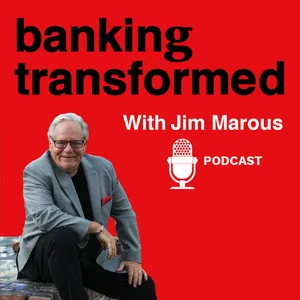
Are you prepared to embrace change, take risks and disrupt yourself in response to the digital disruption in banking? If not, this podcast is for you. Hosted by top 5 banking and fintech influencer, Jim Marous, Banking Transformed highlights the leadership and cultural challenges facing the banking industry. Featuring interviews with some of the top minds in business, this podcast explores how financial institutions can prepare for the future of banking.
Latest Episodes
The most recent episodes — sign up to get AI-powered summaries of each one.
- 5 days ago10 min
Your Rewards Program Secret Weapon
The most valuable thing a rewards program does has almost nothing to do with the reward. Bank of America reopened its rewards program this year and has enrolled more than five million people since May. Jim Marous opened a checking account at one of its branches specifically to hear how the associate would explain it, and what he got was not a product pitch. The program gave that employee a legitimate reason to talk about his whole relationship with the bank, what he would receive right away, and what would change if he brought more of his banking over. That conversation, rather than the cash back, is the part a community bank or credit union can learn from. The episode looks at why most programs cannot have that conversation. The average customer now keeps deposit accounts at three different institutions, and one in five moved money away from their primary institution in the previous three months. Under a typical tiered construct, 80% of customers account for only 14% of deposits, so most of the book sits outside anything the institution would call premium recognition. Jim frames the design problem as a door and a ladder: the door decides who gets in at all, the ladder tells them where they can go next, and most institutions put the hurdle at the door and build nothing above it. He also takes on the affordability objection directly, separating merchant-funded offers from the debit interchange exemption, and he shows what a useful relationship conversation sounds like in three sentences. The episode closes with four decisions any institution can make, including one that costs nothing: deciding which group of customers you will recognize automatically, because of who they are rather than what they hold. Research from Curinos, J.D. Power, PYMNTS Intelligence and the Federal Reserve, with examples from Bank of America and PNC, and material from Jim's interview with Shikha Narula, Head of Consumer Deposits and Rewards at Bank of America. About: Banking Transformed is hosted by Jim Marous, top five banking industry influencer and Co-Publisher of The Financial Brand. Banking Insights episodes deliver the most important strategic ideas in ten minutes, for the executive who wants the takeaway without the deep dive. Subscribe to the Digital Banking Report at digitalbankingreport.com.
- 6 days ago29 min
Bank of America's Loyalty Rewards Reset
Bank of America dropped the $20,000 minimum. 5 million clients enrolled. For most of the last decade, a large bank rewards program was something a client earned their way into. Bank of America’s preferred rewards program required $20,000 in balances, making loyalty a benefit of affluence rather than a feature of everyday relationships. BofA Rewards moved the entry point to any eligible checking account, making 30 million clients eligible immediately. More than 5 million have enrolled since, with 1.5 million of those in the first month. Shikha Narula, Head of Consumer Deposits and Rewards at Bank of America, joins Jim Marous to explain why checking was the non-negotiable anchor, how the higher tiers were made better rather than diluted, and why the lifestyle benefit threshold came down from $1 million in assets to $100,000. She also details what a primacy shift actually looks like in the data: direct deposits moving over, more card transacting, and a change in the top-of-wallet card. The most useful finding for other banks and credit unions is about channels. 80% of enrollments happen digitally in two taps, but Narula is clear that digital is the fulfillment channel and financial center associates are the catalyst. Roughly 20,000 new-to-bank clients open a checking account and enroll every week, 2.5 times the pre-launch rate. Narula closes with her advice to any leader planning a change at this scale, starting with associate education long before launch. Banking Transformed is hosted by Jim Marous, Co-Publisher of The Financial Brand and Owner of the Digital Banking Report. Subscribe for new episodes multiple times each week.
- 1 weeks ago11 min
Marketing is Still Not AI Ready
2026 State of Financial Marketing report is available for free at https://www.digitalbankingreport.com/trends/2026-state-of-financial-marketing/?YouTube More than half of the banks and credit unions in our 2026 State of Financial Marketing research have generative AI operational or better inside marketing. Not one of them describes its customer data as real-time and AI-ready. That gap runs in a straight line through the study. Generative AI raised production capacity, while thin data and almost no predictive decisioning keep the output from being relevant. 55% are not using predictive AI at all. 1% rate AI-driven content and creative as effective, the lowest score on the tactics chart, against the largest planned budget increase in the research. We funded the layer that produces marketing and held flat the layer that decides who should receive it, when it should arrive, and whether it worked. It also explains the distance between what this industry says about personalization and what it does. 83% sit at segment-based personalization or below and 1% call themselves hyper-personalized. Two-thirds of what we call personalization is choosing which audience receives a message, which is list selection under a newer name. Jim walks through what that looked like when he ran marketing at a bank, sorting a core tape by ZIP code and balance tier, and what has genuinely improved since. None of it is a reason to wait. Good solution providers build strong targeting on imperfect data every day. Imperfect data can't recognize what just happened to a customer and respond while it is still happening. Personalization and decisioning is also the least outsourced marketing function in the study at 13%, even though a lack of internal talent is the second-largest barrier, which means this industry outsources its strengths and protects its weaknesses. ABOUT: Jim Marous is Co-Publisher of The Financial Brand, Owner and Publisher of the Digital Banking Report, and host of the Banking Transformed podcast.
- 1 weeks ago10 min
The Technical Debt Your Vendors Control
Your vendor may own the technology debt. Your institution owns the consequences. Technical debt is usually discussed as a money-center bank problem, so community banks and credit unions hear it and go back to work, because they don't write code. But institutions still contracting with a legacy core are paying the maintenance on that provider's accumulated debt. Outsourcing didn't remove the debt; it changed the relationship to it: a large bank can inspect its own and decide what to repair, while a smaller institution can only live with the consequences. In this episode, Jim Marous argues that the real difference is ownership. At a large bank the problem has a department, a register and a budget line. At a community institution it has no owner, no number and no seat at the strategy table, so it surfaces every 5 to 7 years as a procurement conversation about price per account. He puts the argument inside a scene every banker will recognize: a small product change, a room that likes it, an estimate that comes back at 9 months, and an idea that goes on a list nobody reads again. The stakes have changed, because AI is the first technology whose value depends almost entirely on whether the institution can absorb it. The answer is selective decoupling rather than core replacement: hundreds of single-solution providers now run alongside a large core, so the core can remain a stable system of record while the capabilities that need to move fast are free to do so. With a guardrail, because collecting providers badly trades core debt for integration debt. Stop making your core the answer to every technology question. About: Banking Transformed is hosted by Jim Marous, top five banking industry influencer and Co-Publisher of The Financial Brand. Banking Insights episodes deliver the most important strategic ideas in under ten minutes. Subscribe to the Digital Banking Report at digitalbankingreport.com.
- 1 weeks ago46 min
Fifth Third Succeeds Through Empowered Employees
Melissa Stevens has a rule at Fifth Third: your employees are your brand. The chief marketing officer of one of banking's strongest regional brands joins Jim Marous to explain how Fifth Third grows relationships from the inside out, by giving its people the data, the insight, and even the influencer status to become the bank's most trusted voices. Stevens makes the case that customers never experience a bank as a marketing campaign. They experience it as the colleague who answers the question and solves the problem, and she has built her whole approach around that. That means letting employees post about the bank on social media without fully scripting what they say, because you can't script authenticity. It means arming bankers with insight, not just data, so a conversation is about the customer rather than the product. And it means watching for the quiet signals of a customer drifting away, like a direct deposit that suddenly splits in two, and reaching out before they're gone. She's also candid about the tradeoffs. Fifth Third deliberately kept generative AI away from its customers, choosing accuracy over personality, after growing its Jeanie assistant from barely 20 percent accuracy in its early days to the low 90s. She talks through carrying 500,000 Comerica customers into a new brand without breaking their trust. And she grades herself an honest C-minus on the one thing she worries about most as the company grows. For any bank or credit union trying to grow relationships in a crowded market, this is a clear look at what works and what most institutions get wrong about their own people. Hosted by Jim Marous. Subscribe to Banking Transformed for new episodes multiple times each week.
- 2 weeks ago10 min
Banking’s AI Gap: Faster Tasks, Same Results
We won the adoption argument. Every hand in the room. And the income statement didn't notice. Four years ago, Jim Marous asked a room of bankers how many had used an AI tool in their work, and fewer than one in four hands went up. Last week he asked the same question and nearly every hand in the room went up, many of them belonging to bankers over 50. Adoption in the banking industry has moved faster than almost anything Jim has watched in his career. Over the same period, the share of organizations that can point to any impact of AI on their earnings has not changed. This episode opens with a recurring pragmatic check-in on where banking actually is with AI, and it locates the gap elsewhere than in the technology. Banking has digitized the same way three times: paper became PDF, PDF moved behind a portal, and now the work inside the queue has been sped up. Every round improved the surface the work sits on. None of them touched the space between two departments. Mortgage lending shows the result on the income statement, where closings have come down roughly two weeks since 2021 while the cost to originate at a bank or credit union has stayed flat and pull-through has declined. Retirement rollovers show the same failure landing on the customer, where an IRA application takes five minutes, and the transfer still runs on a paper check in the mail, during which about a third of job changers cash out instead. The argument lands on ownership rather than tooling. Every step inside a department has an owner, a budget line, and a number. The space between two departments has none of the three, which is why three waves of digitalization kept landing on documents and never on the gaps. Jim closes with three moves: picking a process instead of a task, assigning one owner across the whole span, and measuring end-to-end. About: Banking Transformed is hosted by Jim Marous, top five banking industry influencer and Co-Publisher of The Financial Brand. Banking Insights episodes deliver the most important strategic ideas in under ten minutes, for the executive who wants the takeaway without the deep dive. Subscribe to the Digital Banking Report at digitalbankingreport.com.
- 2 weeks ago11 min
How to Find Real Differentiation in Banking
Most institutions aren't undifferentiated. Their differences are unwitnessed. Cover the logo on the mobile app, the website and the branch sign, and most leadership teams cannot pick their own institution out of a lineup. Jim Marous opens this episode with that test, then turns it around: the problem is rarely that a bank or credit union has nothing worth choosing. The problem is that the advantage was built somewhere no customer will ever see or feel it. The spine of the episode is an exercise Jim ran with a board recently. Everybody writes one sentence explaining why a customer banks with them, in the customer's words, and then the room crosses out anything that fails three tests. Distinctive, meaning the institution down the street could not write the same sentence. Valuable, meaning a customer has actually named it as the reason they chose or stayed, which most rooms cannot answer because nobody ever asked. And witnessed, meaning a customer can see, feel, measure or describe it through the channels they really use, and so can the prospect still deciding whether to start. From the diagnosis come four moves: capture the customer's own words at the opening, at the anniversary, and on the way out; put a number in front of the customer once a year; publish real voices rather than institutional language; and approve nothing that cannot survive the same three tests. The episode closes on the harder question, which is what an institution should do when nothing survives at all. About: Banking Transformed is hosted by Jim Marous, a top five banking industry influencer and Co-Publisher of The Financial Brand. Banking Insights episodes deliver the most important strategic ideas in under ten minutes, for the executive who wants the takeaway without the deep dive. Subscribe to the Digital Banking Report at digitalbankingreport.com.
- 2 weeks ago59 min
Customer Experience, Straight Up, with Jay Baer
Customer experience expert Jay Baer is stepping away from the keynote stage after 17 years and moving deeper into the world of tequila. He joins Jim Marous for a Banking Transformed conversation centered on five pours and five customer-experience questions for banks and credit unions. Tequilas tasted, in order: → Nosotros Blanco → Lost Lore Joven → Arette Reposado → Wild Common Añejo → Cazcáñes #7 Extra Añejo Each tequila opens a different discussion: first impressions, disconnected experiences across channels, the role of AI and automation, the difference between satisfaction and loyalty, and the advice Jay wants financial leaders to carry into the next decade. Jay explains why connected customer experience is usually a culture and leadership challenge rather than a technology problem. He also argues that as AI tools become widely available, the human touch becomes more valuable, especially when something goes wrong. His parting warning is direct: the more customers are treated like numbers, the more they will treat their financial institution as replaceable. Jay Baer is the author of Talk Triggers and Hug Your Haters and co-founder of The Tequila Report.
Get Banking Transformed with Jim Marous summaries in your inbox
Free AI-powered daily recaps. Key takeaways, quotes, and mentions — in a 5-minute read.
Get Free Summaries →Free forever for up to 3 podcasts. No credit card required.
You Might Also Like
Listeners also like.

RiskReversal Pod
Market analysis and contrarian investing insights from finance and tech experts navigating volatile markets.

Growth Triggers: Content Marketing & AI
A marketing expert shares proven podcasting strategies for growing audience reach, generating leads, and building authority in any niche.

Right About Now - Legendary Business Advice
Real talk from business founders and entrepreneurs about building companies, lessons learned, and what actually works in real-world ventures.

The Restless Ones
Executives at the intersection of technology and business discuss innovation, leadership, and driving change in fast-evolving industries.

Embracing Digital Transformation
Explores how public sector organizations can navigate digital transformation through strategic changes in people, processes, and technology.

The Digital Executive
A daily tech podcast exploring emerging technologies through interviews with Silicon Valley CEOs, influencers, and celebrities.

Monetary Matters with Jack Farley
Expert interviews exploring macroeconomics, financial markets, and monetary policy.

The Paul Morris Podcast
Entrepreneurs and investors share strategies for building wealth, scaling businesses, and leading high-performance teams.

Total Disruption Podcast
Entrepreneurs discuss mindset, business growth, and operational frameworks to move beyond hustle culture and build scalable companies.

Proven Podcast
Charles Schwartz

Invest Like the Best with Patrick O'Shaughnessy
Interviews with top investors and business leaders reveal strategies and insights for smarter investing and decision-making.

Solutions with Henry Blodget
Henry Blodget interviews experts in business, tech, and politics about practical solutions for building a better future.
About Banking Transformed with Jim Marous
Are you prepared to embrace change, take risks and disrupt yourself in response to the digital disruption in banking? If not, this podcast is for you. Hosted by top 5 banking and fintech influencer, Jim Marous, Banking Transformed highlights the leadership and cultural challenges facing the banking industry. Featuring interviews with some of the top minds in business, this podcast explores how financial institutions can prepare for the future of banking.
Customized Recaps
AI-powered recaps with compact key takeaways, quotes, and insights.
Straight to Your Inbox
Get key takeaways from Banking Transformed with Jim Marous in a 5-minute read.
Save Hours Every Week
Stay current on your favorite podcasts without falling behind.
Frequently Asked Questions
What is Podzilla's Banking Transformed with Jim Marous daily summary?
It's a free AI-powered email that summarizes new episodes of Banking Transformed with Jim Marous as soon as they're published. You get the key takeaways, notable quotes, and links & mentions — all in a quick read.
How does the Banking Transformed with Jim Marous podcast summary work?
When a new episode drops, our AI transcribes and analyzes it, then generates a personalized summary tailored to your interests and profession. It's delivered to your inbox every morning.
Is this an official Banking Transformed with Jim Marous product?
No. Podzilla is an independent service that summarizes publicly available podcast content. We're not affiliated with or endorsed by Evergreen Podcasts.
Can I get summaries of other podcasts too?
Absolutely! The free plan covers up to 3 podcasts. Upgrade to Pro for 15, or Premium for 50. Browse our full catalog at /podcasts.
How often does Banking Transformed with Jim Marous release new episodes?
Banking Transformed with Jim Marous publishes daily. Our AI generates a summary within hours of each new episode.
What topics does Banking Transformed with Jim Marous cover?
Banking Transformed with Jim Marous covers topics including News, Technology, Business. Our AI identifies the specific themes in each episode and highlights what matters most to you.
Start getting Banking Transformed with Jim Marous summaries tomorrow morning.
Free forever for up to 3 podcasts. No credit card required.
Free forever for up to 3 podcasts. No credit card required.