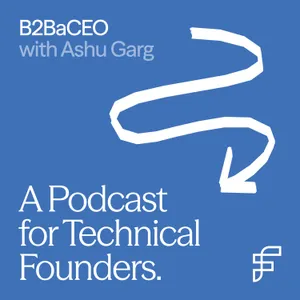
Free Daily Podcast Summary
B2BaCEO (with Ashu Garg): Daily Summaries Delivered
by Foundation Capital, Ashu Garg
B2BaCEO is the show about how to scale your enterprise startup and how to grow from founder to CEO. Hosted by Ashu Garg, general partner at Foundation Capital. Subscribe to the newsletter here: https://ashugarg.substack.com/
Latest Episodes
The most recent episodes — sign up to get AI-powered summaries of each one.
- 1 weeks ago41 min
Why vertical AI apps will win | Munjal Shah, Co-founder and CEO, Hippocratic AI
Hippocratic AI builds clinical voice agents that talk to patients by phone for health systems, payers, and pharma companies, and has already handled over 290M patient interactions. Safety was a priority for Munjal, and the company waited 18 months to ship until its agents tested safer than human nurses.As a founder, Munjal has ridden each major platform shift. He sold his first company to Alibaba and his second to Google. His next venture, a decade-long healthcare startup, didn’t succeed. Rather than end on a loss, he started Hippocratic weeks after seeing ChatGPT. “Wait and wait and wait until you see a forest fire, and then start a company,” he advises.As a founder, Munjal argues for building a bigger founding team even at the cost of more equity. He also makes the case that AI safety is an engineering problem, and that the companies shipping AI should own the risks of what they ship.We end with his hard-earned advice for founders building in AI: find a corner of the market where the big players’ design constraints don’t fit and run into the vertical as fast as you can. The best openings are in the “troughs,” the places where today’s frontier models still fall short.What we covered:00:00 – Cold open00:55 – What Hippocratic AI does01:25 – Munjal’s founder journey05:13 – Why founders should wait for their “forest fire” moment08:15 – Lessons learned across four startups14:23 – Creating culture by design16:10 – If you don’t think it’s safe, don’t ship it23:52 – Why AI labs’ messaging feels contradictory25:30 – Second-order effects and why AI predictions miss them26:30 – Saving $400K by moving to open source.31:50 – Why vertical AI will win35:15 – Targeting the “troughs” in jagged AI intelligence37:12 – The Copilot, Autopilot, Infinite Pilot framework39:40 – The abundance revolutionLinks:Munjal Shah: linkedin.com/in/munjalshah747Hippocratic AI: https://www.hippocraticai.com/
- Sep 17, 202631 min
How to solve AI's security problem | Anshu Sharma, Co-founder & CEO, Skyflow
Today, raw enterprise data can't simply be fed into a model: it's full of personal information that has to be transformed so it protects privacy while preserving meaning. Skyflow controls what data reaches a model, enforces policy on what an agent is allowed to do with it, and manages data sovereignty across borders.Anshu has been chasing this problem for over two decades.At Salesforce, he had to convince early enterprise customers like JPMorgan and Cisco to trust the cloud with their most sensitive data; work that led him to help build Salesforce's identity and app-exchange infrastructure from scratch.That same trust problem kept resurfacing across two more startups before he founded Skyflow in 2019. “At some point you realize, you know what? There's probably a $100B company to be built just protecting the most sensitive data for customers at all these companies,” he explains.As a founder, Anshu draws lessons from leaders like Marc Benioff, noting the way companies position themselves against rivals and partners can shape their success in the market. He also argues that enduring companies start with a meaningful problem and leaders who can build a culture around the shared mission to solve it.We close with his advice for technical founders: learn to respect marketing as a craft. The best sales and marketing comes from understanding your audience so well that it doesn’t feel like sales or marketing at all.What we covered:0:00 – Cold open: Anshu on the biggest misconception in AI security1:00 – What Skyflow does2:35 – Why AI agents raise the stakes on data privacy3:55 – Anshu’s story: from Salesforce to Skyflow8:05 – How AI is reshaping SaaS and infrastructure10:44 – Skyflow's role in the token economy15:59 – The biggest misconception about AI security18:22 – Is cybersecurity a failed industry?19:08 – How Skyflow's product and go-to-market evolved with the AI shift20:57 – Building culture in a company competing with OpenAI and Anthropic for talent22:40 – Lessons from Marc Benioff: beginner's mind and breaking the rules26:12 – The open-weights debate: trust vs. transparency30:16 – Advice for technical founders: respect the art of marketing31:18 – Closing thoughtsLinks:Skyflow: https://www.skyflow.com/
- Feb 20, 202636 min
The case for context graphs | Aaron Levie (Co-founder & CEO, Box)
Aaron Levie has been on the podcast twice before. After we published our context graphs thesis, he wrote a response - so we invited him on to continue the conversation. A context graph is institutional memory for how an organization actually makes decisions: not how the process doc says it should, but how it works in practice. Enterprise software is very good at recording outcomes - the final price, the approved discount, the escalated ticket - but not the reasoning behind them. Which exceptions applied? What precedent mattered? Who approved what, and why? We call these missing records decision traces. Over time, they accumulate into a context graph: a living, queryable map of how an enterprise actually makes decisions, stitched across systems and time so precedent becomes searchable. We think the companies that capture that layer will define the next generation of enterprise software. Aaron read the piece and joined us to push it further. We get into how the services as software opportunity unfolds as agents scale, and what it actually takes to move them out of the sandbox and into production. Chapters: 00:00 Intro: Aaron’s third time on the podcast! 00:43 What is a context graph? 01:35 Aaron’s take: this won’t be zero-sum 04:10 Why systems of record may become more valuable in a world with 100x more agents 05:26 The difference between data and context 06:28 The moat incumbents have: workflow wiring, permissions, access controls 10:35 Which functions are most vulnerable to disruption 15:43 The trillion-dollar greenfield: high headcount, exception-heavy workflows 16:20 Ops as a wedge: RevOps, DevOps, SecOps, and glue work between systems 19:27 How PlayerZero is building context graphs for real engineering workflows 20:48 Is permissioned inference possible? 21:27 “Agents can’t keep secrets”: why access controls are so important 27:45 What Box is building 29:33 Multimodal context: screenshots, audio, and video 32:50 Why vibe coding won’t change the software industry’s power-law 35:03 Aaron’s advice to founders
- Jan 15, 202648 min
Why context graphs are the missing layer for AI
My guests today are Animesh Koratana and Jamin Ball. Animesh is the founder and CEO of our portfolio company PlayerZero, which is building AI production engineers that operate complex enterprise software autonomously - resolving production incidents, catching defects before release, and building durable models of how systems actually behave. Jamin is a partner at Altimeter Capital and the writer behind Clouded Judgement, a Substack where he analyzes emerging trends in enterprise software. Jamin recently sparked a debate with an essay titled “Long Live Systems of Record.” His core argument is that while agents are changing how software is used and where value accrues, they still depend on ground truth. Systems of record won't disappear so much as get pushed down the stack as new agent-native interfaces emerge on top. My partner Jaya and I felt compelled to respond, with Animesh contributing insights based on what he's seeing on the ground as he builds PlayerZero. From our perspective, the missing layer is what happens inside the workflow itself: the judgment, exceptions, and reasoning that agents and humans apply as work gets done. We call these decision traces, and we believe the context graph they form over time will become the most valuable asset for companies building and deploying AI systems. It's a genuine debate - and one that's only going to matter more as agents move from demos to production. Looking forward to keeping the conversation going! Chapters 00:00 Why Jamin’s essay sparked debate 00:35 Jamin’s argument: agents need ground truth 02:00 Animesh on why context graphs matter 07:58 What today's systems of record are missing 08:28 How PlayerZero thinks about context graphs 10:00 How context graphs could change org structures 11:10 How do you capture decisions without making people log everything? 14:35 Which systems of record are most at risk 17:04 Two workflows ripe for disruption: GTM and software development 22:31 Animesh on where context graphs can add most value 28:50 Why context graphs create moats for startups 30:00 Will context graphs be industry-specific or universal? 34:00 Bear case: do context graphs fail like semantic layers? 43:27 2026 predictions: big AI IPOs, world models, enterprise agent adoption 45:00 Hot takes: point solutions die; AI job-loss discourse hits a fever pitch 47:30 Jevons paradox: why agents create more work, not less
- Sep 15, 20251h 2m
How to Build Artificial Superintelligence | Jonathan Siddharth, Founder & CEO of Turing
My guest today is Jonathan Siddharth, co-founder and CEO of Turing.Jonathan incubated Turing in Foundation Capital’s Palo Alto office in 2018. Since then, it has grown into a multi-billion dollar company that powers nearly every frontier AI lab: OpenAI, Anthropic, Google, Meta, Microsoft, and others. If you’ve seen a breakthrough in how AI reasons or codes, odds are Turing had a hand in it.Jonathan has a provocative thesis: within three years, every white-collar job, including the CEO’s, will be automated. In this episode, we talk about what it will take to reach artificial superintelligence, why this goal matters, and how the agentic era will fundamentally reshape work. We also dig into his founder journey: what he learned from his first startup Rover, how he built Turing from day one, and how his leadership style has evolved to emphasize speed, intensity, and staying in the details.Jonathan has been at the edge of AI for years, and he has the rare ability to translate what’s happening at the frontier into lessons for builders today.Hope you enjoy the conversation! Chapters: 00:00 Cold open00:02:06 Jonathan’s backstory: his experience at Stanford00:06:37 Lessons from Rover00:08:39 Early Turing: incubation at Foundation Capital and finding PMF00:13:52 Why Turing took off00:15:12 Evolving from developer cloud to AGI partner for frontier labs00:16:49 How coding improved reasoning - and why Turing became essential00:20:38 Founder lessons: building org speed and intensity00:23:33 Why work-life balance is a false dichotomy00:24:17 Daily standups, flat orgs, and Formula One culture00:25:15 Confrontational energy and Frank Slootman’s influence00:29:50 Positioning Turing as “Switzerland” in the AI arms race00:34:32 The four pillars of superintelligence: multimodality, reasoning, tool use, coding00:37:39 From copilots to agents: the 100x improvement00:40:00 Why enterprise hasn’t had its “ChatGPT moment” yet00:43:09 Jonathan’s thoughts on RL gyms, algorithmic techniques, and evals00:46:32 The blurring line between model providers and AI apps00:47:35 Why defensibility depends on proprietary data and evals00:55:20 RL gyms: how enterprises train agents in simulated environments00:57:39 Underhyped: $30T of white-collar work will be automated
- Jun 23, 20251h 3m
How to Turn Research Into Real Companies | Ion Stoica, Co-founder and Executive Chairman, Databricks
My guest today is Ion Stoica, professor of computer science at UC Berkeley and the co-founder of Conviva, Databricks, and Anyscale. Over the last two decades, Ion’s research labs - the AMP Lab, the RISE Lab, and now the Sky Computing Lab - have seeded a generation of category-defining companies. Ion has the unique ability to turn non-consensus ideas into durable businesses. He applied machine learning to video optimization with Conviva before AI became mainstream. He scaled Apache Spark into a $60B platform with Databricks. And now, with Anyscale, he’s betting on Ray as the foundation for distributed AI workloads. In this episode, we dig into both sides of Ion’s work: how to build world-class research labs, and how to turn research into real companies. His clarity of thought makes the future feel legible, and his track record suggests he’s very often right. Hope you enjoy the conversation! Chapters: 00:00 The Spark thesis: win the ecosystem first, monetize later 01:00 Intro: From lab to company - Ion’s repeatable playbook 03:00 Did you always plan to become a founder, or did it just happen? 05:23 Let’s start with Spark - how did the project come about? 13:04 What were the most important early decisions at Databricks? 23:49 You were the first CEO - what did you have to learn (or unlearn)? 30:01 How was building Anyscale different from building Databricks? 33:53 What’s obvious to you about the future of AI that others miss? 37:31 Why AI works so well for code 41:00 The thesis behind OPAQUE Systems 44:06 Future infra will be heterogeneous, distributed, and vertically integrated 49:03 China’s edge: faster diffusion from lab to market 53:19 Platform companies still work, but only with the right investors 55:57 What role did the Databricks Unit (DBU) play in value capture? 58:02 AI progress is plateauing, but adoption is just beginning
- Jun 6, 202537 min
How to Lead with Empathy and Resilience (Ramesh Srinivasan, Senior Partner, McKinsey)
My guest today is Ramesh Srinivasan, a senior partner at McKinsey and trusted advisor to some of the world’s top CEOs. Over his career, Ramesh has worked with leaders at companies like Cognizant, Moderna, Nissan, and Delta, helping them navigate tough challenges and scale high-performing teams.Ramesh just published a new book, The Journey of Leadership, which distills lessons from thousands of hours spent alongside top executives. In our conversation, he shares practical insights for founders on how to discover their natural leadership style, why empathy is a non-negotiable leadership skill, and what it really takes to inspire people at scale.Hope you find this conversation valuable!Chapters: 00:00:00 Cold open00:01:14 Ramesh’s backstory00:04:34 Things that shaped Ramesh’s leadership philosophy00:05:19 The big idea behind his book: The Journey of Leadership00:09:12 Building empathy: For your team, your customers, your market00:11:00 Lessons from Frank D’Souza at Cognizant00:14:20 Lessons from Stéphane Bancel at Moderna00:17:15 Trust, vulnerability, and the power of asking for help00:19:40 Finding purpose: Starting from life’s crucible moments00:22:00 Renewal: How great leaders evolve over time00:24:00 Common mistakes founders make on the leadership journey00:26:10 Resilience: The ultimate test of a founder’s staying power00:30:20 The impact of AI on leadership and organizational change00:34:00 Where AI is reshaping healthcare today00:36:00 Advice for AI + healthcare founders
- Jan 24, 202542 min
How to Solve AI-Powered Search (Arvind Jain, founder and CEO of Glean)
My guest today is Arvind Jain, the founder and CEO of Glean. Before Glean, Arvind spent over a decade building Google's search infrastructure. He then co-founded Rubrik, which recently passed $1B ARR.With Glean, Arvind is tackling the longstanding challenge of enterprise search. Yet his vision goes beyond this. He believes every employee should have their own team of AI agents to help them work smarter and achieve more. In our conversation, Arvind shares his journey as a technical founder and offers his unique perspective on what it takes to build a successful startup today. We also discuss where AI is heading, and where he sees the biggest opportunities for founders. Hope you find this conversation valuable! Chapters:00:00 Cold open04:42 How Arvind began his journey in search06:59 Arvind on Glean's mission08:50 The evolution of enterprise search12:56 How AI unlocks a new dimension for search16:56 Lessons for AI startup founders21:23 Navigating the AI startup landscape25:44 The "build vs. buy" decision with AI models31:09 Defining the role of AI in business34:57 The future of work with AI agents39:30 The shift from SaaS to Service-as-Software41:21 Concluding thoughts
Get B2BaCEO (with Ashu Garg) summaries in your inbox
Free AI-powered daily recaps. Key takeaways, quotes, and mentions — in a 5-minute read.
Get Free Summaries →Free forever for up to 3 podcasts. No credit card required.
You Might Also Like
Listeners also like.

Sources with Alex Heath
A podcast offering insider interviews with influential tech leaders and rising entrepreneurs shaping Silicon Valley's future.

David Senra
David Senra hosts conversations with the greatest living founders.

What Comes Next with Arun
Explores how data and AI strategy create competitive advantage in business, based on real-world enterprise experience.

Sourcery
Interviews with top investors, CEOs, and founders.
The Entrepreneur DNA
Entrepreneurs share lessons on building businesses and personal growth through real experiences and mistakes.

Lenny's Podcast: Product | Career | Growth
Conversations with top product and growth leaders offering practical strategies for building, launching, and scaling successful products.

No Priors: Artificial Intelligence | Technology | Startups
Discusses AI advancements and implications with researchers, engineers, and founders shaping the future of artificial intelligence.

Silicon Valley Girl: AI, Tech and Career Growth
Marina Mogilko interviews tech leaders and AI founders about career growth, entrepreneurship, and navigating the AI revolution.

The AI XR Podcast
Insightful interviews with tech founders and executives on AI, virtual reality, augmented reality, and the future of spatial computing.

The Room Podcast
Tech founders and funders share behind-the-scenes stories from pivotal moments in their careers.

The Official SaaStr Podcast: SaaS | Founders | Investors
Interviews with top SaaS founders and investors on scaling from $0 to $100M ARR, hiring, and the metrics that drive growth and investment.
Crucible Moments
Stories of pivotal decisions that shaped major tech companies, told by their founders and leaders.
About B2BaCEO (with Ashu Garg)
B2BaCEO is the show about how to scale your enterprise startup and how to grow from founder to CEO. Hosted by Ashu Garg, general partner at Foundation Capital. Subscribe to the newsletter here: https://ashugarg.substack.com/
Customized Recaps
AI-powered recaps with compact key takeaways, quotes, and insights.
Straight to Your Inbox
Get key takeaways from B2BaCEO (with Ashu Garg) in a 5-minute read.
Save Hours Every Week
Stay current on your favorite podcasts without falling behind.
Frequently Asked Questions
What is Podzilla's B2BaCEO (with Ashu Garg) daily summary?
It's a free AI-powered email that summarizes new episodes of B2BaCEO (with Ashu Garg) as soon as they're published. You get the key takeaways, notable quotes, and links & mentions — all in a quick read.
How does the B2BaCEO (with Ashu Garg) podcast summary work?
When a new episode drops, our AI transcribes and analyzes it, then generates a personalized summary tailored to your interests and profession. It's delivered to your inbox every morning.
Is this an official B2BaCEO (with Ashu Garg) product?
No. Podzilla is an independent service that summarizes publicly available podcast content. We're not affiliated with or endorsed by Foundation Capital, Ashu Garg.
Can I get summaries of other podcasts too?
Absolutely! The free plan covers up to 3 podcasts, any in the catalog. Basic raises that to 15, Pro to 40 and Max to 100. Browse our full catalog at /podcasts.
How often does B2BaCEO (with Ashu Garg) release new episodes?
B2BaCEO (with Ashu Garg) publishes occasional. Our AI generates a summary within hours of each new episode.
What topics does B2BaCEO (with Ashu Garg) cover?
B2BaCEO (with Ashu Garg) covers topics including Technology, Business, Entrepreneurship. Our AI identifies the specific themes in each episode and highlights what matters most to you.
Start getting B2BaCEO (with Ashu Garg) summaries tomorrow morning.
Free forever for up to 3 podcasts. No credit card required.
Free forever for up to 3 podcasts. No credit card required.