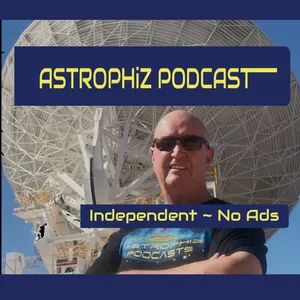
Free Daily Podcast Summary
Astronomy Astrophiz Podcast: Daily Summaries Delivered
by Brendan O'Brien: Astronomers, Astrophysicists & Space Scientists
Astrophiz: In-Depth Interviews with Astronomers and Astrophysicists Discover the wonders of the universe with Astrophiz, the podcast for space enthusiasts and researchers. Join host Brendan O’Brien as he sits down with world-leading scientists to explore the frontiers of astrophysics, radio astronomy, and space science. From the evolution of the Milky Way and the mechanics of solar flares to the cutting-edge technology of the Square Kilometre Array (SKA), we break down complex academic research into engaging stories of discovery. Whether you’re interested in cosmic dust, galaxy evolution, or the latest in telescope technology, Astrophiz brings the experts directly to your ears. Deep dives into: Astrophysics & Galactic Research Radio Astronomy & Space Weather Latest research & Dark Sky Preservation Interviews with NASA, ESA, Australian and International Researchers New episodes feature in-depth conversations that go beyond the headlines to reveal the real science shaping our understanding of the cosmos.
Latest Episodes
The most recent episodes — sign up to get AI-powered summaries of each one.
- Yesterday1h 4m
Astrophiz #246: Dark Skies, Astrotourism and Telescopes with Marnie Ogg and Fred Watson
In Astrophiz Episode 246, host Brendan O'Brien welcomes two guests at once for the first double interview in the podcast's history: dark sky champion Marnie Ogg, founder of the Australasian Dark Sky Alliance (ADSA) and director of Dark Sky Traveller, and Professor Fred Watson, Australia's former Astronomer at Large, author, broadcaster and co-host of the Space Nuts podcast. Marnie explains how a childhood under the stars led her to build Australia's dark sky movement, covering dark sky places, a Guinness World Record, a petition to federal parliament, and why light pollution harms wildlife, pollinators and human health. She also describes the Virtual Solar System Drive audio tour near Siding Spring Observatory and Coonabarabran, and why Australia is the best place on Earth for a first astrotourism trip. Fred traces his remarkable career from Sputnik to the 3.9-metre Anglo-Australian Telescope, where he pioneered optical fibre spectroscopy for studying many stars and galaxies at once. He tells the story of Hans Lipperhey and the unsung Leonard Digges, explains why "What was before the Big Bang?" still stumps us, and shares the tale of Asteroid 5691 Fred Watson. He also talks about his music and APRA award, his concerns about Starlink satellite constellations, and the total solar eclipse of 22 July 2028, the Australia-Wide Eclipse (AWE). Full transcript and show notes: [link to astrophiz.com episode 246 post] Links: Australasian Dark Sky Alliance: https://australasiandarkskyalliance.org/ Space Nuts podcast: https://spacenutspodcast.com/about Fred's APRA award-winning Star Chant (Ross Edwards, Symphony No. 4): https://www.rossedwards.com/symphony-no-4-star-chant-2001/ Marnie's children's book, Lights Out (CSIRO Publishing): https://www.publishing.csiro.au/book/8198 If you hunt around, you can find a range of prices for this gem of a book as a perfect Xmas gift for a child in your life. Astrophiz is an independent, free, ad-free and unsponsored astrophysics podcast. New episodes twice monthly with the world's leading space scientists, plus Dr Ian Musgrave's monthly SkyGuide. Website: astrophiz.com Facebook: https://www.facebook.com/groups/Astrophiz/ BlueSky: https://bsky.app/profile/astrophiz.bsky.social Produced on Yorta Yorta, Pangarang and Gadigal Country. We celebrate and honour the first astronomers of this land, the Aboriginal and Torres Strait Islander peoples. #Astrophiz #DarkSkies #LightPollution #Astrotourism #FredWatson #SpaceNuts #Astronomy #Astrophysics
- 2 weeks ago26 min
Astrophiz 245: November Sky Guide – Jupiter Occultation, Mars & Jupiter, Uranus Opposition, Leonid Storms
Dr Ian 'Astroblog' Musgrave returns with your essential guide to the November 2026 night sky for Australian skies, including a daylight occultation of Jupiter on the 3rd, Mars and Jupiter just one degree apart on the 16th, Uranus at opposition on the 26th, and the Leonid meteor shower on the 18th. Venus returns to the morning sky alongside Spica and reaches greatest brilliancy on the 30th, Saturn still graces the evening sky, and the Full Moon on the 25th is almost a perigee Moon, a harbinger of December's proper one. Ian also has tips for finding Uranus between the Pleiades and the Hyades, and an update on T Coronae Borealis, which still hasn't gone bang. In the Tangent, Ian explains why the Leonids are famous for their spectacular storms in 1833, 1966, 1999, 2001 and 2002, and how new models of the dust trails from Comet 55P/Tempel-Tuttle predict meteor storms in 2033 and 2034 and a strong outburst in 2035. When we watch a meteor shower, we are seeing the memories of comets past. IN THIS EPISODE: • Moon phases and perigee/apogee dates • Evening skies: Saturn • Morning skies: Venus and Spica, Mars and Jupiter in Leo • Daylight occultation of Jupiter, Nov 3 (with safe observing tips) • Uranus at opposition, Nov 26 • The Leonid meteor shower, Nov 18 • Southern skies highlights • The Tangent: Leonid storms and the dust of comets past Full human-curated transcript and resources: https://astrophiz.com Follow Astrophiz: Website: https://astrophiz.com Bluesky: https://bsky.app/profile/astrophiz.bsky.social Facebook: https://www.facebook.com/astrophiz #Astrophiz #SkyGuide #NovemberSky #Jupiter #Leonids #Uranus #Venus #AstronomyPodcast #Australia Astrophiz is an independent, non-commercial, ad-free astrophysics podcast, running since 2016, with over 240 episodes featuring space scientists from around the world. Twice monthly we explore the universe with the world's leading scientists. Produced on Yorta Yorta, Pangarang and Kaurna country. We celebrate and honour the first astronomers of this land, the Aboriginal and Torres Strait Islander people.
- Oct 14, 202642 min
Gravitational Waves, LISA & Dark Matter Black Holes: Laura Burn | Astrophiz 244
What are gravitational waves, and could primordial black holes be dark matter? Astrophysicist Laura Byrne (University of Auckland) explains how the LISA space mission could detect them. Astrophiz podcast Episode 244. Laura Byrne is a PhD candidate modelling gravitational waves from merging black holes ahead of LISA, the first gravitational wave observatory in space. Her current work asks whether tiny primordial black holes orbiting supermassive black holes like Sagittarius A* could produce gravitational wave signals loud enough for LISA to detect, and what that would tell us about dark matter. She won the Kerr Prize for best student talk at the Australasian Conference on General Relativity and Gravitation. IN THIS EPISODE - What are gravitational waves? Ripples in spacetime, "hearing the universe", and over 300 detections since 2015 - The LISA mission: a gravitational wave detector 2.5 million kilometres long vs 5 km for LIGO, Virgo and KAGRA - Primordial black holes as a dark matter candidate - Modelling gravitational waves in Python: hyperbolic orbits, signal-to-noise ratios and the LISA global fit - Machine learning and AI in gravitational wave data analysis - Planetarium presenting, science education research and equity in physics - Early career advice: why universities should value teaching - What to watch next: Vera C. Rubin Observatory and the Roman Space Telescope ABOUT LAURA BYRNE PhD candidate, University of Auckland (supervisor Prof Richard Easther). Integrated master's degree, University of Exeter. Planetarium presenter at Stardome, teaching fellow, and equity advocate in physics. FULL TRANSCRIPT AND SHOW NOTES astrophiz.com Laura's Study with Laura videos: YouTube Lecture: A Human History of Looking Up: From Stargazing to Space Lasers ABOUT ASTROPHIZ Astrophiz is an independent, ad-free, unsponsored astrophysics podcast hosted by Brendan O'Brien, with over 240 episodes featuring the world's leading space scientists. New interviews on the 15th of each month, and Dr Ian Musgrave's SkyGuide on the 1st. Subscribe on Spotify, Apple Podcasts, SoundCloud and YouTube. Produced on Yorta Yorta Country. Clear skies!
- Oct 1, 202623 min
Astrophiz 243: October Sky Guide – Saturn Opposition, Orionids & Life on Venus?
Dr Ian 'Astroblog' Musgrave returns with your October 2026 Sky Guide for Australian skies, including Saturn at opposition (October 4), Mars crossing the Beehive Cluster (M44), the Orionid meteor shower, a daylight Lunar X on the 18th, and the occultation of Elnath (Beta Tauri) on October 29–30. Venus becomes a wire-thin crescent on its way to inferior conjunction on the 24th, Mercury reaches greatest elongation, and T Coronae Borealis still hasn't gone bang. In the Tangent: could life be hiding in the clouds of Venus? Ian explores the "unknown absorber" in Venus's sulfuric acid clouds, a new peptide candidate, the phosphine debate, and the microbes living in Earth's 'black smokers' (deep ocean vents). Full human-curated transcript and resources: WWW.astrophiz.com Follow: https://astrophiz.com | Bluesky: https://web-cdn.bsky.app/profile/astrophiz.bsky.social | Facebook: https://www.facebook.com/astrophiz #Astrophiz #SkyGuide #OctoberSky #Saturn #Orionids #Venus #AstronomyPodcast #Australia Astrophiz is an independent, non-commercial, ad-free astrophysics podcast, running since 2016, with over 240 episodes featuring space scientists from around the world. Also on Spotify, Apple Podcasts and YouTube.
- Sep 14, 202620 min
Astrophiz 242: Has Dark Matter Finally Been Detected? – Dr Sophia Gad-Nasr
Is dark matter finally showing itself? In this episode of Astrophiz, Dr Sophia Gad-Nasr — particle cosmologist, science communicator, and creator of @AstropartiGirl — returns for her second appearance on the show (her first was Episode 90, back in 2019) to unpack the tantalising 2.6-sigma signal detected by the LUX-ZEPLIN (LZ) dark matter experiment, buried deep underground in South Dakota. Sophia walks us through how direct-detection experiments work, why this result is exciting but not yet a discovery, and what it would — and wouldn't — tell us about self-interacting dark matter, the subject of her PhD. We also cover the newly launched Nancy Grace Roman Space Telescope, which Sophia watched lift off in person, and what its huge survey power means for our understanding of dark energy. Plus: an update on Sophia's PhD research into gravothermal collapse and black hole formation, and her thoughts on diversity in physics. Chapters: Introduction & Welcome Back PhD Update: Gravothermal Collapse in Self-Interacting Dark Matter Recap: Cold Dark Matter, WIMPs & SIDM The LUX-ZEPLIN (LZ) Signal Explained Watching the Nancy Grace Roman Space Telescope Launch Self-Interacting Dark Matter vs Direct Detection Sophia's Soapbox: Diversity in Physics & the Big Open Questions Follow Dr Sophia Gad-Nasr: @AstropartiGirl Full transcript and show notes: www.astrophiz.com Astrophiz is an independent, non-commercial, ad-free astrophysics podcast running since 2016. Subscribe, tell your Astro Buddies, and join us on the 1st of each month for Dr Ian Musgrave's SkyGuide, and on the 15th for an in-depth interview with a leading space scientist. Clear skies!
- Aug 26, 202628 min
Astrophiz 241: September Sky Guide — Venus at Greatest Brilliancy & the Occultation of Antares
Dr Ian 'Astroblog' Musgrave returns with your essential guide to the September night sky — Venus at its greatest brilliancy (mag -4.5), the Moon's occultation of Antares, and Mercury lining up with Venus and Spica at dusk. 🔭 In this episode: - Spring equinox (Sept 23) and an apogee First Quarter Moon - Venus at greatest brilliancy, sinking toward evening twilight - Mercury returns and lines up with Spica and Venus - Saturn climbs toward October opposition; Mars crosses Gemini at dawn - Comet 220P/McNaught's second outburst — still visible in binoculars - T Coronae Borealis: still hasn't gone nova - The occultation of Antares, Sept 17–18 (Adelaide, Canberra, Hobart, Melbourne) - Deep-sky spotlight: Sagittarius and the triangle of globular clusters — M28, Omega Centauri, and 47 Tucanae 🌀 The Tangent: Ian traces the thousand-year argument over why Venus and Mercury never wander far from the Sun — from Ptolemy's epicycles to Tycho Brahe, Simon Marius, and Galileo's discovery of the phases of Venus. Full transcript and show notes: https://astrophiz.com Astrophiz is an independent, ad-free astronomy and astrophysics podcast. Free, unsponsored, and produced on Yorta Yorta, Pangarang and Kaurna country. #Astronomy #NightSky #Venus #Antares #Astrophysics
- Aug 12, 20261h 12m
Astrophiz #240: Trevor Barry — The Outback Astronomer | NASA-Grade Planetary Data From a Backyard Observatory
Trevor Barry — the Outback Astronomer — is a world-renowned planetary imager whose backyard observatory in Broken Hill, NSW, produces scientific-grade Jupiter and Saturn data used by NASA. In this episode of Astrophiz, host Brendan O'Brien travels to the outback to sit down with Trevor at his custom-built observatory. Discover how a former mining tradesman built a 16-inch high-resolution planetary telescope with a 32-point mirror cell and Peltier-cooled optics — and why Broken Hill's flat outback terrain produces some of the best planetary seeing on Earth. From tracking Saturn's electrical storms for NASA's Cassini mission to winning the ASA Berenice and Arthur Page Medal and ALPO's Walter H. Haas Award, Trevor breaks down the exact capture, derotation and processing workflow behind his NASA-grade data. IN THIS EPISODE: -Introduction: Arriving in Broken Hill - From the Mines to the Night Sky: the "aha" moment - Building the First Telescope: storm water pipe & a trip into the roses - Why Broken Hill Delivers World-Class Seeing - Inside the Observatory: the 32-point mirror cell & Peltier-cooled optics - First Contact with NASA: discovering an electrical storm on Saturn - From Pretty Pictures to Scientific Data: capture & processing protocols - The Thrill of Discovery: Jupiter's real-time impact scar - A Dream Fulfilled: two nights on the twin Keck telescopes, Mauna Kea - Mission Control at JPL: meeting Dr Carolyn Porco - Advice for Amateurs: where to send your data - Earning Trust in the Professional Community - Looking Ahead: the 2028 total solar eclipse & Saturn's Great Vortex - The Golden Mic: sharing the wonder with the next generation Full transcript & images: https://astrophiz.com Trevor's book "Outback Astronomer": available online & in all good bookstores Trevor's 60 Minutes feature: tinyurl.com/trevorbarry Astrophiz is an independent, ad-free science podcast running since 2016. If you enjoyed this episode, please leave a review on Apple Podcasts or Spotify, or share it with a friend who loves the cosmos. #Astrophiz #TrevorBarry #PlanetaryImaging #Astrophotography #Saturn #Jupiter #NASA #Cassini #BrokenHill #Astronomy #OutbackAstronomer #JPL
- Aug 3, 202649 min
Galaxy Forensics: Decoding Galaxy Evolution with Dr. Elisabete da Cunha (Astrophiz 230)
How do we "autopsy" a galaxy from billions of light-years away? Join world-renowned astrophysicist Dr. Elisabete da Cunha as she sits down with Astrophiz host Brendan O’Brien to explore the life, evolution, and eventual "death" of the most massive structures in the universe. From her early inspirations under the stars of Portugal to her groundbreaking work in Extragalactic Astronomy, Elisabete shares her personal journey and the high-tech tools used to decode Starlight, Cosmic Dust, and Spectral Energy Distributions (SEDs). In this episode, we dive into: Galaxy Evolution: How star systems grow and transform over billions of years. Radio Astronomy: Using invisible light to peer into the deep universe. Stellar Populations: What the chemistry of stars tells us about the history of space. Cosmology & Dark Matter: The invisible forces shaping our galactic neighborhood. Whether you are a student of astrophysics or a casual stargazer, this conversation offers a unique, charming, and deeply insightful window into the forensic evidence of our universe. Read the full transcript and see the show notes at: https://astrophiz.com/2026/03/18/galaxy-forensics-with-dr-elisabete-da-cunha-astrophiz-230/ Subscribe to Astrophiz for your monthly dose of space science, telescope technology, and expert interviews.
Get Astronomy Astrophiz Podcast summaries in your inbox
Free AI-powered daily recaps. Key takeaways, quotes, and mentions — in a 5-minute read.
Get Free Summaries →Free forever for up to 3 podcasts. No credit card required.
You Might Also Like
Listeners also like.
The 365 Days of Astronomy
A daily podcast featuring diverse voices exploring astronomy and space science topics.
Space Nuts: Astronomy Insights & Cosmic Discoveries
Astronomy discussions and cosmic discoveries explored by an astronomer and science communicator.
Astronomy Cast
Weekly discussions on astronomy topics from planets to cosmology, exploring what’s known and being discovered about the universe.
Bedtime Astronomy
A calming exploration of cosmic wonders, sharing stories about stars, planets, and celestial phenomena to inspire curiosity before sleep.
The Cosmic Controversy Podcast
brucedorminey
Through the Telescope
Two hosts explore key astronomy topics in digestible episodes, making the cosmos accessible and engaging for all knowledge levels.
Cosmos in a Pod
Explores space, science, philosophy, and technology to reveal the wonders of the universe and humanity's place within it.
SpaceTime with Stuart Gary
Weekly explorations of astronomy, space, and science news with insights from a veteran science journalist and industry experts.
Planetary Radio: Space Exploration, Astronomy and Science
Explores space exploration, astronomy, and science through conversations with experts and advocates shaping humanity's journey beyond Earth.

Hostile Worlds: Exploring Space
A documentary-style podcast exploring extreme alien environments through immersive audio storytelling aboard a fictional exploration vessel.

Albertans In Space Podcast
Features Albertans working in the space sector and explores how the province can contribute to space exploration and technology.
SpaceTime Conversations
norekiva
About Astronomy Astrophiz Podcast
Astrophiz: In-Depth Interviews with Astronomers and Astrophysicists Discover the wonders of the universe with Astrophiz, the podcast for space enthusiasts and researchers. Join host Brendan O’Brien as he sits down with world-leading scientists to explore the frontiers of astrophysics, radio astronomy, and space science. From the evolution of the Milky Way and the mechanics of solar flares to the cutting-edge technology of the Square Kilometre Array (SKA), we break down complex academic research into engaging stories of discovery. Whether you’re interested in cosmic dust, galaxy evolution, or the latest in telescope technology, Astrophiz brings the experts directly to your ears. Deep dives into: Astrophysics & Galactic Research Radio Astronomy & Space Weather Latest research & Dark Sky Preservation Interviews with NASA, ESA, Australian and International Researchers New episodes feature in-depth conversations that go beyond the headlines to reveal the real science shaping our understanding of the cosmos.
Customized Recaps
AI-powered recaps with compact key takeaways, quotes, and insights.
Straight to Your Inbox
Get key takeaways from Astronomy Astrophiz Podcast in a 5-minute read.
Save Hours Every Week
Stay current on your favorite podcasts without falling behind.
Frequently Asked Questions
What is Podzilla's Astronomy Astrophiz Podcast daily summary?
It's a free AI-powered email that summarizes new episodes of Astronomy Astrophiz Podcast as soon as they're published. You get the key takeaways, notable quotes, and links & mentions — all in a quick read.
How does the Astronomy Astrophiz Podcast podcast summary work?
When a new episode drops, our AI transcribes and analyzes it, then generates a personalized summary tailored to your interests and profession. It's delivered to your inbox every morning.
Is this an official Astronomy Astrophiz Podcast product?
No. Podzilla is an independent service that summarizes publicly available podcast content. We're not affiliated with or endorsed by Brendan O'Brien: Astronomers, Astrophysicists & Space Scientists.
Can I get summaries of other podcasts too?
Absolutely! The free plan covers up to 3 podcasts, any in the catalog. Basic raises that to 15, Pro to 40 and Max to 100. Browse our full catalog at /podcasts.
How often does Astronomy Astrophiz Podcast release new episodes?
Astronomy Astrophiz Podcast publishes biweekly. Our AI generates a summary within hours of each new episode.
What topics does Astronomy Astrophiz Podcast cover?
Astronomy Astrophiz Podcast covers topics including Science. Our AI identifies the specific themes in each episode and highlights what matters most to you.
Start getting Astronomy Astrophiz Podcast summaries tomorrow morning.
Free forever for up to 3 podcasts. No credit card required.
Free forever for up to 3 podcasts. No credit card required.