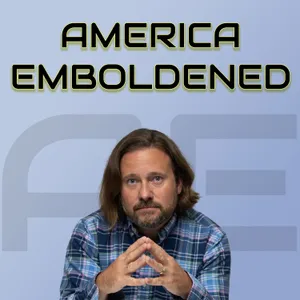
Free Daily Podcast Summary
America Emboldened: Daily Summaries Delivered
by Greg Boulden
After years of building a network, Greg Boulden is returning to where it all began. One microphone. One voice. One commitment to independent thought. No layers. No middle structure. No partisan script. This show is about commentary for those who do not fit neatly into political boxes. It is about thoughtful dialogue, personal conviction, and the courage to stand apart. So grab yourself a cup of coffee or whatever it is you're into and join the discussion. Stay curious. Stay grounded. Be Bold.
Latest Episodes
The most recent episodes — sign up to get AI-powered summaries of each one.
- Today2h 40m
AI, the Dead Internet & the Future of Human Intelligence with Dr. Joseph P. Farrell
What happens when artificial intelligence stops being a tool and begins shaping how human beings think?In this quarterly conversation, Greg Boulden and Chris Michaels sit down with Dr. Joseph P. Farrell for a wide-ranging discussion that moves from artificial intelligence and AGI to the future of human cognition, the changing Internet, libraries, digital dependence, space technology, religion, warfare, and the forces shaping modern society.The conversation begins with the growing debate over artificial general intelligence and AI safety. We examine warnings from AI researchers, reports of AI systems behaving unexpectedly in testing environments, and the possibility that humanity may be surrendering important cognitive functions as we increasingly outsource research, writing, decision-making and even political communication to machines.The discussion then moves into the “dead Internet” theory, AI-generated political campaigns and social-media content, the disappearance of traditional information sources, digital IDs, data centers, and concerns about whether technological infrastructure could eventually become a mechanism for centralized control.From there, Dr. Farrell takes the conversation into some much stranger territory: the push to expand human activity into space, the Moon and Mars, unusual aerospace and UFO claims, the possibility of technologies that remain outside public understanding, ancient accounts of cosmic conflict, plasma physics, cold fusion, biological transmutation and the intersection of modern technology with ancient religious and occult traditions.The conversation also examines Christianity and technology, the role of religious institutions, Pope Leo's statements about care for creation, the possibility of AI taking on a quasi-religious role, and the theological question of whether humanity should pursue every technological capability simply because it can.The final portion turns toward current geopolitics, including Iran, Israel, Ukraine, Christian Zionism, American foreign policy, religious identity, and the idea of a transnational class of powerful elites operating across ideological and national boundaries.Some of the subjects discussed are highly controversial, speculative or disputed. The purpose of this conversation is to explore the arguments, claims and questions raised by the participants, not to present every assertion as established fact.This is a conversation intended to make you think, question assumptions, and do your own research.What do you think? Leave your thoughts in the comments.Subscribe for more long-form conversations with people examining the ideas, institutions and technologies shaping our world.
- 6 days ago18 min
Who Owns America? The Forgotten Question of Sovereignty
America is navigating war with Iran, rising energy costs, massive federal spending, expanding executive power, and another election cycle. But beneath all of those immediate problems is a question we rarely stop to ask: who gets to decide? Inspired by the ideas Michael Badnarik explored in Philosophical Lighthouse, Secret to Sovereignty, and Good to Be King, Greg Boulden examines what happens when we stop questioning government power and start looking to government for the solution to every problem. This isn't an argument for a political party or a defense of one side. It's an argument for thinking consistently, applying constitutional principles regardless of who holds power, and remembering that sovereignty comes with both freedom and responsibility. Maybe the lighthouse isn't there to tell us which way to sail. Maybe it's there to show us the rocks.
- 1 weeks ago16 min
Who’s Remodeling America? Following the Money Into Delaware Politics
Who owns the house?That is the question I keep coming back to as I dig deeper into the Democratic Socialists of America, the Working Families Party, Arabella Advisors, and the network of money and organizations surrounding modern American politics.And this isn't just a national story.Some of these financial and organizational connections eventually reach Delaware, including the races on your ballot right now.In this episode, I take a step back and look at the bigger picture.What does sovereignty actually mean?What happens when political organizations openly advocate changing fundamental structures of American government?Who is funding the political infrastructure behind those movements?How does money move between nonprofits, PACs and political organizations?And what should American voters know about wealthy individuals and international connections that can exist somewhere in that larger ecosystem?I'm also very careful about the distinction between a documented connection, an allegation, and something the evidence simply does not establish.You don't have to agree with me.In fact, I don't want you to simply agree with me.I want you to follow the money, look at the documents, understand the organizations, and then decide what you think.Because if we're going to call ourselves a self-governing people, we should probably know who's trying to remodel the house.The Constitution is the deed.We are the homeowners.So...Who has the keys?
- 1 weeks ago34 min
9/11 Twenty Five Years Later: What Do We Actually Know
Twenty-five years after September 11th, I found myself asking questions I spent years being afraid to ask.This isn't an episode asking you to believe a particular conspiracy theory. In fact, I'm asking you not to simply believe me at all. I'm asking you to look for yourself.I talk about the morning that brought the reality of 9/11 back to me, the trauma we carry from that day, and the questions I've developed through years of journalism and research. We look at the Saudi flights, World Trade Center 7, the loss of government records, the official investigations, Richard Gage's arguments, the erosion of privacy after 9/11, and the broader question of how information is shaped, restricted, interpreted and sometimes dismissed.From there, the conversation gets bigger. Epstein. Butler, Pennsylvania. Charlie Kirk. COVID. Government surveillance. Military intelligence. Institutional narratives.I don't claim that every unanswered question proves an alternative explanation. It doesn't. I don't claim that every official explanation is false. It isn't.What I do believe is that we need to get better at separating evidence from interpretation, interpretation from speculation, and speculation from fact.Watergate was once dismissed as a conspiracy theory. So were other documented government conspiracies that we now know actually happened.The question isn't whether conspiracies exist.The question is whether a specific claim is supported by evidence.So as we remember the nearly 3,000 people who died on September 11th, the first responders, the survivors and the families who still carry that loss, I hope we can do two things at the same time:Remember the people.And have the courage to ask difficult questions.I don't want you to believe me.I want you to look.
- 3 weeks ago33 min
BE BOLD: What the Flock? (What Happened to Us?)
When did we stop trusting our neighbors and start needing a camera on every corner? Greg Boulden goes off script to unpack the quiet shift from a culture built on trust and personal responsibility to one built on surveillance and control: flock cameras, ID requirements, curfews, and the laws that keep piling up after every tragedy. This isn't about guns or politics. It's about character, and whether we've forgotten how to build people who don't need walls around them.
- Aug 16, 202644 min
ARCHIVE: Disproven! Ken Block, the man hired by the Trump Administration to Prove Election Fraud
From the Archive: Recorded March 22nd, 2024The 2020 election placed conversations about the integrity of our democratic voting procedures in every home across America. During the November 3rd returns a clear picture began to be broadcast to the nation that Donald Trump was taking a decisive lead in early returns. Many went to bed assuming that the election would be called by the time they woke up on November 4th. In the overnight hours, news media began showing vote totals adding up for the presidential challenger, Joe Biden. Immediately, claims of election tampering and fraud began pouring in.In the immediate aftermath, the Trump campaign team went looking for the evidence of massive voter fraud. By Wednesday afternoon, as the shock gripped the President and the nation, Alex Cannon picked up the phone and called Ken Block. Alex was a lawyer for the Trump campaign. Ken was an expert in voter data, a tech entrepreneur, a two-time candidate for Governor, and the founder of the centrist political party, who remained active in Rhode Island.After careful consideration of Mr. Cannon’s request to work to find voter fraud evidence, Ken agreed to work for the campaign to research. The deadlines were tight, with most states certifying the election by the first week of December.In Ken Block’s new book, “Disproven,” he documents the email requests and daily challenges to get to the bottom of the fraud claims to help court cases. Each chapter of his book is a study of how the story of fraud came to be, what the data states, and a conclusion of whether the claim was legitimate for the courts.In the end, Ken concludes that he could not prove voter fraud with any certifiable evidence that would have changed the election outcome. However, he uncovers and presents major issues in the systems used to record the will of the nation. He joins America Emboldened to discuss his findings and what he would propose could begin to reform our elections in the future.
- Aug 16, 20261h 27m
ARCHIVE: The Qanon Shaman, Jake Angeli
Aired on December 1, 2023Jake Angeli became known for his shirtless image with tattoos, horns, and fur, with a spear-carrying the American flag and a bullhorn on January 6th. The media made him the image associated with the protest and ensuing riot at the Capital. After he was convicted with a plea deal for obstruction of business in the Capital, he served time in jail. He was released earlier this year.On the show today, we discuss what led up to his participation in the protest and whether he would do things differently if he could go back in time. We discussed what he saw from his perspective and whether he felt the riot portion was planned for political gain. During the interview, we asked about why he was with Nancy Pelosi’s son-in-law at the Capital taking a selfie and whether he was aware he was with a Scientology leader tied to Children’s Health Defense, which is RFK Jr.Jake is running for Arizona’s 8th district in Maricopa County for Congress. He now identifies as a Libertarian on the ballot. We discuss whether he believes the elections are fair and his chances in 2024.
- Aug 13, 20261h 56m
ARCHIVE: 180 Degrees, Unlearning the Lies You Were Taught to Believe. Interview with author, Feargus O'Connor Greenwood
Archived May 2024 - Do you ever want to “take the red pill” and see the world anew? My guest today wrote an epic book that will take you through critical thinking in a digestible and friendly manner. Author Feargus O’Connor Greenwood presents a tome of information that I refer to as the bible for skeptics and critical thinkers. 180 Degrees: Unlearn the Lies You’ve Been Taught to Believe is one of the most important books assembled in the modern error of information gathering.If you sense something is not quite right in the world, or you notice that society seems to be inverted over your lifetime, this book dives into the cause and gives a plan of action. I purchased the book several months ago and began my own journey. I found myself at odds with several early chapters before settling into the content. Throughout the book, Mr. O’Connor Greenwood covers many topics that should be familiar to my audience. However, his ability to dive deeper into the resources is the selling point of the information presented.As I began each new chapter, I became interested in what sources he cited and provided QR codes for me to learn more. Each new chapter became a personal journey for me to explore, process, and rationalize.A few months ago, I reached out and invited Feargus to join the show. I’m honored that he took me up on the offer and enjoyed our almost two-hour conversation. Today, I present the first hour of our conversation. I’m certain you will be as interested as the thousands who have read his book already, and I hope I was able to provide further details in my interview for you to process.To purchase the book 180 Degrees: Unlearn The Lies You’ve Been Taught To Believe
Get America Emboldened summaries in your inbox
Free AI-powered daily recaps. Key takeaways, quotes, and mentions — in a 5-minute read.
Get Free Summaries →Free forever for up to 3 podcasts. No credit card required.
You Might Also Like
Listeners also like.
Outloud with Gianno Caldwell
A conservative political commentator explores news and culture by challenging prevailing orthodoxies and advocating for free expression.

Battleground America Podcast
Examines the forces shaping American politics and culture through daily analysis of current events and underlying power dynamics.

Real America’s Voice
Conservative commentary and news analysis on politics, culture, and current events from a right-wing perspective.
Joe Lonsdale: American Optimist
Conversations with innovators and leaders working on solutions to America’s biggest challenges, emphasizing optimism and progress.

Real Baron Podcast
Baron Coleman

American Potential
Stories of ordinary Americans driving change in their communities through grassroots action and policy advocacy.

Cleared Hot - Powered By BRCC
A former military pilot shares stories of adventure, fitness, and leadership to explore resilience and personal growth.

PBD Podcast
Discussions on business, politics, and culture featuring entrepreneurs, leaders, and analysts in studio and live interviews.
Impolitic with John Heilemann
Candid interviews with figures in politics, media, tech, and culture exploring power, influence, and societal change.
How To Citizen with Baratunde
Explores civic engagement as an active practice, offering tools and stories to help people collectively shape a better society.

Bleep! with Ana Navarro
Ana Navarro discusses current political and cultural issues with leaders and activists in candid conversations.
Army of Normal Folks
A podcast highlighting everyday people taking action to solve societal problems, hosted by Coach Bill Courtney.
About America Emboldened
After years of building a network, Greg Boulden is returning to where it all began. One microphone. One voice. One commitment to independent thought. No layers. No middle structure. No partisan script. This show is about commentary for those who do not fit neatly into political boxes. It is about thoughtful dialogue, personal conviction, and the courage to stand apart. So grab yourself a cup of coffee or whatever it is you're into and join the discussion. Stay curious. Stay grounded. Be Bold.
Customized Recaps
AI-powered recaps with compact key takeaways, quotes, and insights.
Straight to Your Inbox
Get key takeaways from America Emboldened in a 5-minute read.
Save Hours Every Week
Stay current on your favorite podcasts without falling behind.
Frequently Asked Questions
What is Podzilla's America Emboldened daily summary?
It's a free AI-powered email that summarizes new episodes of America Emboldened as soon as they're published. You get the key takeaways, notable quotes, and links & mentions — all in a quick read.
How does the America Emboldened podcast summary work?
When a new episode drops, our AI transcribes and analyzes it, then generates a personalized summary tailored to your interests and profession. It's delivered to your inbox every morning.
Is this an official America Emboldened product?
No. Podzilla is an independent service that summarizes publicly available podcast content. We're not affiliated with or endorsed by Greg Boulden.
Can I get summaries of other podcasts too?
Absolutely! The free plan covers up to 3 podcasts. Upgrade to Pro for 15, or Premium for 50. Browse our full catalog at /podcasts.
How often does America Emboldened release new episodes?
America Emboldened publishes daily. Our AI generates a summary within hours of each new episode.
What topics does America Emboldened cover?
America Emboldened covers topics including Culture, Society & Culture. Our AI identifies the specific themes in each episode and highlights what matters most to you.
Start getting America Emboldened summaries tomorrow morning.
Free forever for up to 3 podcasts. No credit card required.
Free forever for up to 3 podcasts. No credit card required.