Free Daily Podcast Summary
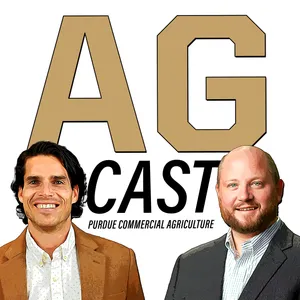
Purdue Commercial AgCast: Daily Summaries Delivered
by Purdue Center for Commercial Agriculture
AgCast brings you conversations about the business of agriculture — from the farmers making decisions every day to the leaders shaping the industry. Hosted by Chad Fiechter and Todd Kuethe from Purdue University, each episode explores the challenges, opportunities, and strategies impacting the ag economy and the business of farming.
Latest Episodes
The most recent episodes — sign up to get AI-powered summaries of each one.
- 2 weeks ago1h 11m
Beyond Buying More Land: A Different Path to Farm Profitability
Buying more farmland is a common way to grow a farming operation. But with tight crop margins, high land values and borrowing costs, is it always the best path to profitability? On this AgCast episode, hosts Chad Fiechter and Todd Kuethe are joined by Nick Paulson of the University of Illinois Farmdoc team for a conversation with Matt and Darin Riggs, the farming brothers behind Riggs Beer Company in Urbana, Illinois. When their father told them the family’s 300-acre farm wasn’t big enough to support the next generation, they decided to find another way. Their answer was unconventional: build a brewery around the grain they grow. The brothers share how they turned that idea into a business, prepared themselves before making the investment, and built a model that creates another market for their grain. They also explain why they refused to put the family farmland up as collateral, how they learned to grow without overextending, and why they believe making their existing acres more profitable can be a better strategy than simply adding more land. In this conversation: Why buying more acres isn’t the only path to farm growth How diversification can create new opportunities for farm income Turning a commodity crop into a differentiated, value-added product Protecting the farm while financing a new business Why a strong business plan, industry experience and learning from others matter How the brothers think about risk, cash flow and sustainable growth What other farmers can learn from doing things differently When margins are tight, the standard answer isn’t always the best answer. The Riggs brothers’ experience offers a practical look at thinking beyond the usual playbook and finding ways to make the farm you have more profitable. Listen in and consider: What opportunities could help your operation capture more value without simply taking on more land and debt? AgCast is a podcast from the Purdue University Center for Commercial Agriculture, bringing commercial farmers and agribusiness professionals insights on the decisions shaping farm profitability and the agricultural economy.
- Sep 17, 202650 min
Can AI Actually Help Me Make Smarter Farm Decisions?
What if you could give AI years of your farm’s data and ask it to challenge the decisions you’re making? Joe Dykhuis, President at Dykhuis Farms in Hamilton, Michigan, took that question seriously. After Chad Fiechter challenged the idea that AI would change much about farm management, Joe decided to build his own farm-management AI tool using Purdue farm management materials and Dykhuis Farms' production and financial data. What happened next surprised Chad and Todd. Joe explains how AI challenged assumptions in a major capital investment decision, acted as an “adversarial checker,” and analyzed about 10 years of hog-loading data in minutes. It also identified patterns involving weather, cleanout timing, labor and logistics that would have taken far more time to uncover using traditional analysis. AI is only as useful as the data, context and management fundamentals behind it. Joe, Chad and Todd talk about what this means for farmers, where AI can actually save time, why “truth sources” matter, and whether the future of farm decision-making might be less about building the perfect spreadsheet and more about building your own tools as you need them. This isn't a conversation about replacing farm managers with AI. It’s about whether AI can become another tool that helps farmers ask better questions, examine their assumptions and make more informed decisions. In this episode: How Joe built an AI tool around real farm data Using AI to challenge a major capital investment decision What 10 years of hog-load data revealed Why good data and farm-management fundamentals still matter How AI can connect information that wasn't originally collected for analysis What farmers should think about before turning AI loose on their own data Subscribe to the Purdue Commercial AgCast for research-based conversations that help commercial farmers and agribusiness professionals make better management decisions.
- Aug 20, 202624 min
From the Farm to Purdue: What Josh Strine Wants to Understand About Farm Decisions
How do farmers make decisions—and what can the growing amount of data generated on farms tell us about those decisions? If you've followed Purdue's Crop Basis Tool or the Center's monthly basis updates, you've probably already heard from Josh Strine. After completing his PhD at Purdue, Josh is staying with the Center for Commercial Agriculture as a postdoc, where he'll continue working on extension tools and research involving farm markets, technology and agricultural finance. In this episode, Josh talks about his path from growing up on a corn and soybean farm in central Ohio to agricultural economics and Purdue. He also explains what he hopes to explore next—including a question that connects his experience on the farm with his research interests: why do farmers make the decisions they make, and what can we learn by combining agronomic information, farm-level data and economics? Josh, Chad and Todd also discuss precision-ag data, agricultural technology, farm lending, extension and what it means to move from a PhD student into a research role. And, of course, there's a little time for Todd and Chad to get Josh off track. Subscribe to the Purdue Commercial AgCast for monthly conversations about the decisions, markets and issues shaping commercial agriculture.
- Jul 23, 202643 min
What TractorZoom's Data Says About the Future of Farm Equipment
Farm equipment markets are constantly changing, but what can auction data tell us about where agriculture is headed? In this episode of the Purdue Commercial AgCast, hosts Chad Fiechter and Todd Kuethe are joined by Andy Campbell, Director of Insights at Tractor Zoom, to discuss how data is reshaping equipment markets and the decisions farmers make every day. The conversation explores what drives equipment values, how auction trends reflect broader economic conditions, the growing role of artificial intelligence in agriculture, and why the next generation of farm machinery may look very different from today's fleets. Whether you're evaluating your next equipment purchase, watching machinery values, or simply interested in where agricultural technology is headed, this episode offers practical insights grounded in real-world data. In this episode: How TractorZoom collects and analyzes equipment market data What influences used equipment values What today's equipment market says about the farm economy How AI is changing agriculture and equipment businesses Why autonomous machinery could transform farming over the next 20 years Subscribe to the Purdue Commercial AgCast for research-based conversations that help commercial farmers and agribusiness professionals make better management decisions.
- Jun 18, 202649 min
Phosphate, Supply Chains & the 2027 Fertilizer Shock
AgCast is back — with new vigor but the same goal: bringing farmers and agricultural leaders together for conversations about the ideas, businesses, and decisions shaping the future of agriculture. In the first episode of the new season of AgCast, Chad Fiechter and Todd Kuethe sit down with Hunter Swisher, CEO and founder of Phospholutions, to explore one of the most important — and least understood — challenges facing modern agriculture: phosphate fertilizer. Phosphorus is essential for crop production, but it’s also a finite resource controlled by a handful of countries around the world. As fertilizer prices remain a major concern for farmers, this conversation breaks down what’s happening behind the scenes — from phosphate mining and global shipping routes to fertilizer production, supply chain disruptions, and what it could mean for farmers heading into future growing seasons. Hunter explains how Phospholutions is working to improve phosphate fertilizer efficiency, why traditional MAP and DAP fertilizers lose much of their value after application, and how new technology could help farmers produce more with fewer inputs. Chad and Todd also discuss: • Why fertilizer supply chains are more complicated than most farmers realize • How global events can impact input availability and prices on the farm • Why fertilizer innovation has been slower than other areas of agriculture • What farmers should understand about phosphate availability heading into 2027 • The future of ag technology, startups, and solving problems across the food system AgCast brings farmers and agricultural leaders together for conversations about the ideas, businesses, and decisions shaping the future of agriculture. Topics: fertilizer prices, phosphate fertilizer, MAP fertilizer, DAP fertilizer, farm inputs, agriculture supply chains, crop production, ag technology, farm profitability
- May 20, 202638 min
Why Profitable Farms Still Run Out of Cash
Margins are tighter. Interest costs are higher. And many farms are discovering that profitability and cash flow are not the same thing. In this episode of the Commercial AgCast, Chad Fiechter and Josh Strine sit down with John Maman of Nutrien Financial to talk about how strong operations manage cash flow, financing, operating lines, and input decisions in today’s farm economy. This conversation goes beyond interest rates and loans. It focuses on the real financial decisions affecting: operating flexibility growth opportunities input purchases working capital profitability under pressure You’ll learn: Why some profitable farms still struggle with cash How large operations think differently about financing When financing creates flexibility — and when it doesn’t The relationship between agronomy and profitability Why trusted advisors matter more during tight margins How farmers can reduce financial pressure without sacrificing productivity John also shares insights from his background in agronomy, ag retail, and agricultural finance — along with practical ways growers can think more strategically about cash management during difficult cycles. If you’re making crop input decisions, managing operating debt, or preparing for tighter margins ahead, this episode will help you think differently about the business side of farming.
- May 6, 202615 min
Farmer Sentiment Is Falling Amid Higher Input Costs
Farmer sentiment declined in April—the pressure on the farm economy is intensifying. In this episode of the Purdue Commercial AgCast, Joana Colussi and Michael Langemeier break down the April 2026 Purdue University/CME Group Ag Economy Barometer. Rising input costs, increasing concern about fertilizer availability, and global uncertainty tied to geopolitical conflict all contributed to a drop in sentiment. Tighter margins, rising break-even costs, and weaker financial expectations are beginning to influence how farmers approach investment, growth, and risk management heading into 2026. More importantly, these signals highlight how producers are shifting from cautious optimism to a more defensive posture. In this episode, we discuss: What’s driving the recent decline in farmer sentiment How fertilizer prices and input availability are impacting decisions Why 2/3 of farmers expect lower income in 2026 What rising break-even prices mean for crop profitability Why farmers are pulling back on machinery and capital investments The widening gap between crop and livestock outlooks How tight margins are influencing cash flow and strategy What’s shaping farmland value expectations Why confidence in the broader U.S. economy is slipping 📊 Read the full Ag Economy Barometer report: https://purdue.ag/barometer127 — For more farm management resources, visit: 👉 https://purdue.ag/commercialag Subscribe to the podcast: 👉 https://purdue.ag/agcast Follow us: X: https://twitter.com/PUCommercialAg Facebook: https://www.facebook.com/PUCommercialAg LinkedIn: https://www.linkedin.com/company/center-for-commercial-agriculture
- Apr 22, 202629 min
Lessons From the Delta, Part 8: Why Ducks Are More Valuable Than Crops in the Delta
Lessons From the Delta continues — and this time, the conversation turns to an unexpected connection between rice farming, water management, and wildlife. In the 8th and final episode of the Purdue Commercial AgCast mini-series, Chad Fiechter and Todd Kuethe travel to eastern Arkansas to explore how rice production systems intersect with conservation—and why organizations like Ducks Unlimited are working directly with farmers. What starts as a discussion about rice fields quickly expands into a deeper look at water use, groundwater depletion, and how wildlife habitat can create additional economic value on farmland. The conversation explores: Why rice fields function as surrogate wetlands for waterfowl How duck hunting and recreation influence land values in the Delta The scale of water use in rice production—and why it matters How farmers are adapting to groundwater decline with new practices The tradeoffs between yield, water efficiency, and management complexity Why agriculture in the Delta requires a fundamentally different system approach With water becoming an increasingly binding constraint, this episode highlights how farmers are balancing productivity, conservation, and long-term sustainability—and what that means for the future of agriculture. We’ll continue sharing video clips and behind-the-scenes footage from the Arkansas trip on our YouTube channel throughout the series. Subscribe to the Purdue Commercial AgCast so you don’t miss upcoming episodes in the Lessons From the Delta series. Learn more about Ducks Unlimited: https://www.ducks.org/ For more farm management resources, visit: 👉 https://purdue.ag/commercialag Subscribe to the podcast: 👉 https://purdue.ag/agcast Follow us: X: https://twitter.com/PUCommercialAg Facebook: https://www.facebook.com/PUCommercialAg LinkedIn: https://www.linkedin.com/company/center-for-commercial-agriculture
Get Purdue Commercial AgCast summaries in your inbox
Free AI-powered daily recaps. Key takeaways, quotes, and mentions — in a 5-minute read.
Get Free Summaries →Free forever for up to 3 podcasts. No credit card required.
You Might Also Like
Listeners also like.
The Acres U.S.A. Podcast
Explores organic and regenerative farming practices through interviews and insights aimed at building a sustainable, profitable food system.

This Is Purdue
Profiles Purdue students, faculty, and alumni pursuing research, innovation, and discovery across disciplines.

Running on Grass
Two ranchers discuss practical challenges of grass management, drought, cattle markets, and daily life on a working ranch.

The AI in Business Podcast
Interviews with AI executives reveal practical applications and strategic insights for business leaders adopting AI.
On-Farm Trials Podcast with the PNW Farmers' Network
Carol McFarland explores on-farm trials and agricultural innovations with experts across the inland Pacific Northwest.

Grassfed Life
Covers small-scale farming, grass-fed livestock, and farm-based entrepreneurship with seasonal insights and practical guidance.

Farming Today
BBC Radio 4
At the Iowa Farm Table Podcast
Explores food and farming in Iowa through conversations with farmers, food producers, and local advocates.
Working Cows - Regenerative Ranching to Maximize Profitability and Soil Health
Ranchers discuss regenerative grazing, soil health, and holistic management to improve land, animals, and profitability.

Regenerative Agriculture: Buzzwords & Bullsh*t
A no-nonsense look at the realities and myths behind regenerative agriculture practices and the claims they generate.

Business for Good Podcast
Entrepreneurs and business leaders discuss building companies that solve global problems while generating profit.

AI Business Daily
Daily insights into AI, tech trends, and digital innovation for entrepreneurs and professionals navigating the future of business.
About Purdue Commercial AgCast
AgCast brings you conversations about the business of agriculture — from the farmers making decisions every day to the leaders shaping the industry. Hosted by Chad Fiechter and Todd Kuethe from Purdue University, each episode explores the challenges, opportunities, and strategies impacting the ag economy and the business of farming.
Customized Recaps
AI-powered recaps with compact key takeaways, quotes, and insights.
Straight to Your Inbox
Get key takeaways from Purdue Commercial AgCast in a 5-minute read.
Save Hours Every Week
Stay current on your favorite podcasts without falling behind.
Frequently Asked Questions
What is Podzilla's Purdue Commercial AgCast daily summary?
It's a free AI-powered email that summarizes new episodes of Purdue Commercial AgCast as soon as they're published. You get the key takeaways, notable quotes, and links & mentions — all in a quick read.
How does the Purdue Commercial AgCast podcast summary work?
When a new episode drops, our AI transcribes and analyzes it, then generates a personalized summary tailored to your interests and profession. It's delivered to your inbox every morning.
Is this an official Purdue Commercial AgCast product?
No. Podzilla is an independent service that summarizes publicly available podcast content. We're not affiliated with or endorsed by Purdue Center for Commercial Agriculture.
Can I get summaries of other podcasts too?
Absolutely! The free plan covers up to 3 podcasts, any in the catalog. Basic raises that to 15, Pro to 40 and Max to 100. Browse our full catalog at /podcasts.
How often does Purdue Commercial AgCast release new episodes?
Purdue Commercial AgCast publishes weekly. Our AI generates a summary within hours of each new episode.
What topics does Purdue Commercial AgCast cover?
Purdue Commercial AgCast covers topics including Technology, Education, Business, Management. Our AI identifies the specific themes in each episode and highlights what matters most to you.
Start getting Purdue Commercial AgCast summaries tomorrow morning.
Free forever for up to 3 podcasts. No credit card required.
Free forever for up to 3 podcasts. No credit card required.