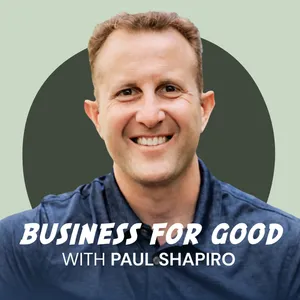
Free Daily Podcast Summary
Business for Good Podcast: Daily Summaries Delivered
by Paul Shapiro
Join host Paul Shapiro as he talks with some of the leading start-up entrepreneurs and titans of industry alike using their businesses to help solve the world's most pressing problems. Whether it's climate change, unsustainable agricultural practices, cyber threats, coral reef die-offs, nuclear waste storage, plastic pollution, or more, many of the world's greatest challenges are also exciting business opportunities. On this show, we feature business leaders who are marrying profit and purpose by inventing solutions to both build a better world and offer investors a bang for their bucks.
Latest Episodes
The most recent episodes — sign up to get AI-powered summaries of each one.
- 5 days ago45 min
Inside the Alt Protein Job Market with Noga Golan
Is alternative protein really a failing industry, or are investors just applying the wrong timeline? Noga Golan, Founder of Food Impact Partners and Food Impact Careers, has an unusually clear view of that question. Her executive recruiting firm and free job board sit at the intersection of candidate demand and company hiring across the global food innovation landscape. In this episode with Paul Shapiro, Noga shares data from nearly 60,000 job views and 35,000 application clicks in the first half of 2026, revealing that companies are still actively hiring even as the broader narrative around alternative protein remains pessimistic. Commercial roles now account for 34 percent of job postings, a signal that the sector is shifting from R&D toward revenue generation. Candidates remain especially drawn to fermentation and cultivated meat positions, often with more enthusiasm than skepticism about the sector's future. Noga argues that much of the perceived distress stems from applying venture capital and software timelines to an industry that still has to build physical supply chains, achieve price parity, and shift consumer behavior. She compares the current moment to the dot-com correction, suggesting that the boom-and-bust cycle may look like noise over a 20- to 30-year horizon. Things You Will Learn: Why alternative protein may be suffering from a timing mismatch rather than a technology problem. How the shift toward commercial hiring signals that food tech companies are moving from invention to revenue. Why candidate interest remains strongest in fermentation and cultivated meat despite sector headwinds. Why mission-aligned employees are not automatically more productive than those motivated by other factors. How founders can avoid common hiring mistakes by focusing on execution goals rather than idealized candidate profiles. Tools & Frameworks Covered: Product Market Fit as a Hiring Lens: Evaluating startup viability and team-building decisions through obsessive focus on the end buyer, rather than leading with technology or mission as the primary filter. Goal-Based Executive Search: Structuring the recruiting process around a company's 12- to 18-month business objectives and anticipated cha
- 2 weeks ago47 min
How Two Grad Students Teamed Up With Sam Altman to Build an $8 Billion Nuclear Energy Company
How does a nuclear energy startup with roughly a million dollars in revenue become an $8 billion publicly traded company sitting on $3 billion in cash? In this episode of Business For Good, Paul Shapiro sits down with Caroline DeWitte, Co-founder and COO of Oklo, to find out what investors are betting on and why the company believes it can deliver. Oklo is building compact nuclear powerhouses that use fast neutrons to extract up to 95 percent of the energy in nuclear fuel, compared to roughly five percent in conventional reactors. The company plans to run its first plants on recycled fuel from a reactor that operated from the 1960s through the 1990s, turning what most people consider nuclear waste into a viable energy source. DeWitte explains how the system shuts itself down through natural physics if something goes wrong, eliminating the need for the layers of backup systems that drive up costs in traditional nuclear plants. The conversation traces Oklo's evolution from a one-megawatt micro-reactor concept to 75-megawatt powerhouses designed for data centers and utilities. DeWitte discusses how Sam Altman became an early backer and longtime board chair, why the company chose to go public through a SPAC during what she calls the doldrums after the SPAC rush, and how President Trump's reactor pilot program allowed Oklo to begin construction under an accelerated Department of Energy pathway. Things You Will Learn: How fast reactors can recover up to 95 percent of the energy in nuclear fuel, compared to roughly five percent in conventional water-cooled reactors. Why Oklo's reactor design shuts itself down through natural physics without any human intervention. How the company went from a grad school idea to an $8 billion publicly traded company backed by Sam Altman. Why President Trump's reactor pilot program dramatically accelerated Oklo's construction timeline. How Oklo brought a reactor from a greenfield site to nuclear criticality in under a year. Tools & Frameworks Covered: Fast Reactor Technology: A nuclear reactor design using fast neutrons and liquid sodium cooling that can fission elements conventional reactors cannot, enabling fuel recycling and dramatically higher energy extraction from uranium. Nuclear Fuel Recycling: A process for reprocessing spent nuclear fuel so that up to 95 percent of its energy content can be used, reducing the volume and half-life of remaining waste from thousands of years to a few hundred. <span class= "author-d-1gg9uz65z1iz85zgdz68zmqkz84zo2qowz80z
- Aug 15, 202644 min
The Geothermal Startup That Made It Big
What if the same drilling technology that powered the shale boom could be redirected to produce clean, carbon-free electricity around the clock? In this episode of Business For Good, Paul Shapiro sits down with Tim Latimer, CEO and chairman of Fervo Energy, to explore how a former oil and gas drilling engineer built one of the most celebrated clean energy companies in the country in under a decade. Tim started Fervo in 2017 with two core beliefs: that the world would need more reliable clean electricity, and that advances in horizontal drilling had made geothermal energy dramatically more cost-effective than anyone in the geothermal industry realized. Those beliefs led to a partnership with Google, a pilot project in Nevada that produced the first horizontal geothermal well ever drilled, and a 2026 IPO that raised over $2 billion. The conversation covers why geothermal has remained a rounding error in the energy mix for over a century, how Fervo reduced drilling times from 70 days to 21 days in just four years, why their process differs fundamentally from oil and gas fracking, and what milestones investors should watch as the company scales toward 500 megawatts at its Project Cape site in Utah. Things You Will Learn: Why geothermal energy has remained less than 1% of U.S. electricity despite being over a century old. How horizontal drilling technology borrowed from oil and gas is transforming the cost structure of geothermal power. Why Fervo's process is structurally different from fossil fuel fracking, even though it borrows similar techniques. How Fervo went from startup to a multi-billion-dollar publicly traded company in under a decade. Where the next wave of geothermal entrepreneurship opportunities may emerge across the value chain. Tools & Frameworks Covered: Horizontal Drilling for Geothermal: Applying directional drilling techniques from the oil and gas industry to access deeper, hotter rock formations and dramatically increase well productivity compared to traditional vertical geothermal wells. The Earned Secret Framework: The idea that successful startups are built on insights that incumbents have missed, whether because the timing was not right, the technology had not yet transferred across industries, or conventional wisdom had not caught up with reality. Investors Invest on a Line, Not a Point: <span class= "autho
- Aug 15, 202644 min
The Geothermal Startup That Made It Big
What if the same drilling technology that powered the shale boom could be redirected to produce clean, carbon-free electricity around the clock? In this episode of Business For Good, Paul Shapiro sits down with Tim Latimer, CEO and chairman of Fervo Energy, to explore how a former oil and gas drilling engineer built one of the most celebrated clean energy companies in the country in under a decade. Tim started Fervo in 2017 with two core beliefs: that the world would need more reliable clean electricity, and that advances in horizontal drilling had made geothermal energy dramatically more cost-effective than anyone in the geothermal industry realized. Those beliefs led to a partnership with Google, a pilot project in Nevada that produced the first horizontal geothermal well ever drilled, and a 2026 IPO that raised over $2 billion. The conversation covers why geothermal has remained a rounding error in the energy mix for over a century, how Fervo reduced drilling times from 70 days to 21 days in just four years, why their process differs fundamentally from oil and gas fracking, and what milestones investors should watch as the company scales toward 500 megawatts at its Project Cape site in Utah. Things You Will Learn: Why geothermal energy has remained less than 1% of U.S. electricity despite being over a century old. How horizontal drilling technology borrowed from oil and gas is transforming the cost structure of geothermal power. Why Fervo's process is structurally different from fossil fuel fracking, even though it borrows similar techniques. How Fervo went from startup to a multi-billion-dollar publicly traded company in under a decade. Where the next wave of geothermal entrepreneurship opportunities may emerge across the value chain. Tools & Frameworks Covered: Horizontal Drilling for Geothermal: Applying directional drilling techniques from the oil and gas industry to access deeper, hotter rock formations and dramatically increase well productivity compared to traditional vertical geothermal wells. The Earned Secret Framework: The idea that successful startups are built on insights that incumbents have missed, whether because the timing was not right, the technology had not yet transferred across industries, or conventional wisdom had not caught up with reality. Investors Invest on a Line, Not a Point: <span class= "author-d-1gg9uz65z1iz8
- Aug 1, 202637 min
Did America Forget How to Build Nuclear Energy?
Nuclear energy was supposed to transform the world. Then came Chernobyl, Three Mile Island, and Fukushima, and public trust collapsed. But for 25 years, engineers across a dozen countries have been quietly designing a new generation of reactors built to fail safely without relying on human intervention or mechanical backup systems. And the target date they set back in 2000 is almost here. In this episode of Business For Good, Paul Shapiro speaks with Edward Friedman, a nuclear historian and advocate who has been writing and speaking publicly about nuclear energy since 1961. Edward walks through the misunderstandings that still shape public perception of nuclear accidents, explains why Generation IV reactor designs represent a fundamental shift in safety architecture, and lays out why the United States risks falling behind China and Russia in building the energy infrastructure the climate crisis demands. Things You Will Learn: Why Generation 4 nuclear reactors are designed to shut down on their own using the laws of physics, without relying on human operators or mechanical safety systems. How the Godzilla franchise shaped decades of public fear about radiation far beyond what the science supports. Why China has connected 55 new nuclear reactors to its grid since 2000 while the United States has connected only three. How Bill Gates' TerraPower plans to replace coal plants with sodium-cooled nuclear reactors of identical size and power output. Why training programs for nuclear technicians and support staff may be one of the biggest bottlenecks in scaling nuclear energy. Tools & Frameworks Covered: Generation IV International Forum: A multinational collaboration launched in 2000 to develop four categories of advanced nuclear reactor designs that are fail-safe, economical, and do not use water-based cooling systems. Fail-Safe Reactor Design: An engineering approach in which reactors shut themselves down through the laws of physics when overheated, using mechanisms like fluid expansion or melt plugs rather than human intervention or active mechanical systems. Coal-to-Nuclear Replacement Model: Bill Gates' strategy of building nuclear reactors sized to match existing coal plants, enabling direct replacement of fossil fuel infrastructure without redesigning the surrounding grid. <span class= "author-d-1gg9uz65z1iz85zgdz68zmqkz84zo2qowz80z
- Jul 15, 202652 min
The Lean Startup's Eric Ries on How Good Companies Go Bad
Most founders assume that building a great product and serving customers well will be enough to protect what they have built. Eric Ries, author of The Lean Startup and the new book Incorruptible, argues that the assumption is dangerously wrong. In this episode of Business For Good, Paul Shapiro sits down with Eric Ries to explore why successful organizations are systematically pulled toward corruption by a force he calls financial gravity. The conversation examines how short-term investor incentives, flawed governance structures, and misaligned compensation hollow out companies from the inside, often without anyone intending it. Eric explains the difference between mission-hopeful companies that merely wish to stay on course and mission-driven companies that have actually engineered structural protections into their governance. The discussion covers why independent directors have statistically failed to prevent corporate corruption, how industrial foundation structures used by companies like Patagonia, IKEA, and Novo Nordisk produce dramatically better long-term outcomes, and why tenured voting rights could realign shareholder power with genuine stewardship. Paul and Eric also explore how the same forces corrupt nonprofit organizations, using examples from animal welfare and Eric's work with Adopt-a-Pet founder David Meyer. Things You Will Learn: Why the most successful companies become the most vulnerable targets for corruption, and why it is a systems problem, not a people problem. How financial gravity collapses organizations over time, stripping away the qualities that made them distinctive. Why independent directors have statistically failed to prevent corporate corruption despite being the standard prescription. How industrial foundation structures produce companies that are roughly five times more likely to survive to year 50 than conventionally governed peers. Why tenured voting rights and multi-stakeholder governance could replace the broken one-share-one-vote model. Tools & Frameworks Covered: Financial Gravity: The systemic force transmitted by financial markets that gradually pulls companies away from their founding mission toward extractive behavior, regardless of the intentions of the people involved. Mission Hopeful vs. Mission Driven: A diagnostic framework for evaluating whether an organization has genuine structural protections for its mission or is simply hoping good intentions will be enough. <span class= "author-d-1gg9uz65z1iz85zgdz68zmqkz84zo2qowz80zsz81z9ytz75zz83zc2kz
- Jul 1, 202637 min
How a Biologist Built a Startup to Stop Billions of Bird Deaths with Dominique Waddoup
Every year, roughly a billion birds die from flying into glass windows and buildings. The problem is massive, well-documented, and largely invisible to the public. In this episode of Business For Good, Paul Shapiro talks with Dominique Waddoup, CEO and Founder of BirdShades, about how she went from studying giant honeybee behavior in Nepal to building a company that makes glass visible to birds without changing the way it looks to humans. Dominique explains how Bird Shades developed a retrofit window film that uses UV-reflective patterns birds can see but people cannot. The product applies to existing glass on homes and commercial buildings, eliminating the need to replace windows entirely. The conversation covers why birds collide with glass in the first place, how bird vision differs from human vision, and why the company is now pursuing licensing models to embed its technology in other window-film products. Paul and Dominique also explore why bird-window collisions remain an underrecognized conservation issue despite killing far more birds than hunting, how emerging building ordinances in the US, Canada, and Europe are beginning to create regulatory demand, and what it took for a scientist with no business background to build a hardware startup from scratch. Things You Will Learn: Why bird-window collisions kill roughly a billion birds per year, far exceeding losses from hunting. How Bird Shades created a window film that is transparent to humans but highly visible to birds using UV-reflective patterns. Why retrofit solutions for existing buildings could have a greater near-term impact than bird-safe glass in new construction. How building ordinances in cities like New York and Washington, DC, are creating regulatory demand for bird-safe products. What it took for a trained animal biologist with no business experience to build and scale a hardware startup. Tools & Frameworks Covered: UV-Reflective Window Film: A retrofit product that applies patterns visible to birds but transparent to humans, leveraging the broader color spectrum that most bird species can perceive. Licensing as a Scaling Model: Rather than manufacturing and distributing the end product alone, embedding patented bird-safe technology into existing window film product lines through licensing partnerships. <span class= "author-d-1gg9uz65z1iz85zgdz68zmqkz84zo2qo
- Jun 15, 202640 min
Turning Waste Biomass Into Carbon-Negative Buildings with Allison Dring
Right now, roughly 40% of global emissions come from the built environment. Most of those emissions are hidden deep within the materials themselves, in the concrete, steel, and plastics that are mined or extracted from underground at enormous energy costs. What if that model could be reversed entirely? In this episode of Business For Good, Paul Shapiro sits down with Allison Dring, CEO of Made of Air, to explore how waste biomass can be converted into carbon-storing building materials through a process called pyrolysis. Instead of mining resources from underground, the company uses sawdust and wood waste that would otherwise go to landfill, bakes it in a high-temperature, low-oxygen oven, and produces biochar, a stable form of elemental carbon that locks atmospheric CO2 away for roughly a thousand years. The conversation covers why the built environment is such a massive source of emissions, how biochar-based cladding panels can replace steel, cement fiber board, and fossil-based plastics at competitive prices, and why the real bottleneck is not the technology but industry adoption. Things You Will Learn: Why roughly 40% of global emissions come from the built environment, with about half of that embedded in the materials themselves. How pyrolysis converts waste biomass into biochar that locks carbon out of the atmosphere for approximately a thousand years. Why no building on earth today has achieved a fully carbon-negative life cycle, and what it would take to change that. How Made of Air's cladding panels replace steel, cement fiber board, and fossil-based plastics with carbon-negative alternatives. Why the company is targeting price parity with conventional building materials by the end of 2027 without any green premium. Tools & Frameworks Covered: Biochar Through Pyrolysis: A process of baking waste biomass in a high-temperature, low-oxygen oven that converts stored CO₂ into stable elemental carbon, creating a material that does not re-release carbon for roughly a thousand years. Above-Ground vs. Below-Ground Resources: A framework for rethinking where building materials come from, shifting from mined and fossil-extracted resources to biomass waste streams that already exist in agriculture and forestry. Embodied Carbon Compliance: <span class= "author-d-1gg9uz65z1iz85zgdz68zmqkz84zo2qowz80zsz81z9ytz75zz83zc2kz79zwz71zz75znv
About Business for Good Podcast
Join host Paul Shapiro as he talks with some of the leading start-up entrepreneurs and titans of industry alike using their businesses to help solve the world's most pressing problems. Whether it's climate change, unsustainable agricultural practices, cyber threats, coral reef die-offs, nuclear waste storage, plastic pollution, or more, many of the world's greatest challenges are also exciting business opportunities. On this show, we feature business leaders who are marrying profit and purpose by inventing solutions to both build a better world and offer investors a bang for their bucks.
Customized Recaps
AI-powered recaps with compact key takeaways, quotes, and insights.
Straight to Your Inbox
Get key takeaways from Business for Good Podcast in a 5-minute read.
Save Hours Every Week
Stay current on your favorite podcasts without falling behind.
Frequently Asked Questions
What is Podzilla's Business for Good Podcast daily summary?
It's a free AI-powered email that summarizes new episodes of Business for Good Podcast as soon as they're published. You get the key takeaways, notable quotes, and links & mentions — all in a quick read.
How does the Business for Good Podcast podcast summary work?
When a new episode drops, our AI transcribes and analyzes it, then generates a personalized summary tailored to your interests and profession. It's delivered to your inbox every morning.
Is this an official Business for Good Podcast product?
No. Podzilla is an independent service that summarizes publicly available podcast content. We're not affiliated with or endorsed by Paul Shapiro.
Can I get summaries of other podcasts too?
Absolutely! The free plan covers up to 3 podcasts. Upgrade to Pro for 15, or Premium for 50. Browse our full catalog at /podcasts.
How often does Business for Good Podcast release new episodes?
Business for Good Podcast publishes biweekly. Our AI generates a summary within hours of each new episode.
What topics does Business for Good Podcast cover?
Business for Good Podcast covers topics including Education, Business. Our AI identifies the specific themes in each episode and highlights what matters most to you.
Start getting Business for Good Podcast summaries tomorrow morning.
Free forever for up to 3 podcasts. No credit card required.
Free forever for up to 3 podcasts. No credit card required.