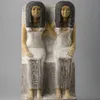
The Hidden and the Formalized: Female Queerness in Ancient Egypt
Thank you paid subscribers, KinchStalker, Phoenix, Tomas Johansson, and many others for tuning into this live video with Jordan Galczynski and Amber Myers! You filled the chat with such sharp and interesting questions. This is exactly the kind of conversation we love — primary sources, spirited disagreement, duck genitalia, and the occasional new moon. We’ll be back soon. CW— mature themes; sex; sexuality; sexual assaultWhat does it mean to look for queer lives in the ancient world? We don’t want to impose today’s freedoms onto a patriarchal past, but we also don’t want to erase the biological reality that queer people have always existed in the world. That tension—generative, unresolved, and genuinely fun to argue about—animated our latest live conversation, and we’re thrilled so many of you joined us for it.Two Women, Arms EntwinedWe kicked things off with a pair statue currently held at the Museo Egizio in Turin. Amber had shared it earlier in the week and it immediately sparked debate among the three of us. Dating to the Thutmosid period and likely from a tomb in the Theban necropolis, it shows two women — Idu and Rui — seated side by side in white linen shifts and elegant bipartite wigs, arms wrapped around each other in precisely the embrace you’d expect to see between a husband and wife. The museum’s own description calls the relationship between them “unclear.”Which is, of course, the perennial problem.Are they friends? Sisters? Mother and daughter? Could they be something more? Kara was the self-described cynical voice in the room, skeptical that ancient Egyptian society would have allowed a formally commemorated queer female relationship — while also being completely open to the possibility that a very real relationship could have existed behind the scenes, just one that could and would never be named outright. Jordan pointed out something quietly fascinating: Idu holds the title nebet per — Mistress of the House — while Rui carries no title at all, no indication of kinship or any named social role. That asymmetry suggests a dependent relationship, but of what kind, we simply can’t say. They seem to have wanted to show themselves as the core of their household.What we can say is that someone commissioned this statue, paid for it, and had it placed in a tomb context so that both women would receive offerings in the afterlife. That’s not nothing. Whatever Idu and Rui were to each other, there was care—plus money, and intention—and a desire to keep this person in one’s eternal company.The group also floated an intriguing hypothesis: what if Idu had outlived her husband, inherited his property, and then got to live exactly as she chose? Two women, a shared household, just friends, obviously. Roommates even. The ancient world’s version of companions traveling down the Nile together — who, as Jordan noted, everyone quietly understood were probably lovers, but who would never in a thousand years have said so in a formal inscription.The Notorious Tomb of Niankhkhnum and KhnumhotepFrom there we moved to the far more famous case of the two manicurists of the Old Kingdom royal court: Niankhkhnum and Khnumhotep, buried together at Saqqara in a shared tomb decorated with images of the two men nose-to-nose, embracing in ways typically reserved for married couples. Scholars have argued they were brothers, conjoined twins, or colleagues — with Kara noting, drily, that “conjoined twins” seems like a remarkable amount of effort just to avoid the word gay. But who knows? This scene is unique and perplexing. We should not try to flatten the complexity of the image: we can acknowledge that queer people existed in the ancient world without pretending they enjoyed anything like modern queer freedom or visibility in society.What the Texts Actually Say (or Don’t)So what does the written record give us? Rather less than you might hope, and rather more ambiguous than anyone would like.Jordan pulled up Book of the Dead 125—the famous Negative Confession—the list of sins the deceased declares they have not committed before the scales of Ma’at. One entry reads something like: I have not copulated with a catamite — or, depending on your translation, I have not copulated with a boy, or I have not laid with a man. The Egy
Podzilla Summary coming soon
Sign up to get notified when the full AI-powered summary is ready.
Free forever for up to 3 podcasts. No credit card required.
Listen to This Episode
More from Afterlives of Ancient Egypt with Kara Cooney

Art in Motion, a Social Tool of Power and Resistance
Crafted to Last
Anatomy of the Ancient Egyptian Soul: The Akh
Anatomy of the Ancient Egyptian Soul: The Ren
Get summaries like this every morning.
Free AI-powered recaps of Afterlives of Ancient Egypt with Kara Cooney and your other favorite podcasts, delivered to your inbox.
Free forever for up to 3 podcasts. No credit card required.