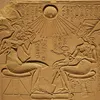
Anatomy of the Ancient Egyptian Soul: The Akh
Not everyone gets to become effective. Not everyone gets to matter after they’re gone. Not everyone becomes a saint. Your Ka, your Ba, your Ren — those showed up the moment you were born, automatic, no work required, the way your name did. The Akh is different. You had to earn it, build it.Amber and I have been in this journey about the different parts of the human personality for weeks now. This is the fourth episode in our series on the anatomy of the Egyptian soul, and definitely the hardest one so far. The Ka and the Ba you can make a go at describing. The Akh doesn’t allow that. It’s not really even a noun. It’s closer to a verb, the same energy as the Egyptian word kheper, “becoming,” transformation-in-progress. This podcast convo ended up going places I didn’t expect: gender, hubris, ecological grief even, and a king who tried to grab the most fleeting, liminal power in the whole Egyptian cosmos and hold it in his own two hands like in that Guardians of the Galaxy movie except without the happy ending. Akh as PhotosynthesisIn his dictionary of Middle Egyptian words, Faulkner tells us that akh means to be effective, glorious, useful, profitable. An Akh is what happens when something works or grows or becomes. This is not metaphorical but actual, like sunlight hitting a seed, the seed becomes a plant. That’s akh. If a person dies and manages to keep acting in the world of the living, that’s akh too, assuming the person passed the scales and saw his heart come out on top, assuming the funerary rituals did their job. The akh has the same kind of power as the plural bau of the word ba, for the soul of mobility. Bau is raw strength. Akh is strength that connects, that intervenes, that changes something.Florence Friedman spent her dissertation and a large part of her career on this topic, and her argument is that calling the Akh a “spirit” tells you nothing. She reads the word as something closer to sunlight. But what does that even mean? Friedman focuses on sunlight specifically, because it is effectiveness par excellence, the mechanism by which the divine reaches across into this world and makes something happen. Sun light is the tree growing, the fruit emerging, the people happily eating that fruit. If you think photosynthesis, you would come close, I think, to what the Egyptians had in mind with the notion of the akh. This effectiveness of spirit can be used for good or ill. The word survives into Coptic language where it means demon. That’s not later Christian problematizing of pagan things but sheer respect for power that cannot be contained. An Akh could bless you or smite you, same as any god could. The force that grows your wheat is the same one that can destroy it in a blight of grasshoppers.The bird that stopped migrating to Egypt :(The hieroglyph for Akh is a real bird—the northern bald ibis, common in Egypt through the Old Kingdom, and then, after that, poof, just gone. The bird’s habitat dried out, Egypt’s climate shifted, and the bird that had given its shape to effective transformation disappeared from the Nile Valley within living memory of the people who used its picture every day in their texts. I did not know this. I am still stunned to have learned it. The Egyptians kept drawing the bird glyph, of course. For thousands of years after its disappearance from their Nile waters, they drew it. A bird nobody living had ever actually seen, got more abstract and stylized the further it got from anyone’s lived experience, until by the New Kingdom it’s sporting something that looks suspiciously like a nemes headdress. The feathers Old Kingdom scribes had faithfully and realistically drawn to identify the bird were reimagined as a kind of linen headcloth or a nod at royal regalia.As far as I know, nobody’s done the actual philological legwork of tracing exactly when the faithfully drawn Akh starts dropping out of the textual record, and I wonder whether it clusters around the sixth through tenth dynasties, right when Egypt is drying up into famine and subsequent civil war. Let me know if there is work out there on this. Somebody go write that dissertation and tell me what you find. Ancient/Now is always free for all! Consider becoming a paid subscriber. All your $$ goes directly to paying Amber and Jordan, which means more of this, more often.Insemination, wombs, and who gets to make things happenNow it’s gonna get sexual, because… Egypt. The Akh is masculine. Akhet the horizon, the place where the sun is born and dies, the zone between worlds, is feminine. The akhet was a container, a womb, the hills cradling the sun like you would hold a newborn. There’s a strange archaic ritual Egyptologists called the Vogellauf, the “bird run,” where the king sprints toward a goddess with a live ibis in his hand and hands
Podzilla Summary coming soon
Sign up to get notified when the full AI-powered summary is ready.
Free forever for up to 3 podcasts. No credit card required.
Listen to This Episode
More from Afterlives of Ancient Egypt with Kara Cooney
Art in Motion, a Social Tool of Power and Resistance
Crafted to Last
Anatomy of the Ancient Egyptian Soul: The Ren
Building Tutankhamun's Digital Afterlife
Get summaries like this every morning.
Free AI-powered recaps of Afterlives of Ancient Egypt with Kara Cooney and your other favorite podcasts, delivered to your inbox.
Free forever for up to 3 podcasts. No credit card required.