Free Daily Podcast Summary
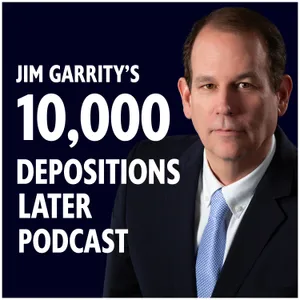
10,000 Depositions Later Podcast: Daily Summaries Delivered
by Jim Garrity
Get key takeaways, quotes, and insights from 10,000 Depositions Later Podcast in a 5-minute read. Delivered straight to your inbox.
Latest Episodes
The most recent episodes — sign up to get AI-powered summaries of each one.
- 1 weeks ago15 min
Episode 172: Second-Order Knowledge Examinations
In this episode, Jim talks about the value of "second-order" examinations - asking deponents not only what they know, but what others know (and what others know that still others know, which is a form of third-order knowledge). It's an incredibly valuable tool for ensuring you fully understand the actors, documents, and events in your cases. Garrity explains why witnesses will talk more freely about what others know than about what they themselves know, and wraps up with practice tips for litigators who are either taking - or defending against - second-order knowledge examinations.As always, thanks for listening!
- 3 weeks ago14 min
Episode 171: Examination Techniques, Part 4 - The Reid Technique
In this final episode of our cross-examination series, Jim Garrity turns to the Reid Technique, the interrogation system developed in the 1940s for American law enforcement. Though the method has drawn serious criticism and been linked to false confessions, many of its individual components quietly appear in depositions, administrative hearings, and arbitrations every day, often deployed by lawyers who have never heard the name John Reid.We break the technique into three "movements" civil litigators will recognize: the non-accusatory, warm opening that triggers reciprocity; confrontation and theme development, where a sympathetic narrative conceals a damaging concession; and the compound question that forces a false binary. Along the way, we cover how to prepare witnesses to recognize tonal shifts, resist softened mischaracterizations, and reject false either/or options. Finally, Jim explains how taking attorneys can ethically deploy these tools themselves.
- Apr 9, 202620 min
Episode 170 - Examination Techniques, Part 3: The Reptile Method
In this third installment of our series on examination techniques, Jim Garrity dives into the so-called Reptile Method, developed by jury consultant David Ball and plaintiff’s attorney Don Keenan, and explained in their 2009 book Reptile: The 2009 Manual of the Plaintiff’s Revolution. It's long been a controversial approach because, some say, it's a disguised version of Golden Rule arguments that are generally forbidden in most jurisdictions. But whether you’re on the plaintiff side looking to deploy it or the defense side looking to neutralize it, you need to understand how the three-stage sequence works, and where it’s vulnerable.SHOW NOTEShttps://columbialawreview.org/content/shadow-tort-law-lessons-from-the-reptile/ (Columbia University law review article on "The Reptile" method)https://lewisbrisbois.com/insights/clientalerts/the-reptile-theory-in-practice (defense firm blog on the Reptile Theory)https://imslegal.com/articles/reptile-brain-strategy-why-use-it-how-counter-it (jury consulting firm article on the Reptile Method)
- Mar 31, 202612 min
Episode 169: Examination Techniques, Part 2: Irving Younger's Ten Commandments of Cross-Examination
In this second episode in a series on different cross-examination methods, Jim Garrity spotlights Irving Younger's famed Ten Commandments of Cross-Examination. It's one of the earliest formal systems for conducting an effective cross. As Jim explains, there isn't a single "best way" to question or cross-examine witnesses. The path to world-class examination styles is being aware of the different approaches, understanding them, experimenting with them, and even possibly combining elements from several to develop your own style.
- Mar 2, 202614 min
Episode 168: Examination Techniques, Part 1: The Pozner-Dodd Technique
In this episode, and over the next few, Jim Garrity analyzes some of the better-known techniques or methods of conducting deposition cross-examinations. He begins with the Pozner-Dodd method, based on the book Cross-Examination: Science and Techniques, by Larry Pozner and Roger J. Dodd. As Jim explains, there isn't a single "best way" to question or cross-examine witnesses. The path to world-class examination styles is being aware of the different approaches, understanding them, experimenting with each, and even possibly combining elements from several to develop your own style.SHOW NOTES:Pozner, Larry and Dodd, Roger J., Cross-Examination: Science and Techniques, 3d. Ed.https://www.amazon.com/Cross-Examination-Science-Techniques-Larry-Pozner/dp/1632843919/ref=sr_1_4?crid=2OP2T6EBDBNI3&dib=eyJ2IjoiMSJ9.o49yLDTFRzsh1lO1WhQd4xBgkEuhYLH3obvuBC2GIdpGyzn1i0dg1lEzyMEYoFcB.NPgrs8W1727PEigEc3OXABbQt85juirYS59s5B12ids&dib_tag=se&keywords=pozner+dodd&qid=1772489570&sprefix=pozner+dod%2Caps%2C227&sr=8-4
- Feb 8, 202613 min
Episode 167 - Schedule-Proofing Your Depositions: Drafting Notices with Multiple Backup Plans
In this episode, Jim Garrity - the leading expert in the country on deposition strategies and tactics - rolls out another spectacular deposition strategy you won't find anywhere else. It's the application of the PACE Method to your deposition scheduling. It will change how you draft your deposition notices forever.PACE - an acronym for Primary, Alternate, Contingency, and Emergency - was devised by the U.S. Military to ensure that if the primary plan goes haywire, there is a Plan B: an immediate go-to backup. And a Plan C, and a Plan D. It sharply increases the odds of mission success because there are no debates or delays when one plan fails. Everyone switches to the next layer of redundancy.Here, Garrity tells you how to apply PACE to deposition scheduling, so that when your primary plan for deposing a witness - say, an in-person deposition - cannot proceed, you (and all other participants) immediately switch to your alternate plans.As always, thanks for listening to the number #1 podcast in the world devoted exclusively to deposition strategies and tactics for litigators handling civil, administrative, arbitrative, and criminal proceedings.
- Jan 20, 202610 min
Episode 166 - Are You Audiorecording Your Depositions (Yet)?
In this episode, Jim Garrity urges you once again (see Episode 7, Audiotaping Your Depositions) to independently audiorecord your depositions. Apart from all the prior, excellent reasons he discussed, there's a new one, and it stems from technical glitches that disrupt the reporter's audio and video feed in a remote deposition. Give this one a careful listen!SHOW NOTESMcGillvary v Riez, et al., Case No. 22-6430-MAS-JBD, 2025 WL 2962775 (D. New. Jersey Oct. 17, 2025) (memorandum order on, among other things, a motion to suppress the transcript of the plainest deposition and to compel production of the audio recording of the deposition, based on allegations that the transcript contained numerous errors and omissions)
- Dec 20, 20254 min
Episode 165: Stopping the "You Can Answer" Gatekeeping
A must-listen episode with actionable guidance for litigators and trial teams who want to keep depositions moving and the record clean. We break down the “you can answer” interjection: why it is usually unnecessary, how it inserts defending counsel into your Q-and-A, and how repetition disrupts tempo and shifts the witness from answering questions to seeking permission. You will get a ready-to-use preliminary instruction that tells the witness to answer after objections unless counsel clearly instructs “don’t answer” or the witness needs a rephrase. We also cover when to address opposing counsel on the record and how to frame the issue as coaching and delay. If the conduct escalates, we explain how Rule 30(d)(3)(A) supports suspending the deposition and seeking a protective order.SHOW NOTES:Sample preliminary instruction to minimize "You can answer" gatekeeping"During this deposition, the lawyers may make objections from time to time. For example, you may hear one of the lawyers say objection, or object to the form. These objections are mainly for the court reporter and, if necessary, for the judge later. They’re not signals to you to stop or to wait for permission. The only time you may hesitate is if the objection you’ve heard is “don’t answer that question.” Otherwise, after objection, or if theres no objection, go ahead and answer the question that was asked, after you heard the objection. You should not turn to your lawyer after each question, or wait for your lawyer to say you can answer after each question. Just listen to the question, and if you understand it, answer it in your own words. The only time you should stop answering as if your lawyers objection is along the lines of don’t answer that question, or if you yourself don’t understand the question and need me to rephrase it. Otherwise, you should go ahead and answer the question.
Get 10,000 Depositions Later Podcast summaries in your inbox
Free AI-powered daily recaps. Key takeaways, quotes, and mentions — in a 5-minute read.
Get Free Summaries →Free forever for up to 3 podcasts. No credit card required.
You Might Also Like
Listeners also like.
I'm Not A Lawyer But: The Debrief
Melanie Goolsby & Studio71
Civil Procedure
Prof. Thomas Main
Get in the Game Podcast from Jury Analyst
Brian Panish
The Deposition
Hug House Productions
The Law School Toolbox Podcast: Tools for Law Students from 1L to the Bar Exam, and Beyond
Alison Monahan and Lee Burgess - Law School Toolbox, LLC
Legit Podcast Pro
Gordon Firemark

Not On Record Podcast
Possibly Correct Media
Above the Law - Thinking Like a Lawyer
Legal Talk Network

Getting Divorced Without Losing Your Mind Podcast
Corey Shapiro

Been There Got Out Podcast
Chris & Lisa

CLP Classroom
Dennis Chong

Study for the Bar in Your Car
Angela Rutledge, LLM, LLB
About 10,000 Depositions Later Podcast
From Jim Garrity, the country’s leading deposition expert, comes this podcast for hardcore litigators. The subject? Taking and defending depositions.Each episode is a one-topic, mini field guide, meant to educate and inform trial lawyers looking for world-class deposition strategies and tactics. Garrity includes a general discussion of the topic, specific insights and guidance, questions to ponder, and case citations to support his observations. They’re jam-packed with immediately useful advice and guidance.Garrity has appeared as lead trial counsel in more than two thousand federal and state civil cases. His personal deposition experience now far exceeds the 10,000 mentioned in the title. (For business reasons, his publisher did not want him to update the title number.) He’s been up against the best litigators at hundreds of firms, from the nation’s largest to sole practitioners, and there’s literally no tactic, trick, variation or strategy he hasn’t seen hundreds of times. Indeed,
Customized Recaps
AI-powered recaps with compact key takeaways, quotes, and insights.
Straight to Your Inbox
Get key takeaways from 10,000 Depositions Later Podcast in a 5-minute read.
Save Hours Every Week
Stay current on your favorite podcasts without falling behind.
Frequently Asked Questions
What is Podzilla's 10,000 Depositions Later Podcast daily summary?
It's a free AI-powered email that summarizes new episodes of 10,000 Depositions Later Podcast as soon as they're published. You get the key takeaways, notable quotes, and links & mentions — all in a quick read.
How does the 10,000 Depositions Later Podcast podcast summary work?
When a new episode drops, our AI transcribes and analyzes it, then generates a personalized summary tailored to your interests and profession. It's delivered to your inbox every morning.
Is this an official 10,000 Depositions Later Podcast product?
No. Podzilla is an independent service that summarizes publicly available podcast content. We're not affiliated with or endorsed by Jim Garrity.
Can I get summaries of other podcasts too?
Absolutely! The free plan covers up to 3 podcasts. Upgrade to Pro for 15, or Premium for 50. Browse our full catalog at /podcasts.
How often does 10,000 Depositions Later Podcast release new episodes?
10,000 Depositions Later Podcast publishes monthly. Our AI generates a summary within hours of each new episode.
What topics does 10,000 Depositions Later Podcast cover?
10,000 Depositions Later Podcast covers topics including Education, Business. Our AI identifies the specific themes in each episode and highlights what matters most to you.
Start getting 10,000 Depositions Later Podcast summaries tomorrow morning.
Free forever for up to 3 podcasts. No credit card required.
Free forever for up to 3 podcasts. No credit card required.