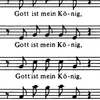
As part of his new job, the 22-year-old Bach had to provide music for Mülhausen’s city council elections. For the first time, he officially had an occasion to write for a large orchestra: brass, timpani, woodwinds, flutes, strings, two choirs— this is BWV 71, Gott ist mein König. Scoring so largely on the page must have been exciting for the young Bach: That’s a lot of parts! The first time Bach writes for brass and drums! Notice the ‘J.J.’ in the upper left corner, Jesu Juva, ‘Jesus help me.’ We see it spelled out on the title page and get to see Bach’s fancy handwriting: I didn’t go into this in the episode, but is there an S.D.G. inside the big G on the title?Write That Fugue!One of the most striking features of this cantata are the multiple instrumental ‘choirs,’ the groups of instruments which Bach placed in separate areas of St. Mary’s church to achieve stereophonic effects. Bach, the organist, expands his knowledge of registration onto a full orchestra that required two conductors! To hear this music in quick succession from separate areas must have been thrilling:Three trumpets and drums! Then immediately:Woodwinds somewhere else! And then two choirs together, singing from opposite lofts:Still more groups of instruments follow, now the flutes:And finally the strings:What a bold and exciting way for Bach to begin his orchestral career. Links to the performances: Suzuki and KoopmanBecome your best Buxtehude:We Rely Exclusively on Paid Subscriptions! Help WTF Bach endure:Join at WTFBach.comThis is the only place Evan checks comments regularly.You can also make a one-time donation here:https://www.paypal.me/wtfbachhttps://venmo.com/wtfbachThank you for your help!Transcript:We’ve been tracing the young Bach’s development, writing his very first cantatas. We looked at what may have been his first two, and we heard on quite a few of these recordings that they had only one voice per part. The orchestrations were very small, maybe an oboe, maybe a pair of violins, but things are very neat, very compact. You could put one of these bands in a van, and you should. He’s 22, he’s moving from one — that’s how it begins. A bit different to the last two cantatas, right? Remember the previous two cantatas? They started with these lovely orchestral introductions. The Actus Tragicus, also an early cantata, started with the most wonderful, most inviting introduction. “Christ lag in Todesbanden,” which we will soon cover, also begins with a nice introduction by the orchestra — Bach saying, “Excuse me, I hope you don’t mind if I write a cantata.” But this one is different: Bach is not asking for permission. He’s been asked to write this piece. This is now part of his job to do this. He will not fail the entire city. Everybody at once, go — big chord, big orchestra, no intro, massive sound.Bach is our new organist. And unlike many cantatas, we have an exact date when this music was first heard: February 4th, 1708. Bach has been the new organist in Mühlhausen for about six months, and there was a recent inauguration of the city council, where the new burgomasters — sort of like the mayors — and the city members are honored. They’re probably given some very official looking clothing, maybe a nice new wig, and there’s a concert in a big church, St. Mary’s, with some required town council music. So all the new city council members, every politician, all the notable persons come to St. Mary’s and hear the world premiere of Bach’s cantata “Gott ist mein König” — God is my king. If today, after elections anywhere in the world, everyone piled into the same room to hear a Bach cantata, why, I dare say the world would be a better place.Now, St. Mary’s in Mühlhausen has several galleries and lofts in the church, and Bach took advantage of this. I love this image of the 22-year-old getting the commission, knowing that this is part of his job now for the town council music, knowing that it’s going to take place at St. Mary’s. He walks into the church, he sees all the lofts, and he thinks: I can put trumpets up there and drums up there, and I could put the strings over there. I can have the oboes and bassoons over there. Now I’ve got the money to have the instruments I want. I can put recorders over there. I can have two choirs — one over there, the other over there. The organ, in a different place, can have some solos. This is how Bach makes this pie
Podzilla Summary coming soon
Sign up to get notified when the full AI-powered summary is ready.
Free forever for up to 3 podcasts. No credit card required.
Listen to This Episode


Get summaries like this every morning.
Free AI-powered recaps of WTF Bach and your other favorite podcasts, delivered to your inbox.
Free forever for up to 3 podcasts. No credit card required.