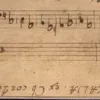
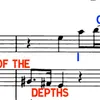
Bachian folklore claims Bach used to disguise himself and wander into random churches to play the organ. After a few minutes the warden was frightened it was either the devil himself or Johann Sebastian Bach. I imagine this piece would have given such an impression.Pedal Shoes Anyone?The Passacaglia BWV 582 appears in the Andreas Bach Book upside down. Its title is in all capitals, spelled like the title of this episode. (Curiously, Buxtehude’s Passacaglia in D Minor BuxWV 16 also appears in all capitals, spelled the same— but it is not upside down.) Have a look:If we rotate the page and zoom in, we see the famous opening bars, played with only the feet:On this theme, Bach pens 20 variations, culminating in a brilliant fugue. The fugue has two countersubjects. Until I made this episode I hadn’t considered the Trinity as a possible vision for the fugue (the nature of countersubjects often demands that they move at different speeds to the theme) but it may be a helpful image: I went long on this episode, so I wasn’t able to feature a full recording of this, I’ll be back in a few days to feature Paul Jacobs. In the meanwhile, here is Ton Koopman’s recording with a score:We Rely Exclusively on Paid Subscriptions! Help WTF Bach endure:Join at WTFBach.comThis is the only place Evan checks comments regularly.You can also make a one-time donation here:https://www.paypal.me/wtfbachhttps://venmo.com/wtfbachThank you for your help!TRANSCRIPT:Hi everyone evan here thanks for tuning in just a quicker episode today or maybe it will be as long but certainly more spontaneous the few days I usually prepare for the podcast researching and writing the show I will now be busy preparing for and playing my first organ concert. I’m quite excited about that. I wrote about this experience at length and I want to share that piece with you. I’m not sure if I’m going to read it aloud on the podcast, however, as it’s a personal essay. In fact, it’s so personal I’ve really been on the fence about whether I should share it or not since I admit some things about myself. Fears, doubts, hesitation. I really don’t hold back. So anyhow, if you’re listening to this podcast without being subscribed to the Substack, you might miss this. But if you follow the links in the episode description, you will be notified when I publish that essay about playing an organ concert, probably the first week of August or so. Thanks, meanwhile, to all my listeners who write me, who offer their insights or their curiosities. Thanks for those of you who take out a paid subscription on Substack. This support means I don’t have to take that one gig that pays, but I really don’t want to play it because it eats away at my soul. Instead, I can focus on what I love about this gig, which is sharing with people what I love about music. Thanks for the support. So a piece I love, a piece that floored me the first time I heard it, this recital, this organ concert ends with that piece, The Mighty Passacaglia and Fugue BWB 582. It’s about time we discussed this piece on the show. No, this is a piece that if you’re into Bach... You haven’t missed this. If you haven’t heard this piece before, take note of where you’re sitting or where you’re standing or maybe you’re running listening to this podcast. Maybe you’re that one listener of mine who rides a tractor while listening to the podcast. Remember where you are because this is the type of piece that you remember where you were the first time you heard it. So let’s go. It’s an early masterpiece, the Passacaglia. In my opinion, the great triumph of Bach’s youth may be this very piece. It comes down to us in a manuscript in the so-called Andreas Bach book, one of the two major collections of keyboard music that gives us remarkable insight into Bach’s youthful compositions. This is a pre-Weimar work. The bulk, I suppose it’s safe to say, or at least a major creative burst of organ compositions happened in Weimar. This precedes that. This is the same period that we’re discussing in these cantatas. 1707 Bach is 22 years old. And if you look into the manuscript, it appears upside down. It’s quite a thrill to flip through the Andreas Bach book and suddenly you wouldn’t even notice if you weren’t really paying close attention to what is upside down. But yes, this Passacaglia... The whole piece is upside down, but it’s not like the pages were sewn in upside down or anything like that. The scribe, Bach’s brother, he turns the page and he flips the whole manuscript 180 degr
Podzilla Summary coming soon
Sign up to get notified when the full AI-powered summary is ready.
Free forever for up to 3 podcasts. No credit card required.
Listen to This Episode
Get summaries like this every morning.
Free AI-powered recaps of WTF Bach and your other favorite podcasts, delivered to your inbox.
Free forever for up to 3 podcasts. No credit card required.