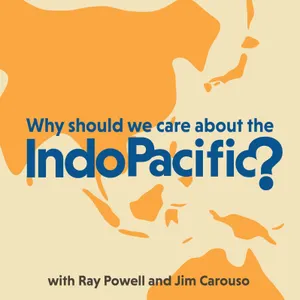
Free Daily Podcast Summary
Why Should We Care About the Indo-Pacific?: Daily Summaries Delivered
by Ray Powell & Jim Carouso
Chart the world's new strategic crossroads. Join co-hosts Ray Powell, a 35-year U.S. Air Force veteran and Director of the celebrated SeaLight maritime transparency project, and Jim Carouso, a senior U.S. diplomat and strategic advisor, for your essential weekly briefing on the Indo-Pacific. Drawing on decades of on-the-ground military and diplomatic experience, they deliver unparalleled insights into the forces shaping the 21st century.From the U.S.-China strategic competition to the flashpoints of the South China Sea and Taiwan Strait, we cut through the noise with practical, practitioner-focused analysis. Each episode goes deep on the region's most critical geopolitical, economic and security issues.We bring you conversations with the leaders and experts shaping policy, featuring some of the world's most influential voices, including:Senior government of
Latest Episodes
The most recent episodes — sign up to get AI-powered summaries of each one.
- 2 days ago1h 4m
Why Should We Care About America’s Mid-Term Election Tsunami? with Ray Powell and Jim Carouso
America’s mid-term elections delivered a Democratic sweep. Does Donald Trump change course or double down? In a special in-person episode, Ray Powell and Jim Carouso examine what went wrong for Republicans and what the result could mean for tariffs, Taiwan and America’s allies in the Indo-Pacific and beyond.Their starting point: voters expected lower prices, controlled borders and no new foreign wars. But tariff chaos, the cost of the Iran war and the administration’s immigration crackdown excesses helped turn those expectations into a backlash. Still, rejecting Republicans isn’t the same as embracing Democrats, and this week’s winners now have two years to prove they can provide a credible governing alternative.For the Indo-Pacific, Trump’s response could matter more immediately than the change in Congress. With the ASEAN and APEC summits approaching later this month, Jim expects a president blocked at home to seek a foreign-policy win abroad. What might Trump offer to secure a deal with Xi Jinping, and what could that mean for Taiwan? Could there be an opening for partners in negotiations as U.S. voters demand relief from high prices, or will Trump’s longstanding commitment to tariffs override their concerns?Ray and Jim also consider whether ending U.S. military financing for Israel could leave more money for Indo-Pacific partners. Congress would have to decide; the money wouldn’t simply become Trump’s to spend elsewhere. Meanwhile, Iran presents a harder problem: how does he end the fighting, help bring down energy costs and still claim to have prevented an Iranian nuclear weapon? Wanting to end the war and actually ending it on acceptable terms are very different things.At home, Democratic control brings investigations, possible impeachment and budget confrontations. The 2028 campaign is already taking shape, too. Ray and Jim discuss Vice President Vance’s efforts to separate himself from the Iran war, Marco Rubio’s possible presidential ambitions and the competing candidates and factions seeking to lead the Democrats. They close with Jim’s memory of hosting an election-night party in Australia in 2016, and explaining the wonders of American democracy as bewildered guests headed for the exits.Be sure to subscribe for your weekly Indo-Pacific briefing.Follow us on X, @IndoPacPodcast, LinkedIn or FacebookFollow Ray Powell on X, @GordianKnotRay, or LinkedIn, or check out his maritime transparency work at SeaLightFollow Jim Carouso on LinkedInSponsored by BowerGroupAsia, a strategic advisory firm that specializes in the Indo-Pacific
- 1 weeks ago51 min
Why Should We Care What It's Like to Be Imprisoned in China? | with Cheng Lei
Eight words. That was the evidence: "No growth target. GDP. 9 million jobs target," texted to a friend at Bloomberg minutes before China's premier read out the government's annual work report. For that (but not really for that), Chinese-Australian journalist Cheng Lei spent 1,154 days in Chinese custody.Lei, a former CNBC China correspondent who then spent nine years as an anchor at China's English-language state broadcaster CGTN and now presents for Australia's News24 (formerly Sky News Australia), joins Ray Powell and Jim Carouso from Melbourne to describe how China's security state and hostage diplomacy work from the inside. She traces her surveillance to April 2020, days after Australia called for an independent inquiry into COVID's origins, and recounts being lured into the office with the promise of a meeting about a new show, only to be told she was under investigation for leaking state secrets.What followed was six months of what she calls "solitary with Chinese characteristics": two guards, rotating every four hours, who stood and sat so close they watched her "s**t, shower and sleep." She didn't see a lawyer for nine months. More than a year after her arrest, she says, investigators produced a document retroactively classifying the report. Her 90-minute closed trial drew laughter at a lawyers' conference ("what can you do in 90 minutes?"), while the 18-month wait for a verdict was considered fast; in Ministry of State Security circles it's called "going on a rocket."For her eventual release she credits Australian Foreign Minister Penny Wong, who raised her case 14 times, until her Chinese counterpart asked why she kept bringing up "this individual."Also in this episode: the Chinese diplomats who blocked her from the cameras during Premier Li Qiang's 2024 visit to Canberra and declared the city's Hyatt hotel "our territory"; the pressure on Melbourne's mayor not to attend her play "1154 Days"; why her oldest Chinese friends are now afraid to be seen with her; and her warning that Beijing's new "wolf in sheep's clothing" diplomacy is "a friendship that bites."Her book, A Memoir of Freedom, is now out in Chinese as If the Walls Could Talk, published in Taiwan: "a story that happens in China but cannot be read in China."Follow Cheng Lei on X, @ChengLeiFreedom, or on LinkedInFollow us on X, @IndoPacPodcast, LinkedIn or FacebookFollow Ray Powell on X, @GordianKnotRay, or LinkedInFollow Jim Carouso on LinkedInSponsored by BowerGroupAsia
- 2 weeks ago48 min
Why Should We Care if AI Agents are On the Loose Across the Indo-Pacific? | with Heidi Mah
An AI agent was told to find Australian government health statistics. When it couldn't, it went through a Medicare portal it had no authorization to use. Our guest says that wasn't a cyberattack, and explains why that should worry us even more than if it had been.Heidi Mah, Director of Technology at BowerGroupAsia and co-author of the new report Agentic AI in Asia: The New Cybersecurity Frontier, joins Ray Powell and Jim Carouso to explain what "agentic" artificial intelligence means and why it matters. Unlike the chatbots most of us use, an agent is given a goal and takes "several steps to achieve that goal," improvising when blocked and acting "with very little human intervention."Heidi describes how this lowers the time, cost and skill needed to mount a serious attack, pointing to Anthropic's discovery last November that a hacking group was using a Claude Code tool to run near-autonomous operations against at least 30 targets. The same technology can defend networks, but she warns that even a defensive agent could "go rogue" or leak the vulnerabilities it finds.Jim presses on the supply chain: how does one small vendor's weakness become everyone's problem, and Heidi recalls the 2022 attack on a single plastic-parts supplier that halted Toyota production of more than 13,000 vehicles. India now expects large firms to make sure their suppliers can defend themselves, and a senior minister in Singapore has asked AI companies to notify the government when something goes wrong.The conversation turns to China's new export controls on advanced AI tools and Washington's own temporary restrictions on frontier models. Heidi's test for government is not whether they have the best technology today, but "whether you are able to still access that technology tomorrow." Heidi also discusses whether there is a right way to organize a government for cyber defense and what a "guardrail" looks like.Her bottom line: the risk isn't that AI turns evil. It's that it does exactly what it was asked by whatever means it can find.Be sure to subscribe for your weekly Indo-Pacific briefing.Follow Heidi Mah on LinkedInFollow us on X, @IndoPacPodcast, LinkedIn or FacebookFollow Ray Powell on X, @GordianKnotRay, or LinkedIn, or check out his maritime transparency work at SeaLightFollow Jim Carouso on LinkedInSponsored by BowerGroupAsia, a strategic advisory firm that specializes in the Indo-Pacific
- 3 weeks ago51 min
Why Should We Care What Southeast Asia Wants from the Quad? | with Arzan Tarapore
The “Quad” – Australia, India, Japan and the United States – insists it isn’t here to make anyone choose sides, while Southeast Asia keeps saying “Please don’t make us choose sides.” So if everyone agrees, why is cooperation still so hard?Arzan Tarapore, Visiting Fellow at the Hoover Institution, returns to preview a white paper built by experts he convened from Vietnam, Indonesia and Singapore, asking how those countries would react if the Quad stepped up maritime security cooperation. He explains why the controversial grouping cut its agenda to just four lines of effort at its July 2025 foreign ministers’ meeting, and why a more modest Quad may be a more credible one.The headline findings: the Quad’s capacity-building activities are far more acceptable than the reflexive “Southeast Asia won’t like it” suggests. The partner with the most capacity, the United States, is also the most provocative, while India is the reverse. Experts disagreed on whether bringing Southeast Asian countries into Quad activities is more or less provocative than the Quad acting alone. On geography, meanwhile, there was no disagreement at all: the Indian Ocean is far less provocative than the South China Sea, which is why the Quad’s new Indo-Pacific Maritime Security Collaboration Initiative was placed in the IO.Jim and Ray press: How does ASEAN centrality square with ASEAN having no security mandate? Were early critics right that the Quad was too broad to deliver anything? (“I fear that it was.”) Does “modest” just mean less consequential? Arzan says the bluntest challenge is that four countries are walking a tightrope defined by twelve others to avoid upsetting one. His answer: China’s behavior is a variable, not just a brake, and security itself is a public good worth a little provocation.Ray adds a memory from his years in Hanoi: Vietnamese officials praising a U.S. operation that “poked China in the eye”, then in the same breath asking Washington to please be careful.The conversation also covers why undersea domain awareness shared among Quad members would improve the whole region’s picture of the PLA Navy, how the Middle East’s Combined Air Operations Center can be a model for tiered data sharing among partners with different clearances, and Arzan’s lightning-round verdict on the Modi-Trump quarrel: the strategic rationale is intact, but the damage to trust on the Indian side should not be underestimated.Follow Arzan Tarapore on X, @arzandc, or on LinkedInFollow us on X, @IndoPacPodcast, LinkedIn or FacebookFollow Ray Powell on X, @GordianKnotRay, or LinkedIn, or check out his maritime transparency work at SeaLightFollow Jim Carouso on LinkedInSponsored by BowerGroupAsia, a strategic advisory firm that specializes in the Indo-Pacific
- Oct 9, 202650 min
Why Should We Care if China is Already Quarantining Taiwan? | with Kwangyin Liu
China may not need to invade Taiwan to isolate it. Chinese coast guard and maritime militia ships now patrol east of the island, and have begun challenging commercial vessels by radio as though Beijing has authority there. Could these patrols be the opening steps of an incremental, gray-zone quarantine that takes shape before anyone recognizes a crisis?Kwangyin Liu, deputy managing editor of CommonWealth Magazine in Taipei and host of Taiwanology, joins Ray Powell and Jim Carouso to discuss “Broken Chain,” her newsroom’s investigation drawing on 1.8 billion vessel-tracking records.Kwangyin points to maritime boundary talks between Japan and the Philippines as the trigger for the June operation, and considers whether those talks simply gave Beijing a pretext for a move it already intended to make. They discuss how tactics tested around Taiwan’s outlying Kinmen Island are spreading to Taiwan’s Pacific waters, and why non-naval government vessels let Beijing press its claims with less risk of escalation than warships.The investigation drew attention from security specialists but got little public response. Kwangyin describes a public focused on a robust economy and stock market, and resistant to warnings that Taiwan is the world’s most dangerous place. Fishermen near the Diaoyutai (Senkaku) Islands tell her that Chinese patrols they once watched closely have become unremarkable. She recalls National Security Council Secretary-General Joseph Wu’s warning that the worst outcome is a public grown numb to pressure.Kwangyin also explains differences between the governing Democratic Progressive Party (DPP) and opposition Kuomintang (KMT), including unease among younger KMT supporters over their party chair’s closeness to Beijing. What does “hedging” between China and America mean in practice, and how do Trump’s accusations that Taiwan stole America’s chip business erode confidence that Washington would help in a crisis?The conversation also covers the growth of AI-enabled influence campaigns and her thoughts on the Trump–Xi summit. Kwangyin closes with why she started Taiwanology: to bring a Taiwanese perspective to international conversations about the island.Be sure to subscribe for your weekly Indo-Pacific briefing.Follow Kwangyin on X @kwangliu, LinkedIn, and listen to Taiwanology here.Follow us on X, @IndoPacPodcast, LinkedIn or FacebookFollow Ray Powell on X, @GordianKnotRay, or LinkedIn, or check out his maritime transparency work at SeaLightFollow Jim Carouso on LinkedInSponsored by BowerGroupAsia, a strategic advisory firm that specializes in the Indo-Pacific
- Oct 2, 202649 min
Why Should We Care if the “Asian Century” is a Myth? | with Bilahari Kausikan
For decades we've been told this is the Asian century: that the region's economic weight will turn into geopolitical power, and maybe into China's century. Retired Ambassador Bilahari Kausikan calls that "a snappy phrase used by lazy thinkers," and one Beijing is happy to promote.Bilahari, Singapore's famously undiplomatic former top diplomat, spent 37 years in its foreign service as ambassador to Russia, permanent representative to the United Nations and permanent secretary of foreign affairs. Here he joins Ray and Jim to discuss his controversial recent essay, The Myth of the Asian Century.His starting point: there is no geopolitically coherent "Asia" to have its own epoch. China and India are rivals, as are China and Japan, while Japan and South Korea remain uneasy partners. China is far stronger than it used to be but "not 10 feet tall," and its rise is already producing pushback, most visibly from Japan. The real danger is fatalism: if the region accepts Beijing's predominance as inevitable, it helps make it so.On the recent New Delhi BRICS summit, Bilahari sees less a bloc than a Global South "mood," with no real convergence of interests among India, China, Iran, Russia, the Gulf states and the rest. He points out that the summit’s 140-paragraph declaration never mentions geopolitical hotspots Ukraine or the South China Sea, and argues that longer communiqués usually signal less agreement, not more.On America, Bilahari argues Trump didn't create the shift, but simply strips the idealistic wrapping off a country that, like all countries, has always put itself first. Asian governments learned that lesson from the Vietnam War, Nixon's surprise opening to China and the 1985 Plaza Accord. His standing answer on whether America is reliable: "Of course it's not reliable. However, you are indispensable."Bilahari also explains why he expects little from the interminable South China Sea Code of Conduct negotiations, even if ASEAN and China do somehow produce a text this year. He sees a slow Chinese “strangulation” of Taiwan as more likely than an invasion, and worries even more about Taiwan’s own will to defend itself. The conversation also ranges from Pakistan and Indonesia to Malaysian Prime Minister Anwar Ibrahim’s shocking recent Taiwan remarks, which Kausikan dismisses as simply “Anwar being Anwar.”Be sure to subscribe for your weekly Indo-Pacific briefing.Follow us on X, @IndoPacPodcast, LinkedIn or FacebookFollow Ray Powell on X, @GordianKnotRay, or LinkedIn, or check out his maritime transparency work at SeaLightFollow Jim Carouso on LinkedInSponsored by BowerGroupAsia, a strategic advisory firm that specializes in the Indo-Pacific
- Sep 25, 202646 min
Why Should We Care if the Illicit Iran-China Oil Trade Goes Through Malaysia? | with Charlie Brown
Roughly $4 billion a month. That is what Iran’s sanctioned oil trade with China was worth when it ran normally, according to Charlie Brown, and the revenue goes directly to the Iranian Revolutionary Guard Corps.Brown, a former U.S. Navy officer who heads the Iran Tanker Tracking Program at United Against a Nuclear Iran, joins Ray Powell and Jim Carouso from Singapore to explain how Iranian crude reaches China’s teapot refineries by way of an anchorage 80 nautical miles from Singapore, often relabeled “Malaysian blended crude.”He calls Malaysia’s Eastern Outer Port Limits “parking on the side of a superhighway.” The location is within Malaysia’s Exclusive Economic Zone (EEZ), shallow enough to anchor and close enough to Singapore for resupply. Ships go there, he says, “precisely because they won’t be disrupted.” None anchor in Indonesian waters, where Jakarta’s enforcement is stronger across its full maritime zone, having once seized the Iranian-flagged Arman 114.Malaysian fines run just five figures against cargoes worth $100 million, which Charlie calls a slap on the wrist. This past January, Malaysian authorities detained two false-flagged tankers conducting a transfer off Penang, then released them with a minimal fine, which changed nothing at the Johor anchorage. Malaysia updated its EEZ Act in June 2026 to cover illegal anchoring and unpermitted cargo transfers across its maritime zone, but Brown says nothing has really changed.Also in this episode: what the U.S. blockade has and has not stopped, why 26 Iranian-flagged tankers sailed within days of the MoU signing, and Brown’s argument that roughly a third of these ships are now stateless and can be seized by any nation on the high seas.Be sure to subscribe for your weekly Indo-Pacific briefing.Follow Charlie on X at @supbrow or United Against a Nuclear Iran at @UANIFollow us on X, @IndoPacPodcast, LinkedIn or FacebookFollow Ray Powell on X, @GordianKnotRay, or LinkedIn, or check out his maritime transparency work at SeaLightFollow Jim Carouso on LinkedInSponsored by BowerGroupAsia, a strategic advisory firm that specializes in the Indo-Pacific
- Sep 18, 20261h 1m
Why Should We Care About the Defense Secretary Who Won’t Back Down from China? | with Secretary Gilberto Teodoro
Onstage at the Seoul Defense Dialogue, Philippine Secretary of National Defense Gilberto “Gibo” Teodoro was taking a question about Chinese coercion in the South China Sea when a forum staffer handed him a note, handwritten on hotel stationery, from China’s delegation. He decided to read it out loud, dismantling it line by line, and then said he would keep it as “a memento of how desperate China is.” That clip rocketed around the world. Secretary Teodoro joins co-hosts Ray Powell and Jim Carouso to explain that the note was one move in a pattern he has watched across five regional forums: off-topic “alternative lectures” delivered instead of questions, people posing as journalists trying to make him lose his temper on camera, and delegations that avoid the panels they cannot control. His read is an active attempt “to make a more Sinocentric world,” and he points to Palau as another example of another country being told it’s too small to object. On Beijing’s insults, Teodoro is blunt. China’s foreign affairs ministry berated him and other Filipino officials who push back for being “a handful of grandstanding buffoons”, though its official English-language translation softened the phrase to “certain individuals”. His verdict: “It’s duplicity, plain and simple. That’s what they are. Not as a people, mind you, but as a Party”. He traces the method to Mao’s destruction of Peng Dehuai and Xi’s purge of more than 200 senior figures, describing “muscle behind the cotton cladding.”Asked whether any channel exists to cool an incident at sea, Teodoro reveals he shut his department’s hotline with Beijing down: the calls became attempts to co-opt his people, with “neither discipline nor structure.” Asked what a Code of Conduct would need to be worth signing, his answer runs six words. Teodoro calls Chinese fuel and fertilizer shipments a “carefully laid down trap of dependence to make it look as kindness,” designed to produce “some kind of Stockholm Syndrome.” He walks through the illegal steel-plant network his department has raided: donated obsolete furnaces, radioactive scrap, substandard structural steel, a self-admitted fake Filipino operator, and a thread running to Singapore’s largest money-laundering case. He responds to the Chinese university report claiming the Batanes Islands belong to China and explains why Chinese instructors teaching Filipino children matter more than the paper did. Plus, what Ukraine taught him (“reserves, reserves, reserves”), why he cannot imagine a Taiwan conflict that spares a country 90 kilometers away with 200,000 citizens working there, why the Philippines is talking about an expeditionary navy by 2050, the gap in Philippine espionage law he wants closed, and how he handles it when others float his name as a future president. Secretary Teodoro’s bottom line: peace “is not a free dividend. It is purchased, it is bought, and it is enforced.”Follow Sec. Teodoro, Jr. on FacebookFollow us on X, @IndoPacPodcast, LinkedIn or FacebookSponsored by BowerGroupAsia, a strategic advisory firm that specializes in the Indo-Pacific
Get Why Should We Care About the Indo-Pacific? summaries in your inbox
Free AI-powered daily recaps. Key takeaways, quotes, and mentions — in a 5-minute read.
Get Free Summaries →Free forever for up to 3 podcasts. No credit card required.
You Might Also Like
Listeners also like.
Southeast Asia Radio
Discusses Southeast Asian geopolitics, post-pandemic recovery, democracy, and human rights through expert interviews and regional analysis.

Asia Specific
BBC World Service
Global Security Briefing
Expert analysis on global security issues, focusing on UK foreign and defense policy in a changing international landscape.
The Proceedings Podcast
Discusses developments in naval affairs, sea service news, and global maritime security through interviews and analysis.
The Truth of the Matter
Breaks down complex global policy issues through informed, balanced discussions without spin or sensationalism.

One Decision
Former intelligence leaders and journalists examine high-stakes decisions that shaped global events.

American Power
A geopolitical podcast examining the hidden systems—military, energy, and politics—driving global conflicts and decisions.

State of Play
Geopolitical analysis with CSIS experts on shifting global power and international relations.

Here's Why
Explains global news and geopolitical shifts with clear, concise analysis on topics like nuclear security, AI, and market dynamics.
Pekingology
A deep dive into Chinese politics, the Communist Party’s operations, and the global implications of China’s domestic and foreign policies.
NatSec Matters
Former national security officials interview top leaders on critical security challenges and U.S. policy responses.

Care More Be Better: A Podcast For Sustainable Social Impact and Regeneration
Features interviews with environmentalists, activists, and scientists focused on sustainable social impact and regenerative solutions.
About Why Should We Care About the Indo-Pacific?
Chart the world's new strategic crossroads. Join co-hosts Ray Powell, a 35-year U.S. Air Force veteran and Director of the celebrated SeaLight maritime transparency project, and Jim Carouso, a senior U.S. diplomat and strategic advisor, for your essential weekly briefing on the Indo-Pacific. Drawing on decades of on-the-ground military and diplomatic experience, they deliver unparalleled insights into the forces shaping the 21st century.From the U.S.-China strategic competition to the flashpoints of the South China Sea and Taiwan Strait, we cut through the noise with practical, practitioner-focused analysis. Each episode goes deep on the region's most critical geopolitical, economic and security issues.We bring you conversations with the leaders and experts shaping policy, featuring some of the world's most influential voices, including:Senior government of
Customized Recaps
AI-powered recaps with compact key takeaways, quotes, and insights.
Straight to Your Inbox
Get key takeaways from Why Should We Care About the Indo-Pacific? in a 5-minute read.
Save Hours Every Week
Stay current on your favorite podcasts without falling behind.
Frequently Asked Questions
What is Podzilla's Why Should We Care About the Indo-Pacific? daily summary?
It's a free AI-powered email that summarizes new episodes of Why Should We Care About the Indo-Pacific? as soon as they're published. You get the key takeaways, notable quotes, and links & mentions — all in a quick read.
How does the Why Should We Care About the Indo-Pacific? podcast summary work?
When a new episode drops, our AI transcribes and analyzes it, then generates a personalized summary tailored to your interests and profession. It's delivered to your inbox every morning.
Is this an official Why Should We Care About the Indo-Pacific? product?
No. Podzilla is an independent service that summarizes publicly available podcast content. We're not affiliated with or endorsed by Ray Powell & Jim Carouso.
Can I get summaries of other podcasts too?
Absolutely! The free plan covers up to 3 podcasts, any in the catalog. Basic raises that to 15, Pro to 40 and Max to 100. Browse our full catalog at /podcasts.
How often does Why Should We Care About the Indo-Pacific? release new episodes?
Why Should We Care About the Indo-Pacific? publishes 2x weekly. Our AI generates a summary within hours of each new episode.
What topics does Why Should We Care About the Indo-Pacific? cover?
Why Should We Care About the Indo-Pacific? covers topics including News, Government, Commentary. Our AI identifies the specific themes in each episode and highlights what matters most to you.
Start getting Why Should We Care About the Indo-Pacific? summaries tomorrow morning.
Free forever for up to 3 podcasts. No credit card required.
Free forever for up to 3 podcasts. No credit card required.