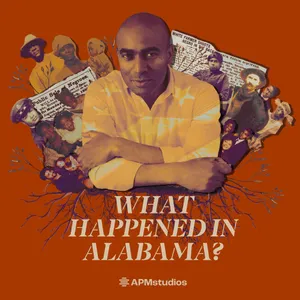
Free Daily Podcast Summary
What Happened In Alabama?: Daily Summaries Delivered
by American Public Media
Get key takeaways, quotes, and insights from What Happened In Alabama? in a 5-minute read. Delivered straight to your inbox.
Latest Episodes
The most recent episodes — sign up to get AI-powered summaries of each one.
- Feb 12, 202518 min
Action and Accountability
Real estate accounts for 18% GDP and each home sale generates two jobs. It’s a top priority for state officials and business leaders across the country to build stable communities. In Minnesota, efforts to address inequity that keeps people locked out of the property market are well-advanced. Lee sits down to interview those directly involved.TranscriptPart 3 – Action and AccountabilityLT GOV PEGGY FLANAGAN: An apology is powerful. But in the same way that I think things like land acknowledgements are powerful. If you don't have policies and investments to back them up, then they're simply words.You’re listening to Unlocking The Gates, Episode 3.My name is Lee Hawkins. I’m a journalist and the author of the book I AM NOBODY’S SLAVE: How Uncovering My Family’s History Set Me Free.I investigated 400 years of my Black family’s history—how enslavement and Jim Crow apartheid in my father’s home state of Alabama, the Great Migration to St. Paul, and our move to the suburbs shaped us.Community and collaboration are at the heart of this story. I’ve shared deeply personal accounts, we’ve explored historical records, and everyone we’ve spoken to has generously offered their memories and perspectives.Jackie Berry is a Board Member at Minneapolis Area Realtors. She’s been working to address the racial wealth gap in real estate. And she says;JACKIE BERRY: We need to do better. We have currently, I think it's around 76% of white families own homes, and it's somewhere around 25-26% for black families.If we're talking about Minnesota, in comparison to other states, we are one of the worst with that housing disparity gap. And so, it's interesting, because while we have, while we make progress and we bring in new programs or implement new policies to help with this gap, we're still not seeing too big of a movement quite yet.Jackie says there’s a pretty clear reason for this.JACKIE BERRY: Racial covenants had a direct correlation with the wealth gap that we have here today. Okay, if you think about a family being excluded from home ownership, that means now they don't have the equity within their home to help make other moves for their family, whether it's putting money towards education or by helping someone else purchase a home or reducing debt in other areas in their life.Racial covenants were not just discriminatory clauses—they were systemic barriers that shaped housing markets and entrenched inequality.LT GOV PEGGY FLANAGAN In my community of St Louis Park, there is, you know, there are several racial covenants. You know, our home does not have one, fortunately.Lieutenant governor Peggy Flanagan is the highest ranking Native American female politician in the country. I asked her about her experience and how it informs her leadership.LT GOV PEGGY FLANAGAN: I can tell you that I never forget that I'm a kid who benefited from a section eight housing voucher, and that my family buying a home made a dent in that number of native homeowners in this state, and I take that really seriously,LEE HAWKINS: You know? And it's powerful, because I relate to you on that. You know, this series is about just that, about the way that the system worked for a group of people of color who were just doing what everyone else wants to do, is to achieve the American Dream for their children. And so I see you getting choked up a little bit about that. I relate to that, and that's what this series is about.Homeownership is more than a marker of personal achievement—it’s a cornerstone of the U.S. economy.Real estate accounts for 18% of GDP, and each home sale generates two jobs. This is why state officials and business leaders continue to prioritize stable and thriving communities.Remember earlier in the series we spoke about some other influential men in the state who were involved in creating the housing disparity gap that we have today.LT GOV PEGGY FLANAGAN: I don’t believe that that Thomas Frankson ever imagined that there would be an Ojibwe woman as lieutenant governor several, several years after he was in this role, and additionally, right? It’s symbolic, but also representation without tangible results, right? Frankly, doesn’t, doesn’t matter. And so, I think acknowledging that history is powerful. I think it has to do with how we heal and move forward. And we can’t get stuck there.MARGARET THORPE-RICHARDS: Thorpe Brothers was very much a part of my childhood and sort of upbringing. But my own father, Frank Thorpe, was not part of the real estate business. He chose to do investments.This is Margaret Thorpe-Richards. Her grandfather is Samuel Thorpe. Head
- Feb 12, 202523 min
The Perpetual Fight
Racial covenants along with violence, hostility and coercion played an outsized role in keeping non-white families out of sought after suburbs. Lee learns how these practices became national policy after endorsement by the state’s wealthy business owners and powerful politicians.TranscriptPart 2 – Discrimination and the Perpetual FightCold Open:PENNY PETERSEN: He doesn't want to have his name associated with this. I mean, it is a violation of the 14th Amendment. Let's be clear about that. So he does a few here and there throughout Minneapolis, but he doesn't record them. Now, deeds don't become public records until they're recorded and simultaneously, Samuel Thorpe, as in, Thorpe brothers, is president of the National Board of Real EstateFRANCES HUGHES (ACTOR): “Housing for Blacks was extremely limited after the freeway went through and took so many homes. We wanted to sell to Blacks only because they had so few opportunities.”LEE HAWKINS: You know, all up and down this street, there were Black families. Most of them — Mr. Riser, Mr. Davis, Mr. White—all of us could trace our property back to Mr. Hughes at the transaction that Mr. Hughes did.CAROLYN HUGHES-SMITH: What makes me happy is our family was a big part of opening up places to live in the white community.You’re listening to Unlocking The Gates, Episode 2.My name is Lee Hawkins. I’m a journalist and the author of the book I AM NOBODY’S SLAVE: How Uncovering My Family’s History Set Me Free.I investigated 400 years of my Black family’s history — how enslavement and Jim Crow apartheid in my father’s home state of Alabama, the Great Migration to St. Paul, and our move to the suburbs shaped us.We now understand how the challenges Black families faced in buying homes between 1930 and 1960 were more than isolated acts of attempted exclusion.My reporting for this series has uncovered evidence of deliberate, systemic obstacles, deeply rooted in a national framework of racial discrimination.It all started with me shining a light on the neighborhood I grew up in – Maplewood.Mrs. Rogers, who still lives there, looks back, and marvels at what she has lived and thrived through.ANN-MARIE ROGERS: My kids went to Catholic school, and every year they would have a festival. I only had the one child at the time. They would have raffle books, and I would say, don’t you dare go from door to door. I family, grandma, auntie, we'll buy all the tickets, so you don't have to and of course, what did he do? And door to door, and I get a call from the principal, Sister Gwendolyn, and or was it sister Geraldine at that time? I think it was sister Gwendolyn. And she said, Mrs. Rogers, your son went to a door, and the gentleman called the school to find out if we indeed had black children going to this school, and she said, don’t worry. I assured him that your son was a member of our school, but that blew me away.In all my years in Maplewood, I had plenty of similar incidents, but digging deeper showed me that the pioneers endured so much more, as Carolyn Hughes-Smith explains.CAROLYN HUGHES-SMITH: The one thing that I really, really remember, and it stays in my head, is cross burning. It was a cross burning. And I don't remember exactly what's it on my grandfather's property? Well, all of that was his property, but if it was on his actual home site.Mrs. Rogers remembers firsthand –ANN-MARIE ROGERS: I knew the individual who burned the cross.Mark Haynes also remembers –MARK HAYNES: phone calls at night, harassment, crosses burnedIn the archives, I uncovered a May 4, 1962, article from the St. Paul Recorder, a Black newspaper, that recounted the cross-burning incident in Maplewood. A white woman, Mrs. Eugene Donavan, saw a white teen running away from a fire set on the lawn of Ira Rawls, a Black neighbor who lived next door to Mrs. Rogers. After the woman’s husband stamped out the fire, she described the Rawls family as “couldn’t be nicer people.” Despite the clear evidence of a targeted act, Maplewood Police Chief Richard Schaller dismissed the incident as nothing more than a "teenager’s prank."Instead of retreating, these families, my own included, turned their foothold in Maplewood into a foundation—one that not only survived the bigotry but became a catalyst for generational progress and wealth-building.JESON JOHNSON: when you see somebody has a beautiful home, they keep their yard nice, they keep their house really clean. You know that just kind of rubs off on you. And there's just something that, as you see that more often, you know it just, it's something that imprints in your m
- Feb 12, 202522 min
Integration Generation
Host Lee Hawkins investigates how a secret nighttime business deal unlocked the gates of a Minnesota suburb for dozens of Black families seeking better housing, schools, and safer neighborhoods. His own family included.TranscriptIntroLEE HAWKINS: This is the house that I grew up in and you know we're standing here on a sidewalk looking over the house but back when I lived here there was no sidewalk, and the house was white everything was white on white. And I mean white, you know, white in the greenest grass.My parents moved my two sisters and me in 1975, when I was just four years old. Maplewood, a suburb of 25,000 people at the time, was more than 90% white.As I rode my bike through the woods and trails. I had questions: How and why did these Black families manage to settle here, surrounded by restrictions designed to keep them out?The answer, began with the couple who lived in the big house behind ours… James and Frances Hughes.You’re listening to Unlocking The Gates, Episode 1.My name is Lee Hawkins. I’m a journalist and the author of the book I AM NOBODY’S SLAVE: How Uncovering My Family’s History Set Me Free.I investigated 400 years of my Black family’s history — how enslavement and Jim Crow apartheid in my father’s home state of Alabama, the Great Migration to St. Paul, and our later move to the suburbs shaped us.My producer Kelly and I returned to my childhood neighborhood. When we pulled up to my old house—a colonial-style rambler—we met a middle-aged Black woman. She was visiting her mother who lived in the brick home once owned by our neighbors, Mr. and Mrs. Hutton.LEE HAWKINS: How you doing? It hasn't changed that much. People keep it up pretty well, huh?It feels good to be back because it’s been more than 30 years since my parents sold this house and moved. Living here wasn’t easy. We had to navigate both the opportunities this neighborhood offered and the ways it tried to make us feel we didn’t fully belong.My family moved to Maplewood nearly 30 years after the first Black families arrived. And while we had the N-word and mild incidents for those first families, nearly every step forward was met with resistance. Yet they stayed and thrived. And because of them, so did we.LEE HAWKINS: You know, all up and down this street, there were Black families. Most of them — Mr. Riser, Mr. Davis, Mr. White—all of us can trace our property back to Mr. Hughes at the transaction that Mr. Hughes did.I was friends with all of their kids—or their grandkids. And, at the time, I didn’t realize that we, were leading and living, in real-time, one of the biggest paradigm shifts in the American economy and culture. We are the post-civil rights generation—what I call The Integration Generation.Mark Haynes was like a big brother to me, a friend who was Five or six years older. When he was a teenager, he took some bass guitar lessons from my dad and even ended up later playing bass for Janet Jackson when she was produced by Minnesota’s own Jimmy Jam and Terry Lewis.Since his family moved to Maplewood several years before mine, I called him to see what he remembered.MARK HAYNES: "It's a pretty tight-knit group of people,"Mark explained how the community came together and socialized, often –MARK HAYNES: "they—every week, I think—they would meet, actually. I was young—maybe five or six.LEE HAWKINS: And what do you remember about it? I asked. What kind of feeling did it give you?MARK HAYNES: It was like family, you know, all of them are like, uh, aunts and uncles to me, cousins. It just felt like they were having a lot of fun. I think there was an investment club too."Herman Lewis was another neighbor, some years older than Mark—an older teenager when I was a kid. But I remember him and his brother, Richard. We all played basketball, and during the off-season, we’d play with my dad and his friends at John Glenn, where I’d eventually attend middle school. Herman talked to me about what it meant to him.HERMAN LEWIS: We had friends of ours and our cousins would come all the way from Saint Paul just to play basketball on a Friday night. It was a way to keep kids off the street, and your dad was very instrumental trying to make sure kids stayed off the street. And on a Friday night, you get in there at five, six o'clock, and you play till 9, 10 o'clock, four hours of basketball. On any kid, all you're going to do is go home, eat whatever was left to eat. And if there's nothing left to eat, you pour yourself a bowl of cereal and you watch TV for about 15 to 25-30, minutes, and you're sleeping there, right in front of the TV, right?<
- Sep 19, 202437 min
Bonus Episode: She Has A Name
We have a special episode for you today. We’re sharing an episode of the podcast She Has A Name. Set against the backdrop of the drug epidemic in 1980s Detroit, She Has A Name blends elements of investigative journalism, memoir, and speculative fiction to tell the story of Anita, a sister that Tonya learned about more than a decade after she went missing. It’s a story of loss and redemption, mending broken family ties, and facing the trauma experienced by countless individuals who've lost loved ones to violence.In this first episode, Tonya begins her quest to unravel how a sister she never knew about could end up as a Jane Doe. Here is Episode 1.If you’d like to hear more, you can find She Has A Name wherever you get your podcasts.
- Jul 17, 202426 min
EP 10: Epilogue
In the final episode of What Happened In Alabama, Lee considers the man his father became, despite the obstacles in his way. Later, Lee goes back to Alabama and reflects with his cousins on how far they’ve come as a family. Now that we know what happened, Lee pieces together what it all means and looks forward to the future. Over the last nine episodes, you’ve listened to me outline the impact of Jim Crow apartheid on my family, my ancestors and me. I’ve shared what I’ve learned through conversations with experts, creating connections to how the effects of Jim Crow manifested in my own family.In the process of this work I lost my father. But without him, this work couldn’t have been accomplished.My name is Lee Hawkins and this is What Happened In Alabama: The Epilogue Rev. James Thomas: You may be seated. We come with humble hearts. We come, dear Jesus, with sorrow in our hearts. But dear Jesus, we know that whatever you do,dear God,it is for your will and purpose. And it is always good. We buried my father on March 9, 2019. His funeral was held at the church I grew up in. Mount Olivet Baptist Church in St. Paul Minnesota.Rev. James Thomas: Dear God, I pray that you would be with this family. Like you have been with so many that have lost loved ones and even one day we all know we are going to sleep one day.Thank you for preparing a better place for us.Mount Olivet’s pastor, Rev. James Thomas, knew my parents well, especially since my father was part of the music ministry there for 30 years. It was a snowy day, but people came from all over Minnesota and from as far away as Prague to pay their last respects. I looked at the packed parking lot and all the cars lined up and down the street, and I felt a sense of gratitude in knowing that my dad had played such a strong role in so many people’s lives, not just the lives of his own children and family.Rev. James Thomas: Brother Leroy is probably playing the guitar over there. We can hear him with that squeak voice “yeeeee.” Jalen Morrison: We could talk about Prince, we could talk about gospel music. He was even up on the hip hop music, too, which kind of shook me up. But I was like, okay, Grandpa [laughter] Naima Ferrar Bolden: He really just had me seeing far beyond where I could see. He had me seeing far past my circumstances. He really changed my perspective, and that was just life altering for me ever since I was a little girl. Herman Jones: He just had the heavy, heavy accent. He still had that booooy. But you know,he was always smiling, always happy all the time. You know, just full of life.As I sat and listened to all the speeches that came before my eulogy of my dad, I couldn’t help but recognize both the beauty of their words and the extent to which my father had gone to shield so many of the people he loved from the hardest parts of his life—especially Alabama. It was as if he didn’t want to burden them, or, for most of our lives, his children, with that complexity. Most people remembered and honored him as that big, smiling, gregarious man with the smooth, first tenor voice, who lit up any space he was in and lit up when his wife, children, grandchildren, family, or friends walked into a room. He loved deeply; and people loved him deeply in return. And though he was victimized under Jim Crow, he was never a victim. In fact, after he sat for those four years of interviews with me for this show, opening up the opportunity for so many secrets to be revealed, he emerged as even more of a victor.In our last conversation, he told me he wasn’t feeling well and that he had been to the doctor three times that week, but was never tested for anything. And Dad, after that third visit, he just accepted it. I do wonder if there was ever a time in those moments that he had a flashback to his mother being sent home in a similar way - 58 years prior - but from a segregated Jim Crow Alabama hospital. I don’t know. I’ll never know.Tony Ware: Yeah. Mine. You know, I would always ask my mom, you know, about Alabama. You know, she was one of the five that came up here. That’s my cousin Tony Ware. His mom was my Aunt Betty. The “five” that he’s talking about were my Dad’s siblings who migrated to Minnesota from Alabama - my aunts Helen, Toopie, Dorothy, Betty, and my Dad. Tony Ware: They kind of hung around together and they would always have sit downs where they would talk. Get a moon pie, a soda. Hmm. So
- Jul 10, 20241h 0m
Ep 9: Death by Jim Crow
Lee revisits his father Leroy’s final moments in the hospital, and tries to parse out what really led up to his father’s death. Later in the episode, Lee talks with Natalie Slopen, an assistant professor at Harvard University, about ACES (Adverse Childhood Experiences) and how they can contribute to shortened life expectancy. Lee also speaks with Dr. Nathaniel Harnett, a neuroscientist and the director of Neurobiology of Affective and Traumatic Experiences Laboratory at McClean Hospital, about childhood trauma and how it disproportionately affects Black children.TRANSCRIPTMy name is Lee Hawkins and this is What Happened in Alabama.This episode is very emotional for me because we’ll be revisiting the details of my dad’s death. My sister, Tiffany, recorded some of our exchanges with the intensive care doctor and nurse in our father’s final hours. It’s difficult to listen to some of it, so sensitive listeners, please take care. I want to understand how the stressful experiences my father had growing up as a child under Jim Crow apartheid affected his health as an adult, and the role I believe racism-related stress played in his death, first in Alabama, but later in Minnesota. The conversations in this episode connect the dots between the Adverse Childhood Experiences of three groups: the twelve generations of enslaved Black people in the US, the five generations of Black people who, like my father, lived through Jim Crow, and the millions of Black American descendants of both who are alive today.But, if you’re joining us for the first time, you’ll get a whole lot more out of this episode if you go back and listen to the prologue first - that’ll give you some context for putting the whole series in perspective. Do that, and then join us back here. Thank you so much.Lee: Don't put our father through any pain with restarting his heart. We know you wanted that and we agreed to that. So now this is where we are…Roberta: We just want our time with himIt’s 3:30 in the morning on February 28th 2019. My entire family - my mom, two sisters and me, are in my dad’s hospital room. I had been sleeping in my hotel room down the street when my sister Tiffany woke me up to tell me that the night shift doctor wanted to meet with all of us. Four days earlier, he was rushed to the hospital by helicopter after his heart had stopped at the Buddy Guy concert he’d gone to with my mom. It was a date night. They were celebrating their 50th anniversary. Though they were able to restart his heart a few times, his condition wasn’t improving. The ICU room was slightly smaller than a college dorm room. It had a curtain instead of a door and a window that faced the hospital entrance. Every day, I could see Dad as I approached the room, with a bunch of tubes connected to his upper body. An intubation tube protruded from his mouth, and a breathing tube came out of his nose. An electronic panel behind his head monitored every sign of progress and every setback. Those four days were an emotional whirlwind. My dad still looked youthful with his hair parted on the side as always, and that gave me a little hope. But his kidneys were another story. A dialysis machine had been moved into his room. He wasn’t talking, but there was a good chance that he could hear all the conversations happening in the room.Eventually, the doctor walked in to give an update. “Your father is a very sick man,” he began. “We see cases like this, and the survival rate is very low. There are so many possibilities with this. His lungs aren’t clearing up, and we’re worried he could develop sepsis at some point. He’s on dialysis now, but if we take him off, he’ll stop functioning within two hours. His organs are shutting down.”I thanked him for the information and then gave him our position. Knowing that our father was a God-fearing man who would want us to exhaust every option before pulling the plug, we were standing by our consistent position that we were going to keep praying for a miracle and that we wouldn’t be stopping dialysis at any point. I told him that we appreciated the work they were doing to keep him as comfortable as possible and that we wanted to continue until his situation improved or his heart or organs shut down naturally. We made it clear, once again, that the only way we would allow them to discontinue treatment was if my father’s heart was to stop again. Using a defibrillator at that point would have been brutal.The doctor’s position was that we should just trust him and the medical staff and that every person–including my father–would want his or her family to stop dialysis at this stage. I felt resentment towards them. They were culturally clueless, just blindly assuming that Black patients and their families trust medical institutions. Our decisions to embrace our faith and our father’s
- Jul 3, 20241h 8m
Ep 8: Maplewood, USA
When Lee’s parents moved to Maplewood in the mid ’70s, they were part of a wave of Black families integrating into majority white suburbs. They were seeking opportunity and safety, but were often met with hostility and racism. In this episode, Lee sits down with Christopher Lehman, a professor of ethnic studies at St. Cloud State University, to understand what pushed Black families to want to integrate white suburbs and how they were received. Later, Lee sits down with some childhood friends who grew up in Maplewood, to break down what it was really like being a Black boy in a white Minnesotan suburb in the 1980s and 1990s.TRANSCRIPTWe wanted to give a heads up that this episode includes talk of abuse, and acts of violence. You can find resources on our website, WhatHappenedInAlabama.org - listener discretion is advised.My name is Lee Hawkins and this is What Happened in Alabama.Today we’ll be going back to Maplewood, in particular my high school days. I have many fond memories of that time. I was elected class president all four years, I had a bunch of friends and my weekends were always full, but there were a lot of difficult times too. The racism I experienced in Maplewood was rough. And I wasn’t alone. Today, I’m joined by some brothers I grew up with. Not my biological brothers, but we’re united by our shared experiences. I call them the Maplewood Crew and we’ll be breaking down what it was like to be a Black boy in Maplewood in the 80s and 90s. But, you’ll get a whole lot more out of it if you go back and listen to the prologue first - that’ll give you some context for putting the whole series in perspective. Do that, and then join us back here. Thank you so much. When my dad moved to Minnesota from Alabama, his family settled in the city of St. Paul, in a neighborhood called Rondo. After he married my mom, they purchased a home in a suburb called Maplewood. Other black families had started moving into the community after the development of a highway cut through Rondo and displaced more than 600 families. My parents were just under 30 when they got to Maplewood. They were young, hopeful and growing a family. To them and other black families who moved there in the 60s and 70s, Maplewood represented opportunity and upward mobility, a chance for their kids to flourish in ways they weren’t able to. And, we did flourish. As a student leader, I was in the news quite often. Everybody was proud… My parents, my friends, my favorite teachers, and my coaches. But some people hated it. Sophomore year, I was doing a lot of guest speaking at schools, churches, and public events. I was doing a lot of acting back then. This time, it was a one-act play, where I delivered the last speech that Dr. King gave to a group of Black Sanitation workers in Memphis, the night before he was killed. And that generated publicity.That year, there was an article in a Minnesota paper headlined, “Student Brings Meaning to Black History Month,” with a big picture, after I spoke to some kids at a school.A few days later, I got called down to the principal’s office. I figured it was about a student council matter, or sometimes the news camera crews would call about doing a story. But when I got to the office, those nice sweet ladies who worked in the office said hello and handed me a manila envelope that was addressed to me. I’d never received mail at school before, so I opened it right away and inside of it were letters, and cut out pictures of my face, with bible verses written all over them. The sender didn’t sign their name.I can still feel the eeriness, standing there, looking at myself on the page. In my photo I had a flattop and a young, naive smile. In that moment, I realized someone out there had to be stalking me. All the letters repeated the same theme: That so-called race-mixing was a form of racial genocide akin to the holocaust. They warned that God did not create mixed race people – that sinful man did – and to destroy God’s races is to hate God.I read this trash and I kept thinking about my parents, and how they told me as a kid, “Somebody’s always watching you, so watch yourself.” It could have been anyone. Neighbors across the street, teachers at the school, the police, really, anybody. I didn’t know who to trust, so I took the letters home.I was almost afraid to tell my parents, out of fear that they would tell me I told you so, and that all my activism and speaking out against racism had led to this, and was going to get the whole family killed, as they’d always feared. I knew they would be scared. And man, they really were. Lee Hawkins: So, you know, that white man that sent me those letters? These letters gave my father flashbacks to his life in Jim Crow Alabama in the 1950s. That on
- Jun 26, 20241h 1m
EP 7: Spare the Rod
Whooping. Spanking. Beating. Whatever you want to call it, corporal punishment was a central part of Lee’s upbringing. Growing up, he was made to believe that it was a Black custom but as an adult he began wondering if it ended up doing more harm than good. In this episode, Lee speaks with Dr. Andrew Garner, a pediatrician who has studied the effects of corporal punishment on children, and how the nervous system is altered by it. Later, Lee speaks with Geoff Ward, a Professor of African and African American Studies at Washington University in St. Louis, to discuss how corporal punishment has extended beyond the home, and into schools.TranscriptWe wanted to give a heads up that this episode includes talk of abuse, and acts of violence. You can find resources on our website, WhatHappenedInAlabama.org - listener discretion is advised.Hi - this is Lee Hawkins and we’re about to dive into episode seven of What Happened in Alabama. This conversation is about corporal punishment in homes and schools. Beating, spanking, whooping, whatever you call it, that’s what we’ll be talking about. This is very personal to me because it’s how I and so many of my peers were raised. We were taught that it was not only normal, but necessary. Today we’re going to get into the short and long-term effects of corporal punishment on the physical, mental, and emotional development and well-being of children, often following them into adulthood. It’s a heavy and important topic But you’ll get a lot more out of it if you go back and listen to the prologue - that’ll give you some context for the series and this episode. Do that, and then join us back here. Thank you so much. In February 2019, I had my final interview with my dad for this project. We talked for over 3 hrs. I had a deadline to hit, and because I had so many interviews already recorded I did one final interview with him, just to get specific questions answered without having to go back through all that tape. He did the final interview – and he answered some extremely difficult questions, with compassion, regret, and especially grace.Lee: And so how did you get into the whooping thing? Like you beating us with your belt? What made.. Like, where did you get that from?Lee Sr: That I can't say. I don't know, man. It was just a, some kind of a stress that I had, evidently. Lee Sr: it's hard to say how this shit went man.Asking my dad directly about this I realized that families often repeat certain patterns and cycles from generation to generation, without understanding why or where they come from. That four year process of interviewing my father about his upbringing in 1950-era Jim Crow Alabama shined a powerful light on why I was raised the way I was. But while I had gained a better understanding of some of the historical factors that shaped my upbringing, I still needed to understand the forces that prevented my father from breaking the cycle of belt whipping when we were kids. Lee: But what were the stresses that you were going through? Lee Sr: Things that I had seen my mom had to go through with people and shit and that was hard to push it. And so when I thought you guys did something, that was when I would, you know, get out of control like I did man, because that is out of control. I don't give a fuck how you put it. It was validating to hear Dad declare that hitting children with belts was wrong, and something that he profoundly regretted, and was genuinely sorry for, because I struggled for my whole life to understand the sentiment that Black children – especially – need to be beaten, even as I accepted it. I didn’t need much more than to hear my dad acknowledge that no, we didn’t deserve it – Black kids or not. Lee Sr: If it was up to me and the way I feel about things, I would've never done nothing like that. But I don't know how I got out of control like that. Something was back there in my life that did that and I know it.My mom told me that there were nights that my dad came to bed and cried after those interviews. Though I never saw those tears, it doesn’t surprise me. Revisiting painful memories that led my father to try to whip us into perfection out of deep love and concern was obviously excruciating for him. Despite my belief in “honor thy mother and father” and occasionally unnecessary guilt, I didn't feel obligated to shield him from the pain he caused my sister Tiffany and me at times. I accepted that the burden of his actions was not mine to carry. Expecting a victim to accept the blame for a perpetrator's actions, fearing that a grown man might cry, just isn’t fair.I was determined to lead my dad down the path to finally put these generational demons to rest, for both of us and for future generations of our family. If he cried, he cried. When
Get What Happened In Alabama? summaries in your inbox
Free AI-powered daily recaps. Key takeaways, quotes, and mentions — in a 5-minute read.
Get Free Summaries →Free forever for up to 3 podcasts. No credit card required.
You Might Also Like
Listeners also like.
Unreformed: the Story of the Alabama Industrial School for Negro Children
iHeartPodcasts
1819 News: The Podcast
1819 Media
Buried Truths
WABE
Unforgotten
Alabama Cold Case Advocacy
Gone South
Audacy Podcasts

American History Tellers
Audible
Our Ancestors Were Messy
Nichole Hill
America's Untold Stories
Eric Hunley
The American Story
Christopher Flannery
One Mic Black History
Michael Motley jr
LET'S GET TO IT
The Educator
What Was That Like - True Stories. Real People.
Scott Johnson & Glassbox Media.
About What Happened In Alabama?
What Happened in Alabama? is a series born out of personal experiences of intergenerational trauma, and the impacts of Jim Crow that exist beyond what we understand about segregation. Through intimate stories of his family, coupled with conversations with experts on the Black American experience, award-winning journalist Lee Hawkins unpacks his family history and upbringing, his father’s painful nightmares and past, and goes deep into discussions to understand those who may have had similar generational - and present day - experiences. What Happened In Alabama? is a series to end the cycles of trauma for Lee, for his family, and for Black America.
Customized Recaps
AI-powered recaps with compact key takeaways, quotes, and insights.
Straight to Your Inbox
Get key takeaways from What Happened In Alabama? in a 5-minute read.
Save Hours Every Week
Stay current on your favorite podcasts without falling behind.
Frequently Asked Questions
What is Podzilla's What Happened In Alabama? daily summary?
It's a free AI-powered email that summarizes new episodes of What Happened In Alabama? as soon as they're published. You get the key takeaways, notable quotes, and links & mentions — all in a quick read.
How does the What Happened In Alabama? podcast summary work?
When a new episode drops, our AI transcribes and analyzes it, then generates a personalized summary tailored to your interests and profession. It's delivered to your inbox every morning.
Is this an official What Happened In Alabama? product?
No. Podzilla is an independent service that summarizes publicly available podcast content. We're not affiliated with or endorsed by American Public Media.
Can I get summaries of other podcasts too?
Absolutely! The free plan covers up to 3 podcasts. Upgrade to Pro for 15, or Premium for 50. Browse our full catalog at /podcasts.
How often does What Happened In Alabama? release new episodes?
What Happened In Alabama? publishes weekly. Our AI generates a summary within hours of each new episode.
What topics does What Happened In Alabama? cover?
What Happened In Alabama? covers topics including History. Our AI identifies the specific themes in each episode and highlights what matters most to you.
Start getting What Happened In Alabama? summaries tomorrow morning.
Free forever for up to 3 podcasts. No credit card required.
Free forever for up to 3 podcasts. No credit card required.