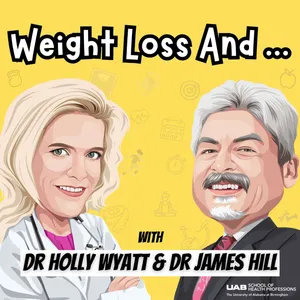
Free Daily Podcast Summary
Weight Loss And ...: Daily Summaries Delivered
by Holly Wyatt & James Hill
Your go-to hangout for everything weight loss… and beyond! “Weight Loss and…” is brought to you by the University of Alabama at Birmingham (UAB) and hosted by seasoned experts in weight management, Dr. James Hill and Dr. Holly Wyatt.We’re your friendly guides through the maze of weight loss, but with a fun twist. We’re not here to preach the latest fad diet or promise a miracle workout. Instead, we’re all about embracing the journey, acknowledging there’s more than one way to hit your health goals, and having a good laugh while we’re at it.We get it: weight loss can be tough, and sometimes pretty serious business. But why can’t it also be enjoyable? With a side of humor, we’ll bring you science-backed insights, real-life stories, and some hard truths. (Spoiler alert: there’s no magic answer - but that doesn’t mean we can’t find what works best for you.)“Weight Loss and…” is your inclusive space to explore, question, and learn — and to feel part of a community along the way. This
Latest Episodes
The most recent episodes — sign up to get AI-powered summaries of each one.
- 2 days ago41 min
Resistance Training and Weight Loss: Why Muscle Matters More Than the Scale
The scale says you're down 50 pounds, but what if you feel weaker climbing stairs or getting up from a low couch? Weight loss is a big win, but what you lose along the way matters just as much as how much you lose.Join Holly and Jim as they work through the research on muscle loss, protein, and resistance exercise. You'll hear what the studies say about whether GLP-1 medications are really to blame, whether protein alone can protect your strength, and why exercise may matter for a reason that has nothing to do with burning calories. Along the way, they share practical, science-based ways to protect your strength without living in the gym.If you're on a GLP-1, thinking about starting one, or want to lose weight and keep the life you're losing it for, this episode is for you. Press play, then get out there and lift something.Discussed on the episode:The question everyone asks about GLP-1s and muscle loss, and why Holly thinks it may be the wrong oneWhy the scale can't tell the difference between fat and muscleWhat a pair of large 2026 meta-analyses reveal about how much exercise can really make a differenceThe popular "must-have" for protecting muscle that may be more icing than cakeWhether weighted vests can stand in for strength training (the answer may disappoint the trend-followers)An unexpected piece of "exercise equipment" that's already in your bathroom.Where a hotel room, a pair of bands, and 10 to 15 minutes fit into the pictureHow to build a "strength report card" and why your suitcase and the overhead bin might be part of itWhat happens to your progress if you skip your workouts for a few weeks, and the one mistake not to make when you get backWhy both hosts admit they struggle with resistance training, and what's still left to figure out
- 1 weeks ago48 min
Why Lifestyle Matters More Than Ever with Dr. Gary Foster
If you've ever been told lifestyle change is the key to losing weight, this episode might make you rethink the job we've been asking lifestyle to do. Now that powerful medications can produce substantial weight loss, what is healthy eating and movement really for?Join Holly and Jim as they sit down with Dr. Gary Foster, a clinical psychologist who has spent decades studying behavioral weight management. He has led academic research programs, served as chief science officer at WW (formerly Weight Watchers), and is now chief scientific officer and head of clinical and medical affairs at Lingo, a division of Abbott. Gary has seen lifestyle treatment from every angle, and he makes the case for reinventing it, not abandoning it. You'll hear what behavioral science got right, what it got wrong, and why lifestyle may matter more than ever, even when the scale isn't the point.Whether you're on a GLP-1 or just curious about where weight management is heading, you'll gain practical ideas and a more hopeful outlook. It's not medications or lifestyle. It's medications and lifestyle.Discussed on the episode:The question that may change how you think about lifestyle programs: have we been asking them to do the wrong job?What decades of behavioral science got right, and the surprising things it missedWhy Gary says "some is better than none" when it comes to tracking, and a realistic way to build awareness without logging everythingThe "I wonder…" mindset shift that makes healthy habits feel lighter.The two signals, beyond the number on the scale, that Gary suggests paying attention toWhy eating less and eating better are not the same thing, and what people on these medications are asking for help withA simple behavior that may be easy to overlook when your appetite and thirst cues changeThe one habit Gary says predicts who keeps weight off, and why no pill or injection can teach it.Gary's advice if you haven't exercised in years (hint: it starts smaller than you think)What we really know, and don't yet know, about life after stopping a medication.Why planning for "what happens when I reach my goal" is worth doing nowWhere obesity rates and prevention may be headedRapid-fire questions, including Gary's most overrated piece of weight loss advice and the one thing GLP-1s changed his mind aboutThe two habits Gary thinks everyone should prioritize, regardless of weight
- 2 weeks ago38 min
What Surprised Us Most About GLP-1 Medications and Obesity Management
What if the medications that were supposed to fix obesity turned out to be just the beginning of the story? After decades of studying weight loss, Holly and Jim thought they had seen it all. Then a new class of medications arrived and overturned some of their most basic assumptions.In this episode, each of them brings five things that genuinely surprised them about the GLP-1 era. Some are about the science, some are about what they see in patients, and some are about what these medications were expected to solve but haven't. Two longtime experts admit what they got wrong, what they're still puzzling over, and where they disagree. Join Holly and Jim for a candid look at where obesity treatment stands now, and why they believe the most interesting questions are only just being asked.Discussed on the episode:The question Holly and Jim never imagined asking in their careers, and why the answer may change what "success" meansWhy a tool once thought impossible outside the operating room is now in the hands of manyThe appetite finding that went against everything they'd taught about the body's backup systemsWhat the medications haven't changed (so far), and why that disappointed one of them more than it surprised themA hormone-based therapy with a risk profile that Holly says doesn't behave the way hormones usually doThe hidden "background noise" that patients only noticed once it was gone, and the swing Holly predicts is coming nextWhy so many people walk away from a treatment that works, and the two-track approach Jim and Holly take to thatOne medication, a surprisingly long list of possible uses, and a few that may raise your eyebrowsWhy Jim believes weight loss and successful obesity treatment may not be the same thingTheir predictions for what will surprise us five and ten years from now
- 3 weeks ago44 min
Why Losing Weight Might Not Make You Happier
You’ve hit your goal weight, or you’re close. So why doesn’t life feel as different as you expected? For many people, the number on the scale was never really the point. It was a stand-in for feeling confident, joining in, and finally enjoying life.Today’s weight loss medications are helping people lose weight that once felt out of reach. A large new BMJ analysis asked whether quality of life is keeping pace, and the answer may make you rethink what success means. Join Holly and Jim as they dig into the findings, why feeling better and weighing less don’t always move together, and share what they’d do about it.You’ll leave with practical, doable steps you can start now, long before you reach your goal weight. Press play to find out what to work on alongside your weight loss.Discussed on the episode:What a huge new review of nearly 100,000 participants revealed about weight loss and quality of lifeThe surprising gap between how much weight people lose and how much better life getsWhy “quality of life” and “happiness” aren’t quite the same thing, and why the difference mattersThe question Holly asks every patient that gets underneath the number they say they wantWhy waiting to be happy until you reach your goal could work against you.A simple fill-in-the-blank exercise to uncover what you really want your weight loss to make possibleThe “life score” you may want to track alongside your weightFeeling better but being disappointed is completely normal, and what to do if the medication itself is part of the problem.A rapid-fire round that puts the hosts on the spot, including a food noise question Holly says isn’t fair.The pattern Holly admits she’s guilty of, and what it means for celebrating your winsResources mentioned:Nong et al., "Comparative Effects of Drugs for Adults with Overweight or Obesity: A Systematic Review and Network Meta-Analysis," BMJ (2026).*Losing the Weight Loss Meds* book by James Hill and Holly WyattWeight Loss And… Episode 147: The Weight Comes Off Easy. Now What?Weight Loss And… Episode 146: Losing Weight on GLP-1s: Are You Moving More or Less Than Before?Weight Loss And… Episode 145: Are You Eating Healthier While Eating Less on GLP-1 Medications?
- Oct 14, 202643 min
What Does Your Pharmacist Want You to Know About Weight Loss Medications?
Your friend just started semaglutide. She got it online; it's "compounded," it has B12 in it, and it's only $199 a month. Sounds like a great deal, right? But what exactly is in that vial, who made it, and how much are you supposed to take? More and more people are facing these questions every day, and most of us don't know how to answer them.Join Holly and Jim as they welcome not one, not two, but three guests for the very first time: Misty Gaddis, pharmacy manager of medication compounding safety; Jessica Pescatore, clinical director of the Alabama Poison Information Center; and Richelle Chambliss, a clinical pharmacist who supports UAB's weight management clinics. Together, they pull back the curtain on compounded GLP-1s and share what your pharmacist wants you to know about weight loss medications, from dosing and side effects to insurance, access, and stopping and restarting. You'll come away with practical questions to ask and red flags to watch for before you inject anything.Discussed on the episode:Why "compounded" doesn't mean "generic," and the common misconception that could put you at riskThe real reason B12 shows up in so many online semaglutide products (and whether it's doing anything for your weight loss)What the Poison Center hears when dosing goes wrong, and why compounded products create a whole new level of riskThe surprising truth about why the cheapest option may not be the cheapest for longA tempting shortcut to save money that pharmacists urge you not to takeWhy the "best" dose may not be the highest oneWhat can happen when you stop and restart your medication on your ownThe red flags that should make you pause before taking anything you've ordered onlineThe underrated ways your pharmacist can help you succeed, and when to call themA question Holly and Jim have never asked in decades of weight loss work, and why it's now on the table
- Oct 7, 202640 min
The Weight Comes Off Easy. Now What?
New obesity medications can now produce weight loss once thought impossible without surgery. That success is forcing doctors to ask a question they never had to face before: what if a treatment doesn't know when to stop?Join Holly and Jim as they unpack six new questions these next-generation drugs have raised in obesity medicine. Using a relatable patient case, they explore the difference between losing the maximum amount of weight and losing the optimal amount, and why those two things are no longer the same. You'll also hear where lifestyle fits into treatment now, what "success" really means when the scale isn't the whole story, and why the answers may ultimately come down to a conversation between patient and provider.Discussed on the episode:Why hitting the weight-loss "ceiling" used to save doctors from a decision they never had to makeA patient case that reveals what happens when someone loses more weight than she may actually needThe hidden trade-off between the number on the scale and what's happening to muscle and strengthWhy nutrition and physical activity haven't become less important on these medications, just differentThe rapid-fire round that puts Holly and Jim on the spot with some of obesity medicine's toughest new dilemmas
- Sep 30, 202645 min
Losing Weight on GLP-1s: Are You Moving More or Less Than Before?
If losing weight made movement easier, wouldn’t you naturally start moving more? It’s the kind of assumption that feels almost too obvious to question: shed 40 or 50 pounds, and your knees stop aching, the stairs get easier, and you’re out there living more. Holly and Jim certainly believed it. But in the age of GLP-1 medications, where rapid, substantial weight loss is now common, does this assumption still hold up?In this episode, Holly and Jim put that belief to the test with real data. Diving into three separate studies (including brand-new, cutting-edge research), they explore what happens to physical activity levels once people start losing weight on GLP-1s. The results might surprise you, and as Jim warns early on, they might leave you feeling a little deflated too. But stick around, because Holly and Jim don’t just deliver the bad news; they explain why it matters and what you can actually do about it.Discussed on the episodeThe surprising step-count numbers researchers found when they measured GLP-1 users with wearable devices and why the results left Jim unimpressed.What happened when scientists tracked the same people’s activity levels before and after starting a GLP-1 medication (hint: it wasn’t what anyone expected)Why a control group matters so much in this kind of research, and what’s still missing from the pictureThe difference between “free living” activity and structured exercise, and which one may be quietly decliningA few theories on why physical activity might dip on these medications, and why even Jim isn’t fully convinced by any of themFive practical strategies for making sure your activity level doesn’t get left behind while the pounds come offHolly and Jim’s honest, personal reactions to research that challenges something they’ve believed for years
- Sep 23, 202645 min
Are You Eating Healthier While Eating Less on GLP-1 Medications?
Everyone knows GLP-1 medications help people eat less. But does eating less actually mean eating better? It’s a question the weight loss field never really had to ask before, and the answer might surprise you.Join Holly and Jim as they dig into three GLP-1 studies looking at what people are actually eating. You’ll hear the real numbers behind diet quality, protein intake, and nutrient gaps on these medications, plus what it means for anyone currently taking (or considering) a GLP-1. Holly and Jim also share five practical tips to help ensure your diet works as hard as your medication is.Discussed on the episodeWhy losing weight on a GLP-1 doesn’t automatically mean you’re eating a healthier dietThe surprising “Healthy Eating Index” scores researchers found in people taking these medications.Which micronutrients tend to slip through the cracks when food intake dropsThe protein timing pattern showing up in the data and why it might matter.Whether cravings actually go away on GLP-1s, or if that’s a mythFive things anyone on a GLP-1 can do right now to protect their diet qualityAnswers to listener questions on appetite loss, ongoing hunger, and whether there’s a “best” GLP-1 dietA teaser for the next episode, which flips the lens to physical activity on GLP-1s
Get Weight Loss And ... summaries in your inbox
Free AI-powered daily recaps. Key takeaways, quotes, and mentions — in a 5-minute read.
Get Free Summaries →Free forever for up to 3 podcasts. No credit card required.
You Might Also Like
Listeners also like.

Weight Loss for Busy Physicians | Helping Women Physicians Lose Weight for the Last Time
Helps women physicians lose weight by addressing stress eating, exhaustion, and time constraints in their demanding careers.
The Real Weight Loss Coach
A nutritionist examines the root causes of weight gain and health issues through expert interviews and science-based discussions on metabolism, food, and mindset.

SAY GRACE | Forever Weight Loss for Overwhelmed Women, Consistency, Realistic, Mindset Motivation, No Restrictions
Constance Shelby- Dietitian/Weight Loss Expert

Live Like a Girl with Dr. Mindy Pelz
Dr. Mindy Pelz explores women's health through hormone science and wellness conversations to help women live in rhythm with their bodies.

Heart Led Wellness
Teaches women to heal their relationship with food through nervous system regulation and somatic practices.

The Exam Room by the Physicians Committee
Experts reveal how plant-based diets and nutrition science can prevent disease and extend lifespan.

Health vs Hype with the American Medical Association
A medical expert debunks viral health trends and misinformation with science-backed insights from physicians.

ZOE Science & Nutrition
Experts break down cutting-edge health and nutrition science to help you make better choices for your body and gut.

The Dr. Hyman Show
Explores root causes of chronic disease and promotes functional medicine, nutrition, and preventive health through expert discussions.

DR. GUNDRY PODCAST: GUT HEALTH, WEIGHT LOSS, AND NUTRITION
Explores gut health, nutrition, and chronic illness through the lens of plant-based diets, lectin avoidance, and microbiome science.
Losing 100 Pounds with Corinne, Weightloss for Women
A weight loss podcast for women focused on overcoming emotional eating and staying consistent during stressful times.

The Dr. Tyna Show
Discusses health truths and medical empowerment, offering practical wellness insights to foster personal and community resilience.
About Weight Loss And ...
Your go-to hangout for everything weight loss… and beyond! “Weight Loss and…” is brought to you by the University of Alabama at Birmingham (UAB) and hosted by seasoned experts in weight management, Dr. James Hill and Dr. Holly Wyatt.We’re your friendly guides through the maze of weight loss, but with a fun twist. We’re not here to preach the latest fad diet or promise a miracle workout. Instead, we’re all about embracing the journey, acknowledging there’s more than one way to hit your health goals, and having a good laugh while we’re at it.We get it: weight loss can be tough, and sometimes pretty serious business. But why can’t it also be enjoyable? With a side of humor, we’ll bring you science-backed insights, real-life stories, and some hard truths. (Spoiler alert: there’s no magic answer - but that doesn’t mean we can’t find what works best for you.)“Weight Loss and…” is your inclusive space to explore, question, and learn — and to feel part of a community along the way. This
Customized Recaps
AI-powered recaps with compact key takeaways, quotes, and insights.
Straight to Your Inbox
Get key takeaways from Weight Loss And ... in a 5-minute read.
Save Hours Every Week
Stay current on your favorite podcasts without falling behind.
Frequently Asked Questions
What is Podzilla's Weight Loss And ... daily summary?
It's a free AI-powered email that summarizes new episodes of Weight Loss And ... as soon as they're published. You get the key takeaways, notable quotes, and links & mentions — all in a quick read.
How does the Weight Loss And ... podcast summary work?
When a new episode drops, our AI transcribes and analyzes it, then generates a personalized summary tailored to your interests and profession. It's delivered to your inbox every morning.
Is this an official Weight Loss And ... product?
No. Podzilla is an independent service that summarizes publicly available podcast content. We're not affiliated with or endorsed by Holly Wyatt & James Hill.
Can I get summaries of other podcasts too?
Absolutely! The free plan covers up to 3 podcasts, any in the catalog. Basic raises that to 15, Pro to 40 and Max to 100. Browse our full catalog at /podcasts.
How often does Weight Loss And ... release new episodes?
Weight Loss And ... publishes weekly. Our AI generates a summary within hours of each new episode.
What topics does Weight Loss And ... cover?
Weight Loss And ... covers topics including Nutrition, Fitness, Health & Fitness. Our AI identifies the specific themes in each episode and highlights what matters most to you.
Start getting Weight Loss And ... summaries tomorrow morning.
Free forever for up to 3 podcasts. No credit card required.
Free forever for up to 3 podcasts. No credit card required.