Free Daily Podcast Summary
Wealth On Main Street: Daily Summaries Delivered
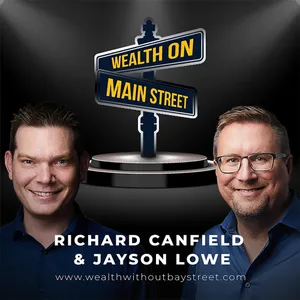
by Richard Canfield & Jayson Lowe
Welcome to the Wealth On Main Street podcast, a guide to building dependable wealth. Join Richard Canfield and Jayson Lowe as they unlock the secrets to creating financial peace of mind in an uncertain world. Discover the strategies and mindsets for a financial future you can bank on. Discussing the Infinite Banking Concept and strategy of Becoming Your Own Banker in North America.
Latest Episodes
The most recent episodes — sign up to get AI-powered summaries of each one.
- 1 weeks ago55 min
338: How Much Life Insurance Do I Actually Need?
It’s one of the most common questions people type into Google, ask ChatGPT, and search on YouTube. Richard Canfield breaks down the concept that insurance companies actually use to answer it: human life value. What is human life value? According to Richard, it’s “the economic value associated with your life based on the people that depend on you.” Insurance companies don’t know your family’s full story; what they know is your income and your age, and that’s largely what determines the number they land on. As Richard puts it, “your family doesn’t love you because of your income. They love you […]
- 1 weeks ago1h 2m
337: Am I Too Old for Life Insurance?
No, the majority of people who start whole life insurance or Infinite Banking are between 45 and 65 years old. “I’m in my 50s. I’m in my 60s. Isn’t this going to be too expensive?” It’s one of the most common questions Neil Dietrich, Lead Advisor at Ascendant Financial, hears from clients and in this episode of Wealth on Main Street, he joins Richard Canfield to answer it directly, along with several other real-world “trench stories” from years of helping clients navigate Infinite Banking. At What Age Should You No Longer Have Life Insurance? Here’s what might surprise you: the overwhelming […]
- 2 weeks ago50 min
336: Financial Planning After Loss | Jeff Treleaven's Story
Money is never just about money. It’s about the people we love and the future we’re all trying to protect, especially in the moments we never see coming. In this episode of Wealth on Main Street, we sit down with Jeff Treleaven, a teammate at Ascendant Financial, for a conversation that goes far beyond typical financial planning. Jeff has walked through grief most people can’t imagine: losing his father at 16, and losing his oldest daughter suddenly in 2023. Through that pain, he found a deeper calling, helping families build the agency, resilience, and preparation they need before life changes in […]
- 3 weeks ago1h 1m
335: Infinite Banking for Business Owners - A Real Example
Karyn Kokeny, 10X business coach, discussing Infinite Banking for business owners on Wealth on Main Street
- Aug 17, 202643 min
334: Nelson Nash's Foundation Lesson in Infinite Banking
How long do you suppose a skyscraper would stand on a weak foundation? That’s the question Nelson Nash, the founder of the Infinite Banking Concept, asked Jayson Lowe the first time they spoke at a conference. Decades later, it’s still the question that separates people who actually understand Infinite Banking from people who are just shopping for a better insurance product. In a recent episode of Wealth on Main Street, teammate Paul Eikeland flipped the format and interviewed Jayson Lowe and Richard Canfield about their personal history with Nelson Nash and what his teaching really meant. Here’s what came out of […]
- Aug 7, 202646 min
333: Farming Is One of the Most Capital-Intensive Businesses
When people picture farming, they picture open fields, tractors, and sunsets. What they don’t picture is one of the most capital-intensive businesses on the planet, millions of dollars tied up in land, equipment that can cost as much as a family home, and banks that “somehow always seem to know exactly when your payment is due.” Jayson Lowe and Richard Canfield sit down with Dan Allen, co-author of Growing Your Own Capital, and his clients, Ryan and Brittany, a young farming couple near Strathmore, Alberta, to talk about what changed once they took control of their own capital. Why is farming […]
- Jul 30, 202647 min
332: How Does Infinite Banking Actually Work? A Client-Turned-Advisor Explains
Reading time: 2 minutes Before John Saintloth ever taught the Infinite Banking Concept, he lived it. Before he became an advisor at Ascendant Financial, he was a client. Before either of those things, he was a 14-year-old boy reuniting with his mother in Canada five years after she had to flee Haiti and seek asylum at the American embassy. On a recent episode of Wealth on Main Street, hosts Jayson Lowe, CEO, Ascendant Financial, and Richard Canfield, Bestselling Author and Podcast Host, sat down with John to talk about the moment a Facebook ad stopped him mid-scroll, the book that kept […]
- Jul 24, 202652 min
331: How Does Key Person Insurance Work? A Complete Guide for Business Owners
Ever feel like your business is one precarious Monday away from chaos? You’re not alone. Most entrepreneurs spend more time worrying about printer jams and coffee shortages than life’s big curveballs, like, you know, unexpectedly losing the one person who holds the whole operation together (hint: it often isn’t the guy refilling the toner). Welcome back to the “Wealth on Main Street” podcast blog, where money myths go to die, and practical wealth-building is always on tap. I’m Richard Canfield, Authorized Infinite Banking Practitioner with the Nelson Nash Institute, Amazon bestselling author, podcast host, and your friendly neighbourhood Kolbe Consultant. Today, […]
Get Wealth On Main Street summaries in your inbox
Free AI-powered daily recaps. Key takeaways, quotes, and mentions — in a 5-minute read.
Get Free Summaries →Free forever for up to 3 podcasts. No credit card required.
You Might Also Like
Listeners also like.

Wake Up to Wealth
A real estate expert shares strategies and stories on building wealth through real estate, entrepreneurship, and financial mindset.
Financial Advisor Success
Real stories and strategies from top financial advisors and consultants on building and growing a successful advisory business.

ChooseFI | Financial Independence Podcast
ChooseFI experts answer listener-submitted questions about financial independence.
The BetterLife Podcast
Real estate investing, wealth building, and lifestyle design through conversations with investors and entrepreneurs.

Afford Anything | Get Smarter With Money
A weekly discussion on financial freedom covering psychology, income, investing, real estate, and entrepreneurship with experts.

BiggerPockets Business Podcast
Real entrepreneurs share practical advice on starting, growing, and selling businesses, covering hiring, marketing, and raising capital.

Money And Wealth With John Hope Bryant
Offers financial education and wealth-building strategies with a focus on economic empowerment in the Black community.
The MORE Show
A real estate investor shares systems and interviews successful peers to help listeners build wealth through property investing.

Right About Now - Legendary Business Advice
Real talk from business founders and entrepreneurs about building companies, lessons learned, and what actually works in real-world ventures.

The Investor's Podcast (We Study Billionaires) - The Investor’s Podcast Network
Analyzes the investment strategies of billionaire investors and explores lessons from legendary financiers on wealth, wisdom, and life.

The Money Mondays
Discusses investments, side hustles, and charity through interviews with entrepreneurs and celebrities in their homes and studios.

How to Money
Two friends break down personal finance topics like debt payoff and investing in simple, practical terms for everyday listeners.
About Wealth On Main Street
Welcome to the Wealth On Main Street podcast, a guide to building dependable wealth. Join Richard Canfield and Jayson Lowe as they unlock the secrets to creating financial peace of mind in an uncertain world. Discover the strategies and mindsets for a financial future you can bank on. Discussing the Infinite Banking Concept and strategy of Becoming Your Own Banker in North America.
Customized Recaps
AI-powered recaps with compact key takeaways, quotes, and insights.
Straight to Your Inbox
Get key takeaways from Wealth On Main Street in a 5-minute read.
Save Hours Every Week
Stay current on your favorite podcasts without falling behind.
Frequently Asked Questions
What is Podzilla's Wealth On Main Street daily summary?
It's a free AI-powered email that summarizes new episodes of Wealth On Main Street as soon as they're published. You get the key takeaways, notable quotes, and links & mentions — all in a quick read.
How does the Wealth On Main Street podcast summary work?
When a new episode drops, our AI transcribes and analyzes it, then generates a personalized summary tailored to your interests and profession. It's delivered to your inbox every morning.
Is this an official Wealth On Main Street product?
No. Podzilla is an independent service that summarizes publicly available podcast content. We're not affiliated with or endorsed by Richard Canfield & Jayson Lowe.
Can I get summaries of other podcasts too?
Absolutely! The free plan covers up to 3 podcasts. Upgrade to Pro for 15, or Premium for 50. Browse our full catalog at /podcasts.
How often does Wealth On Main Street release new episodes?
Wealth On Main Street publishes weekly. Our AI generates a summary within hours of each new episode.
What topics does Wealth On Main Street cover?
Wealth On Main Street covers topics including Business. Our AI identifies the specific themes in each episode and highlights what matters most to you.
Start getting Wealth On Main Street summaries tomorrow morning.
Free forever for up to 3 podcasts. No credit card required.
Free forever for up to 3 podcasts. No credit card required.