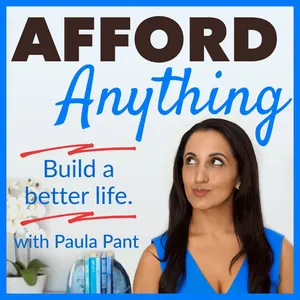
Free Daily Podcast Summary
Afford Anything | Get Smarter With Money: Daily Summaries Delivered
by Paula Pant, Personal Finance Expert | Cumulus Podcast Network
45 million downloads. One question: what does it actually take to build wealth? Each week, Paula Pant brings in economists, investors, business leaders, authors, and researchers to dig into the five pillars of financial freedom — financial psychology, increasing income, investing, real estate, and entrepreneurship. Deep insights rooted in economics and behavioral finance. First-principles thinking. No surface-level tips. Get smarter with money. Build wealth.
Latest Episodes
The most recent episodes — sign up to get AI-powered summaries of each one.
- Yesterday1h 9m
AI, Debt, and a Social Security Shortfall. Should Your Money Plans Change? With Rob Berger
#755: Many retirees fear running out of money more than they fear dying. AI is reshaping the economy, the U.S. now spends over $1 trillion on interest, and Social Security faces a shortfall. Rob Berger says if you're worried about all that, it's a sign you're thinking clearly. Rob Berger is a former securities lawyer, founder of the personal finance site Dough Roller, and host of a nearly 300,000-subscriber YouTube channel on investing and retirement planning. He started writing about money in 2007, just months before the Great Recession. In this episode, we discuss: How to tell whether today's high stock prices should change your plan When to trim a stock that's grown too big, and when to let it ride Why a booming economy can still leave so many people feeling squeezed What a looming Social Security shortfall could mean for your retirement How to cover your basic bills with guaranteed income, whatever markets do How to ease into retirement instead of going from 40 hours to zero Why daily spending habits matter more than investing knowledge Whether you're five years from retirement or five years into your career, this episode will help you separate what's truly changing from what never does. 🔗 RESOURCES MENTIONED RETIREMENT WORRIES FEEL OVERWHELMING? SEE YOUR WHOLE FINANCIAL PICTURE ON ONE PAGE 👉 http://affordanything.com/cornerstone Rob Berger on YouTube 👉 https://www.youtube.com/channel/UC9C17-OMxa-7oRSaCtztObw Rob's free weekly retirement newsletter 👉 https://robberger.com/newsletter Learn more about your ad choices. Visit podcastchoices.com/adchoices
- 4 days ago1h 14m
Q&A: We Have $80K in Cash and Want a 1–2 Year Sabbatical. Is It Enough?
#754: Four months of savings in the bank, a goal of eight, and a career break she's excited to fund. Does everything else really have to wait? Paula and Joe's answer: don't turn your emergency fund into an emergency. A 42-year-old UK listener asks how to split money between an emergency fund, a career break, and retirement. Then we map out a 30-something couple's sabbatical and ask whether you can objectively grade a politician on the economy. In this episode, we discuss: How to tell a true emergency from an expense you know is coming How to rank competing savings goals when you can't fund them all How to protect retirement without putting your life on hold How to cover a sabbatical when your cash runs short Why low-income years are a prime window for Roth conversions How to test whether you can stomach an all-stock portfolio How to judge a politician's economic record without the spin If you're juggling short-term plans and long-term goals and feel pulled in every direction, this episode will help you decide what gets funded first, and what can wait. ⏱️ TIMESTAMPS Note: Timestamps may vary slightly depending on dynamic ad placements. The real difference between emergencies and expenses Why a former planner never said "emergency fund" The monthly math that breaks most wish lists One question that reveals what you really want Why four months of savings is enough for now Fund the sabbatical before earmarking a down payment Why a career break is prime time for Roth conversions How to test if you can handle a 22% drop Judge politicians on policies, not short-term results Why focusing on what you control grows your influence 🔗 RESOURCES MENTIONED 👉 Emergency fund, sabbatical, retirement? See which box each dollar belongs in with this free one-page worksheet: https://affordanything.com/cornerstone 👉 Paul Merriman's free model portfolios and investing courses: https://paulmerriman.com 👉 Adventure Capitalist by Jim Rogers: https://amzn.to/4xOaEg3 Learn more about your ad choices. Visit podcastchoices.com/adchoices
- 1 weeks ago1h 25m
Why 60,000 New York Apartments Sit Empty in a Housing Crisis, with Kenny Burgos
#753: New York City is short roughly half a million homes, yet at least 60,000 rent-regulated apartments sit empty. Under current rules, many owners lose less money by leaving them vacant than by fixing them up. Kenny Burgos is CEO of the New York Apartment Association, which represents owners of rent-stabilized buildings, and a former New York State Assemblymember from the Bronx. In this episode, we discuss: How New York's rent rules work, and why they've lasted since 1969 Why the typical New Yorker pays about $1,600 while listings ask $5,500 Why some buildings now sell for $50,000 an apartment, and why that isn't a deal How a rent freeze pushes costs onto market-rate renters and delayed repairs Why a targeted rent freeze for seniors and disabled residents works better What Vienna's housing model accounts for that New York's doesn't What aspiring landlords should weigh before buying rent-regulated property Whether you own rentals, hope to, or just want to understand the rent-control debate, this episode shows what happens when costs keep rising and rents can't. 🔗 RESOURCES MENTIONED 👉 Ready to buy your first rental property, or get more out of the one you already own? Join the waitlist for Your First Rental Property. You'll be the first to know when enrollment opens: courses.affordanything.com 👉 New York Apartment Association: https://housingny.org 👉 Housing New York podcast with Kenny Burgos: https://housingny.org/housingnypodcast 👉 Kenny Burgos on X: https://x.com/KennyBurgosNY ⏱️ TIMESTAMPS Note: Timestamps may vary slightly depending on dynamic ad placements. Why New York's 1969 emergency rent rules never ended The surprisingly low rent most New Yorkers actually pay Why buildings now sell for $50,000 an apartment Costs rose 4.5%. Rents were frozen at 0%. The rent-freeze program that actually works Who really pays when rents are frozen Why 60,000 apartments sit empty during a shortage Buyout or pressure? The $150,000 question What Vienna gets right that New York doesn't Should you buy a rental in New York? Learn more about your ad choices. Visit podcastchoices.com/adchoices
- 1 weeks ago1h 0m
Q&A: I’m Tired of Managing My Rental Property. Should I Sell It?
#752: A caller's rental is performing fine, but a late-paying tenant and a roof replacement have her ready to sell it before she moves to Madrid for her MBA. Paula argues the real fix isn't selling — it's a hire she hasn't made yet. This week, Joe joins Paula to help a caller decide whether to sell a rental property from abroad, then dig into new data on why women's labor force participation dropped in July while their share of new jobs surged in August. In this episode, we discuss: How to tell if you're making the right call for the wrong reason Why a new roof or a set of windows can be a form of forced investing The one hire that can solve the same problem as selling your rental A simple way to estimate a rental property's real return What to weigh before selling a working investment on gut feel alone Why women's labor force participation fell in July even as their job gains led the year Why the trades are becoming a stronger bet than a four-year degree for some new grads This one's for anyone facing a big financial decision that feels more emotional than mathematical — whether that's a rental property, a career move, or a job you're not sure is worth keeping. ⏱️ TIMESTAMPS Note: Timestamps may vary slightly depending on dynamic ad placements. Why she wants to sell a rental that's "objectively good" When it's actually okay to sell a good investment One hire that stops panic-selling a rental property The simple math to compare rental returns vs. stocks Paula's own confession about hating her first rental property Why doing what you're best at beats doing everything yourself 100% of last month's labor force drop was women The real reasons women are leaving the workforce right now Why women got 85% of new jobs created this year The industry that could fix jobs and housing at once 🔗 RESOURCES MENTIONED 👉 Torn on selling a rental? Get our free 10-day guide, which includes a deal-analysis exercise to help you decide with the numbers, not just your gut: https://affordanything.com/fiire 👉 Sign up for our newsletter (get the new site first): https://affordanything.com/newsletter 👉 Leave us a voicemail with your own money question: https://affordanything.com/voicemail 👉 Read the BLS jobs report Paula cites in this episode: https://www.bls.gov/news.release/empsit.nr0.htm Learn more about your ad choices. Visit podcastchoices.com/adchoices
- 2 weeks ago1h 7m
Why Self-Worth Predicts Your Income More Than Your SAT Score Does, with Marisa Franco
#751: The belief that’s quietly sabotaging your progress might not even be true. Free worksheet to question it: https://affordanything.com/turn-it-around Two people can grow up with the exact same test scores — and as adults, one of them ends up earning double the other. Psychologist Marisa Franco says the deciding factor isn't intelligence, and it isn't luck. It's whether you actually believe good things are allowed to happen to you. Dr. Marisa Franco is a psychologist and professor at the University of Maryland, and the New York Times bestselling author of Platonic. She's back to talk about her new book, Worth: The New Science of Self-Esteem and Secure Attachment. In this episode, we discuss: How self-worth — not intelligence or family income — predicts how much you'll earn as an adult Why some people quietly sabotage their own portfolio right before they hit financial independence The difference between "good" and "bad" high self-esteem, and why one of them wrecks relationships Why getting more love or praise than you expect can make you pull away instead of lean in How to actually process a hard emotion instead of shoving it down Why hitting a big financial goal can leave you feeling strangely empty once you get there How to rebuild your sense of self after losing an identity you were attached to Whether you've ever undermined your own progress right before a finish line, or wondered why reaching a goal didn't feel the way you thought it would, this episode gives you a framework for understanding — and changing — that pattern. ⏱️ TIMESTAMPS Note: Timestamps may vary slightly depending on dynamic ad placements. The two very different types of high self-esteem Self-esteem vs. self-worth: the real difference Why self-worth predicts income more than SAT scores Sabotaging your own portfolio right before you hit FI The self-fulfilling prophecy behind financial fear Why too much love can make you pull away How low self-worth blocks promotions and job offers The memory trick that can change your brain Why self-worth matters most in a bad market Does self-worth actually drive your net worth? 🔗 RESOURCES MENTIONED 👉 Worth: The New Science of Self-Esteem and Secure Attachment: https://drmarisagfranco.com/worth-the-book/ 👉 Marisa's website (speaking, articles, more): https://drmarisagfranco.com 👉 Marisa on Instagram (for signed copies via Lost City Books): https://www.instagram.com/drmarisagfranco/ Learn more about your ad choices. Visit podcastchoices.com/adchoices
- 2 weeks ago1h 57m
Your "Diversified" Portfolio Might Secretly Be One Big Bet on AI, with Alec Litowitz
#750: Free worksheet: question the belief that might be keeping you stuck — before reality forces the update for you: http://affordanything.com/turn-it-around Alec Litowitz spent three decades building one of the world's largest hedge funds, and he says the highest-IQ people in the room are often the last to notice the world has changed. His answer isn't more intelligence — it's the willingness to be wrong, quickly, and update before everyone else catches up. Alec co-founded Citadel alongside Ken Griffin and later founded Magnetar Capital, one of the largest alternative asset managers in the world. His new book, The Adaptability Quotient, is out September 15. In this episode, we discuss: How adaptability quotient (AQ) differs from IQ and EQ — and why it matters more now What a doomed Antarctic expedition reveals about real adaptability Why AI makes knowledge abundant and judgment scarce How to stop needing to be right so you can update faster The real reason Blockbuster lost to Netflix (it wasn't a bad decision) A 4-part test for telling a temporary shift from a permanent one Why a "diversified" portfolio might secretly be one big bet right now This episode is for anyone whose career, portfolio, or plans feel less certain than they used to — a way of thinking that doesn't require predicting the future, just noticing when your old model has stopped working. Learn more about your ad choices. Visit podcastchoices.com/adchoices
- 3 weeks ago1h 33m
How a Blind Man and His Guide Dog Survived Sept. 11 — and What His Mindset Can Teach Us, with Michael Hingson
#749: Michael Hingson was on the 78th floor of the North Tower of the World Trade Center when the first plane hit on Sept. 11. He felt the impact, but couldn’t see it. Michael has been blind since shortly after birth. Alongside his guide dog, Roselle, they descended 1,463 steps – escaping just before the South Tower, 100 yards away, collapsed. They then helped a woman who was temporarily blinded by the dust. Michael's story answers the question – What do you do when something terrifying is happening, you don't have enough information, you cannot control the outcome, and everyone around you is beginning to panic? Michael's answer is surprisingly practical. 1. Prepare before you need the preparation. 2. Know what you know, know what you don't know. 3. Stop mentally rehearsing outcomes you cannot control 4. Keep acting on the part that remains within your control. He had deliberately learned the World Trade Center's exits, emergency procedures, physical layout, and systems long before Sept 11 because he believed that was part of being responsible for his office. When the building was struck, he describes that preparation as a “mindset” that simply kicked in. ⏱️ TIMESTAMPS Note: Timestamps may vary slightly depending on dynamic ad placements. Life before September 11 The plane hits the North Tower Fear takes over in the stairwell Turning tragedy into a new career Challenging attitudes about blindness Supporting guide dog organizations 🔗 RESOURCES MENTIONED michaelhingson.com guidedogs.com Learn more about your ad choices. Visit podcastchoices.com/adchoices
- 3 weeks ago1h 1m
Q&A: My Dream Job Won't Wait If I Take a Family Gap Year — Do I Quit Anyway?
#748: The real question behind quitting a job you love or paying off debt anyway? Your money mindset. Take our free quiz to find yours: https://affordanything.com/fiire A listener with $686,000 saved and a job she loves wants to take her family on a year-long trip — but Paula says her real question isn't about money at all. Later: a dad chooses to stop maxing his IRA to pay off a mortgage, even though the math says otherwise. Joe joins from the road to help answer three listener questions: a family weighing a year off against a job she loves, a dad debating whether to stop maxing his IRA to pay off a house, and a longtime listener with a smarter way to save for college. In this episode, we discuss: How to decide whether a job you love is worth walking away from for a family gap year The three factors that actually predict whether you'll love your next job Why "retiring early" might be the wrong goal — and what to aim for instead How to know if you're financially ready for a career break, and what to prep first Why paying off your mortgage can beat investing, even when the math says otherwise How to structure your mortgage term like a finance pro (and why the 30-year can win) Why saving in separate, labeled accounts makes it easier to actually hit your goals Whether you're weighing a big life pivot, deciding what to do with extra cash, or just trying to make saving feel less abstract, this episode offers frameworks — not just formulas — for making the call. ⏱️ TIMESTAMPS Note: Timestamps may vary slightly depending on dynamic ad placements. Can you afford to quit a job you love? Three things that actually predict job satisfaction Why this window with your kids won't come twice Why retiring often beats retiring early Why bad trip experiences count as good data Why paying off debt can beat the math Why coasting on your current savings pace is risky How to think like a CFO about your mortgage Why one bucket per goal makes saving easier Why your 401k isn't really about retirement 🔗 OTHER RESOURCES 👉 The real question behind quitting a job you love or paying off debt anyway? Your money mindset. Take our free quiz to find yours: https://affordanything.com/fiire 👉 Camp Fi, the financial independence retreats Paula and Joe swap stories about this episode: https://campfi.org 👉 Heavy Metal Money, Chris Luger's personal-finance podcast (Joe recorded this episode from his place): https://heavymetal.money 👉 Got a question of your own? Leave a voicemail for Paula: https://affordanything.com/voicemail Learn more about your ad choices. Visit podcastchoices.com/adchoices
Get Afford Anything | Get Smarter With Money summaries in your inbox
Free AI-powered daily recaps. Key takeaways, quotes, and mentions — in a 5-minute read.
Get Free Summaries →Free forever for up to 3 podcasts. No credit card required.
You Might Also Like
Listeners also like.

NerdWallet's Smart Money Podcast
Personal finance experts break down budgeting, saving, investing, and credit to help listeners make informed money decisions.

The Paul Morris Podcast
Entrepreneurs and investors share strategies for building wealth, scaling businesses, and leading high-performance teams.
Money And Wealth With John Hope Bryant
Offers financial education and wealth-building strategies with a focus on economic empowerment in the Black community.

Money Guy Show
Teaches wealth-building strategies to help listeners grow their assets and achieve financial goals efficiently.
How to Money
Two friends break down personal finance topics like debt payoff and investing in simple, practical terms for everyday listeners.

Financial Feminist
A feminist take on personal finance, teaching women to earn, save, and grow wealth while challenging patriarchal systems.

Other People's Pockets
A show that explores personal finances by having guests openly discuss their income, spending, and money habits.

Money Rehab with Nicole Lapin
A financial guide to overcoming money taboos and improving personal finance with practical advice from Nicole Lapin.

The Money Mondays
Discusses investments, side hustles, and charity through interviews with entrepreneurs and celebrities in their homes and studios.

Wake Up to Wealth
A real estate expert shares strategies and stories on building wealth through real estate, entrepreneurship, and financial mindset.

Your Money Guide on the Side
A practical guide to personal finance and investing, breaking down complex topics with expert insights and actionable advice.

Trading Secrets
A former athlete discusses personal finance, careers, and money taboos with experts to help listeners make smarter financial decisions.
About Afford Anything | Get Smarter With Money
45 million downloads. One question: what does it actually take to build wealth? Each week, Paula Pant brings in economists, investors, business leaders, authors, and researchers to dig into the five pillars of financial freedom — financial psychology, increasing income, investing, real estate, and entrepreneurship. Deep insights rooted in economics and behavioral finance. First-principles thinking. No surface-level tips. Get smarter with money. Build wealth.
Customized Recaps
AI-powered recaps with compact key takeaways, quotes, and insights.
Straight to Your Inbox
Get key takeaways from Afford Anything | Get Smarter With Money in a 5-minute read.
Save Hours Every Week
Stay current on your favorite podcasts without falling behind.
Frequently Asked Questions
What is Podzilla's Afford Anything | Get Smarter With Money daily summary?
It's a free AI-powered email that summarizes new episodes of Afford Anything | Get Smarter With Money as soon as they're published. You get the key takeaways, notable quotes, and links & mentions — all in a quick read.
How does the Afford Anything | Get Smarter With Money podcast summary work?
When a new episode drops, our AI transcribes and analyzes it, then generates a personalized summary tailored to your interests and profession. It's delivered to your inbox every morning.
Is this an official Afford Anything | Get Smarter With Money product?
No. Podzilla is an independent service that summarizes publicly available podcast content. We're not affiliated with or endorsed by Paula Pant, Personal Finance Expert | Cumulus Podcast Network.
Can I get summaries of other podcasts too?
Absolutely! The free plan covers up to 3 podcasts. Upgrade to Pro for 15, or Premium for 50. Browse our full catalog at /podcasts.
How often does Afford Anything | Get Smarter With Money release new episodes?
Afford Anything | Get Smarter With Money publishes 2x weekly. Our AI generates a summary within hours of each new episode.
What topics does Afford Anything | Get Smarter With Money cover?
Afford Anything | Get Smarter With Money covers topics including Business. Our AI identifies the specific themes in each episode and highlights what matters most to you.
Start getting Afford Anything | Get Smarter With Money summaries tomorrow morning.
Free forever for up to 3 podcasts. No credit card required.
Free forever for up to 3 podcasts. No credit card required.