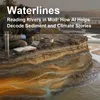
Reading Rivers in Mud: How AI Helps Decode Sediment and Climate Stories
A handful of mud can hold the memory of a river flood, a lake edge, or a dust storm that crossed a continent. That matters because sediments are one of the main ways water leaves a record of past environments, climate shifts, and landscape change. In this episode of Waterlines, we unpack a new study that asks a practical question: if scientists use grain size to read those records, how can they reduce the human guesswork built into the methods?The paper follows 73,393 sediment samples from loess, river, and lake-delta settings, mostly in China and Central Asia. The authors use an existing grain-size decomposition approach to create training examples, then bring in deep learning, including convolutional neural networks and generative adversarial networks, to build a more consistent tool for separating mixed sediment into likely components. We explain the idea with everyday analogies: sorting trail mix after it has been shaken together, reading the energy of water from sand and silt, and teaching a model with both real and carefully generated examples.We also talk about what the work does not solve. The model performed well where training data matched the new samples, but struggled where loess from Central Asia differed from loess on the Chinese Loess Plateau. That limitation is important: AI does not remove the need for field knowledge, shared data, and careful interpretation. It may, however, help scientists compare sediment records more fairly across river basins, lakes, deserts, and ancient climate archives.Citation: Liu, Y., Wang, T., Wen, T., Zhang, J., Liu, B., Li, Y., Zhang, H., Rong, X., Ma, L., Guo, F., Liu, X. and Sun, Y. (2024) Deep learning-based grain-size decomposition model: A feasible solution for dealing with methodological uncertainty. Sedimentology. doi: 10.1111/sed.13195.Disclosure: This Waterlines episode package is written for public science communication and is intended to be performed with AI-generated voices.
Podzilla Summary coming soon
Sign up to get notified when the full AI-powered summary is ready.
Free forever for up to 3 podcasts. No credit card required.
Listen to This Episode
More from Waterlines: How Water Shapes Our World
California’s Groundwater Checkup: Measuring Risk by Place and by People
Who Gets Tap Water from Underground? Mapping America’s Public-Supply Groundwater

When Wetlands Whisper and Groundwater Speaks: Tracking Chemistry in a Flat Michigan Stream
The Water Cycle Picture Is Missing Us
Get summaries like this every morning.
Free AI-powered recaps of Waterlines: How Water Shapes Our World and your other favorite podcasts, delivered to your inbox.
Free forever for up to 3 podcasts. No credit card required.