Free Daily Podcast Summary
Value Coffee Talk: Daily Summaries Delivered
by Genius Drive
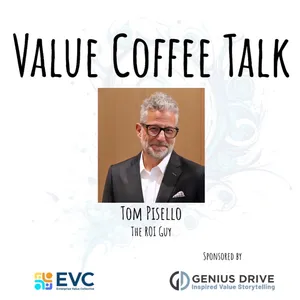
B2B buyers want to know the business outcomes they can expect from proposed solutions and the realized value of what they've already purchased. Yet far too few solution providers can articulate value. Value Coffee Talk interviews sales, marketing and customer success leaders about their value programs to discuss the challenges, opportunities and share best practices. Hosted by author and serial entrepreneur Tom Pisello, the ROI Guy, and value expert April Morley, the pair grab a coffee with their guests and dive into the tough questions that need answering in order to drive value success. This show is a service of the Enterprise Value Collective (EVC), a community of business value leaders and practitioners, and independent value consultancy Genius Drive.
Latest Episodes
The most recent episodes — sign up to get AI-powered summaries of each one.
- 3 days ago29 min
The Quota Problem: Why Sales Performance Starts with Environment, Not Effort
Most sales organizations treat missed quota as an execution failure. Fractional CRO Mark Small asks the harder question: are the targets realistic in the first place? Drawing on experience in cybersecurity sales, he unpacks how market dynamics, flawed target setting, and compensation models disconnected from revenue quality set sellers up to fail before the quarter begins.The conversation then turns to what actually moves performance. Mark argues that playbooks and tools have hit their limits, and that the real gains come from disciplined qualification, focusing effort on high-value opportunities, and confronting the cognitive biases that keep reps chasing deals they should walk away from.On AI, he offers a balanced view. AI can sharpen effectiveness, but without context and perspective it produces activity, not outcomes. The antidote is measuring real results instead of vanity metrics, and pairing technology with simulation and real-world practice rather than replacing it.He closes on culture, and it is the heart of the episode. Peer-to-peer learning, team esprit de corps, and genuine support for new sellers are what build resilient organizations. His advice to sellers is equally direct: choose a company with stability and a soul.For sales leaders, enablement teams, and revenue executives rethinking how they set targets and develop talent, this is a candid look at why environment beats effort.
- 1 weeks ago32 min
Scaling Value Selling with AI: Inside Google Cloud’s AI Value Engine
Every AI conversation eventually lands on one question: what is the ROI of this use case? Ray Peng, Global Head of GTM AI Platform & Strategy for Value Creation for Google Cloud, explains why most sellers struggle to answer it, and how his team built the AI Value Engine to close that gap by generating relevant use cases, value hypotheses, and account strategies at scale.The conversation is refreshingly candid about what it takes. Ray walks through the early struggles of use case development, how usage analytics across accounts revealed where value conversations stall, and why post-sales measurement and feedback loops are what make the engine smarter over time. His core argument: data is the currency of the value group, and without governance and clean inputs, AI simply automates guesswork.He then reframes the role itself. Value leaders deploying AI are no longer just analysts or consultants; they are product managers. That means owning guardrails, building deterministic models where reliability matters, making deliberate build versus buy decisions, and treating experimentation as a discipline rather than a side project.For value practitioners, sales leaders, and enablement teams under pressure to scale value selling without scaling headcount, this is a practical blueprint from one of the largest AI deployments in enterprise sales.
- 2 weeks ago28 min
The Listening Problem in Sales and Why Curiosity Beats Expertise
The conversation is unusually practical. Scott walks through the listening mirror technique, how open-ended questions guide a conversation without steering it, and why letting silence sit after a hard question is where the real information surfaces. He also gets into amplifying customer pain responsibly: not manufacturing urgency, but helping a buyer articulate consequences they had felt but never quantified.Scott then addresses the buyer who has already done the research. Educated buyers do not need information; they need judgment. That shifts the seller's job from explaining to guiding, and it raises the bar on credibility. In a market saturated with content and AI-generated answers, the human contribution is experience applied to a specific situation.He closes on mentorship, and it is worth staying for. Scott's view is that listening is not learned from a course. It is learned by watching someone good do it and being corrected when you get it wrong.For sales leaders, coaches, and value practitioners working on seller EQ rather than just methodology, this is a grounded conversation about the skill everyone claims to have.
- 3 weeks ago34 min
Selling to Procurement: Why Value Always Beats Discount
Most sellers still treat procurement as the last obstacle between them and a signature. Dean Edwards would like a word.In this episode of Value Coffee Talk, Tom Pisello sits down with procurement expert Dean Edwards to explain what the function has actually become. The cost-squeeze caricature is a decade out of date. Modern procurement is measured on risk exposure, supplier resilience, and alignment to corporate objectives, which means the professional across the table is often solving a harder problem than the seller assumes.Dean’s point is blunt: if you cannot articulate how your solution advances the objectives on your buyer’s annual report, you have given procurement nothing to work with except price.The conversation reframes the RFP as diagnostic rather than adversarial. Tenders reveal where the buying organization thinks its gaps are, and the gaps they left out are frequently the more interesting opportunity.Dean also explains the decision logic that governs procurement behavior: choices must be defensible and rational to people who were not in the room. Sellers who understand that stop arguing for preference and start arming their contact with justification.From there, Dean and Tom get into where procurement is heading. Outcome-based agreements and shared value plans are moving from novelty to expectation, which raises the bar on proof.Committing to a business result means committing to measure it, and vendors who cannot demonstrate delivered ROI will find renewal conversations far less forgiving. Handled well, the same rigor turns procurement from gatekeeper into the internal advocate who unlocks expansion.For CROs, value practitioners, and enterprise sellers navigating complex buying committees, this is a rare look at the deal from the other side of the table.
- Oct 7, 202633 min
Productizing IP for Recurring Revenue: How AI Is Rewriting Professional Services
The billable hour is not under pressure from a competitor. It is under pressure from a buyer who now has an analyst on their phone.In this episode of Value Coffee Talk, Sherri Sklar of AI Venture Catalyst makes the case that professional services firms are facing a business model problem, not a technology problem. Buyers have stopped paying for access to expertise they can approximate instantly. What they will still pay for, and pay well for, is a guaranteed outcome. That shift breaks the economics of selling time and forces a hard question: what does a firm actually own that cannot be replicated by a general purpose model?Sherri's answer is proprietary knowledge, and her argument is that most firms are sitting on it without monetizing it. The path forward is productization: turning judgment, methodology, and accumulated pattern recognition into something that scales without a consultant in the room. She walks through what that looks like in practice, from firms that have successfully packaged their IP into recurring revenue to the ones that stalled by building technology before clarifying the outcome they were selling.The conversation is candid about the difficulty. Choosing where to build versus buy, developing AI capability without an engineering culture, and pricing an outcome instead of an engagement are all real obstacles. Sherri's position is that none of them justify waiting, because the buyer expectation has already moved.For consultancy leaders, agency owners, and services executives weighing how to defend margin, this is a practical look at converting expertise into an asset.Sound bites"Why should I spend X on analyst subscriptions when I have an analyst on my phone?""You can't sit still in this economy; you must adapt.""Your proprietary knowledge is your most valuable asset."Chapters00:00 Introduction to AI in Professional Services02:44 Challenges Faced by Professional Services Firms05:39 The Shift in Buyer Behavior08:44 The Need for Outcome-Based Business Models11:25 Productization of Services and AI Integration14:11 Navigating the Technology Landscape17:13 Real-World Examples of Successful Productization19:52 Overcoming Challenges in AI Development22:48 Strategic Advice for Service Firms25:40 Conclusion and Call to Action
- Sep 30, 202628 min
The Jolt Effect: How High Performing Sellers Overcome Customer Indecision
Most lost deals are not lost to a competitor. They are lost to nothing at all, the buyer who agrees with everything, nods through the business case, and then goes quiet. Ted McKenna's research puts a number on it: a large share of pipeline dies not from preference for the status quo, but from fear of making the wrong choice.In this episode of Value Coffee Talk, Ted McKenna, co-author of The Jolt Effect, breaks down why the standard playbook makes indecision worse. When a seller senses hesitation, the instinct is to pile on more proof, more references, more ROI. Ted's data shows that response often deepens the paralysis, because the buyer was never questioning whether the problem was real. They were questioning whether they could be blamed for the decision.The conversation gets specific about what high performers do instead. They separate fear of the status quo from fear of failure and treat them as different problems. They build trust in the change itself, not just in the seller. And they use long-term capability planning to right-size expectations, giving the buyer a defensible path rather than a maximalist promise.Ted closes with a caution the market needs right now. As vendors lean harder into AI narratives and outcome commitments, overpromising has become the fastest way to manufacture the exact indecision sellers are trying to overcome. Trust broken at implementation costs far more than a deal that closes slowly.For CROs, enablement leaders, and value practitioners staring at flat win rates and aging pipeline, this is a clear-eyed look at where the real friction sits.
- Sep 23, 202626 min
Why Sales Quotas Fail and How to Fix Them
Roughly half of sellers miss quota every year, and the industry keeps treating it as a rep problem. Lee Levitt argues it is a management problem, and it has been hiding in plain sight for decades.In this episode of Value Coffee Talk, sales performance consultant Lee Levitt takes apart the assumptions behind quota setting, pipeline math, and the coaching that never actually happens. His diagnosis is uncomfortable: most sales organizations hire for activity, measure for activity, then wonder why buyers do not see value. Lee's counter: a structure for turning a seller from a taker into a giver who earns the second meeting rather than begging for it.The conversation goes deeper than technique. Lee makes the case that buying decisions are emotional before they are rational, that soft skills and emotional intelligence are the real differentiators in a market where AI has commoditized information, and that improv, not scripting, is what lets a seller stay present when a conversation turns. He also challenges leaders directly: you cannot coach authenticity into a team you manage by dashboard.For CROs, enablement leaders, and value practitioners rebuilding how their teams sell, this episode is a candid look at why the fundamentals still fail and what to fix first.
- Sep 16, 202625 min
Customer-Centric Success: Insights from a veteran Chief Customer Officer
Every vendor now leads with an AI story. Far fewer can prove what that AI actually delivered.In this episode of Value Coffee Talk, Jim Richmond, veteran Chief Customer Officer at Smartling, joins us to unpack the widening gap between AI promises and proven outcomes, and what customer-facing leaders must do to close it. Jim makes the case that buyers are no longer impressed by capability demos. They want to know which metric moved, by how much, and whether the result holds at renewal.The conversation gets practical: how to quantify outcomes that were actually delivered rather than modeled, how to keep the customer at the center of the narrative instead of the product, and why curiosity beats defensiveness when a customer starts questioning your AI claims. Jim also challenges the reflex to answer pain with features, arguing that CS teams earn their seat by diagnosing the business problem first.For CROs, Value Leaders, and Customer Success executives under pressure to defend AI investments, this is a working session on turning promises into proven value.
Get Value Coffee Talk summaries in your inbox
Free AI-powered daily recaps. Key takeaways, quotes, and mentions — in a 5-minute read.
Get Free Summaries →Free forever for up to 3 podcasts. No credit card required.
You Might Also Like
Listeners also like.

Your Brand Amplified
Explores the strategies and mindsets of successful entrepreneurs in business growth, marketing, and personal branding.

The AI in Business Podcast
Interviews with AI executives reveal practical applications and strategic insights for business leaders adopting AI.
Smart Talks with IBM
Conversations with leaders leveraging AI, quantum computing, and emerging technologies to transform global businesses.

The Vault Unlocked
Founders share hard-earned lessons on what actually worked, what failed, and the pivotal decisions behind growing successful companies.

Right About Now - Legendary Business Advice
Raw business insights from founders and industry leaders, revealing real wins, failures, and actionable strategies without the fluff.

Coaching Inc with Tom Krol
Teaches coaches and consultants how to generate consistent leads and increase income using proven, efficient marketing strategies.

Coffeez with Joe Shalaby
Conversations with entrepreneurs, investors, and cultural figures reveal the real strategies, struggles, and costs behind success.

The Selling Well
Explores strategies and insights from top sales leaders to help professionals improve their sales performance.

Hunters and Unicorns
Explores the strategies and journeys of top tech leaders and sales innovators shaping the software industry.

The GaryVee Audio Experience
A compilation of marketing insights, business advice, keynote speeches, and interviews from entrepreneur Gary Vaynerchuk.

Proven Podcast
Charles Schwartz

Total Disruption Podcast
Discussions with entrepreneurs and thought leaders on how disruptions in life and business drive personal and professional transformation.
About Value Coffee Talk
B2B buyers want to know the business outcomes they can expect from proposed solutions and the realized value of what they've already purchased. Yet far too few solution providers can articulate value. Value Coffee Talk interviews sales, marketing and customer success leaders about their value programs to discuss the challenges, opportunities and share best practices. Hosted by author and serial entrepreneur Tom Pisello, the ROI Guy, and value expert April Morley, the pair grab a coffee with their guests and dive into the tough questions that need answering in order to drive value success. This show is a service of the Enterprise Value Collective (EVC), a community of business value leaders and practitioners, and independent value consultancy Genius Drive.
Customized Recaps
AI-powered recaps with compact key takeaways, quotes, and insights.
Straight to Your Inbox
Get key takeaways from Value Coffee Talk in a 5-minute read.
Save Hours Every Week
Stay current on your favorite podcasts without falling behind.
Frequently Asked Questions
What is Podzilla's Value Coffee Talk daily summary?
It's a free AI-powered email that summarizes new episodes of Value Coffee Talk as soon as they're published. You get the key takeaways, notable quotes, and links & mentions — all in a quick read.
How does the Value Coffee Talk podcast summary work?
When a new episode drops, our AI transcribes and analyzes it, then generates a personalized summary tailored to your interests and profession. It's delivered to your inbox every morning.
Is this an official Value Coffee Talk product?
No. Podzilla is an independent service that summarizes publicly available podcast content. We're not affiliated with or endorsed by Genius Drive.
Can I get summaries of other podcasts too?
Absolutely! The free plan covers up to 3 podcasts, any in the catalog. Basic raises that to 15, Pro to 40 and Max to 100. Browse our full catalog at /podcasts.
What topics does Value Coffee Talk cover?
Value Coffee Talk covers topics including Business, Marketing, Management. Our AI identifies the specific themes in each episode and highlights what matters most to you.
Start getting Value Coffee Talk summaries tomorrow morning.
Free forever for up to 3 podcasts. No credit card required.
Free forever for up to 3 podcasts. No credit card required.