Free Daily Podcast Summary
Unwritten Law: Daily Summaries Delivered
by New Civil Liberties Alliance
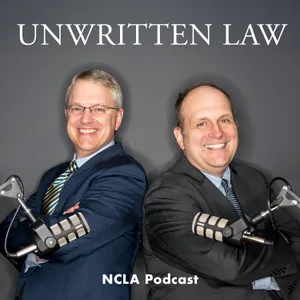
Unwritten Law is a podcast hosted by Mark Chenoweth and John Vecchione, brought to you by the New Civil Liberties Alliance (NCLA). This show dives deep into the world of unlawful administrative power, exposing how bureaucrats operate outside the bounds of written law through informal guidance, regulatory “dark matter,” and unconstitutional agency overreach.
Latest Episodes
The most recent episodes — sign up to get AI-powered summaries of each one.
- Yesterday18 min
Who Can Challenge the White House Ballroom?
The Supreme Court has allowed construction of the new White House ballroom to continue—but the Court's 5–4 decision turned largely on a threshold question: Who actually has standing to challenge it?On this episode of Unwritten Law, NCLA Senior Litigation Counsel John Vecchione is joined by NCLA Staff Attorney Andreia Trifoi to break down National Park Service v. National Trust for Historic Preservation in the United States.The National Trust sued over the demolition and replacement of the White House East Wing. A lower court blocked above-ground construction, but the Supreme Court has now stayed that injunction, concluding that the Trust is likely to lack Article III standing. Its theory rested on a member who argued that the new ballroom would injure her aesthetic, cultural, and historical interests when she viewed the White House. John and Andreia discuss why the Court rejected that theory, how the decision fits with decades of environmental standing cases, and the unusual 5–4 split—with Chief Justice Roberts joining Justices Sotomayor, Kagan, and Jackson in dissent.They also tackle the question lurking beneath the standing fight: If Congress—not a preservation group—has the strongest claim to challenge the project, why hasn't Congress acted?
- 6 days ago33 min
NCLA Asks SCOTUS to Rein In the SEC
Can the SEC force someone to give up money when it cannot identify a single harmed investor?NCLA is asking the Supreme Court to take Spartan Securities Group v. SEC, a case that has been winding through the courts for years and now presents two significant questions about the reach of federal securities law.NCLA President and Chief Legal Officer Mark Chenoweth and Senior Litigation Counsel John Vecchione are joined by Senior Litigation Counsel Kara McKenna Rollins, who has worked on the case since 2019.After a 14-count SEC complaint, NCLA’s clients were found not liable on 13 counts. The remaining dispute has now reached the Supreme Court, where NCLA is challenging both the scope of securities-fraud liability and the SEC’s use of disgorgement.First, NCLA argues that statements made privately to FINRA and the Depository Trust Company cannot be treated as statements made “in connection with” the purchase or sale of securities when there is no evidence any investor ever saw or heard them. Second, NCLA argues that traditional equitable principles do not allow the SEC to obtain disgorgement when there are no harmed investors and the money instead goes to the U.S. Treasury.Mark, John, and Kara explain why the case could give the Supreme Court an opportunity to clarify important limits on SEC enforcement—and resolve a question that has been developing in the lower courts for nearly a decade.
- 2 weeks ago19 min
60 Years Without Congressional Authorization
For roughly 60 years, the Department of Labor’s Office of Federal Contract Compliance Programs enforced a sweeping regulatory regime governing federal contractors—one rooted largely in presidential executive orders rather than laws passed by Congress.Now, the Department of Labor has acknowledged that much of that regime lacked statutory authority.In this episode of Unwritten Law, NCLA President and Chief Legal Officer Mark Chenoweth and Senior Litigation Counsel John Vecchione are joined by Senior Litigation Counsel Kara Rollins to discuss a major change at OFCCP and NCLA’s role in bringing it about.Kara explains how OFCCP’s regulatory system developed from Executive Order 11246 and expanded over decades, imposing requirements on companies that do business with the federal government. NCLA has argued that executive orders cannot substitute for congressional authorization when the government imposes binding legal obligations.After Executive Order 11246 was revoked, the Department of Labor reconsidered its implementing regulations. NCLA submitted comments urging the Department not merely to rescind the regulations, but to acknowledge that much of the regime lacked statutory authority in the first place. The Department’s final action embraces that central argument while preserving OFCCP’s enforcement of requirements that do have statutory foundations, including protections concerning veterans and individuals with disabilities.Mark, John, and Kara discuss what this means for federal contractors, why Congress—not the executive branch—must make the law, and how participating in the public-comment process can actually influence federal policy.As Mark puts it, this 60-year regulatory regime is “Exhibit A” for Unwritten Law.
- 2 weeks ago16 min
Why Is Washington Tracking Crabbers 24/7?
In this episode of Unwritten Law, NCLA Senior Litigation Counsel John Vecchione is joined by NCLA General Counsel Zhonette Brown to discuss Franey v. Washington Department of Fish and Wildlife, NCLA’s challenge to Washington State’s warrantless surveillance of commercial crabbers.Washington requires commercial crabbers to install government-mandated tracking equipment on their boats. Once crab pots are placed in the water, the government tracks the vessel continuously—every minute—even when the crabbers are back at port or using their boats for activities completely unrelated to fishing. The resulting location information is stored in a government database. John and Zhonette explain why NCLA argues this surveillance violates the Fourth Amendment and Washington State Constitution’s protections against unreasonable searches. They also discuss NCLA’s takings claims, the state’s requirement that crabbers place tracking equipment on their private property, and why the Washington Department of Fish and Wildlife lacks statutory authority to impose the mandate. The episode also examines the broader implications of cheap, persistent electronic surveillance. As technology makes it easier for government to track people continuously and store that information indefinitely, John and Zhonette discuss why constitutional protections for privacy become more—not less—important. NCLA has moved for summary judgment and is seeking to stop Washington from enforcing the tracking requirement against its clients.
- 3 weeks ago17 min
When Regulatory Shortcuts Become the Rule
In this episode of Unwritten Law, NCLA President and Chief Legal Officer Mark Chenoweth and Senior Litigation Counsel John Vecchione discuss the D.C. Circuit’s recent decision in Heroes Technology v. Consumer Product Safety Commission.NCLA challenged a CPSC safety rule affecting infant support cushions. Congress created a streamlined rulemaking process for a limited category of “durable infant or toddler products,” including products such as cribs, playpens, and high chairs. But CPSC used that shortcut to regulate infant support cushions—and potentially thousands of other products that NCLA argues fall well outside the category Congress had in mind.Mark, who served as a CPSC commissioner shortly after Congress created this expedited process, explains why he believes the agency has stretched the law far beyond its original purpose. He and John discuss the D.C. Circuit’s decision upholding the rule, what counts as a “durable” infant product, and why allowing regulators to bypass the normal rulemaking process can have consequences not only for the rule of law, but for consumer safety itself.The conversation also explores regulatory creep, statutory interpretation, and an important lesson for Congress: when lawmakers leave statutory lists open-ended, agencies may find ways to expand exceptions far beyond their intended scope.
- 3 weeks ago26 min
Should Federal Judges Get to Pick Federal Prosecutors?
In this episode of Unwritten Law, NCLA President and Chief Legal Officer Mark Chenoweth and Senior Litigation Counsel John Vecchione are joined by Senior Litigation Counsel Jacob Huebert to discuss NCLA’s amicus brief in Rogoff v. Trump, a case raising an unusual separation-of-powers question: Should federal judges be allowed to appoint the U.S. attorneys who prosecute cases in their own courts?Federal law allows a district court to appoint a U.S. attorney when a temporary appointment expires without Senate confirmation. That practice dates back to the Civil War era. But NCLA argues that it conflicts with the Constitution’s separation of powers and the Appointments Clause. U.S. attorneys exercise substantial executive authority, deciding whom to prosecute, what charges to bring, and which enforcement priorities to pursue. NCLA argues that officials wielding that kind of power should not be selected by judges. Jacob explains why NCLA argues U.S. attorneys are principal officers who must be nominated by the President and confirmed by the Senate—and why cross-branch appointments would remain constitutionally problematic even if they are considered inferior officers. The discussion also explores judicial independence, the appearance of impartiality when a judge appoints the prosecutor appearing before that court, and the practical consequences of a system increasingly reliant on temporary and court-appointed U.S. attorneys. Mark, John, and Jacob also debate the other issue in Rogoff: whether President Trump had the authority to remove the court-appointed U.S. attorney. And they consider whether the court will ever reach the larger—and more interesting—constitutional appointment question.
- Aug 17, 202617 min
BASE Jumping, Bureaucrats, and Criminal Law
In this episode of Unwritten Law, NCLA Senior Litigation Counsel John Vecchione is joined by Litigation Counsel Casey Norman to discuss NCLA’s appeal in BASE Access v. National Park Service, now before the U.S. Court of Appeals for the Fifth Circuit.For decades, the National Park Service has treated BASE jumping as a federal crime in national parks. But Congress never passed a law specifically criminalizing BASE jumping. Instead, the Park Service relies on a 1965 regulation prohibiting the “delivery” of people or objects by parachute or other airborne means—a rule adopted roughly 13 years before BASE jumping emerged in the United States. Casey explains NCLA’s argument that Congress unconstitutionally transferred criminal lawmaking power to the executive branch and why the Park Service’s decades-old regulation does not actually apply to people who enter a park normally, climb to a jumping point, and parachute to another location within the park. But before those arguments can even be decided, NCLA must overcome the district court’s ruling that the BASE jumpers lack standing. The court concluded that a pre-enforcement challenge requires an interest in exercising a specific constitutional right—even though several plaintiffs have previously been prosecuted for BASE jumping and want to do it again. Casey explains why NCLA says that standard would effectively force Americans to break the law, risk prosecution, and potentially go to prison before they can challenge an unconstitutional criminal prohibition. John and Casey also discuss NCLA’s Fifth Amendment vagueness and Administrative Procedure Act claims, the Park Service’s refusal to conduct the planning process it says is necessary to permit BASE jumping, and why NCLA is asking the Fifth Circuit to revive the case.
- Aug 14, 202615 min
Education Is Speech: NCLA's Groundbreaking Case for Parental Choice
In this episode of Unwritten Law, NCLA Senior Litigation Counsel John Vecchione is joined by NCLA General Counsel Zhonette Brown to discuss Jacobsen v. Spellerberg, NCLA's newly filed lawsuit advancing a groundbreaking First Amendment argument: education is speech, and parents have a constitutional right to choose the educational speech provided to their children.Nebraska requires parents to educate their children while directing substantial public funding exclusively toward the state's public-school system. Parents who choose homeschooling or private education because they disagree with the messages conveyed in public schools must bear those costs themselves while continuing to support the public system. NCLA argues that this amounts to viewpoint discrimination and imposes an unconstitutional condition on parents who exercise their First Amendment rights.Zhonette explains the legal theory developed by NCLA founder Philip Hamburger, the families challenging Nebraska's system, and the century-old Supreme Court precedents recognizing parents' authority to direct their children's education. She and John also discuss what NCLA is asking the court to do and how a victory could expand educational choice in Nebraska.Show NotesPublic Schools Shouldn’t Be Fiefdoms of Government Speech — Philip Hamburger, National ReviewNew NCLA Lawsuit: Nebraska’s Educational Scheme Violates Parents’ Free SpeechEducation Is Speech: Parental Free Speech in Education — Philip Hamburger, Texas Law Review
About Unwritten Law
Unwritten Law is a podcast hosted by Mark Chenoweth and John Vecchione, brought to you by the New Civil Liberties Alliance (NCLA). This show dives deep into the world of unlawful administrative power, exposing how bureaucrats operate outside the bounds of written law through informal guidance, regulatory “dark matter,” and unconstitutional agency overreach.
Customized Recaps
AI-powered recaps with compact key takeaways, quotes, and insights.
Straight to Your Inbox
Get key takeaways from Unwritten Law in a 5-minute read.
Save Hours Every Week
Stay current on your favorite podcasts without falling behind.
Frequently Asked Questions
What is Podzilla's Unwritten Law daily summary?
It's a free AI-powered email that summarizes new episodes of Unwritten Law as soon as they're published. You get the key takeaways, notable quotes, and links & mentions — all in a quick read.
How does the Unwritten Law podcast summary work?
When a new episode drops, our AI transcribes and analyzes it, then generates a personalized summary tailored to your interests and profession. It's delivered to your inbox every morning.
Is this an official Unwritten Law product?
No. Podzilla is an independent service that summarizes publicly available podcast content. We're not affiliated with or endorsed by New Civil Liberties Alliance.
Can I get summaries of other podcasts too?
Absolutely! The free plan covers up to 3 podcasts. Upgrade to Pro for 15, or Premium for 50. Browse our full catalog at /podcasts.
What topics does Unwritten Law cover?
Unwritten Law covers topics including News, Business, Government, Politics. Our AI identifies the specific themes in each episode and highlights what matters most to you.
Start getting Unwritten Law summaries tomorrow morning.
Free forever for up to 3 podcasts. No credit card required.
Free forever for up to 3 podcasts. No credit card required.