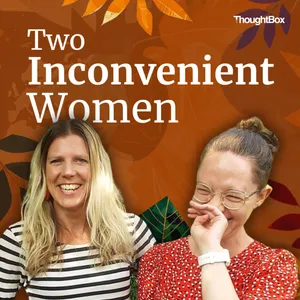
Free Daily Podcast Summary
Two Inconvenient Women: Daily Summaries Delivered
by ThoughtBox Education
Get key takeaways, quotes, and insights from Two Inconvenient Women in a 5-minute read. Delivered straight to your inbox.
Latest Episodes
The most recent episodes — sign up to get AI-powered summaries of each one.
- 4 days ago1h 4m
What does systems change look like from the inside out?
Whilst systems-change, systems-thinking and systems-transformation are becoming much more common terms used in conversations these days, discussions around 'inner systems change' are only just beginning to emerge in more public discourse. When we start to focus on systems change from the inside out, it is an invitation into introspection and exploring some of the habits, mindsets, behaviours and thought patterns that may be keeping us stuck in external behaviours contributing to many of the crises we face. This sort of 'inner work' - as it is often coined - can feel overwhelming, yet offers a doorway into profound change in the wider world as well as within ourselves, and begins by simply paying attention.In this week's episode we dive into the connections between inner and outer systems transformation, with the appreciation that how we think, feel and connect with the world shapes our outward actions. We talk about our own personal journeys, struggles and growth points in the journey of systems change, and how the Triple WellBeing approach that sits at the heart of ThoughtBox is an invitation to be working from the inside out and outside in at the same time.In this episode we reference the following:Theory U - The Presencing Institute / Otto Scharmer (book & website)Thinking in Systems - Donella Meadows (book)The work of Joanna Macy (website / books)Impossible Choices - Gregory Bateson (article)Warm Data - Nora Bateson (website)The Triple WellBeing Framework (PDF / website) Hosted on Acast. See acast.com/privacy for more information.
- 1 weeks ago51 min
Is self-awareness a skill we all need more of?
"Know thyself" is often cited as the foundation of philosophy and self-awareness. Yet what does this mean? How can we 'know ourselves' and where might this journey of exploration begin and end?In this week's episode, we explore the quality of self-awareness, thinking about why this level of conscious awareness is more needed than ever in our world. From exploring the qualities that make up the 'self' (e.g. mind, body, heart, soul) to the journey to find our core essence, this conversation meanders to the depths and back of the human experience, touching upon some of the key practices, tools, approaches and inquiries we can take to become more self-aware and, as a result, more consciously connected to the world around us.In this episode we reference the following:Atlas of the Heart - Brene Brown (book)Triple WellBeing practice cards - ThoughtBox (card deck)The Medicine Wheel - ancient indigenous map (website)Watching the English - Kate Fox (book)The Power of Now - Eckhart Tolle (book)Neuroplasticity in action - Sentis (video)NVC - The Centre for Non-Violent Communication (website)The Guesthouse - Jalāl al-Dīn Muḥammad Rūmī (poem) Hosted on Acast. See acast.com/privacy for more information.
- 2 weeks ago1h 7m
What's the point of school?
Whilst many different models of schooling have evolved across recent history, the predominant mainstream model of school which has prevalence in countries and cultures across the world (spread through colonial history, missionaries and the rapid onset of a globalised world) remains deeply problematic. As the world rapidly changes around us, this structure remains designed around an archaic framing in a world far different from the one we're now living in. So what is the point of school? In this conversation we ask this question from several vantage points: What was the point of school when it was first designed? What is the point of school in our current context? What might the point of school be for the world we're moving into? By diving into each of these questions, we take time to better understand some of the constraints and limitations within the contexts of school which continue to shape the challenges being faced in our current contexts. This week's conversation dives into some of the deep complexities being faced in our current schooling system; zooming out to understand the parameters of limitation and opportunities for evolution and engages with many of the alternative pathways for an education transformation happening across the world.In this episode we reference the following:Changing Education Paradigms - Ken Robinson (RSA Animation)The Factory of Memory - Richard Hames / The Hames Report (substack)Person School Report 2026 (PDF)The Story of Triple WellBeing - Rachel Musson (Ebook) Hosted on Acast. See acast.com/privacy for more information.
- 3 weeks ago54 min
Why is being inconvenient becoming increasingly important?
One of the foundational premises that underpins the work of ThoughtBox is our inconvenience. We're an organisation that questions the status quo; that raises a hand in conversations to ask the vital question: "Why?"; the folks who appreciate that there are always other stories to be heard, to listen to and to perhaps follow instead. It's not easy being inconvenient - it's often quite a lonely place, but it is a place that allows us to do what is right, not what is easy. It takes courage, conviction and a lot of energy - and the recognition that the more of us there are being inconvenient, the more likely we are to turn the tide towards a more health-ful way of living together.In this episode we shine a light on some of the reasons for standing up for the moral injury of these times and how becoming inconvenient can be both liberating and energising in the work ahead. We are (excitedly!) launching in this episode The Inconvenient Club: a place for all of you out there who also question the status-quo to come join us and be part of a movement of inconvenience.In this episode we reference the following:The Inconvenient Club - membership club (website)Moral injury (website definition)A profession built on hope, strained by loss - Rhett Ayers Butler (article) Hosted on Acast. See acast.com/privacy for more information.
- Apr 17, 20261h 6m
THROWBACK EPSIODE: How do we heal our broken world?
RE-LISTEN: This episode was recorded in October 2025.A painful truth in our current cultures is how much we are all struggling with our mental and emotional wellbeing. This is especially true in young people who are facing an increasing amount of overwhelm in their lives in this VUCA* world (*volatile, uncertain, complex and ambiguous). And yet the ways of suffering and the ways of wellbeing are actually two sides of the same coin...Holly and Rachel are just back from Europe's largest trauma, mental health and wellbeing conference hosted at Oxford University, under the title 'Healing our relational world'. Bringing together over 3000 educators, therapists, mental health practitioners and healers with world-renowned trauma and emotional health experts, the conference was an extraordinarily rich and deep insight and exploration of how to heal our connection with ourselves, each other and the wider world.In this episode we dive deeply into some of the 'brokenness' of our world (our inner and outer worlds) bringing in our own decade of research along with learnings from the conference. We look at some of the patterns in human behaviours that connect all of these elements of brokenness to better understand how to notice them and how to heal. We explore the impact of early attachment on shaping our relationships and the profound ways of healing in ourselves, our communities and with the planet. We touch on how the ways to respond to the symptoms and root causes of disconnection are the same and explore the foundational routes to healing.In this episode we reference the following:Dr Dan Siegel - professor (website)Dr Bessel van der Kolk - psychiatrist (website)Dr Richard Shwartz - therapist, author (website)Linda Thai - trauma therapist (website)Interpersonal Neurobiology - Dan Siegel (video)The Body Keeps The Score - Bessel van der Kolk (book / website)Internal Family Systems - Dr Richard Shwartz (website) Hosted on Acast. See acast.com/privacy for more information.
- Apr 10, 202659 min
THROWBACK EPISODE: The inconvenience of joy
THROWBACK EPISODE: This podcast was first recorded in July 2025“I will never apologise for embracing joy and beauty - even when the world is falling apart – for joy and beauty are the fuel for my activism”. These words by Karen Walrond are one of the inspirations for this week’s conversation on 'Joy', exploring how cultivating joy is both a way to resource ourselves and build the resilience needed to meet the challenges of our world. Joy is often seen as being the same thing as happiness, and yet these two emotions are profoundly different; one coming from external sources, one being cultivated from within. It is not a surprise that the practice of joy is embedded into all world religions as it can become a deeply spiritual practice – as well as a beautifully infectious state to find ourselves in.In this week's conversation we dive into the meaning of joy, how it shows up in our lives; how activists across history have cultivated joy in their lives and work and what happens when we learn to practice joy as part of our daily rhythms.In this episode we reference the following:Mission: Joy – Dalai Lama & Desmond Tutu (video)Habits for practising joy - ThoughtBox (PDF)Seeking Language Large Enough – David Whyte / On Being (podcast)Climate Courage Campaign – Climate Majority Project (website)Joy Over Fear – St Ebbe’s School (website)Schools of Dreams - Kimberley Oliff Cooper TEDx Talk (video)The Fun Habit - Mike Rucker (book)Glorious – MaMuse (Rachel’s current favourite joyful song) Hosted on Acast. See acast.com/privacy for more information.
- Apr 3, 20261h 14m
Why is the wisdom of children's books so relevant right now?
All of us are former children and for most have memories of some of the stories we read or were told when we were children. As adults, many of us still encounter these stories - whether from reading to young ones or for our own enjoyment. As a medium, children's stories are doing more than just keeping young people entertained - they are pathways for growth; helping to navigate some of the challenges, hurdles and opportunities of life in a safe and supported way. When starting to explore why storytelling is a foundation stone for human evolution, our entire understanding of children's stories can begin to expand. As former English teachers, Holly and Rachel have read and taught a lot of fiction to younger readers and we both are avid readers of children's stories, advocating the deep wisdom to be found in many classic texts, no matter our age. In this conversation we explore the why, what and how of the values and constructs of children's fiction; explore how myth and storytelling has passed down through human history; think about the impact of films on story learning and reflect on some of the wisdom of key classic texts across the world. In this episode, we mention:Why You Should Read Children's Books, Even Though You Are So Old and Wise - Katherine Rundell (article)C. S. Lewis on Writing For Children - CS Lewis (article)Meister Eckhart's Book of Darkness & Light: Meditations on the Path of the Wayless Way - Jon M. Sweeney, Mark S. Burrows and Meister Eckhart (book)The Death of the Author - Roland Barthes (book)Triple WellBeing Storybooks - Rachel Musson & Alex Brenan (storybooks) Hosted on Acast. See acast.com/privacy for more information.
- Mar 27, 202659 min
Are our 'social contracts' falling apart and what does that mean for society?
The concept of social contracts in modern culture came through the work and philosophies of folks such as Thomas Hobbes, John Locke and Jean-Jacques Rousseau as a way of communities agreeing to behave and trust in collective ideals. Whilst intentions may be valid, the structures of this imposed model of organising communities falls down when trust is broken - and we're finding ourselves in that state of collapse in many countries and societies around the world. Which has the potential to open up different ways of belonging and living alongside one another - ways that come not from an imposed and centralised narrative, but that actually work within the contexts and communities we live in. In this week's episode we talk about the impact of the social contract falling away, and the reneging of social promise in many parts of our societies. We discuss where trust comes into the equation and explore models across our human story that shine a light on more robust and localised ways of building resilient and healthy communities. During the conversation we reference the following:The Social Contract - Jean-Jacques Rousseau (PDF)Local Futures (website and movement)The real Lord of the Flies - Rucker Bregnan (article)Beyond Civilisation - Daniel Quinn (PDF)Transforming Leadership - online short course (website) Hosted on Acast. See acast.com/privacy for more information.
Get Two Inconvenient Women summaries in your inbox
Free AI-powered daily recaps. Key takeaways, quotes, and mentions — in a 5-minute read.
Get Free Summaries →Free forever for up to 3 podcasts. No credit card required.
You Might Also Like
Listeners also like.

No Offence, But…
No Offence, But…
The Curious Introvert
Meredith Hackwith Edwards
Inquiring Minds
Indre Viskontas

Make Discomfort Your B*tch
Cher Anderton
Living in the Matrix
Jonathan Brink & Rich Goulette
Stories of Change & Creativity
Professor Judy Oskam
The Story Box
Jay Fantom
DangerMouth: The Innovation Station
Mike Conroy
Everyday Spirituality
Monique Lindner
WeBeTheChange: Conversations with Evolutionaries
Colleen Akiko
All That We Are
Amisha Tala Oak / Amisha Ghadiali
Back2Different
Mac Bogert
About Two Inconvenient Women
In a world which can feel increasingly volatile and uncertain, join Holly and Rachel from ThoughtBox as we explore some of the inconvenient truths, possibilities and opportunities of our rapidly changing world.Each episode we’ll be diving deep into the big, tricky issues of our time, exploring what it means to be ‘inconvenient’ in our work to transform lives, communities and mindsets towards a healthier future for people and planet.To find out more about the work we do at ThoughtBox Education, visit www.thoughtboxeducation.com. Hosted on Acast. See acast.com/privacy for more information.
Customized Recaps
AI-powered recaps with compact key takeaways, quotes, and insights.
Straight to Your Inbox
Get key takeaways from Two Inconvenient Women in a 5-minute read.
Save Hours Every Week
Stay current on your favorite podcasts without falling behind.
Frequently Asked Questions
What is Podzilla's Two Inconvenient Women daily summary?
It's a free AI-powered email that summarizes new episodes of Two Inconvenient Women as soon as they're published. You get the key takeaways, notable quotes, and links & mentions — all in a quick read.
How does the Two Inconvenient Women podcast summary work?
When a new episode drops, our AI transcribes and analyzes it, then generates a personalized summary tailored to your interests and profession. It's delivered to your inbox every morning.
Is this an official Two Inconvenient Women product?
No. Podzilla is an independent service that summarizes publicly available podcast content. We're not affiliated with or endorsed by ThoughtBox Education.
Can I get summaries of other podcasts too?
Absolutely! The free plan covers up to 3 podcasts. Upgrade to Pro for 15, or Premium for 50. Browse our full catalog at /podcasts.
How often does Two Inconvenient Women release new episodes?
Two Inconvenient Women publishes weekly. Our AI generates a summary within hours of each new episode.
What topics does Two Inconvenient Women cover?
Two Inconvenient Women covers topics including Science, Education, Fitness, Nature, Health & Fitness, Mental Health. Our AI identifies the specific themes in each episode and highlights what matters most to you.
Start getting Two Inconvenient Women summaries tomorrow morning.
Free forever for up to 3 podcasts. No credit card required.
Free forever for up to 3 podcasts. No credit card required.