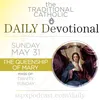
It's the Feast of Trinity Sunday, 1st Class, with the color of White. In this episode: the meditation: "The Mystery of the Trinity", today's news from the Church: "Rest in Peace, Fr. Dreher", and today's thought from the Archbishop Marcel Lefebvre. Have feedback or questions about the DD or our other shows? podcast@sspx.org Sources Used Today: "The Mystery of the Trinity" — Eastertide Day by Dayhttps://angeluspress.org/products/eastertide-day-by-day "Rest in Peace, Fr. Dreher" (FSSPX.news) https://sspx.org/en/news/rest-peace-fr-dreher-59395 The Spiritual Life — Archbishop Marcel Lefebvre (Angelus Press) https://angeluspress.org/products/spiritual-life-archbishop Please support our new project, the Archbishop Lefebvre Biography Audiobook! Learn more:https://www.youtube.com/watch?v=Y-Wp4MQdK2oDonate:https://sspx.gifts/audiobook The Feast of the Queenship of Mary celebrates a title that Christians have given to the Blessed Virgin for many centuries: Mary as Queen of Heaven and Earth. While the feast itself is relatively recent in the Church’s calendar, the belief behind it reaches back to the earliest centuries of Christianity. The foundation of this title is found in Mary's unique relationship to Christ. The Church teaches that Jesus is not only the Savior, but also the King of Kings. In the ancient kingdoms of Israel, the king's mother held a special position of honor as queen mother, interceding for the people before her son. The early Christians saw this as a foreshadowing of the Blessed Virgin Mary. If Christ reigns forever as the Son of David, then Mary, His mother, shares in a unique way in His royal dignity. The earliest Christian writers and hymnographers frequently referred to Mary with royal titles. By the fourth and fifth centuries, saints and theologians were already calling her "Lady," "Sovereign," and "Queen." In the Eastern Church especially, hymns praised her as the Queen standing beside the heavenly King. During the Middle Ages, devotion to Mary's queenship became deeply woven into Catholic spirituality. The familiar prayer Salve Regina ("Hail, Holy Queen"), composed around the eleventh century, helped spread the title throughout the Christian world. The feast itself has a more recent history. In 1954, following the Marian Year that commemorated the centenary of the definition of the Immaculate Conception, Pope Pius XII established the Feast of the Queenship of Mary through his encyclical Ad Caeli Reginam. At a time when many nations were abandoning Christian principles and political ideologies were challenging the social kingship of Christ, Pius XII wished to emphasize Mary's royal dignity and her role in leading souls to her Son. Originally, the feast was celebrated on May 31, closing the month traditionally dedicated to Our Lady. Following the calendar revisions after the Second Vatican Council, it was moved to August 22, the octave day of the Assumption, highlighting the connection between Mary's being assumed into heaven and her crowning as Queen. Throughout Catholic history, artists have depicted the Coronation of Mary as Queen of Heaven, and countless churches, shrines, and religious orders have been dedicated under this title. The Fifth Glorious Mystery of the Rosary likewise invites the faithful to contemplate her heavenly coronation. The Feast of the Queenship of Mary reminds Catholics that the Mother of Christ reigns not as a worldly ruler, but as a loving Queen who intercedes for her children and leads them to the eternal kingdom of her Son. Holy Mary, Que
Podzilla Summary coming soon
Sign up to get notified when the full AI-powered summary is ready.
Free forever for up to 3 podcasts. No credit card required.
Listen to This Episode
Get summaries like this every morning.
Free AI-powered recaps of Traditional Catholic Daily Devotional and your other favorite podcasts, delivered to your inbox.
Free forever for up to 3 podcasts. No credit card required.