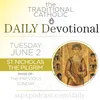
It's a Feria, 4th Class, with the color of Green. In this episode: the meditation: "The Trinity: Model of Charity", today's news from the Church: "Sacraments for the Church", and today's thought from the Archbishop Marcel Lefebvre. Have feedback or questions about the DD or our other shows? podcast@sspx.org Sources Used Today: "The Trinity: Model of Charity" — Eastertide Day by Dayhttps://angeluspress.org/products/eastertide-day-by-day "Sacraments for the Church" (FSSPX.news) https://fsspx.news/en/news/sacraments-church-59351 The Spiritual Life — Archbishop Marcel Lefebvre (Angelus Press) https://angeluspress.org/products/spiritual-life-archbishop Please support our new project, the Archbishop Lefebvre Biography Audiobook! Learn more:https://www.youtube.com/watch?v=Y-Wp4MQdK2oDonate:https://sspx.gifts/audiobook Saint Nicholas Peregrinus, also known as Nicholas the Pilgrim, is one of the most unusual saints of the Middle Ages. Unlike many saints who spent their lives in monasteries or positions of leadership, Nicholas was known for his simplicity, his constant pilgrimage, and his burning devotion to the Holy Name of Jesus. He was born around the year 1075 in Greece, likely in the region of Epirus, and from a young age displayed an intense love for God that often appeared strange to those around him. As a teenager, Nicholas embraced a life of wandering pilgrimage. Carrying little more than the clothes on his back, he traveled from place to place, constantly repeating the prayer, "Kyrie eleison" – "Lord, have mercy." He would chant these words in the streets, on the roads, and among crowds, urging people to remember God and seek His mercy. Many considered him foolish or eccentric. Some mocked him, while others viewed him with suspicion. Yet beneath his unusual behavior was a profound love of God and a desire to call souls to prayer. Nicholas eventually crossed the Adriatic Sea and arrived in southern Italy. There, he continued his life of pilgrimage, walking through towns and villages while encouraging people to turn their hearts toward God. Though he possessed no wealth, learning, or social position, his sincerity and holiness gradually won the respect of those who encountered him. He finally arrived in the city of Trani, where his earthly pilgrimage came to an end. Nicholas died in 1094 at only nineteen years of age. Yet almost immediately after his death, reports of miracles began to spread. The people of Trani quickly recognized the sanctity of the young pilgrim they had come to know and love, and devotion to him grew rapidly throughout the region. The Church honors Saint Nicholas Peregrinus as a reminder that holiness often appears in unexpected forms. His life demonstrates that God sometimes chooses the simple and overlooked to proclaim important spiritual truths. Though he left behind no writings and founded no religious order, his witness of prayer, humility, and devotion touched countless lives. Devotion to Saint Nicholas remains especially strong in Trani, where he is honored as the city's patron saint. His feast day on June 2 is celebrated with processions, prayers, and local festivities. For modern Catholics, Nicholas offers a powerful reminder that the Christian life itself is a pilgrimage toward heaven, and that the simplest prayer, faithfully repeated, can draw a soul ever closer to God. Saint Nicholas Peregrinus, humble pilgrim and faithful servant of Christ, pray for us. <a href="https://sspx.gifts/collections/frontpage/products/sspx-podcast" target="_
Podzilla Summary coming soon
Sign up to get notified when the full AI-powered summary is ready.
Free forever for up to 3 podcasts. No credit card required.
Listen to This Episode



Get summaries like this every morning.
Free AI-powered recaps of Traditional Catholic Daily Devotional and your other favorite podcasts, delivered to your inbox.
Free forever for up to 3 podcasts. No credit card required.