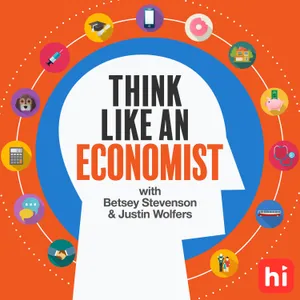
Free Daily Podcast Summary
Platypus Economics with Justin Wolfers: Daily Summaries Delivered
by Betsey Stevenson & Justin Wolfers
From world events to everyday decisions, economics explains it all. Platypus Economics makes it clear, useful, and actually fun.
Latest Episodes
The most recent episodes — sign up to get AI-powered summaries of each one.
- Yesterday58 min
The Fed Raised Rates. Here's What It's Fighting. | Off The Clock
The Fed just raised rates unanimously — and Justin Wolfers explains why that 12-0 vote matters more than the rate itself. Joined by Bloomberg Businessweek's Stacey Vanek-Smith on Off The Clock, Justin unpacks what "Silent Kevin" Warsh actually signaled, why the president's dream of 1% interest rates would light a fire under inflation, and why even a government that repays its debts can end up unable to borrow again.Then, Justin and Stacey debate whether "the feelings are the data," and Stacey builds the whole global economy into one bacon cheeseburger.Finally, Justin turns thousands of YouTube comments into a data set to show Americans something the U.S. media keeps missing: just how angry Canadians are, and why they'll accept real economic pain.Subscribe:on YouTube 👉 https://youtube.com/platypuseconomicson Substack 👉 https://newsletter.platypuseconomics.comthe Podcast 👉 https://platypuseconomics.com/podcastFollow on Social Media @PlatypusEconomics and @JustinWolfers
- 2 days ago18 min
The Hawk Behind The Hike | The Professor Is In
The Fed just raised its target rate by a quarter of a percentage point, the first hike since 2023 — but Justin Wolfers argues the number on the front page isn't the real story. In this episode of The Professor Is In, producer Augusta Chapman brings you audience questions, and Justin explains why the bigger signal was new Fed chair Kevin Warsh convincing markets he's a genuine inflation hawk.Subscribe:on YouTube 👉 https://youtube.com/platypuseconomicson Substack 👉 https://newsletter.platypuseconomics.comthe Podcast 👉 https://platypuseconomics.com/podcastFollow on Social Media @PlatypusEconomics and @JustinWolfers
- 4 days ago13 min
Understanding The Fed’s Rate Hike Decision | Diving In
Understanding The Fed’s Rate Hike Decision | Diving InThe Federal Reserve raised interest rates on Wednesday by a quarter of a percentage point. It’s the first time the Central Bank upped rates since July, 2023.All 12 members of the Federal Open Market Committee, including Fed Chair Kevin Warsh, voted in favor of a rate hike. Justin Wolfers, professor of economics and founder of Platypus Economics, breaks down the Fed’s decision, and unpacks how it’ll impact your life.Subscribe:on YouTube 👉 https://youtube.com/platypuseconomicson Substack 👉 https://newsletter.platypuseconomics.comon Apple Podcasts 👉 https://podcasts.apple.com/us/podcast/platypus-economics-with-justin-wolfers/id1523898793on Spotify 👉 https://open.spotify.com/show/4sOVMPFJmCROADLMDdDwjsFollow on Social Media @PlatypusEconomics and @JustinWolfers
- 6 days ago20 min
The Canadian Boycott is About More than Economics | The Professor Is In
Why an "infinity percent" tariff on Canada may hurt Americans more than Canadians.The U.S.–Canada trade war just got weirder, and Justin Wolfers walks through what actually changed. After Canada answered Washington's tariffs with a measured, dollar-for-dollar response, the White House escalated again. They proposed an outright import ban on things like Canadian alcohol, dairy, and auto products. His point: banning a product punishes the American buyers who wanted it most and now can't get it at any price.That’s not the only way Americans are getting hurt. Canadian consumers are boycotting anything U.S. You can see it in the empty hotel rooms in Las Vegas and half-full convention centers. Canadians are "speaking from their heart" about sovereignty and dignity. No handshake between leaders will make that disappear.Why should you care? Because the price of the clowning around lands in your pocket. This could look like a lost bonus, a thinner paycheck, or your employer's shrinking income. If Canada decides it can't trust its neighbor and diversifies toward Europe and Asia, that shift outlasts any single election.Chapters:0:00 Jazz hands and an update1:00 What's changed since the last video3:19 Meet the "infinity percent" tariff4:30 Why a ban punishes American buyers5:30 Do consumer boycotts actually work?9:07 The real cost is the clowning around11:07 How big a hit is this, really?12:10 Should Canada diversify away from the U.S.?Subscribe — it's the one relationship with the U.S. that comes with zero tariffs:on YouTube 👉 https://youtube.com/platypuseconomicson Substack 👉 https://newsletter.platypuseconomics.comFollow on Social Media @PlatypusEconomics and @JustinWolfers
- 1 weeks ago50 min
The Hidden Link Between Government Debt and Everyday Credit | Off the Clock
Why does the bond market matter more than the stock market for your wallet? Justin Wolfers and Bloomberg Businessweek columnist Stacey Vanek Smith take on August's inflation report, the rising odds the Fed hikes rates, and the one market that quietly sets the price of your car loan, your student loan, and your mortgage.Subscribe — it's the one interest rate that never rockets up on you:on YouTube 👉 https://youtube.com/platypuseconomicson Substack 👉 https://newsletter.platypuseconomics.comFollow on Social Media @PlatypusEconomics and @JustinWolfers
- 1 weeks ago14 min
What August’s Inflation Report Means for You
Inflation is stuck at 3.4% and prices are outrunning your paycheck. Here's what August really showed.The August inflation report just landed, and Justin Wolfers walks you through what it means for your wallet. Plus the all-important burrito price index.Subscribe — it's the one price that isn't rocketing up this month:on YouTube 👉 https://youtube.com/platypuseconomicson Substack 👉 https://newsletter.platypuseconomics.comFollow on Social Media @PlatypusEconomics and @JustinWolfers
- 1 weeks ago17 min
Vote Republican, Get $5,000? | Diving In
Is the promise real, and who actually pays for it?At a midterm campaign rally Wednesday night, President Trump promised every adult American citizen a $5,000 check, but only if Republicans win both the House and the Senate. He's calling them "Trump dividends."Justin Wolfers is here with a reality check, on Diving In.Subscribe — I'll owe you $5,000, and I promise about as much as the President does:on YouTube 👉 https://youtube.com/platypuseconomicson Substack 👉 https://newsletter.platypuseconomics.comFollow on Social Media @PlatypusEconomics and @JustinWolfers
- 1 weeks ago19 min
How Governments Manipulate Statistics Without Lying | Professor Is In
Can you still trust the jobs numbers after Commerce dropped its ban on political interference?In August the Commerce Department quietly crossed out the rules that shielded official statistics from political meddling — meaning reports can now be delayed, buried, reworded, or stripped of their uncertainty. So can you still trust the numbers that shape your paycheck, your mortgage rate, and the price of your groceries? In this episode of The Professor Is In, Justin Wolfers answers the question a whole audience asked: in light of this, why should we believe the latest jobs numbers?Most useful of all, Justin hands you a rule of thumb for telling independent statistics from political claims — trust the official statistical agencies, be wary of anything from 1600 Pennsylvania Avenue, and remember that someone who lied to you once will lie to you again.Chapters:0:00 An expensive way to make propaganda0:56 Can we still trust the jobs numbers?1:56 Which agencies are actually at risk2:50 Why the jobs data is still protected3:50 How statistics really get manipulated6:22 The one report that was a lie9:11 The tin-pot dictator club10:02 Why propaganda destroys data's value13:12 A rule of thumb for reading statistics15:39 Official agencies vs. 1600 Pennsylvania AveSubscribe — it's one number you can trust to go up honestly:on YouTube 👉 https://www.youtube.com/platypuseconomicson Substack 👉 https://newsletter.platypuseconomics.comFollow on Social Media @PlatypusEconomics and @JustinWolfers
Get Platypus Economics with Justin Wolfers summaries in your inbox
Free AI-powered daily recaps. Key takeaways, quotes, and mentions — in a 5-minute read.
Get Free Summaries →Free forever for up to 3 podcasts. No credit card required.
You Might Also Like
Listeners also like.
Optimist Economy
Economists discuss U.S. economic challenges and practical solutions to improve outcomes for workers, retirees, and aspiring Americans.

Pitchfork Economics with Nick Hanauer
A deep dive into middle-out economics and the shift away from trickle-down policies, featuring leading thinkers and policy experts.
It's The Economy
A weekly breakdown of economic concepts and their real-world impact, explained by experts in short, accessible episodes.
Planet Money
Explains how economic forces influence everyday life and global events through storytelling and deep dives into surprising topics.

Planet Money Summer School
A crash course in economics that teaches fundamental concepts through real-world examples in everyday life.

EconTalk
Long-form conversations on economics, philosophy, history, and human behavior with experts from diverse fields.
Monetary Matters with Jack Farley
Expert interviews exploring macroeconomics, financial markets, and monetary policy.
Trumponomics
A weekly analysis of Donald Trump’s economic policies and their impact on the U.S. and global economy.

The Stacking Benjamins Show
Two friends discuss personal finance, investing, and money trends with humor and expert guests in a casual, accessible way.
The Economics of Everyday Things
Examines the hidden economic forces behind everyday objects and routines.

Freakonomics Radio
Explores the hidden side of everyday phenomena, from human behavior to economic quirks, using data and storytelling.

Patrick Boyle On Finance
Explores quantitative finance, financial markets, and investor strategies through interviews and deep dives into financial history.
About Platypus Economics with Justin Wolfers
From world events to everyday decisions, economics explains it all. Platypus Economics makes it clear, useful, and actually fun.
Customized Recaps
AI-powered recaps with compact key takeaways, quotes, and insights.
Straight to Your Inbox
Get key takeaways from Platypus Economics with Justin Wolfers in a 5-minute read.
Save Hours Every Week
Stay current on your favorite podcasts without falling behind.
Frequently Asked Questions
What is Podzilla's Platypus Economics with Justin Wolfers daily summary?
It's a free AI-powered email that summarizes new episodes of Platypus Economics with Justin Wolfers as soon as they're published. You get the key takeaways, notable quotes, and links & mentions — all in a quick read.
How does the Platypus Economics with Justin Wolfers podcast summary work?
When a new episode drops, our AI transcribes and analyzes it, then generates a personalized summary tailored to your interests and profession. It's delivered to your inbox every morning.
Is this an official Platypus Economics with Justin Wolfers product?
No. Podzilla is an independent service that summarizes publicly available podcast content. We're not affiliated with or endorsed by Betsey Stevenson & Justin Wolfers.
Can I get summaries of other podcasts too?
Absolutely! The free plan covers up to 3 podcasts. Upgrade to Pro for 15, or Premium for 50. Browse our full catalog at /podcasts.
How often does Platypus Economics with Justin Wolfers release new episodes?
Platypus Economics with Justin Wolfers publishes daily. Our AI generates a summary within hours of each new episode.
What topics does Platypus Economics with Justin Wolfers cover?
Platypus Economics with Justin Wolfers covers topics including Science, Education, Business, Courses, Social Sciences. Our AI identifies the specific themes in each episode and highlights what matters most to you.
Start getting Platypus Economics with Justin Wolfers summaries tomorrow morning.
Free forever for up to 3 podcasts. No credit card required.
Free forever for up to 3 podcasts. No credit card required.