Free Daily Podcast Summary
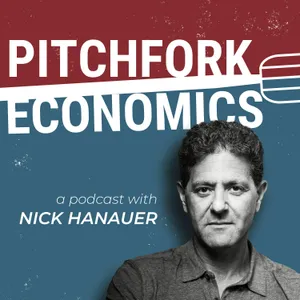
Pitchfork Economics with Nick Hanauer: Daily Summaries Delivered
by Civic Ventures
We are living through a paradigm shift from trickle-down neoliberalism to middle-out economics — a new understanding of who gets what and why. Join zillionaire class-traitor Nick Hanauer and some of the world’s leading economic and political thinkers as they explore the latest thinking on how the economy actually works.
Latest Episodes
The most recent episodes — sign up to get AI-powered summaries of each one.
- 5 days ago42 min
Can We Build a Common Good Economy? (with Mariana Mazzucato)
Economics teaches us to think of markets as natural forces, and government as something that should only intervene when they fail. In her new book, The Common Good Economy: How to Make Capitalism Work for Us All, economist Mariana Mazzucato argues that story is backward. She joins Nick and Goldy to ask what changes when we recognize that markets are choices — shaped by rules, institutions, public investment, and power — and what that means for the kind of economy we could build instead. If we designed this system, can we redesign it? Mariana Mazzucato is a Professor in the Economics of Innovation and Public Value at University College London (UCL) and founding director of the UCL Institute for Innovation and Public Purpose. She is the author of several acclaimed books, including The Entrepreneurial State, The Value of Everything, Mission Economy, The Big Con, and most recently, The Common Good Economy: How to Make Capitalism Work for Us All. Social Media: @mazzucatom.bsky.social @MazzucatoM @mazzucatom Further reading: The Common Good Economy: How to Make Capitalism Work for Us All UCL Institute for Innovation and Public Purpose The Entrepreneurial State Mission Economy: A Moonshot Guide to Changing Capitalism The Big Con The Great Transformation by Karl Polanyi A Mission-Oriented Approach to School Meals Mission-Oriented Public-Private Partnerships: Lessons from the Oxford–AstraZeneca COVID-19 Vaccine Website: http://pitchforkeconomics.com Facebook: Pitchfork Economics Podcast Bluesky: @pitchforkeconomics.bsky.social Instagram: @pitchforkeconomics Threads: pitchforkeconomics TikTok: @pitchfork_econ YouTube: @pitchforkeconomics LinkedIn: Pitchfork Economics Twitter: @PitchforkEcon, @NickHanauer Substack: The Pitch Nick’s Substack: NickHanauer.Substack.com
- 1 weeks ago33 min
The $29 Trillion Social Security Crisis We Already Know How to Fix ( with Rey Fuentes)
Americans are told Social Security is in trouble because there are more retirees and fewer workers to support them. But that story leaves out a major part of the problem: how much income now sits outside the system that funds Social Security. Roosevelt Institute’s Rey Fuentes joins Nick and Goldy to explain how rising inequality, stagnant wages, and an outdated payroll-tax structure helped create Social Security’s looming shortfall — and why benefit cuts are far from inevitable. Plus, Nick puts forward a different way to think about fixing the system — one that starts with a basic question: why should some kinds of income count toward Social Security while others don’t? Rey Fuentes is Director of Strategic Initiatives at the Roosevelt Institute. The $29 trillion figure in this episode’s title refers to Social Security’s projected 75-year unfunded obligation. According to the 2026 Social Security Trustees Report, the combined retirement, survivor, and disability programs are projected to have a $29.3 trillion financing shortfall, measured in present-value dollars, between 2026 and 2100. That is not $29 trillion that comes due when the retirement trust fund is projected to deplete its reserves in 2032. Read the 2026 Social Security Trustees Report Summary Social Media: @rooseveltinstitute.org @rooseveltinst @therooseveltinstitute Further reading: Social Security Doesn’t Need Cuts. The Fiscal Panic Is Missing Where the Money Is 1983 v. 2032: The Economics of the Last and Next Social Security Reform What’s Actually Behind Social Security’s Trust Fund Shortfall “Will Social Security Run Out?” Is the Wrong Question: How Lawmakers Can Protect Beneficiaries and Strengthen OASI “Sound, Needy, and Patriotic Legislation”: Preserving the Fundamental Promises of the Social Security System Website: http://pitchforkeconomics.com Facebook: Pitchfork Economics Podcast Bluesky: @pitchforkeconomics.bsky.social Instagram: @pitchforkeconomics Threads: pitchforkeconomics TikTok: @pitchfork_econ YouTube: @pitchforkeconomics LinkedIn: Pitchfork Economics Twitter: @PitchforkEcon, @NickHanauer Substack: The Pitch Nick’s Substack: NickHanauer.Substack.com
- 2 weeks ago39 min
Profit, Power, and the Crisis of the Common Good (with Sen. Chris Murphy)
Why do so many Americans feel powerless, lonely, and disconnected — and what does that have to do with our economy? Senator Chris Murphy joins Nick and Goldy to discuss his new book, Crisis of the Common Good, which makes the case that America’s political crisis is inseparable from a deeper collapse of power, connection, and shared purpose. They dig into the “cult of profit,” Market Humanism, AI, scarcity, corruption, and the limits of an economy organized around efficiency and extraction. It’s a conversation about what happens when profit becomes the highest measure of success, and what it would mean to build an economy rooted in dignity, connection, and the common good. Senator Chris Murphy is the junior United States Senator for Connecticut Social Media: @chrismurphyct.bsky.social @ChrisMurphyCT Further reading: Crisis of the Common Good: The Fight for Meaning and Connection in a Broken America Watch Nick Debate Obama Admin Economist Jason Furman: NickHanauer.Substack.com Website: http://pitchforkeconomics.com Facebook: Pitchfork Economics Podcast Bluesky: @pitchforkeconomics.bsky.social Instagram: @pitchforkeconomics Threads: pitchforkeconomics YouTube: @pitchforkeconomics LinkedIn: Pitchfork Economics Twitter: @PitchforkEcon, @NickHanauer Substack: The Pitch Nick’s Substack: NickHanauer.Substack.com
- 3 weeks ago42 min
Chains of Command: How Franchising Turned Control Without Responsibility Into a Business Model (with Brian Callaci)
When you walk into a McDonald’s, it looks like one company. But legally, the person making your fries probably doesn’t work for McDonald’s at all. Brian Callaci, Chief Economist at the Open Markets Institute and author of Chains of Command, joins Nick and Goldy to explain how franchising became a blueprint for corporate control without responsibility — shifting risk, liability, and labor costs onto franchisees and workers while profits flow upward. Brian Callaci is the chief economist at the Open Markets Institute and author of Chains of Command: The Rise and Cruel Reign of the Franchise Economy. Social Media: @briancallaci.bsky.social @brian_callaci briancallaci.com Further reading: Chains of Command: The Rise and Cruel Reign of the Franchise Economy Franchise: The Golden Arches in Black America by Marcia Chatelain Sectoral bargaining FAQ: Collective bargaining, sectoral wage and standards boards, and worker power The Founder (2016) Continental T.V., Inc. v. GTE Sylvania, Inc., 433 U.S. 36 (1977) Senate Subcommittee on Antitrust & Monopoly Hearing on Distribution problems affecting small business. Part 1: franchising agreements, March (1965) Website: http://pitchforkeconomics.com Facebook: Pitchfork Economics Podcast Bluesky: @pitchforkeconomics.bsky.social Instagram: @pitchforkeconomics Threads: pitchforkeconomics TikTok: @pitchfork_econ YouTube: @pitchforkeconomics LinkedIn: Pitchfork Economics Twitter: @PitchforkEcon, @NickHanauer Substack: The Pitch
- Aug 18, 202641 min
The Joy of Money (with Carrie Joy Grimes)
Most personal finance advice starts with the same basic premise: you’re doing money wrong. But Carrie Joy Grimes, founder of WorkMoney and author of The Joy of Money, says that misses half the story. Yes, people need real tools to budget, save, pay down debt, and plan for the future. But no amount of discipline can fix an economy where wages are too low, costs are too high, and working people have lost power over the rules that shape their lives. This week, Nick and Goldy talk with Grimes about why money is “math and feelings,” how shame keeps people stuck, why so much financial advice is written for people who already have money, and why the best thing we can do is not teach people to be better at being poor — but build an economy where fewer people are poor in the first place. Carrie Joy Grimes is the founder and CEO of WorkMoney and author of The Joy of Money. Before founding WorkMoney, she spent two decades as a union organizer fighting for higher wages, better benefits, and stronger worker power. Social Media: Carrie Joy Grimes Instagram TikTok YouTube Work Money Instagram TikTok YouTube Twitter Further reading: The Joy of Money: How to Do More With and Feel Better About Your Money—No Matter How Much You Have WorkMoney - Provides free tools, tips, and resources to help people lower their living costs, find financial assistance, and increase their overall income. MoneyFinder - A bill-negotiation service launched by WorkMoney. Website: http://pitchforkeconomics.com Facebook: Pitchfork Economics Podcast Bluesky: @pitchforkeconomics.bsky.social Instagram: @pitchforkeconomics Threads: pitchforkeconomics TikTok: @pitchfork_econ YouTube: @pitchforkeconomics LinkedIn: Pitchfork Economics Twitter: @PitchforkEcon, @NickHanauer Substack: The Pitch
- Aug 11, 202645 min
What Happened to Liberal Democracy (with Nobel Prize-winning economist Daron Acemoglu)
Nobel Prize-winning MIT economist Daron Acemoglu joins Nick and Goldy to discuss his new book, What Happened to Liberal Democracy? Remaking a Politics of Shared Prosperity. They explore why so many people have lost faith in democracy, how inequality and weakened worker power have reshaped politics, and why democracy has to deliver in people’s daily lives. They also dig into AI, automation, and whether new technology will concentrate even more wealth and power — or help build a more prosperous, democratic future. Daron Acemoglu is a Nobel Prize-winning economist and Institute Professor at MIT. He is one of the world’s leading thinkers on political economy, institutions, inequality, technology, and the relationship between democracy and shared prosperity. His books include Why Nations Fail, The Narrow Corridor, and Power and Progress. His new book is What Happened to Liberal Democracy? Remaking a Politics of Shared Prosperity. Social Media: @dacemoglumit.bsky.social @DAcemogluMIT Further reading: What Happened to Liberal Democracy? Remaking a Politics of Shared Prosperity New York Times - Nearly 200 Economists and Tech Leaders Warn of A.I. Threats NBER - Automation and Repression Check out THE BILLIONAIRE AGE on IDEAS Website: http://pitchforkeconomics.com Facebook: Pitchfork Economics Podcast Bluesky: @pitchforkeconomics.bsky.social Instagram: @pitchforkeconomics Threads: pitchforkeconomics TikTok: @pitchfork_econ YouTube: @pitchforkeconomics LinkedIn: Pitchfork Economics Twitter: @PitchforkEcon, @NickHanauer Substack: The Pitch
- Aug 4, 202639 min
What Happens When the Other Washington Stops Enforcing Antitrust? (with WA State Attorney General Nick Brown)
Paramount Skydance wants to merge with Warner Bros. Discovery in a $111 billion deal that would put even more of Hollywood—and two major newsrooms—under one corporate roof. Washington State Attorney General Nick Brown joins Nick and Goldy to explain why a coalition of states is suing to stop it, how they forced Paramount to pause the merger, and why state attorneys general are increasingly stepping in as the federal government retreats from antitrust enforcement. They also discuss the successful fights against Live Nation–Ticketmaster and Kroger–Albertsons—and what happens when corporations become powerful enough to escape competition. Nick Brown is the Attorney General of Washington State Social Media: @atg.wa.gov @AGOWA Further reading: Washington Post - Washington state is suing Paramount. Here’s why. Washington State Office of the Attorney General Check out THE BILLIONAIRE AGE on IDEAS Website: http://pitchforkeconomics.com Facebook: Pitchfork Economics Podcast Bluesky: @pitchforkeconomics.bsky.social Instagram: @pitchforkeconomics Threads: pitchforkeconomics TikTok: @pitchfork_econ YouTube: @pitchforkeconomics LinkedIn: Pitchfork Economics Twitter: @PitchforkEcon, @NickHanauer Substack: The Pitch
- Jul 28, 202641 min
The Good Life Economy (with Elizabeth Wilkins)
What is the economy for — GDP, corporate profits, or people? This week, Nick and Goldy talk with Elizabeth Wilkins, President and CEO of the Roosevelt Institute, about Roosevelt’s new Good Life Agenda and why so many old assumptions about markets, government, and growth are suddenly up for grabs. It’s a conversation about human flourishing, public power, and what democracy has to deliver if people are going to believe in it again. Elizabeth Wilkins is the President and CEO of the Roosevelt Institute.She previously served as Chief of Staff to the Chair and Director of the Office of Policy Planning at the Federal Trade Commission. She has also held senior roles in the White House and the Office of the Attorney General for the District of Columbia, clerked for Justice Elena Kagan and then-Judge Merrick Garland. She began her career as a labor organizer with SEIU 32BJ. She is one of the authors of Roosevelt’s new report, The Good Life: An Agenda for Fuller Lives, a Stronger Economy, and Renewed Trust. Social Media: @elizabethwwilkins.bsky.social @ewwilkins Further reading: The Good Life: An Agenda for Fuller Lives, a Stronger Economy, and Renewed Trust. Website: http://pitchforkeconomics.com Facebook: Pitchfork Economics Podcast Bluesky: @pitchforkeconomics.bsky.social Instagram: @pitchforkeconomics Threads: pitchforkeconomics TikTok: @pitchfork_econ YouTube: @pitchforkeconomics LinkedIn: Pitchfork Economics Twitter: @PitchforkEcon, @NickHanauer Substack: The Pitch
Get Pitchfork Economics with Nick Hanauer summaries in your inbox
Free AI-powered daily recaps. Key takeaways, quotes, and mentions — in a 5-minute read.
Get Free Summaries →Free forever for up to 3 podcasts. No credit card required.
You Might Also Like
Listeners also like.
Optimist Economy
Economists discuss U.S. economic challenges and practical solutions to improve outcomes for workers, retirees, and aspiring Americans.
Platypus Economics with Justin Wolfers
Economics applied to global events and daily life, explained clearly and engagingly.
It's The Economy
A weekly breakdown of economic concepts and their real-world impact, explained by experts in short, accessible episodes.
Capitalisn't
Examines the flaws in modern capitalism and explores solutions to make it work better for society.
Planet Money
Explains how economic forces influence everyday life and global events through storytelling and deep dives into surprising topics.

The Ezra Klein Show
Conversations on pressing political, social, and cultural issues with experts and thinkers.

EconTalk
Long-form conversations on economics, philosophy, history, and human behavior with experts from diverse fields.
Trumponomics
A weekly analysis of Donald Trump’s economic policies and their impact on the U.S. and global economy.

Conversations with Tyler
Discussions with intellectuals and experts on ideas, culture, and global issues.
Monetary Matters with Jack Farley
Expert interviews exploring macroeconomics, financial markets, and monetary policy.
The Uncertain Hour
Explores how U.S. economic policies and for-profit welfare programs contribute to inequality and shape financial outcomes.

Peak Prosperity
Explores economic, energy, environmental, and geopolitical systems to offer clarity beyond mainstream narratives.
About Pitchfork Economics with Nick Hanauer
We are living through a paradigm shift from trickle-down neoliberalism to middle-out economics — a new understanding of who gets what and why. Join zillionaire class-traitor Nick Hanauer and some of the world’s leading economic and political thinkers as they explore the latest thinking on how the economy actually works.
Customized Recaps
AI-powered recaps with compact key takeaways, quotes, and insights.
Straight to Your Inbox
Get key takeaways from Pitchfork Economics with Nick Hanauer in a 5-minute read.
Save Hours Every Week
Stay current on your favorite podcasts without falling behind.
Frequently Asked Questions
What is Podzilla's Pitchfork Economics with Nick Hanauer daily summary?
It's a free AI-powered email that summarizes new episodes of Pitchfork Economics with Nick Hanauer as soon as they're published. You get the key takeaways, notable quotes, and links & mentions — all in a quick read.
How does the Pitchfork Economics with Nick Hanauer podcast summary work?
When a new episode drops, our AI transcribes and analyzes it, then generates a personalized summary tailored to your interests and profession. It's delivered to your inbox every morning.
Is this an official Pitchfork Economics with Nick Hanauer product?
No. Podzilla is an independent service that summarizes publicly available podcast content. We're not affiliated with or endorsed by Civic Ventures.
Can I get summaries of other podcasts too?
Absolutely! The free plan covers up to 3 podcasts. Upgrade to Pro for 15, or Premium for 50. Browse our full catalog at /podcasts.
How often does Pitchfork Economics with Nick Hanauer release new episodes?
Pitchfork Economics with Nick Hanauer publishes weekly. Our AI generates a summary within hours of each new episode.
What topics does Pitchfork Economics with Nick Hanauer cover?
Pitchfork Economics with Nick Hanauer covers topics including News, Business, Government, Politics. Our AI identifies the specific themes in each episode and highlights what matters most to you.
Start getting Pitchfork Economics with Nick Hanauer summaries tomorrow morning.
Free forever for up to 3 podcasts. No credit card required.
Free forever for up to 3 podcasts. No credit card required.