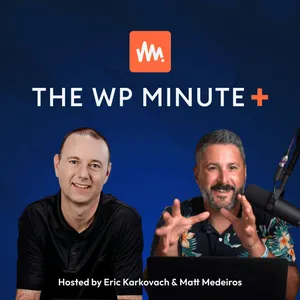
Free Daily Podcast Summary
The WP Minute+: Daily Summaries Delivered
by Matt Medeiros
For long-form interviews, news, and commentary about the WordPress ecosystem. This is the companion show to The WP Minute, your favorite 5-minutes of WordPress news every week.
Latest Episodes
The most recent episodes — sign up to get AI-powered summaries of each one.
- Yesterday27 min
WordPress Publishing Without WordPress? Meet Quill
Thanks Pressable for supporting the show! Get your special hosting deal at https://pressable.com/wpminuteBecome a WP Minute Supporter & Slack member at https://thewpminute.com/supportWhat if you could manage your WordPress content without ever opening the WordPress dashboard?In this episode of The WP Minute, Eric Karkovack talks with Chris Poteet, the developer behind Quill, a native macOS app built to make writing and managing WordPress content simpler. Chris shares how his background in IT consulting, user experience, and AI-assisted development inspired him to build a different kind of publishing experience.Quill offers a focused writing environment for posts, pages, drafts, and media, while preserving compatibility with Gutenberg and blocks from plugins. Chris also demonstrates how its AI features can evaluate writing, suggest improvements, and better reflect a writer’s personal style instead of producing generic AI content.The conversation explores the role of AI in software development, the challenge of building a product that feels powerful without becoming overwhelming, and what it might take to bring Quill to Windows or WordPress.com in the future.Could a native desktop app be a better way to publish with WordPress? Chris explains what he’s building and why.Key TakeawaysQuill lets Mac users write and manage WordPress content outside the WordPress dashboard.The app is designed around a focused writing experience rather than recreating the entire WordPress admin.Quill preserves unsupported blocks so content can move between Quill and Gutenberg.AI features can evaluate writing, suggest edits, and better match a user's personal voice.AI-assisted development helps developers focus more on product decisions and user experience.Quill supports media uploads, image controls, and embeds from services like YouTube and Spotify.Building good software means deciding what not to include, not just adding more features.Windows support, WordPress.com integration, and extensibility depend on user interest and development priorities.Important LinksChris Poteet's Blog — https://www.siolon.com/The WP Minute Newsletter — https://thewpminute.com/subscribe/Quill — https://quill.siolon.com/ ★ Support this podcast ★
- 1 weeks ago39 min
Is AI Making WordPress Irrelevant?
Thanks Pressable for supporting the show! Get your special hosting deal at https://pressable.com/wpminuteBecome a WP Minute Supporter & Slack member at https://thewpminute.com/supportWhat happens when AI can build a website in minutes—and WordPress is no longer the obvious choice?In this episode of The WP Minute, Matt Medeiros talks with Nathan Tyler, co-founder of Simply Schedule Appointments, about why he moved his own sites away from WordPress and launched Blink Pages, a platform built around AI-powered website management and static sites.Nathan explains why he believes AI is changing the value of the WordPress plugin ecosystem, why simple brochure websites may no longer need a traditional CMS, and where WordPress still has an advantage. Matt pushes back on some of those ideas, making the case for WordPress's community, flexibility, and role in more complex projects.They also dig into what this shift means for agencies and freelancers. If AI can build a website in 15 minutes, where does the value—and the revenue—come from? Nathan argues that agencies have an opportunity to move beyond building websites and focus on solving bigger business problems, from SEO to ongoing growth.Plus, Nathan explains how Blink Pages helps agencies migrate sites to Astro, give clients a familiar editing experience, and use AI without handing over complete control.Is this the beginning of a new era for WordPress—or a reminder that the best tool depends on the job?TakeawaysAI is challenging the value of simple WordPress plugins and traditional CMS workflows.Simple websites may no longer need the overhead of a full WordPress installation.WordPress still has a place in complex projects like membership sites and LMS platforms.AI-generated websites can be quick to launch but still need structure and maintainability.Agencies may need to shift from building websites to delivering measurable business results.AI is best used to handle repetitive implementation work, not replace a business's unique voice.Static sites and Git-based workflows can offer stronger version control and staging options.Client-friendly editing tools are essential when developers and marketers work differently.Agencies can use AI to expand their services, including SEO and ongoing optimization.Blink Pages aims to combine AI-powered workflows with guardrails and familiar editing tools.Important LinksBlink Pages — https://blinkpages.com/Simply Schedule Appointments — https://simplyscheduleappointments.com/Astro — https://astro.build/Cloudflare — https://www.cloudflare.com/GitHub — https://github.com/Nathan Tyler on LinkedIn — https://www.linkedin.com/in/nathantyler13/The WP Minute Newsletter — https://thewpminute.com/subscribe/ ★ Support this podcast ★
- 2 weeks ago25 min
Your WordPress Security Plugin Isn't Enough
Thanks Pressable for supporting the show! Get your special hosting deal at https://pressable.com/wpminuteBecome a WP Minute Supporter & Slack member at https://thewpminute.com/supportThis episode of The WP Minute takes a closer look at the state of WordPress security with Robert Abela, founder and CEO of Melapress, who joins Eric Karkovack to discuss the findings from Melapress’s annual WordPress security survey.The conversation starts with a surprising reality: security is a major concern for WordPress professionals, but many still don't have a plan for what happens when a site gets hacked. Robert explains why simply restoring a backup isn't enough, how attackers can leave backdoors behind, and why figuring out how a site was compromised needs to happen before recovery.Robert and Eric also dig into how WordPress professionals actually discover security incidents. Too often, it's a client, a search engine, or someone noticing strange behavior. By the time that happens, the damage may already be done. Logs, user monitoring, session management, and alerts can help catch problems much earlier.The episode also covers why smaller websites shouldn't assume they're safe, how AI is making targeted attacks easier, why security requires more than one tool, and the biggest security improvement agencies and freelancers can make right now: educating themselves and their teams.TakeawaysInstalling a security plugin isn't a complete security strategy.Restoring a backup won't fix the vulnerability that caused a hack.Logs can help uncover how a WordPress site was compromised.Early detection can dramatically reduce the damage from an attack.Small websites are still targets because most attacks aren't personal.AI is making targeted attacks easier to create.MFA and strong passwords don't protect against every attack.Security needs prevention, detection, and recovery working together.Many WordPress professionals still don't have a breach recovery plan.User education may be the most important security control of all.Important LinksThe full survey results discussed in the episode — Melapress WordPress Security Survey 2026 Real-world stories of WordPress security incidents and what it took to recover — Melapress Security StoriesRobert's company and the WordPress security plugins discussed in the episode — Melapress Connect with Robert — Melapress Robert Abela on LinkedIn Robert's personal site — Robert Abela's website Subscribe to The WP Minute and join the community — The WP Minute Newsletter ★ Support this podcast ★
- 3 weeks ago39 min
AI Built the Plugin. Now What?
Thanks Pressable for supporting the show! Get your special hosting deal at https://pressable.com/wpminuteBecome a WP Minute Supporter & Slack member at https://thewpminute.com/supportThis episode of The WP Minute follows Eric Karkovack through his first experience releasing a WordPress plugin with a little help from AI.Eric joins Matt to talk about Karks CRM, an open-source CRM and invoicing plugin he built to replace his aging QuickBooks Desktop workflow. Claude did much of the coding, but Eric provided the direction, testing, revisions, and real-world business requirements.The conversation gets into what AI can actually handle, where human judgment still matters, and what happens when AI-generated code meets the standards of the WordPress.org plugin repository. Eric shares what he learned from the review process, including an issue with CSV sanitization that required multiple rounds of changes.Matt and Eric also talk about why WordPress's stability and community still matter, especially as developers rush toward AI-generated tools and frameworks. And with Karks CRM now open source, the next question is what happens when other WordPress users start asking for features.TakeawaysAI can build a working plugin surprisingly fast.The developer still has to direct, test, and validate the work.AI-generated code doesn't automatically meet WordPress standards.WordPress's plugin review process still catches problems AI misses.UI and usability can require more iteration than the code itself.Open source turns a personal tool into a community commitment.WordPress's stability is still valuable for long-term client work.Community is one of WordPress's biggest advantages.Client data makes hosting and security decisions especially important.AI may change how plugins get built, but judgment still matters.Important LinksKarks CRM: Karks CRM on WordPress.orgKarks CRM website: Karks CRMClaude Code: Claude CodePlugin Check:. Plugin CheckWP-CLI: WP-CLIEmail delivery service Eric mentions: MailgunRecommended security setup for a site containing client data: Cloudflare ★ Support this podcast ★
- 4 weeks ago27 min
Is AI About to Render Traditional WordPress Plugins Obsolete? Inside Weglot 2.0
Thanks Pressable for supporting the show! Get your special hosting deal at https://pressable.com/wpminuteBecome a WP Minute Supporter & Slack member at https://thewpminute.com/supportThe days of clunky manual translation workflows and generic, brand-deaf automated output might finally be numbered. On this episode of The WP Minute+, host Eric Karkovack sits down with Augustin, CEO and founder of Weglot, to unwrap Weglot 2.0. They dive deep into how personalized AI models, live website data, and server-side infrastructure are rewriting the playbook for building high-converting, localized WordPress sites—without needing a native speaker on staff.Key TakeawaysWeglot 2.0 builds a bespoke AI translation model using your existing site data as a base, preserving your specific audience, tone, and brand identity.The updated dashboard allows users to choose their operational speed—ranging from total autonomous automation to explicit review workflows and agency validation stages.In-house testing across millions of prompts showed that multi-language sites appear up to 3x more frequently in Google AI Overviews and LLM search results.Translation isn't just plain text anymore; localized media, image alt tags, and video elements can now be detected, served, and managed directly.A simple 3-month strategy: deploy automated translations across ~12 candidate languages based on traffic data, analyze the conversion lift, and double down on top performers.Important LinksWeglot — Weglot.comWeglot on LinkedIn — @WeglotThe WP Minute Subscribe — https://thewpminute.com/subscribe/ ★ Support this podcast ★
- Oct 5, 202648 min
Brian Richards on Restructuring LoopConf: Ditching Corporate Sponsors for Attendee-Funded Events
Thanks Pressable for supporting the show! Get your special hosting deal at https://pressable.com/wpminuteBecome a WP Minute Supporter & Slack member at https://thewpminute.com/supportOn this episode of The WP Minute+ podcast, Matt Medeiros sits down with Brian Richards to discuss the evolving economics of event sponsorship and the restructuring of LoopConf US. Brian shares why he is moving away from traditional corporate sponsorship models in favor of an attendee-funded approach, relying on early ticket sales to secure working capital. They also explore the value of intimate conference environments, pragmatic software choices, incorporating non-WordPress technologies into production pipelines, and why open-source software remains resilient during periods of community uncertainty.Event Info & Ticket Details: LoopConf USDates: June 16–17, 2027Location: Grand Rapids, MichiganWebsite: loopconf.comPricing Tiers:Early Bird: $299General Admission: $349Refund Policy: Tickets are 100% fully refundable until January 31st, with transfer options available after that date.Key Takeaways:Relying strictly on corporate sponsor budgets or standard affiliate links leaves creators and event organizers vulnerable to shifting corporate priorities.Selling tickets up to ten months in advance provides the working capital needed to run the event without corporate sponsor backing.LoopConf intentionally caps attendance between 100 and 200 people to preserve high-value hallway track conversations.The official LoopConf website is built as a lightweight static site rather than on WordPress to match the exact requirements of the project.Incorporating workflows and perspectives from outside WordPress, such as Ghost or Ruby on Rails, expands developer capabilities.GPL open-source licensing ensures that site codebases remain functional and community-supported regardless of corporate leadership shifts.Important links:Register for LoopConfWPSessionsThe WP Minute+ Podcast: thewpminute.com/subscribe ★ Support this podcast ★
- Sep 30, 202657 min
How do we get Agents to use WordPress?
Thanks Pressable for supporting the show! Get your special hosting deal at https://pressable.com/wpminuteBecome a WP Minute Supporter & Slack member at https://thewpminute.com/supportThis episode of The WP Minute brings together Alex Panagis, Brian Coords, Andy Peatling, and Mike McAlister to tackle a big question: How do we get AI agents to actually use WordPress?The conversation starts with a problem that could have major implications for WordPress: when people ask AI agents to build a website, WordPress isn't always the recommendation. The group digs into why that is, what agents actually need from WordPress, and whether the platform is moving quickly enough.They explore AI-generated websites, discoverability, public benchmarks, design systems, MCP, the WordPress Abilities API, WP-CLI, Gutenberg, and the growing tension between WordPress's flexibility and the simplicity agents are looking for.The bigger question isn't just whether AI can build a WordPress site. It's whether WordPress can become a platform that AI agents actually want to build with.TakeawaysAI agents aren't consistently recommending WordPress.WordPress needs to become easier for agents to discover and use.AI-generated sites are changing what people expect from website builders.Public benchmarks could show whether WordPress is improving.Design systems give agents reusable building blocks.MCP could change how agents interact with WordPress.WordPress needs stronger opinions about how agents should use the platform.The Abilities API could become an important foundation for agentic WordPress.WordPress's open-source architecture creates both opportunities and challenges.The future may involve agents working alongside WordPress rather than entirely inside Important LinksWooCommerce Developer Resources: https://developer.woo.com/Ollie: https://olliewp.com/Miles: https://buymiles.ai/WordPress.com: https://wordpress.com/WordPress.org: https://wordpress.org/WP-CLI: https://wp-cli.org/Subscribe to The WP Minute: https://thewpminute.com/subscribeThe WP Minute Slack: https://thewpminute.com/support ★ Support this podcast ★
- Sep 28, 202654 min
Lessons Learned From Vibe Coding Plugins (August 2026 Member Meetup)
Thanks Pressable for supporting the show! Get your special hosting deal at https://pressable.com/wpminuteBecome a WP Minute Supporter & Slack member at https://thewpminute.com/supportThis edition of The WP Minute’s member meetup focuses on best practices for your vibe coding projects. GridPane’s Patrick Gallagher joined Eric and Matt to discuss the good, bad, and ugly of vibe coding plugins and apps with AI.Patrick shows off a slide deck he generated from a single prompt in Claude Design, explains recent leaps in AI capability since OpenAI’s o1 Pro reasoning model, and the rising power of local open models. He also points out that persistent hallucinations continue to be an issue, underscoring the need for human accountability and multi-model “red teaming” to verify code and security.You’ll also find takes on why AI tools rarely default to WordPress for site building, how negativity and training data may influence model choices, and why real product value still depends on execution, responsibility, and serving specific customer needs.It’s everything you need to turn vibe-coded projects into usable products!Editor's Note: GridPane is a Pillar Sponsor of The WP Minute.Takeaways:AI can create substantial code and content incredibly quickly.Human expertise is still essential for verifying AI-generated work.AI models can hallucinate confidently, even when told not to guess.Developers should use multiple AI models to inspect and refine code.AI makes execution easier, allowing us to focus on real customer issues.Narrow, specialized WordPress products can still succeed by serving a specific audience.AI may replace simple utility plugins, but established products with support remain valuable.In-person communities may become more important as online discourse gets noisier and more negative.Important Links:GridPaneArtificial AnalysisConnect with Patrick: LinkedIn | Twitter/X The WP Minute+ Podcast: thewpminute.com/subscribe ★ Support this podcast ★
Get The WP Minute+ summaries in your inbox
Free AI-powered daily recaps. Key takeaways, quotes, and mentions — in a 5-minute read.
Get Free Summaries →Free forever for up to 3 podcasts. No credit card required.
You Might Also Like
Listeners also like.

Elementor Talks
Elementor Page Builder
Unriveted
Discusses technology, AI, machine learning, data engineering, cloud services, and the startup experience.

TWiT News (Audio)
Covers breaking tech news and product announcements from major technology companies with expert analysis.

The Future Tools Podcast
Explores AI, machine learning, and future tech advancements, simplifying complex topics while covering practical uses, ethics, and history.

This Week in Tech (Audio)
A weekly roundtable of tech insiders discusses the latest developments in AI, robotics, computing, and digital privacy.

The TWIML AI Podcast (formerly This Week in Machine Learning & Artificial Intelligence)
Explores machine learning and artificial intelligence through interviews with leading researchers, engineers, and industry experts.

It's Been a Minute
Brittany Luse explores the cultural, political, and social forces shaping identity, technology, health, and pop culture.

TechStuff Daily
iHeartPodcasts

This Week in Tech (Video)
Leo Laporte and a panel of tech experts discuss recent developments in AI, robotics, computing, and privacy each week.

Everyday AI Podcast – An AI and ChatGPT Podcast
Covers practical uses of AI tools like ChatGPT and Midjourney to help people work more efficiently and advance their careers.

This Week in AI
Four AI experts analyze the latest news and trends in artificial intelligence each week.

TechStuff
TechStuff explores how technology, AI, and the internet reshape culture, identity, and power, from Silicon Valley to everyday life.
About The WP Minute+
For long-form interviews, news, and commentary about the WordPress ecosystem. This is the companion show to The WP Minute, your favorite 5-minutes of WordPress news every week.
Customized Recaps
AI-powered recaps with compact key takeaways, quotes, and insights.
Straight to Your Inbox
Get key takeaways from The WP Minute+ in a 5-minute read.
Save Hours Every Week
Stay current on your favorite podcasts without falling behind.
Frequently Asked Questions
What is Podzilla's The WP Minute+ daily summary?
It's a free AI-powered email that summarizes new episodes of The WP Minute+ as soon as they're published. You get the key takeaways, notable quotes, and links & mentions — all in a quick read.
How does the The WP Minute+ podcast summary work?
When a new episode drops, our AI transcribes and analyzes it, then generates a personalized summary tailored to your interests and profession. It's delivered to your inbox every morning.
Is this an official The WP Minute+ product?
No. Podzilla is an independent service that summarizes publicly available podcast content. We're not affiliated with or endorsed by Matt Medeiros.
Can I get summaries of other podcasts too?
Absolutely! The free plan covers up to 3 podcasts, any in the catalog. Basic raises that to 15, Pro to 40 and Max to 100. Browse our full catalog at /podcasts.
How often does The WP Minute+ release new episodes?
The WP Minute+ publishes weekly. Our AI generates a summary within hours of each new episode.
What topics does The WP Minute+ cover?
The WP Minute+ covers topics including News, Business, Entrepreneurship. Our AI identifies the specific themes in each episode and highlights what matters most to you.
Start getting The WP Minute+ summaries tomorrow morning.
Free forever for up to 3 podcasts. No credit card required.
Free forever for up to 3 podcasts. No credit card required.