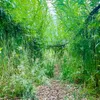
In this installment of Willow Worlds, I want to put in a philosophical thought about why I’m so excited about the idea of using willow in the way we are. I’ve decided to write about affordances. Affordances, the main idea in the Theory of Affordances, is quite simple and only grows into something more complicated as it goes on. For the bits that ‘go on’, I would refer you to thinkers such as Stuart Kauffman and writers like Jeremy Lent - it really is a bit of a niche philosophical area. It is possible to take the idea of affordance and speculate about the very base of existence and even the emergence of consciousness. Fortunately for you, I don’t have quite enough brain to grasp it and explain it and, unfortunately for me, those who have enough brain can’t make it simple enough for me to understand either. But if there is an answer to the ultimate questions, I really do think it has something to do with the idea of affordances. Just don’t ask me how, because I’ll get confused and send you what I wrote yesterday - and you’ll be none the wiser for that.So, I just want to say a few simple things about affordances, in the way I actually do understand them and get excited by them. In these times of climate crisis, biodiversity collapse and neoliberal chaos - we need to believe in our own agency - that we can do something to change things. I just read “The Invisible Doctrine” by George Monbiot and Peter Hutchison, and I think they’re right about quite a lot - we need a profound change in our politics. We need something to really get people up on their feet, to drive the social and political changes we need, and I’m sorry [I pat my pockets], I don’t have that idea on me right now, not even for paid subscribers, but maybe the idea of affordances can help a wee bit.An affordance is a quality that creates complexity. Some affordances are in the design of things, for example, a cup is designed to afford the holding of water. We’d say that holding water is an affordance of a cup. Oh that’s easy but wait. A cup sitting outside and half full of water affords a perch to a small bird that wants to drink. A perch then is an affordance of a cup, to a bird - but only if the bird is small enough and if the bird spots the potential and… notice how the perch is afforded by the cup and the bird, not the far away cup designer. The cup also affords a shadow, a reflection, an obstacle, a risk of spillage and so on. The possible affordances are endless but, the ones actualised in time are both finite and unpredictable.Children are fascinated by affordances, it’s why we pick up a stick and make it into a sword, a fishing rod or a magic wand. Child’s play is full of exploring the affordances of different surfaces, shapes, strengths, textures, slopes, trees and so on. Exploring a wood, setting a fire, going on a night hike, climbing a tree, throwing stones and making dens with sticks are all experiments with affordances.What a plastic tree guard affords to nature is worse than useless - a century of crumbling microplastic dust affords little the future can thank us for. The things of the artificial world have far fewer affordances in them than those found in nature because a living thing has a natural affinity with other living things: they trade in affordances: they feed, shape, live on, move around and consume each other. Living things afford much to each other.A willow tree affords food for beavers, willow evolved next to such voracious herbivores and is quite used to being cut down and having to start again. If you cut a branch of willow and stick it in the ground, it will afford a new tree. It’s amazing. Growing in the ground around our school, a thin willow tree affords a quick snack for a passing deer, then it’s dead. That’s a problem, because the trees never get a break from the deer.But, if we plant sturdy branches of willow in a criss-cross pattern we make a fedge - a living fence hedge - and that affords protection for the willow because the deer can only nuzzle one side of the trunk and not all the way around. If we make the criss-cross patterned fedge into a circle then we afford protection to not only the willow but whatever trees are inside the circle. In this way, fedge circles (Willow Worlds) afford tree protection without tree guards. Fedge therefore affords a nature-based solution to deer overgrazing.Willow Worlds maximises the ecosystem services that willow can afford and this sidesteps what we usually use to afford things: money. It takes money to make a tree guard and money, as a capitalist will tell you, makes the world go round. But what if you could get a tree guard without spending any money? The world would not stop going round, it would simply be a bit different - and the protection of trees would be more effective. My idea of using trees to protect trees effectively cuts out all the middle men in the tree guard industry,
Podzilla Summary coming soon
Sign up to get notified when the full AI-powered summary is ready.
Free forever for up to 3 podcasts. No credit card required.
Listen to This Episode
Get summaries like this every morning.
Free AI-powered recaps of The Willow Worlds Podcast and your other favorite podcasts, delivered to your inbox.
Free forever for up to 3 podcasts. No credit card required.